WELCOME
N.S AGRICULTURAL COLLEGE
COURSE NO: GPBR 314
COURSE TITLE: Principles of Seed Technology
TOPIC: Seed Act & Main features of Seed Act,1966-Seed Act Enforcement-Duties &
Powers of Seed Inspector-Offences and Penalties-Seed Control Order, 1983-Features of
New Seed Bill, 2004
Submitted to: Submitted by:
Dr. V. Umesh Kumar sir NAA/18-09
Asst.professor NAA/18-16
Department of Genetics & Plant Breeding NAA/18-24
BSc(Hons) Agriculture 3rd year
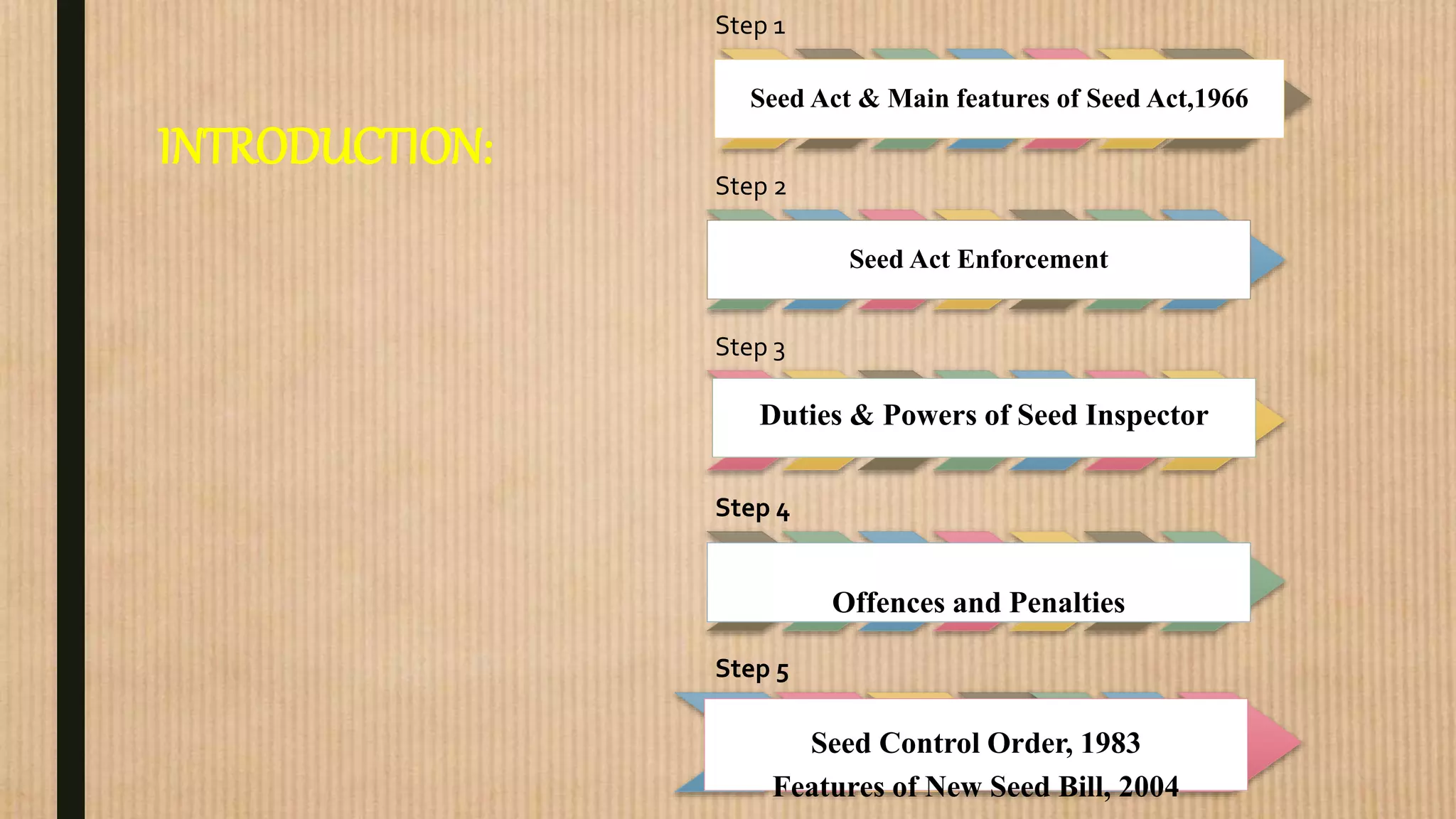
INTRODUCTION:
Step 1
Seed Act & Main features of Seed Act,1966
Step 2
Seed Act Enforcement
Step 3
Duties & Powers of Seed Inspector
Step 4
Offences and Penalties
Step 5
Seed Control Order, 1983
Features of New Seed Bill, 2004
■ In order to ensure the availability of quality seeds,
Government of India has enacted Seeds Act, 1966 and
Seed rules, 1968.
■ The seed (control) order, 1983 was promulgated under
essential commodities act, 1955 in order to ensure the
production, marketing and equal distribution of the
seeds.
SEED ACT
MAIN FEATURES OF SEED ACT
The main features of the Seeds Act, 1966 are discussed below:
■ 1.Applicability: It is applicable only to notified
kinds/varieties of seed and vegetatively propagating materials
used for sowing.
■ 2.Sanctioning legislation: The Act provides for the
formation of an apex advisory body, namely, the Central Seed
Committee; the Central seed Certification Board;
establishment of Seed Certification Agencies; and Central
and State Seed Testing Laboratories, etc.
■ 3.Regulatory legislation: The Act provides for the
provisions for notification of kinds/varieties to be
brought under the purview of the Seeds Act; regulation
regarding the sale of seed; and the establishment of a
suitable seed law enforcement machinery. Under the Act
the Central Govt. is empowered to make rules to carry
out the purposes of the Act and to give directions to State
Govts., it necessary, for carrying into execution, in the
state concerned, the provisions of the Act or Rules.
SEED LAW ENFORCEMENT
The responsibilities for enforcing various provisions regarding
regulation of sale of seeds of notified kinds/varieties rests with the
seed inspectors. The seed inspector is required to:
■ Inspect of frequently as may be required all places used for the
growing, storage or sale of any seed of any notified kind r
variety;
■ Satisfy himself that the conditions of the certificates/labels are
being observed;
■ Procure and send for analysis, if necessary, samples of
any seeds, which he has reason to suspect, are being
produced, stocked or sold or exhibited for sale in
contravention of the provisions of the Act of the Rules.
■ Investigate any complaint which may be made to him in
writing in respect of any contravention of the provisions
of the Act, or the Rules
■ Maintain a record of all inspections made and action taken
by him in the performance of his duties, including the taking
of samples and the seizure of stocks and to submit copies of
such records to the Director of Agriculture, or the
certification agency.
■ Perform such other duties as may be entrusted to him by the
competent authority from time to time.
Seed Law Enforcement- Seed Inspectors appointed by state
Governments (under section 13 of Seed Act-1966).
Seed sampling by Seed Inspectors and verification of records or
any other material and seize the same if not as per Seeds act to
ensure the quality of seeds.
• When so authorized by the State Government, to detain imported
containers which he has reason to suspect contain seeds, the import
of which is prohibited, except and in accordance with the
provisions of the Act and the Rules.
• Institute prosecution in respect to breaches of the Act and the Rules.
DUTIES AND POWERS OF SEED INSPECTOR:
■ He can draw representative samples of any kind/variety from
any person selling such seed them analysis to the seed analyst.
■ To enter and search any place in which he believes that an
offered under this Act has been committed. He can order not
to despise any stock of such seed for a specific period not
exceeding 30 days.
■ To examine any records, Register and seize them, if he
feels that they can furnish evidence of an offered
punishable Under the Act.
■ On demand to pay the cost of seed calculated at the rate at
which such seed is sold to the public.
■ He can break open the door and premises of seed seller if
the seller refuses to open the door.
■ Search seizes the stocks & records etc.
■ He can investigate any complaint made to him in writing.
■ He can investiture prosecutions in respect of breach of
out & rules.
■ Prohibit the sales of such seed which he feels are below
the maximum limits of germination or improperly labeled
and can initiate actions against the sellers.
OFFENSES OF SEED ACT
If the seed lot is found to be substandard legal action can be
initiated against the seller or if the labels are absent he may be
request to label the seeds propels:
■ 1. Legal proceedings can be initiated in a court of low for
selling sub-standard seed & on conviction a fine upto Rs. 500/-
can be imposed to the default.
■ 2. If a same crime is committed for second time – In second
convictions the penalty may extend upto 6 months
impressments or fine upto Rs. 1000/- or both.
■ 3. Forfeiting of property (Section 20 seeds Act 1966) –
When any person has been convicted under the Act, the
seed in respect of the contraventions may be for fasted to
the Govt.
■ 4. Offences by companies – (Section21) When an offence
is committed by a Company every person, who at the time
of offered are Incharge & responsible to the Company shall
be descend to be surety of the offered & are liable to
punishment.
SEEDS CONTROL ORDER, 1983
■ Dealers in seed to be licensed for 3 years at a time-No
person shall carry on the business of selling, exporting or
importing seeds at any place except under and in accordance
with the terms and conditions of license granted to him
under this order. This is applicable to ANY SEED and not
just NOTIFIED KINDS or VARIETIES.
■ Dealers to display stock and price list.
■ Dealer to give cash or credit memorandum to purchaser.
■ Power to distribute seeds with seeds controller, when
considered to be in a public interest.
■ Licensing authority to be set up by State Government.
■ State Government to appoint Inspectors to inspect and draw
samples of any seed.
■ The Seeds Act, 1966 does not have provisions such as
compulsory licensing of the seed dealers, price control, and
submission of information about procurement and sale of
seed.
■ The GOI issued the seeds (control) Order, 1983 under the
Essential Commodities Act, 1955 to license seed dealers
throughout the country.
FEATURES OF THE SEED
BILL,2004
■ The bill proposes to establish Central Seed Committee and
sub committees. Any type of seed which is for sale has to be
registered with Registration sub-committee. The registration
is valid 18 years for long duration perennial crops and for 15
years for annual/biennial crops.
■ All registered seed has to meet the minimum standard with
respect to the proportion of seed that must germinate, the
level of physical and genetic purity and the permitted
proportion of diseased seeds.
■ A variety of seed containing any technology considered
harmful or potentially harmful to environment and ecology
shall not be registered. These transgenic seeds can only be
register after the applicant has obtained clearance from
Environment (protection) Act,1986.
■ Every seed producer and dealer, and horticulture nursery has
to be registered with state government.
RIGHTS OF FARMER:
■ If seeds fail to perform to expected standard than farmer can
claim compensation from the vender or dealer under the
Consumer Protection Act, 1986.
IMPORT AND EXPORT:
■ Import of seed would be subject to Plant Quarantine order,
2003 or any order under Destructive Insect and Pest
Act,1914. Such seeds should also conform to minimum
standard mentioned below. The government can restrict
export of the seed if it feels food security of India is affected.
THANK YOU

Seed Act and main features of seed act

  • 1.
  • 2.
    N.S AGRICULTURAL COLLEGE COURSENO: GPBR 314 COURSE TITLE: Principles of Seed Technology TOPIC: Seed Act & Main features of Seed Act,1966-Seed Act Enforcement-Duties & Powers of Seed Inspector-Offences and Penalties-Seed Control Order, 1983-Features of New Seed Bill, 2004 Submitted to: Submitted by: Dr. V. Umesh Kumar sir NAA/18-09 Asst.professor NAA/18-16 Department of Genetics & Plant Breeding NAA/18-24 BSc(Hons) Agriculture 3rd year
  • 3.
    INTRODUCTION: Step 1 Seed Act& Main features of Seed Act,1966 Step 2 Seed Act Enforcement Step 3 Duties & Powers of Seed Inspector Step 4 Offences and Penalties Step 5 Seed Control Order, 1983 Features of New Seed Bill, 2004
  • 5.
    ■ In orderto ensure the availability of quality seeds, Government of India has enacted Seeds Act, 1966 and Seed rules, 1968. ■ The seed (control) order, 1983 was promulgated under essential commodities act, 1955 in order to ensure the production, marketing and equal distribution of the seeds. SEED ACT
  • 6.
    MAIN FEATURES OFSEED ACT The main features of the Seeds Act, 1966 are discussed below: ■ 1.Applicability: It is applicable only to notified kinds/varieties of seed and vegetatively propagating materials used for sowing. ■ 2.Sanctioning legislation: The Act provides for the formation of an apex advisory body, namely, the Central Seed Committee; the Central seed Certification Board; establishment of Seed Certification Agencies; and Central and State Seed Testing Laboratories, etc.
  • 7.
    ■ 3.Regulatory legislation:The Act provides for the provisions for notification of kinds/varieties to be brought under the purview of the Seeds Act; regulation regarding the sale of seed; and the establishment of a suitable seed law enforcement machinery. Under the Act the Central Govt. is empowered to make rules to carry out the purposes of the Act and to give directions to State Govts., it necessary, for carrying into execution, in the state concerned, the provisions of the Act or Rules.
  • 8.
    SEED LAW ENFORCEMENT Theresponsibilities for enforcing various provisions regarding regulation of sale of seeds of notified kinds/varieties rests with the seed inspectors. The seed inspector is required to: ■ Inspect of frequently as may be required all places used for the growing, storage or sale of any seed of any notified kind r variety; ■ Satisfy himself that the conditions of the certificates/labels are being observed;
  • 9.
    ■ Procure andsend for analysis, if necessary, samples of any seeds, which he has reason to suspect, are being produced, stocked or sold or exhibited for sale in contravention of the provisions of the Act of the Rules. ■ Investigate any complaint which may be made to him in writing in respect of any contravention of the provisions of the Act, or the Rules
  • 10.
    ■ Maintain arecord of all inspections made and action taken by him in the performance of his duties, including the taking of samples and the seizure of stocks and to submit copies of such records to the Director of Agriculture, or the certification agency. ■ Perform such other duties as may be entrusted to him by the competent authority from time to time.
  • 11.
    Seed Law Enforcement-Seed Inspectors appointed by state Governments (under section 13 of Seed Act-1966). Seed sampling by Seed Inspectors and verification of records or any other material and seize the same if not as per Seeds act to ensure the quality of seeds. • When so authorized by the State Government, to detain imported containers which he has reason to suspect contain seeds, the import of which is prohibited, except and in accordance with the provisions of the Act and the Rules. • Institute prosecution in respect to breaches of the Act and the Rules.
  • 12.
    DUTIES AND POWERSOF SEED INSPECTOR: ■ He can draw representative samples of any kind/variety from any person selling such seed them analysis to the seed analyst. ■ To enter and search any place in which he believes that an offered under this Act has been committed. He can order not to despise any stock of such seed for a specific period not exceeding 30 days.
  • 13.
    ■ To examineany records, Register and seize them, if he feels that they can furnish evidence of an offered punishable Under the Act. ■ On demand to pay the cost of seed calculated at the rate at which such seed is sold to the public. ■ He can break open the door and premises of seed seller if the seller refuses to open the door.
  • 14.
    ■ Search seizesthe stocks & records etc. ■ He can investigate any complaint made to him in writing. ■ He can investiture prosecutions in respect of breach of out & rules. ■ Prohibit the sales of such seed which he feels are below the maximum limits of germination or improperly labeled and can initiate actions against the sellers.
  • 15.
    OFFENSES OF SEEDACT If the seed lot is found to be substandard legal action can be initiated against the seller or if the labels are absent he may be request to label the seeds propels: ■ 1. Legal proceedings can be initiated in a court of low for selling sub-standard seed & on conviction a fine upto Rs. 500/- can be imposed to the default. ■ 2. If a same crime is committed for second time – In second convictions the penalty may extend upto 6 months impressments or fine upto Rs. 1000/- or both.
  • 16.
    ■ 3. Forfeitingof property (Section 20 seeds Act 1966) – When any person has been convicted under the Act, the seed in respect of the contraventions may be for fasted to the Govt. ■ 4. Offences by companies – (Section21) When an offence is committed by a Company every person, who at the time of offered are Incharge & responsible to the Company shall be descend to be surety of the offered & are liable to punishment.
  • 17.
    SEEDS CONTROL ORDER,1983 ■ Dealers in seed to be licensed for 3 years at a time-No person shall carry on the business of selling, exporting or importing seeds at any place except under and in accordance with the terms and conditions of license granted to him under this order. This is applicable to ANY SEED and not just NOTIFIED KINDS or VARIETIES. ■ Dealers to display stock and price list. ■ Dealer to give cash or credit memorandum to purchaser.
  • 18.
    ■ Power todistribute seeds with seeds controller, when considered to be in a public interest. ■ Licensing authority to be set up by State Government. ■ State Government to appoint Inspectors to inspect and draw samples of any seed. ■ The Seeds Act, 1966 does not have provisions such as compulsory licensing of the seed dealers, price control, and submission of information about procurement and sale of seed. ■ The GOI issued the seeds (control) Order, 1983 under the Essential Commodities Act, 1955 to license seed dealers throughout the country.
  • 19.
    FEATURES OF THESEED BILL,2004 ■ The bill proposes to establish Central Seed Committee and sub committees. Any type of seed which is for sale has to be registered with Registration sub-committee. The registration is valid 18 years for long duration perennial crops and for 15 years for annual/biennial crops. ■ All registered seed has to meet the minimum standard with respect to the proportion of seed that must germinate, the level of physical and genetic purity and the permitted proportion of diseased seeds.
  • 20.
    ■ A varietyof seed containing any technology considered harmful or potentially harmful to environment and ecology shall not be registered. These transgenic seeds can only be register after the applicant has obtained clearance from Environment (protection) Act,1986. ■ Every seed producer and dealer, and horticulture nursery has to be registered with state government.
  • 21.
    RIGHTS OF FARMER: ■If seeds fail to perform to expected standard than farmer can claim compensation from the vender or dealer under the Consumer Protection Act, 1986. IMPORT AND EXPORT: ■ Import of seed would be subject to Plant Quarantine order, 2003 or any order under Destructive Insect and Pest Act,1914. Such seeds should also conform to minimum standard mentioned below. The government can restrict export of the seed if it feels food security of India is affected.
  • 22.