Magnetism
Section 1
Essential Questions
How do magnetic poles interact?
Why does a magnet exert a force on distant
magnetic materials?
Why are some materials magnetic but others are not?
How do magnetic domains model magnetic behavior?
Review Vocabulary
electric field: surrounds an electric charge and
exerts a force on other electric charges
New Vocabulary
magnetism
magnetic field
magnetic pole
magnetic domain
Magnets
More than 2,000 years ago, the Greeks discovered deposits of
a mineral that was a natural magnet. They noticed that chunks
of this mineral could attract pieces of iron. This mineral was
found in a region of Turkey that was known as Magnesia, so
the Greeks called the mineral magnetic stone. This mineral is
now called magnetite.
Since the discovery of magnetite, many devices have been
developed that rely on magnets. In the twelfth century,
Chinese sailors used magnetite to make compasses that
improved navigation. The figure on the next screen shows
common magnets and familiar devices that use magnets
today. In science, magnetism refers to the properties and
interactions of magnets.
Magnets
Magnets can be found on your refrigerator door and in many
devices that you use every day, such as TVs, headphones, video
games systems, and telephones.
Matt
Meadows/McGraw-Hill
Education
Magnetic Force
Magnets apply a force on each other. These forces make magnets
do one of two things. The magnets can attract, which means
they pull together. Or the magnets can repel, which means they
push each other away. How they react depends on which ends of
the magnets are close together. Two magnets interact with each
other even before they touch. As the magnets move closer
together, the force between them increases. As the magnets move
farther apart, the force decreases.
Cordelia
Molloy/Science
Source
Magnetic Fields
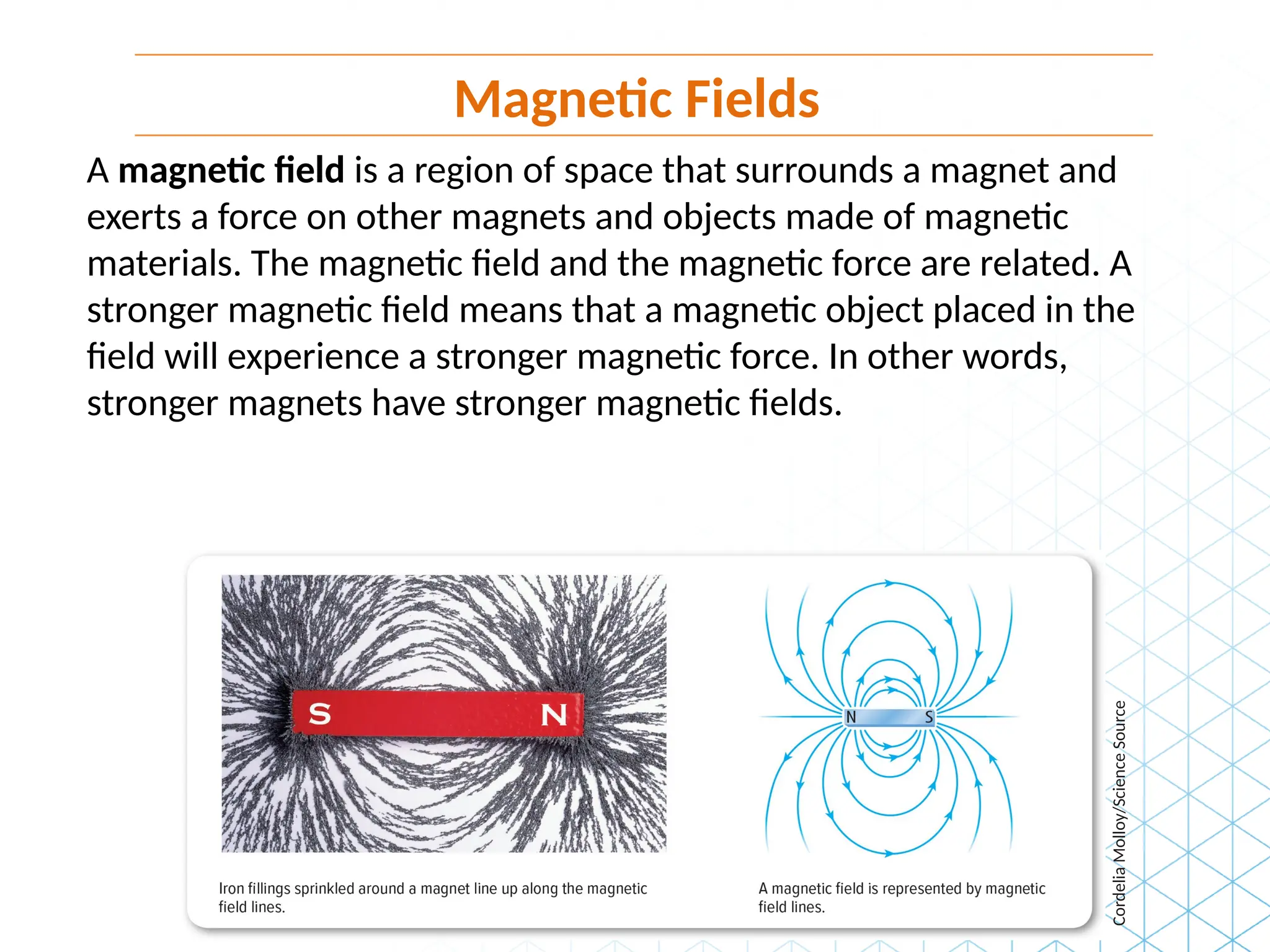
A magnetic field is a region of space that surrounds a magnet and
exerts a force on other magnets and objects made of magnetic
materials. The magnetic field and the magnetic force are related. A
stronger magnetic field means that a magnetic object placed in the
field will experience a stronger magnetic force. In other words,
stronger magnets have stronger magnetic fields.
Cordelia
Molloy/Science
Source
Magnetic Field Line
The magnetic field can be represented by lines of force called magnetic
field lines. Lines can represent a magnetic field. The figures below
show what magnetic fields might look like. The arrows show that
magnetic fields have direction.
The closer together the magnetic field lines are, the stronger the
magnetic field is at that point. The field lines are closer together near
the magnet in the picture to the left. This is also seen in the figures to
the right with horseshoe and disk magnets.
Cordelia
Molloy/Science
Source
Magnetic Poles
Magnetic poles are the places on a magnet that exert, or put forth, the
strongest magnetic force. All magnets have a north and a south pole. In
the figure we see the north and south poles are at the opposite ends of
a bar magnet. The lines that represent the magnetic field are closest
together at the poles.
Cordelia
Molloy/Science
Source
Magnetic Poles
How do magnetic poles interact?
Remember, two magnets can either attract or repel each other. This
depends on which poles of the magnets are placed close together. Two
north poles will repel each other. The same is true for two south poles.
However, a north pole and a south pole always attract each other. Like
magnetic poles repel each other and unlike poles attract each other.
How do magnets affect compasses?
A compass needle is a small bar magnet. The force
exerted by another bar magnet will make the compass
needle turn. The needle turns until it lines up with
magnetic field lines. The south pole in a compass needle
is attracted to the north pole of a magnet.
Magnetic Poles
How does Earth act like a magnet?
Earth is like a giant bar magnet. It is surrounded by a magnetic field
and has a north and a south magnetic pole. Earth also has a north and
a south geographic pole. The geographic poles are at opposite ends of
Earth—one in the north and one in the south. These are different from
the magnetic poles. The south magnetic pole is near the geographic
north pole.
Cordelia
Molloy/Science
Source
Magnetic Poles
How does Earth act like a magnet?
A compass needle lines up with Earth’s magnetic field lines. The needle
always points toward Earth’s geographic north pole. Remember that
magnetic poles are attracted only to their opposite. So, even though
the compass is pointing at the geographic north pole of Earth, the
north pole of the compass is pointing at the south magnetic pole of
Earth.
The figure shows the magnetic
field lines around Earth. No one
is sure what causes Earth’s
Magnetic field. Earth’s inner core
is made of iron and nickel. One
theory suggests that this may
produce Earth’s magnetic field.
Cordelia
Molloy/Science
Source
Magnetic Materials
A magnet will not attract all metal objects. For example, a
magnet will not attract aluminum foil. Only a few metals, such
as iron, cobalt, and nickel are attracted by magnets. These
metals can be made into permanent magnets. Permanent
magnets keep their magnetism even after they have been
removed from a magnetic field. Think back to what you have
learned about electrons. Recall that electrons have magnetic
properties. In most elements, the magnetic properties of the
electrons cancel out. But in iron, cobalt, and nickel, they don’t
cancel out. Each atom in these metals acts like a small magnet
with its own magnetic field
Magnetic Domains
In magnetic materials, the magnetic field made by each
atom exerts a force on other nearby atoms. This causes the
atoms to rotate and form a magnetic domain. A magnetic
domain is a large group of atoms with their magnetic poles
lined up in the same direction. Because the atoms are lined
up, a domain acts like a magnet. A domain has a north pole
and a south pole.
Magnetic Domains
How do domains line up?
An iron nail has a large number of magnetic domains that act
like magnets. So why doesn’t a nail act like a magnet? The poles
of the domains point in different directions. Since the domains
do not line up, the magnetic fields cancel each other out.
Therefore, the nail does not act like a magnet. The figure below
shows the magnetic domains of a nail. One way to make the
domains line up is to touch a bar magnet to the nail. The
domains will rotate and point in the same direction because of
the magnetic field of the magnet. Now the nail acts like a
magnet. The second figure shows domains that have lined up.
Permanent Magnets
Permanent magnets can be made by placing a magnetic
material, such as iron, in a strong magnetic field. The strong
magnetic field causes the magnetic domains to line up and
combine to make a strong magnetic field inside the material.
This field keeps the atoms from bumping the domains out of
line. The material becomes a permanent magnet.
Heating a permanent magnet causes it to lose its magnetism.
Heat causes the atoms in the magnet to move faster. This moves
the domains out of line. The permanent magnet will then lose
its magnetic field.
Permanent Magnets
Can a pole be isolated?
Suppose a magnet is broken into two
pieces as shown in the figure. Is one
piece a north pole and the other piece
a south pole?
Remember, each atom in a magnetic
material acts like a tiny magnet. So,
every magnet is made up of many smaller magnets that are
lined up. Both pieces of a broken magnet have their own north
and south poles.
It decreases then increases.
D
It increases.
C
It decreases.
B
It remains constant.
A
What happens to the magnetic force as the distance
between two magnetic poles decreases?
Assessment
1.
CORRECT
north and south magnetic poles.
D
no magnetic poles.
C
only south magnetic poles.
B
only north magnetic poles.
A
Atoms at the north pole of a magnet have
Assessment
2.
CORRECT
point D
D
point C
C
point B
B
point A
A
Where is the magnetic
field strongest?
Assessment
3.
CORRECT
Electricity and Magnetism
Section 2
Essential Questions
How do moving electric charges and magnets
interact?
What is the electromagnetic force?
How do an electromagnet’s properties affect its
magnetic field strength?
How does an electric motor operate?
Review Vocabulary
electric current: the flow of electric charges in a
wire or any conductor
New Vocabulary
electromagnetic force
electromagnetism galvanometer
solenoid
electromagnet
electric motor
Electric Current and Magnetism
In 1820, Danish physics teacher Hans Christian Oersted found that
electricity and magnetism are
related. While doing a demonstration
involving electric current, he
happened to have a compass near an
electric circuit. He noticed that the
electric current affected the direction
of the compass needle. Oersted
hypothesized that the electric current must produce a magnetic field
around the wire and that the direction of the field depends on the
direction of the current.
The figure shows that when the current in the wire changes direction,
then the direction of the magnetic field lines also change. A strong
current in the wire makes a strong magnetic field, and moving away from
the wire weakens the magnetic field.
Electromagnetism
Moving electric charges are surrounded by magnetic fields. So a
magnet close to an electric wire will be affected by the current.
Scientists determined that magnetism and electric current must
be related. The interaction between magnets and electric
charges is called electromagnetism. The force that is produced
by the interaction of electric force and magnetic force is called
the electromagnetic force. The electromagnetic force is a
fundamental force, like gravity.
Electromagnetism is what makes magnets so useful. Many
devices, including MP3 players, operate because of these
interactions. Electromagnetism is also essential in producing,
transmitting, and using electricity.
Electromagnets
An electromagnet is a temporary magnet created when there is a
current in a wire coil. Often, the current-carrying coil is wrapped
around an iron core, as shown on the right in the figure below. The
coil’s magnetic field temporarily magnetizes the iron core. As a
result, the electromagnet’s field can be more than 1,000 times
greater than the field of the solenoid.
You can make a magnetic field stronger. This is done with a
solenoid. A solenoid (SOH luh noyd) is a single wire carrying electric
current that is wrapped into a cylinder-shaped coil. It looks like a
spring. The figure to the middle is a solenoid.
Ken
Cavanagh/McGraw-Hill
Education
Electromagnets
An electromagnet is a solenoid wrapped around
an iron core. The figure to the right is an
electromagnet. The solenoid’s magnetic field
temporarily magnetizes the iron core.
The magnetic field inside the electromagnet
can be 1,000 times stronger than the field inside a solenoid without
an iron core.
Electromagnets
How do electromagnets behave?
Electromagnets are temporary magnets. The magnetic field is
present only when current is flowing in the solenoid. The
magnetic field of an electromagnet can be made stronger by
adding more coils of wire or by adding more current.
An electromagnet acts like any other magnet. It has a north and a
south pole, attracts magnetic materials, and is attracted or repelled
by other magnets. If put in a magnetic field, an electromagnet will
line itself up along the magnetic field lines.
Ken
Cavanagh/McGraw-Hill
Education
Electromagnets
How do electromagnets behave?
Electromagnets are useful because you can control how they act by
changing the electric current flowing through the solenoid. When
the current flows in the electromagnet and it moves toward or
away from another magnet, electric energy is changed into
mechanical energy. The mechanical energy will do work.
Electromagnets make mechanical energy to do the work in many
devices, such as stereo speakers and electric motors.
Ken
Cavanagh/McGraw-Hill
Education
Electromagnets
What makes an electromagnet rotate?
A permanent magnet can apply forces on an electromagnet to
make it rotate. The figure below shows an electromagnet between
the north and south poles of a permanent magnet. The north and
south poles of the electromagnet are attracted to the opposite
poles of the permanent magnet. This causes a downward force on
the left side of the electromagnet in the figure and an upward force
on the right side. These forces make the electromagnet
rotate until opposite poles are lined up.
Ken
Cavanagh/McGraw-Hill
Education
Electromagnets
What makes an electromagnet rotate?
The electromagnet continues to rotate until its poles are
next to the opposite poles of the permanent magnet. Once the
north and south poles of the electromagnet are in opposite
directions, the electromagnet stops rotating.
Ken
Cavanagh/McGraw-Hill
Education
Using Electromagnets
When an electromagnet rotates, electrical energy is converted into
mechanical energy to do work. Electromagnets do work in various devices,
such as stereo speakers and electric motors.
Changes in the electric
current cause the
electromagnet to move back
and forth. The attached
speaker cone vibrates and
produces sound.
Using Electromagnets
How does a fuel gauge work?
A galvanometer is a device that uses an electromagnet to measure
electric current. The figure below is a galvanometer. An electromagnet is
located between the poles of a permanent magnet and is connected to a
small spring. The electromagnet rotates until the force applied by the
spring is balanced with the
Magnetic forces on the
electromagnet. A needle is
attached to the electromagnet,
so it turns also.
Electric Motors
An electric motor is a device that changes electrical energy into
mechanical energy. Electric motors are used in all types of
industry, agriculture, and transportation. If you were to look
carefully, you might find electric motors in every room of your
house. For example, electric motors are used in DVD players,
computers, and hair dryers.
This electric fan uses an electric motor to transform electrical
energy into mechanical energy that turns the blades.
Spike
Mafford/Getty
Images
Electric Motors
How does a simple electric motor work?
Any machine that changes electric energy into kinetic energy is
a motor. A motor is a permanent magnet and an electromagnet
connected to an electric source. The electromagnet is
positioned so that it is able to spin in the magnetic field of the
permanent magnet. Electricity from the source creates the
magnetic field of the electromagnet. The opposite poles of the
two magnets attract one another and the electromagnet spins.
The wire ends of the electromagnet rub against a circular device
that is split so that the current reverses in the electromagnet at
the midpoint of its spin. This allows it to spin continuously as its
poles change and interact with the poles of the permanent
magnet. The figure shows a simple motor set up.
Producing Electric Current
Section 3
Essential Questions
What is electromagnetic induction?
How does a generator produce an electric current?
What is the difference between alternating current
and direct current?
How does a transformer change the voltage of an
alternating current?
Review Vocabulary
voltage difference: related to the force that causes
electric charges to flow; measured in volts (V)
New Vocabulary
electromagnetic induction
generator alternating current (AC)
turbine
direct current (DC)
transformer
Electromagnetic Induction
Working independently in 1831, Michael Faraday in Britain and Joseph
Henry in the United States both found that moving a loop of wire through
a magnetic field caused an electric current in the wire. They also found
that moving a magnet through a loop of wire produces a current, as
shown below.
When the magnet and wire loop are moving relative to each other, the
magnetic field inside the loop changes with time and induces, which
means generates, an electric current in the wire coil. The generation
of an electric current by a changing magnetic field is electromagnetic
induction.
Matt
Meadows/McGraw-Hill
Education
Generators
Generators use electromagnetic induction to change mechanical
energy into electrical energy. The figure shows a hand turning the
handle of a simple generator. The turning handle provides
mechanical energy to rotate the coil between the poles of a
permanent magnet producing a current in the coil.
McGraw-Hill
Education
Generators
A simple generator with a turning wire coil rotates through the
magnetic field of the permanent magnet. This makes a current
flow through the coil. Each time the coil makes half of a turn, the
ends of the coil move past opposite poles of the permanent
magnet. This causes the current to change direction. The current
in the coil changes direction twice each time it makes one full
turn. You can control how often the current changes direction by
controlling how fast the generator rotates. In the United States,
generators rotate 60 times per second to produce electric current.
This is equal to 3,600 turns per minute.
Generators
Generators are used in cars. They are called alternators and
provide electrical energy for the car’s lights. They also provide
electrical energy to the spark plugs in the car’s engine. The spark
plugs ignite (cause a spark that burns) the fuel in the cylinders
of the engine. Once the engine is running, the fuel provides the
mechanical energy to turn the coil in the alternator.
McGraw-Hill
Education
Generators
How is electricity produced for your home?
Electric power plants produce most of the electrical energy. The
huge generators in electric power plants operate in a different
way from the alternator. The coil does not rotate. Instead, the
permanent magnet rotates. Mechanical energy rotates the
magnet, and electrical current is produced in the coil.
The electrical energy you use in your home comes from a power
plant with huge generators. These generators have many coils of
wire wrapped around huge iron cores. The magnets are connected
to a turbine (TUR bine), a large windmill-like wheel. The turbine
rotates when it is pushed by steam, water, or wind, and the
rotating magnets produce the electric current in the wire coils.
Generators
How is electricity produced for your home?
Power plants use three different kinds of energy to make
electricity. They use thermal, wind, or water energy. For thermal
energy, power plants burn fossil fuels such as oil, natural gas, and
coal, or use heat made by nuclear reactors. The thermal energy is
used to heat water and produce steam. When the steam pushes
the turbine blades, the thermal energy is changed into mechanical
energy. The generator then changes the mechanical energy into
the electrical energy you use.
Direct and Alternating Currents
Because power outages can occur, some electric devices, such
as alarm clocks, use batteries as a backup source of electrical
energy. However, the current produced by a battery is different
from the current produced by an electric generator. A battery
produces a direct current. Direct current (DC) is electric current
that is always in one direction through a wire.
Direct and Alternating Currents
When you plug an appliance into a wall outlet, it is receiving an
alternating current. Alternating current (AC) is electric current
that reverses the direction in a regular pattern. In North
America, the alternating current in a wall socket has a frequency
of 60 Hz and an average voltage of 120 V. Electronic devices that
use backup batteries usually require direct current to operate.
The device’s electronic components reduce the voltage of the
alternating current and convert it to direct current.
Transformers
To reduce the voltage without changing the amount of electrical
energy, many devices use transformers. A transformer is a
device that increases or decreases the voltage of an alternating
current. A transformer is made of a primary coil and a
secondary coil wrapped around the same iron core. A
transformer that increases the voltage is called a step-up
transformer, and a transformer that decreases the voltage is
called a step-down transformer.
Transformers increase or decrease voltage, depending on the
ratio of turns in the primary coil to turns in the secondary coil.
Transmitting Electrical Energy
Electrical energy is often transmitted along wires known as power lines,
as shown below. During transmission, some of the electrical energy is
converted into thermal energy due to the resistance of the wires and
cannot be used to operate electrical devices. Electric resistance increases
as the wires get longer. Power lines can be many kilometers long. As a
result, large amounts of electrical energy transform into thermal energy
that heats the surroundings.
It varies irregularly.
D
It varies regularly.
C
It is direct.
B
It is constant.
A
Which describes the direction of the electric current
in AC?
Assessment
1.
CORRECT
battery
D
turbine
C
magnet
B
wire coil
A
Which is not part of a generator?
Assessment
2.
CORRECT

Magnets and Electromagnetism powerpoint HS.pptx

  • 1.
  • 2.
    Essential Questions How domagnetic poles interact? Why does a magnet exert a force on distant magnetic materials? Why are some materials magnetic but others are not? How do magnetic domains model magnetic behavior?
  • 3.
    Review Vocabulary electric field:surrounds an electric charge and exerts a force on other electric charges
  • 4.
  • 5.
    Magnets More than 2,000years ago, the Greeks discovered deposits of a mineral that was a natural magnet. They noticed that chunks of this mineral could attract pieces of iron. This mineral was found in a region of Turkey that was known as Magnesia, so the Greeks called the mineral magnetic stone. This mineral is now called magnetite. Since the discovery of magnetite, many devices have been developed that rely on magnets. In the twelfth century, Chinese sailors used magnetite to make compasses that improved navigation. The figure on the next screen shows common magnets and familiar devices that use magnets today. In science, magnetism refers to the properties and interactions of magnets.
  • 6.
    Magnets Magnets can befound on your refrigerator door and in many devices that you use every day, such as TVs, headphones, video games systems, and telephones. Matt Meadows/McGraw-Hill Education
  • 7.
    Magnetic Force Magnets applya force on each other. These forces make magnets do one of two things. The magnets can attract, which means they pull together. Or the magnets can repel, which means they push each other away. How they react depends on which ends of the magnets are close together. Two magnets interact with each other even before they touch. As the magnets move closer together, the force between them increases. As the magnets move farther apart, the force decreases. Cordelia Molloy/Science Source
  • 8.
    Magnetic Fields A magneticfield is a region of space that surrounds a magnet and exerts a force on other magnets and objects made of magnetic materials. The magnetic field and the magnetic force are related. A stronger magnetic field means that a magnetic object placed in the field will experience a stronger magnetic force. In other words, stronger magnets have stronger magnetic fields. Cordelia Molloy/Science Source
  • 9.
    Magnetic Field Line Themagnetic field can be represented by lines of force called magnetic field lines. Lines can represent a magnetic field. The figures below show what magnetic fields might look like. The arrows show that magnetic fields have direction. The closer together the magnetic field lines are, the stronger the magnetic field is at that point. The field lines are closer together near the magnet in the picture to the left. This is also seen in the figures to the right with horseshoe and disk magnets. Cordelia Molloy/Science Source
  • 10.
    Magnetic Poles Magnetic polesare the places on a magnet that exert, or put forth, the strongest magnetic force. All magnets have a north and a south pole. In the figure we see the north and south poles are at the opposite ends of a bar magnet. The lines that represent the magnetic field are closest together at the poles. Cordelia Molloy/Science Source
  • 11.
    Magnetic Poles How domagnetic poles interact? Remember, two magnets can either attract or repel each other. This depends on which poles of the magnets are placed close together. Two north poles will repel each other. The same is true for two south poles. However, a north pole and a south pole always attract each other. Like magnetic poles repel each other and unlike poles attract each other. How do magnets affect compasses? A compass needle is a small bar magnet. The force exerted by another bar magnet will make the compass needle turn. The needle turns until it lines up with magnetic field lines. The south pole in a compass needle is attracted to the north pole of a magnet.
  • 12.
    Magnetic Poles How doesEarth act like a magnet? Earth is like a giant bar magnet. It is surrounded by a magnetic field and has a north and a south magnetic pole. Earth also has a north and a south geographic pole. The geographic poles are at opposite ends of Earth—one in the north and one in the south. These are different from the magnetic poles. The south magnetic pole is near the geographic north pole. Cordelia Molloy/Science Source
  • 13.
    Magnetic Poles How doesEarth act like a magnet? A compass needle lines up with Earth’s magnetic field lines. The needle always points toward Earth’s geographic north pole. Remember that magnetic poles are attracted only to their opposite. So, even though the compass is pointing at the geographic north pole of Earth, the north pole of the compass is pointing at the south magnetic pole of Earth. The figure shows the magnetic field lines around Earth. No one is sure what causes Earth’s Magnetic field. Earth’s inner core is made of iron and nickel. One theory suggests that this may produce Earth’s magnetic field. Cordelia Molloy/Science Source
  • 14.
    Magnetic Materials A magnetwill not attract all metal objects. For example, a magnet will not attract aluminum foil. Only a few metals, such as iron, cobalt, and nickel are attracted by magnets. These metals can be made into permanent magnets. Permanent magnets keep their magnetism even after they have been removed from a magnetic field. Think back to what you have learned about electrons. Recall that electrons have magnetic properties. In most elements, the magnetic properties of the electrons cancel out. But in iron, cobalt, and nickel, they don’t cancel out. Each atom in these metals acts like a small magnet with its own magnetic field
  • 15.
    Magnetic Domains In magneticmaterials, the magnetic field made by each atom exerts a force on other nearby atoms. This causes the atoms to rotate and form a magnetic domain. A magnetic domain is a large group of atoms with their magnetic poles lined up in the same direction. Because the atoms are lined up, a domain acts like a magnet. A domain has a north pole and a south pole.
  • 16.
    Magnetic Domains How dodomains line up? An iron nail has a large number of magnetic domains that act like magnets. So why doesn’t a nail act like a magnet? The poles of the domains point in different directions. Since the domains do not line up, the magnetic fields cancel each other out. Therefore, the nail does not act like a magnet. The figure below shows the magnetic domains of a nail. One way to make the domains line up is to touch a bar magnet to the nail. The domains will rotate and point in the same direction because of the magnetic field of the magnet. Now the nail acts like a magnet. The second figure shows domains that have lined up.
  • 17.
    Permanent Magnets Permanent magnetscan be made by placing a magnetic material, such as iron, in a strong magnetic field. The strong magnetic field causes the magnetic domains to line up and combine to make a strong magnetic field inside the material. This field keeps the atoms from bumping the domains out of line. The material becomes a permanent magnet. Heating a permanent magnet causes it to lose its magnetism. Heat causes the atoms in the magnet to move faster. This moves the domains out of line. The permanent magnet will then lose its magnetic field.
  • 18.
    Permanent Magnets Can apole be isolated? Suppose a magnet is broken into two pieces as shown in the figure. Is one piece a north pole and the other piece a south pole? Remember, each atom in a magnetic material acts like a tiny magnet. So, every magnet is made up of many smaller magnets that are lined up. Both pieces of a broken magnet have their own north and south poles.
  • 19.
    It decreases thenincreases. D It increases. C It decreases. B It remains constant. A What happens to the magnetic force as the distance between two magnetic poles decreases? Assessment 1. CORRECT
  • 20.
    north and southmagnetic poles. D no magnetic poles. C only south magnetic poles. B only north magnetic poles. A Atoms at the north pole of a magnet have Assessment 2. CORRECT
  • 21.
    point D D point C C pointB B point A A Where is the magnetic field strongest? Assessment 3. CORRECT
  • 22.
  • 23.
    Essential Questions How domoving electric charges and magnets interact? What is the electromagnetic force? How do an electromagnet’s properties affect its magnetic field strength? How does an electric motor operate?
  • 24.
    Review Vocabulary electric current:the flow of electric charges in a wire or any conductor
  • 25.
    New Vocabulary electromagnetic force electromagnetismgalvanometer solenoid electromagnet electric motor
  • 26.
    Electric Current andMagnetism In 1820, Danish physics teacher Hans Christian Oersted found that electricity and magnetism are related. While doing a demonstration involving electric current, he happened to have a compass near an electric circuit. He noticed that the electric current affected the direction of the compass needle. Oersted hypothesized that the electric current must produce a magnetic field around the wire and that the direction of the field depends on the direction of the current. The figure shows that when the current in the wire changes direction, then the direction of the magnetic field lines also change. A strong current in the wire makes a strong magnetic field, and moving away from the wire weakens the magnetic field.
  • 27.
    Electromagnetism Moving electric chargesare surrounded by magnetic fields. So a magnet close to an electric wire will be affected by the current. Scientists determined that magnetism and electric current must be related. The interaction between magnets and electric charges is called electromagnetism. The force that is produced by the interaction of electric force and magnetic force is called the electromagnetic force. The electromagnetic force is a fundamental force, like gravity. Electromagnetism is what makes magnets so useful. Many devices, including MP3 players, operate because of these interactions. Electromagnetism is also essential in producing, transmitting, and using electricity.
  • 28.
    Electromagnets An electromagnet isa temporary magnet created when there is a current in a wire coil. Often, the current-carrying coil is wrapped around an iron core, as shown on the right in the figure below. The coil’s magnetic field temporarily magnetizes the iron core. As a result, the electromagnet’s field can be more than 1,000 times greater than the field of the solenoid. You can make a magnetic field stronger. This is done with a solenoid. A solenoid (SOH luh noyd) is a single wire carrying electric current that is wrapped into a cylinder-shaped coil. It looks like a spring. The figure to the middle is a solenoid. Ken Cavanagh/McGraw-Hill Education
  • 29.
    Electromagnets An electromagnet isa solenoid wrapped around an iron core. The figure to the right is an electromagnet. The solenoid’s magnetic field temporarily magnetizes the iron core. The magnetic field inside the electromagnet can be 1,000 times stronger than the field inside a solenoid without an iron core.
  • 30.
    Electromagnets How do electromagnetsbehave? Electromagnets are temporary magnets. The magnetic field is present only when current is flowing in the solenoid. The magnetic field of an electromagnet can be made stronger by adding more coils of wire or by adding more current. An electromagnet acts like any other magnet. It has a north and a south pole, attracts magnetic materials, and is attracted or repelled by other magnets. If put in a magnetic field, an electromagnet will line itself up along the magnetic field lines. Ken Cavanagh/McGraw-Hill Education
  • 31.
    Electromagnets How do electromagnetsbehave? Electromagnets are useful because you can control how they act by changing the electric current flowing through the solenoid. When the current flows in the electromagnet and it moves toward or away from another magnet, electric energy is changed into mechanical energy. The mechanical energy will do work. Electromagnets make mechanical energy to do the work in many devices, such as stereo speakers and electric motors. Ken Cavanagh/McGraw-Hill Education
  • 32.
    Electromagnets What makes anelectromagnet rotate? A permanent magnet can apply forces on an electromagnet to make it rotate. The figure below shows an electromagnet between the north and south poles of a permanent magnet. The north and south poles of the electromagnet are attracted to the opposite poles of the permanent magnet. This causes a downward force on the left side of the electromagnet in the figure and an upward force on the right side. These forces make the electromagnet rotate until opposite poles are lined up. Ken Cavanagh/McGraw-Hill Education
  • 33.
    Electromagnets What makes anelectromagnet rotate? The electromagnet continues to rotate until its poles are next to the opposite poles of the permanent magnet. Once the north and south poles of the electromagnet are in opposite directions, the electromagnet stops rotating. Ken Cavanagh/McGraw-Hill Education
  • 34.
    Using Electromagnets When anelectromagnet rotates, electrical energy is converted into mechanical energy to do work. Electromagnets do work in various devices, such as stereo speakers and electric motors. Changes in the electric current cause the electromagnet to move back and forth. The attached speaker cone vibrates and produces sound.
  • 35.
    Using Electromagnets How doesa fuel gauge work? A galvanometer is a device that uses an electromagnet to measure electric current. The figure below is a galvanometer. An electromagnet is located between the poles of a permanent magnet and is connected to a small spring. The electromagnet rotates until the force applied by the spring is balanced with the Magnetic forces on the electromagnet. A needle is attached to the electromagnet, so it turns also.
  • 36.
    Electric Motors An electricmotor is a device that changes electrical energy into mechanical energy. Electric motors are used in all types of industry, agriculture, and transportation. If you were to look carefully, you might find electric motors in every room of your house. For example, electric motors are used in DVD players, computers, and hair dryers. This electric fan uses an electric motor to transform electrical energy into mechanical energy that turns the blades. Spike Mafford/Getty Images
  • 37.
    Electric Motors How doesa simple electric motor work? Any machine that changes electric energy into kinetic energy is a motor. A motor is a permanent magnet and an electromagnet connected to an electric source. The electromagnet is positioned so that it is able to spin in the magnetic field of the permanent magnet. Electricity from the source creates the magnetic field of the electromagnet. The opposite poles of the two magnets attract one another and the electromagnet spins. The wire ends of the electromagnet rub against a circular device that is split so that the current reverses in the electromagnet at the midpoint of its spin. This allows it to spin continuously as its poles change and interact with the poles of the permanent magnet. The figure shows a simple motor set up.
  • 39.
  • 40.
    Essential Questions What iselectromagnetic induction? How does a generator produce an electric current? What is the difference between alternating current and direct current? How does a transformer change the voltage of an alternating current?
  • 41.
    Review Vocabulary voltage difference:related to the force that causes electric charges to flow; measured in volts (V)
  • 42.
    New Vocabulary electromagnetic induction generatoralternating current (AC) turbine direct current (DC) transformer
  • 43.
    Electromagnetic Induction Working independentlyin 1831, Michael Faraday in Britain and Joseph Henry in the United States both found that moving a loop of wire through a magnetic field caused an electric current in the wire. They also found that moving a magnet through a loop of wire produces a current, as shown below. When the magnet and wire loop are moving relative to each other, the magnetic field inside the loop changes with time and induces, which means generates, an electric current in the wire coil. The generation of an electric current by a changing magnetic field is electromagnetic induction. Matt Meadows/McGraw-Hill Education
  • 44.
    Generators Generators use electromagneticinduction to change mechanical energy into electrical energy. The figure shows a hand turning the handle of a simple generator. The turning handle provides mechanical energy to rotate the coil between the poles of a permanent magnet producing a current in the coil. McGraw-Hill Education
  • 45.
    Generators A simple generatorwith a turning wire coil rotates through the magnetic field of the permanent magnet. This makes a current flow through the coil. Each time the coil makes half of a turn, the ends of the coil move past opposite poles of the permanent magnet. This causes the current to change direction. The current in the coil changes direction twice each time it makes one full turn. You can control how often the current changes direction by controlling how fast the generator rotates. In the United States, generators rotate 60 times per second to produce electric current. This is equal to 3,600 turns per minute.
  • 46.
    Generators Generators are usedin cars. They are called alternators and provide electrical energy for the car’s lights. They also provide electrical energy to the spark plugs in the car’s engine. The spark plugs ignite (cause a spark that burns) the fuel in the cylinders of the engine. Once the engine is running, the fuel provides the mechanical energy to turn the coil in the alternator. McGraw-Hill Education
  • 47.
    Generators How is electricityproduced for your home? Electric power plants produce most of the electrical energy. The huge generators in electric power plants operate in a different way from the alternator. The coil does not rotate. Instead, the permanent magnet rotates. Mechanical energy rotates the magnet, and electrical current is produced in the coil. The electrical energy you use in your home comes from a power plant with huge generators. These generators have many coils of wire wrapped around huge iron cores. The magnets are connected to a turbine (TUR bine), a large windmill-like wheel. The turbine rotates when it is pushed by steam, water, or wind, and the rotating magnets produce the electric current in the wire coils.
  • 48.
    Generators How is electricityproduced for your home? Power plants use three different kinds of energy to make electricity. They use thermal, wind, or water energy. For thermal energy, power plants burn fossil fuels such as oil, natural gas, and coal, or use heat made by nuclear reactors. The thermal energy is used to heat water and produce steam. When the steam pushes the turbine blades, the thermal energy is changed into mechanical energy. The generator then changes the mechanical energy into the electrical energy you use.
  • 50.
    Direct and AlternatingCurrents Because power outages can occur, some electric devices, such as alarm clocks, use batteries as a backup source of electrical energy. However, the current produced by a battery is different from the current produced by an electric generator. A battery produces a direct current. Direct current (DC) is electric current that is always in one direction through a wire.
  • 51.
    Direct and AlternatingCurrents When you plug an appliance into a wall outlet, it is receiving an alternating current. Alternating current (AC) is electric current that reverses the direction in a regular pattern. In North America, the alternating current in a wall socket has a frequency of 60 Hz and an average voltage of 120 V. Electronic devices that use backup batteries usually require direct current to operate. The device’s electronic components reduce the voltage of the alternating current and convert it to direct current.
  • 52.
    Transformers To reduce thevoltage without changing the amount of electrical energy, many devices use transformers. A transformer is a device that increases or decreases the voltage of an alternating current. A transformer is made of a primary coil and a secondary coil wrapped around the same iron core. A transformer that increases the voltage is called a step-up transformer, and a transformer that decreases the voltage is called a step-down transformer. Transformers increase or decrease voltage, depending on the ratio of turns in the primary coil to turns in the secondary coil.
  • 54.
    Transmitting Electrical Energy Electricalenergy is often transmitted along wires known as power lines, as shown below. During transmission, some of the electrical energy is converted into thermal energy due to the resistance of the wires and cannot be used to operate electrical devices. Electric resistance increases as the wires get longer. Power lines can be many kilometers long. As a result, large amounts of electrical energy transform into thermal energy that heats the surroundings.
  • 55.
    It varies irregularly. D Itvaries regularly. C It is direct. B It is constant. A Which describes the direction of the electric current in AC? Assessment 1. CORRECT
  • 56.
    battery D turbine C magnet B wire coil A Which isnot part of a generator? Assessment 2. CORRECT