Biot & Savarat
BY: THE UNIVERSITY OF FAISALABD
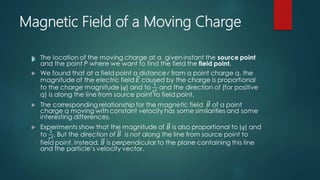
Magnetic Field of a Moving Charge

Magnetic Field of a Moving Charge
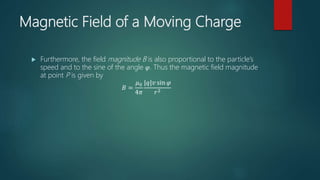
 Furthermore, the field magnitude B is also proportional to the particle’s
speed and to the sine of the angle 𝜑. Thus the magnetic field magnitude
at point P is given by
𝐵 =
𝜇0
4𝜋
|𝑞|𝑣 sin 𝜑
𝑟2
Magnetic Field of a Moving Charge
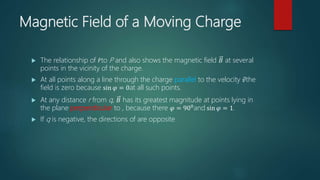
 The relationship of 𝑟to P and also shows the magnetic field 𝐵 at several
points in the vicinity of the charge.
 At all points along a line through the charge parallel to the velocity 𝑣the
field is zero because sin 𝜑 = 0at all such points.
 At any distance r from q, 𝐵 has its greatest magnitude at points lying in
the plane perpendicular to , because there 𝜑 = 900and sin 𝜑 = 1.
 If q is negative, the directions of are opposite
Magnetic Field of a Current Element
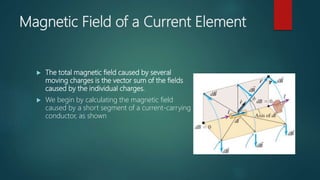
 The total magnetic field caused by several
moving charges is the vector sum of the fields
caused by the individual charges.
 We begin by calculating the magnetic field
caused by a short segment of a current-carrying
conductor, as shown
Magnetic Field of a Current Element
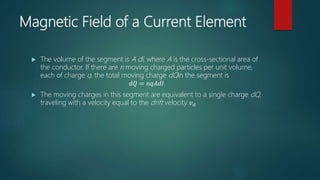
 The volume of the segment is A dl, where A is the cross-sectional area of
the conductor. If there are n moving charged particles per unit volume,
each of charge q, the total moving charge dQin the segment is
𝑑𝑄 = 𝑛𝑞𝐴𝑑𝑙
 The moving charges in this segment are equivalent to a single charge dQ,
traveling with a velocity equal to the drift velocity 𝑣 𝑑
Magnetic Field of a Current Element
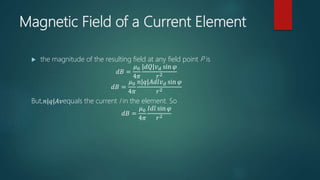
 the magnitude of the resulting field at any field point P is
𝑑𝐵 =
𝜇0
4𝜋
|𝑑𝑄|𝑣 𝑑 sin 𝜑
𝑟2
𝑑𝐵 =
𝜇0
4𝜋
𝑛|𝑞|𝐴𝑑𝑙𝑣 𝑑 sin 𝜑
𝑟2
But,𝑛|𝑞|𝐴𝑣equals the current I in the element. So
𝑑𝐵 =
𝜇0
4𝜋
𝐼𝑑𝑙 sin 𝜑
𝑟2
Magnetic Field of a Current Element
 In vector form, using the unit vector 𝑟, we have
𝑑𝐵 =
𝜇0
4𝜋
𝐼𝑑𝑙 × 𝑟
𝑟2
 Where 𝑑𝑙 is a vector with length dl, in the same direction as the current in the
conductor.
 Equation is called the law of Biot and Savart.
 We can use this law to find the total magnetic field 𝐵at any point in space due
to the current in a complete circuit.
Magnetic Field of a Current Element
 To do this, we integrate Eq. over all segments 𝑑𝑙that carry current;
𝐵 =
𝜇0
4𝜋
𝐼𝑑𝑙 × 𝑟
𝑟2
Ampere’s Law
 calculations of the magnetic field due to a current have involved finding
the infinitesimal field 𝑑𝐵due to a current element and then summing all
the 𝑑𝐵’s to find the total field.
 Gauss’s law for electric fields involves the flux 𝐸of through a closed
surface; it states that this flux is equal to the total charge enclosed within
the surface, divided by the constant 𝜀0. Thus this law relates electric fields
and charge distributions.
Ampere’s Law
 Gauss’s law for magnetic fields, states that the flux of 𝐵 through any closed
surface is always zero, whether or not there are currents within the surface.
 So Gauss’s law for can’t be used to determine the magnetic field produced by a
particular current distribution.
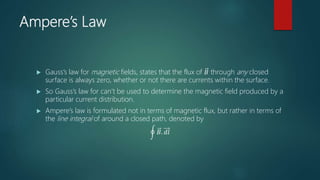
 Ampere’s law is formulated not in terms of magnetic flux, but rather in terms of
the line integral of around a closed path, denoted by
𝐵. 𝑑𝑙
Ampere’s Law
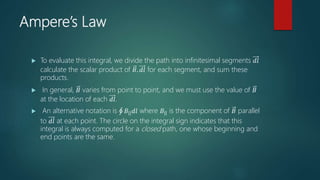
 To evaluate this integral, we divide the path into infinitesimal segments 𝑑𝑙
calculate the scalar product of 𝐵. 𝑑𝑙 for each segment, and sum these
products.
 In general, 𝐵 varies from point to point, and we must use the value of 𝐵
at the location of each 𝑑𝑙.
 An alternative notation is 𝐵|| 𝑑𝑙 where 𝐵|| is the component of 𝐵 parallel
to 𝑑𝑙 at each point. The circle on the integral sign indicates that this
integral is always computed for a closed path, one whose beginning and
end points are the same.
Ampere’s Law for a Long, Straight
Conductor
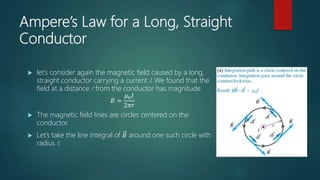
 let’s consider again the magnetic field caused by a long,
straight conductor carrying a current I. We found that the
field at a distance r from the conductor has magnitude
𝐵 =
𝜇0 𝐼
2𝜋𝑟
 The magnetic field lines are circles centered on the
conductor.
 Let’s take the line integral of 𝐵 around one such circle with
radius r,
Ampere’s Law for a Long, Straight
Conductor
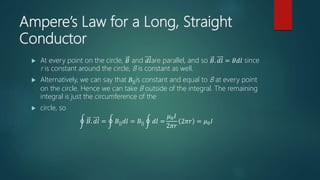
 At every point on the circle, 𝐵 and 𝑑𝑙are parallel, and so 𝐵. 𝑑𝑙 = 𝐵𝑑𝑙 since
r is constant around the circle, B is constant as well.
 Alternatively, we can say that 𝐵||is constant and equal to B at every point
on the circle. Hence we can take B outside of the integral. The remaining
integral is just the circumference of the
 circle, so
𝐵. 𝑑𝑙 = 𝐵|| 𝑑𝑙 = 𝐵|| 𝑑𝑙 =
𝜇0 𝐼
2𝜋𝑟
2𝜋𝑟 = 𝜇0 𝐼
Ampere’s Law for a Long, Straight
Conductor
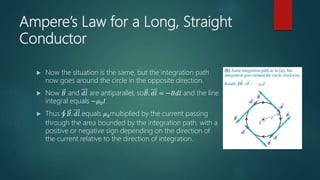
 Now the situation is the same, but the integration path
now goes around the circle in the opposite direction.
 Now 𝐵 and 𝑑𝑙 are antiparallel, so𝐵. 𝑑𝑙 = −𝐵𝑑𝑙 and the line
integral equals −𝜇0 𝐼.
 Thus 𝐵. 𝑑𝑙 equals 𝜇0multiplied by the current passing
through the area bounded by the integration path, with a
positive or negative sign depending on the direction of
the current relative to the direction of integration.
Ampere’s Law for a Long, Straight
Conductor
 There’s a simple rule for the sign of the current; you won’t be
surprised to learn that it uses your right hand.
 Curl the fingers of your right hand around the integration path
so that they curl in the direction of integration (that is, the
direction that you use to evaluate 𝐵. 𝑑𝑙 ).
 Then your right thumb indicates the positive current direction.
Currents that pass through the integration path in this direction
are positive; those in the opposite direction are negative.
Ampere’s Law: General Statement
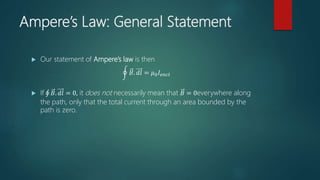
 Our statement of Ampere’s law is then
𝐵. 𝑑𝑙 = 𝜇0 𝐼𝑒𝑛𝑐𝑙
 If 𝐵. 𝑑𝑙 = 0, it does not necessarily mean that 𝐵 = 0everywhere along
the path, only that the total current through an area bounded by the
path is zero.
Magnetic Materials
 How currents cause magnetic fields, we have assumed that the conductors are
surrounded by vacuum.
 But the coils in transformers, motors, generators, and electromagnets nearly always
have iron cores to increase the magnetic field and confine it to desired regions.
Permanent magnets, magnetic recording tapes, and computer disks depend
directly on the magnetic properties of materials; when you store information on a
computer disk, you are actually setting up an array of microscopic permanent
magnets on the disk.
 So it is worthwhile to examine some aspects of the magnetic properties of
materials. After describing the atomic origins of magnetic properties, we will
discuss three broad classes of magnetic behavior that occur in materials; these are
called Para magnetism, diamagnetism, and ferromagnetism.
The Bohr Magneton
 The atoms that make up all matter contain moving electrons, and these
electrons form microscopic current loops that produce magnetic fields of
their own.
 In many materials these currents are randomly oriented and cause no net
magnetic field.
 But in some materials an external field (a field produced by currents
outside the material) can cause these loops to become oriented
preferentially with the field, so their magnetic fields add to the external
field.
 We then say that the material is magnetized.
The Bohr Magneton
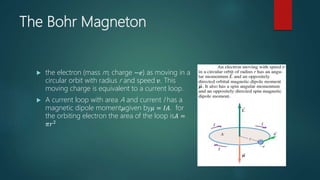
 the electron (mass m, charge −𝑒) as moving in a
circular orbit with radius r and speed 𝑣. This
moving charge is equivalent to a current loop.
 A current loop with area A and current I has a
magnetic dipole moment𝜇given by𝜇 = 𝐼𝐴. for
the orbiting electron the area of the loop is𝐴 =
𝜋𝑟2
The Bohr Magneton
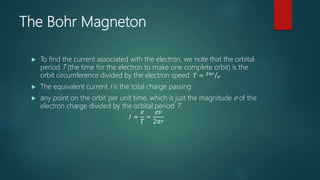
 To find the current associated with the electron, we note that the orbital
period T (the time for the electron to make one complete orbit) is the
orbit circumference divided by the electron speed: 𝑇 = 2𝜋𝑟
𝑣
 The equivalent current I is the total charge passing
 any point on the orbit per unit time, which is just the magnitude e of the
electron charge divided by the orbital period T:
𝐼 =
𝑒
𝑇
=
𝑒𝑣
2𝜋𝑟
The Bohr Magneton
 The magnetic moment 𝜇 = 𝐼𝐴is then
𝜇 =
𝑒𝑣
2𝜋𝑟
𝜋𝑟2 =
𝑒𝑣𝑟
2
 It is useful to express 𝜇in terms of the angular momentum L of the
electron.
 For a particle moving in a circular path, the magnitude of angular
momentum equals the magnitude of momentum 𝑚𝑣multiplied by the
radius r, that is L = 𝑚𝑣𝑟
The Bohr Magneton
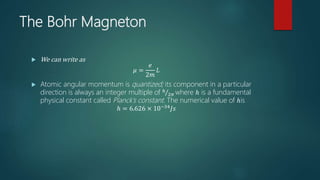
 We can write as
𝜇 =
𝑒
2𝑚
𝐿
 Atomic angular momentum is quantized; its component in a particular
direction is always an integer multiple of ℎ
2𝜋 where ℎ is a fundamental
physical constant called Planck’s constant. The numerical value of ℎis
ℎ = 6.626 × 10⁻³⁴ 𝐽𝑠
The Bohr Magneton
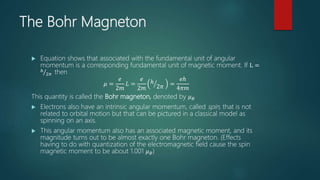
 Equation shows that associated with the fundamental unit of angular
momentum is a corresponding fundamental unit of magnetic moment. If L =
ℎ
2𝜋 then
𝜇 =
𝑒
2𝑚
𝐿 =
𝑒
2𝑚
ℎ
2𝜋 =
𝑒ℎ
4𝜋𝑚
This quantity is called the Bohr magneton, denoted by 𝜇 𝐵
 Electrons also have an intrinsic angular momentum, called spin, that is not
related to orbital motion but that can be pictured in a classical model as
spinning on an axis.
 This angular momentum also has an associated magnetic moment, and its
magnitude turns out to be almost exactly one Bohr magneton. (Effects
having to do with quantization of the electromagnetic field cause the spin
magnetic moment to be about 1.001 𝜇 𝐵)
Biot and savarat law

  • 1.
    Biot & Savarat BY:THE UNIVERSITY OF FAISALABD
  • 2.
    Magnetic Field ofa Moving Charge 
  • 3.
    Magnetic Field ofa Moving Charge  Furthermore, the field magnitude B is also proportional to the particle’s speed and to the sine of the angle 𝜑. Thus the magnetic field magnitude at point P is given by 𝐵 = 𝜇0 4𝜋 |𝑞|𝑣 sin 𝜑 𝑟2
  • 5.
    Magnetic Field ofa Moving Charge  The relationship of 𝑟to P and also shows the magnetic field 𝐵 at several points in the vicinity of the charge.  At all points along a line through the charge parallel to the velocity 𝑣the field is zero because sin 𝜑 = 0at all such points.  At any distance r from q, 𝐵 has its greatest magnitude at points lying in the plane perpendicular to , because there 𝜑 = 900and sin 𝜑 = 1.  If q is negative, the directions of are opposite
  • 6.
    Magnetic Field ofa Current Element  The total magnetic field caused by several moving charges is the vector sum of the fields caused by the individual charges.  We begin by calculating the magnetic field caused by a short segment of a current-carrying conductor, as shown
  • 7.
    Magnetic Field ofa Current Element  The volume of the segment is A dl, where A is the cross-sectional area of the conductor. If there are n moving charged particles per unit volume, each of charge q, the total moving charge dQin the segment is 𝑑𝑄 = 𝑛𝑞𝐴𝑑𝑙  The moving charges in this segment are equivalent to a single charge dQ, traveling with a velocity equal to the drift velocity 𝑣 𝑑
  • 8.
    Magnetic Field ofa Current Element  the magnitude of the resulting field at any field point P is 𝑑𝐵 = 𝜇0 4𝜋 |𝑑𝑄|𝑣 𝑑 sin 𝜑 𝑟2 𝑑𝐵 = 𝜇0 4𝜋 𝑛|𝑞|𝐴𝑑𝑙𝑣 𝑑 sin 𝜑 𝑟2 But,𝑛|𝑞|𝐴𝑣equals the current I in the element. So 𝑑𝐵 = 𝜇0 4𝜋 𝐼𝑑𝑙 sin 𝜑 𝑟2
  • 9.
    Magnetic Field ofa Current Element  In vector form, using the unit vector 𝑟, we have 𝑑𝐵 = 𝜇0 4𝜋 𝐼𝑑𝑙 × 𝑟 𝑟2  Where 𝑑𝑙 is a vector with length dl, in the same direction as the current in the conductor.  Equation is called the law of Biot and Savart.  We can use this law to find the total magnetic field 𝐵at any point in space due to the current in a complete circuit.
  • 10.
    Magnetic Field ofa Current Element  To do this, we integrate Eq. over all segments 𝑑𝑙that carry current; 𝐵 = 𝜇0 4𝜋 𝐼𝑑𝑙 × 𝑟 𝑟2
  • 11.
    Ampere’s Law  calculationsof the magnetic field due to a current have involved finding the infinitesimal field 𝑑𝐵due to a current element and then summing all the 𝑑𝐵’s to find the total field.  Gauss’s law for electric fields involves the flux 𝐸of through a closed surface; it states that this flux is equal to the total charge enclosed within the surface, divided by the constant 𝜀0. Thus this law relates electric fields and charge distributions.
  • 12.
    Ampere’s Law  Gauss’slaw for magnetic fields, states that the flux of 𝐵 through any closed surface is always zero, whether or not there are currents within the surface.  So Gauss’s law for can’t be used to determine the magnetic field produced by a particular current distribution.  Ampere’s law is formulated not in terms of magnetic flux, but rather in terms of the line integral of around a closed path, denoted by 𝐵. 𝑑𝑙
  • 13.
    Ampere’s Law  Toevaluate this integral, we divide the path into infinitesimal segments 𝑑𝑙 calculate the scalar product of 𝐵. 𝑑𝑙 for each segment, and sum these products.  In general, 𝐵 varies from point to point, and we must use the value of 𝐵 at the location of each 𝑑𝑙.  An alternative notation is 𝐵|| 𝑑𝑙 where 𝐵|| is the component of 𝐵 parallel to 𝑑𝑙 at each point. The circle on the integral sign indicates that this integral is always computed for a closed path, one whose beginning and end points are the same.
  • 14.
    Ampere’s Law fora Long, Straight Conductor  let’s consider again the magnetic field caused by a long, straight conductor carrying a current I. We found that the field at a distance r from the conductor has magnitude 𝐵 = 𝜇0 𝐼 2𝜋𝑟  The magnetic field lines are circles centered on the conductor.  Let’s take the line integral of 𝐵 around one such circle with radius r,
  • 15.
    Ampere’s Law fora Long, Straight Conductor  At every point on the circle, 𝐵 and 𝑑𝑙are parallel, and so 𝐵. 𝑑𝑙 = 𝐵𝑑𝑙 since r is constant around the circle, B is constant as well.  Alternatively, we can say that 𝐵||is constant and equal to B at every point on the circle. Hence we can take B outside of the integral. The remaining integral is just the circumference of the  circle, so 𝐵. 𝑑𝑙 = 𝐵|| 𝑑𝑙 = 𝐵|| 𝑑𝑙 = 𝜇0 𝐼 2𝜋𝑟 2𝜋𝑟 = 𝜇0 𝐼
  • 16.
    Ampere’s Law fora Long, Straight Conductor  Now the situation is the same, but the integration path now goes around the circle in the opposite direction.  Now 𝐵 and 𝑑𝑙 are antiparallel, so𝐵. 𝑑𝑙 = −𝐵𝑑𝑙 and the line integral equals −𝜇0 𝐼.  Thus 𝐵. 𝑑𝑙 equals 𝜇0multiplied by the current passing through the area bounded by the integration path, with a positive or negative sign depending on the direction of the current relative to the direction of integration.
  • 17.
    Ampere’s Law fora Long, Straight Conductor  There’s a simple rule for the sign of the current; you won’t be surprised to learn that it uses your right hand.  Curl the fingers of your right hand around the integration path so that they curl in the direction of integration (that is, the direction that you use to evaluate 𝐵. 𝑑𝑙 ).  Then your right thumb indicates the positive current direction. Currents that pass through the integration path in this direction are positive; those in the opposite direction are negative.
  • 18.
    Ampere’s Law: GeneralStatement  Our statement of Ampere’s law is then 𝐵. 𝑑𝑙 = 𝜇0 𝐼𝑒𝑛𝑐𝑙  If 𝐵. 𝑑𝑙 = 0, it does not necessarily mean that 𝐵 = 0everywhere along the path, only that the total current through an area bounded by the path is zero.
  • 19.
    Magnetic Materials  Howcurrents cause magnetic fields, we have assumed that the conductors are surrounded by vacuum.  But the coils in transformers, motors, generators, and electromagnets nearly always have iron cores to increase the magnetic field and confine it to desired regions. Permanent magnets, magnetic recording tapes, and computer disks depend directly on the magnetic properties of materials; when you store information on a computer disk, you are actually setting up an array of microscopic permanent magnets on the disk.  So it is worthwhile to examine some aspects of the magnetic properties of materials. After describing the atomic origins of magnetic properties, we will discuss three broad classes of magnetic behavior that occur in materials; these are called Para magnetism, diamagnetism, and ferromagnetism.
  • 20.
    The Bohr Magneton The atoms that make up all matter contain moving electrons, and these electrons form microscopic current loops that produce magnetic fields of their own.  In many materials these currents are randomly oriented and cause no net magnetic field.  But in some materials an external field (a field produced by currents outside the material) can cause these loops to become oriented preferentially with the field, so their magnetic fields add to the external field.  We then say that the material is magnetized.
  • 21.
    The Bohr Magneton the electron (mass m, charge −𝑒) as moving in a circular orbit with radius r and speed 𝑣. This moving charge is equivalent to a current loop.  A current loop with area A and current I has a magnetic dipole moment𝜇given by𝜇 = 𝐼𝐴. for the orbiting electron the area of the loop is𝐴 = 𝜋𝑟2
  • 22.
    The Bohr Magneton To find the current associated with the electron, we note that the orbital period T (the time for the electron to make one complete orbit) is the orbit circumference divided by the electron speed: 𝑇 = 2𝜋𝑟 𝑣  The equivalent current I is the total charge passing  any point on the orbit per unit time, which is just the magnitude e of the electron charge divided by the orbital period T: 𝐼 = 𝑒 𝑇 = 𝑒𝑣 2𝜋𝑟
  • 23.
    The Bohr Magneton The magnetic moment 𝜇 = 𝐼𝐴is then 𝜇 = 𝑒𝑣 2𝜋𝑟 𝜋𝑟2 = 𝑒𝑣𝑟 2  It is useful to express 𝜇in terms of the angular momentum L of the electron.  For a particle moving in a circular path, the magnitude of angular momentum equals the magnitude of momentum 𝑚𝑣multiplied by the radius r, that is L = 𝑚𝑣𝑟
  • 24.
    The Bohr Magneton We can write as 𝜇 = 𝑒 2𝑚 𝐿  Atomic angular momentum is quantized; its component in a particular direction is always an integer multiple of ℎ 2𝜋 where ℎ is a fundamental physical constant called Planck’s constant. The numerical value of ℎis ℎ = 6.626 × 10⁻³⁴ 𝐽𝑠
  • 25.
    The Bohr Magneton Equation shows that associated with the fundamental unit of angular momentum is a corresponding fundamental unit of magnetic moment. If L = ℎ 2𝜋 then 𝜇 = 𝑒 2𝑚 𝐿 = 𝑒 2𝑚 ℎ 2𝜋 = 𝑒ℎ 4𝜋𝑚 This quantity is called the Bohr magneton, denoted by 𝜇 𝐵  Electrons also have an intrinsic angular momentum, called spin, that is not related to orbital motion but that can be pictured in a classical model as spinning on an axis.  This angular momentum also has an associated magnetic moment, and its magnitude turns out to be almost exactly one Bohr magneton. (Effects having to do with quantization of the electromagnetic field cause the spin magnetic moment to be about 1.001 𝜇 𝐵)