Seminar
On
MAGIC
MEMRISTOR AIDED LOGIC
Submitted To: Submitted
By:
Dept. of Electronics and Communication Lavisha
Bhatia
Rno. 12/129
Contents
• What is Memristor
• Circuit relationship
• Types of Memristor
• TiO2 Memristor
• Working of TiO2 Memristor
• Analogy of Memristor
• Why Memristor
• Memristor aided logic(MAGIC)
• Logic gates using MAGIC
 MAGIC AND
 MAGIC OR
 MAGIC NAND
 MAGIC NOR
 MAGIC NOT
• Properties of Memristor
• Benefits of Memristor
• Applications of Memristor
• Conclusion
WHAT IS Memristor
Memristor
MEMORY REGISTER
A Memristor is a semiconductor whose resistance
varies as a function of flux and charge. This
allows it to “remember” what has passed through
the circuit.
It is characterised by “Memresistance”.
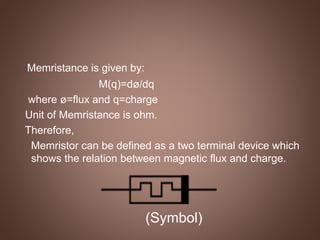
Memristance is given by:
M(q)=dø/dq
where ø=flux and q=charge
Unit of Memristance is ohm.
Therefore,
Memristor can be defined as a two terminal device which
shows the relation between magnetic flux and charge.
(Symbol)
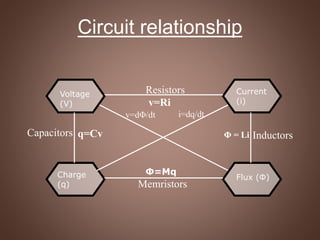
Circuit relationship
Memristors
Φ=Mq
Voltage
(V)
Current
(i)
Charge
(q)
Flux (Φ)
Φ = Li Inductors
v=dΦ/dt i=dq/dt
Resistors
v=Ri
q=CvCapacitors
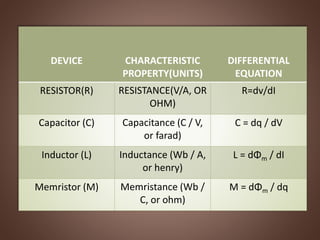
DEVICE CHARACTERISTIC
PROPERTY(UNITS)
DIFFERENTIAL
EQUATION
RESISTOR(R) RESISTANCE(V/A, OR
OHM)
R=dv/dI
Capacitor (C) Capacitance (C / V,
or farad)
C = dq / dV
Inductor (L) Inductance (Wb / A,
or henry)
L = dΦm / dI
Memristor (M) Memristance (Wb /
C, or ohm)
M = dΦm / dq
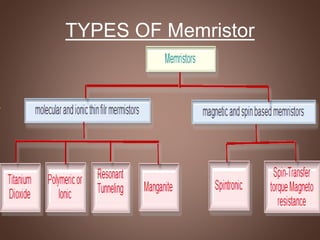
TYPES OF Memristor
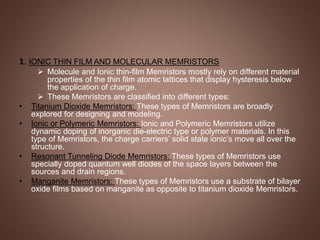
1. IONIC THIN FILM AND MOLECULAR MEMRISTORS
 Molecule and Ionic thin-film Memristors mostly rely on different material
properties of the thin film atomic lattices that display hysteresis below
the application of charge.
 These Memristors are classified into different types:
• Titanium Dioxide Memristors: These types of Memristors are broadly
explored for designing and modeling.
• Ionic or Polymeric Memristors: Ionic and Polymeric Memristors utilize
dynamic doping of inorganic die-electric type or polymer materials. In this
type of Memristors, the charge carriers’ solid state ionic’s move all over the
structure.
• Resonant Tunneling Diode Memristors: These types of Memristors use
specially doped quantum well diodes of the space layers between the
sources and drain regions.
• Manganite Memristors: These types of Memristors use a substrate of bilayer
oxide films based on manganite as opposite to titanium dioxide Memristors.
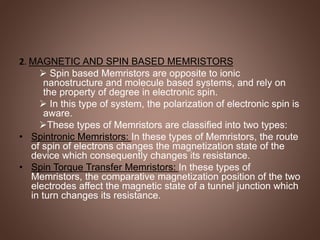
2. MAGNETIC AND SPIN BASED MEMRISTORS
 Spin based Memristors are opposite to ionic
nanostructure and molecule based systems, and rely on
the property of degree in electronic spin.
 In this type of system, the polarization of electronic spin is
aware.
These types of Memristors are classified into two types:
• Spintronic Memristors: In these types of Memristors, the route
of spin of electrons changes the magnetization state of the
device which consequently changes its resistance.
• Spin Torque Transfer Memristors: In these types of
Memristors, the comparative magnetization position of the two
electrodes affect the magnetic state of a tunnel junction which
in turn changes its resistance.
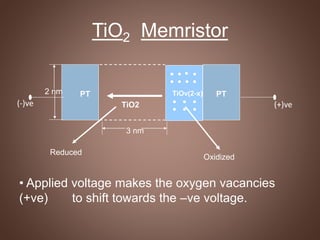
TiO2 Memristor
PT PTTiOv(2-x)
TiO2
3 nm
2 nm
Oxidized
Reduced
(-)ve (+)ve
• Applied voltage makes the oxygen vacancies
(+ve) to shift towards the –ve voltage.
• Titanium dioxide thin films were deposited on crystalline
silicon substrates by electron beam physical vapor deposition.
• The deposition was performed under vacuum ranging
without process gases, resulting in homogeneous layers of
TiO2-x with a thickness of around 100 nm.
• Samples were then annealed at high temperatures ranging
from 500 to 800 degree Celsius for 4 hours under nitrogen,
and their structural and optical properties along with their
chemical structure were characterized before and after
annealing.
• The chemical and structural characterization revealed a sub
stoichiometric film with oxygen vacancies.
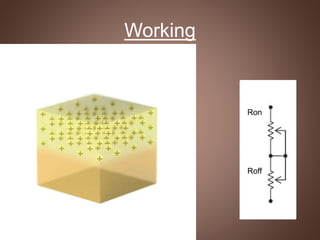
Working
Tio2-x
Tio2
Ron
Roff
WHY Memristor
• Conventional devices use only 0 and 1 but
Memristor can use any value between 0 and 1.
• Faster than Flash memory.
– Allow digital cameras to take pictures with no
delay in between.
• Smaller than transistors.
• Non volatile.
• Generate less heat & consumes less power.
MAGIC-Memristor Aided Logic
• MAGIC requires only memristors within the logic gates.
• The logical state in a MAGIC gate is represented as a resistance,
where the high and low resistances are considered , respectively, as
logical zero and one (for simplicity, the resistance of logical zero and
logical one is considered, respectively, as ROFF and RON).
•The inputs and output of the logic gates are the logical states of the
memristors. Separate memristors are required for the input and
output.
•The inputs of the MAGIC gates are the initial logical state of the input
memristors, and the output is the final logical state of the memristor.
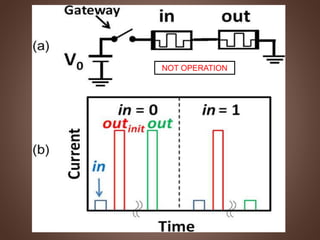
• Operation of a MAGIC gate consists of two sequential stages. The first
stage initializes the output memristor to a known logical state. In the
second stage of operation, a voltage V0 is applied across the logic gate.
While applying V0, the voltage across the output memristor depends
upon the logical state of the input and output memristors.
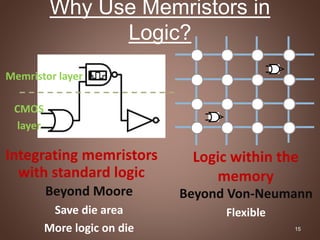
Why Use Memristors in
Logic?
Integrating memristors
with standard logic
15
Logic within the
memory
Memristor layer
CMOS
layer
Beyond Moore
Save die area
More logic on die
Beyond Von-Neumann
Flexible
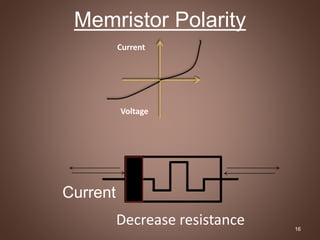
Memristor Polarity
16
Decrease resistance
Current
Voltage
Current
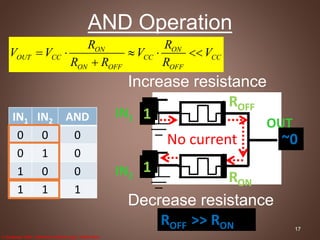
AND Operation
17
Decrease resistance
ANDIN2IN1
000
010
001
111
ROFF
RON
0
0
No current 0
1
1
1
Increase resistance
ROFF >> RON
~0
IN1
IN2
OUT
ON ON
OUT CC CC CC
ON OFF OFF
R R
V V V V
R R R
    

S. Kvatinsky “MRL – Memristor Ratioed Logic,” CNNA 2012
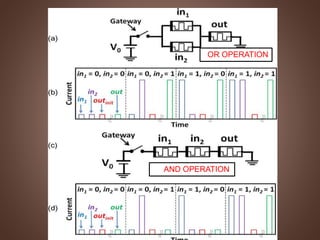
AND OPERATION
OR OPERATION
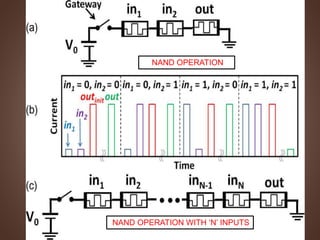
NAND OPERATION
NAND OPERATION WITH ‘N’ INPUTS
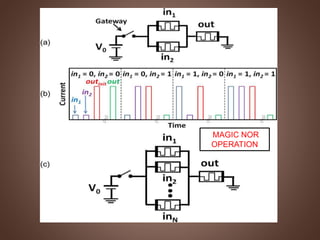
MAGIC NOR
OPERATION
NOT OPERATION
• Remember (or recall) the last resistance it
had, before being shut off.
• By changing the speed and strength of the
current, it is possible to change the
behavior of the device.
• A fast and hard current causes it to act as a
digital device.
• A soft and slow current causes it to act as
an analog device.
Properties Of Memristor
Benefits Of Memristor Technology
• Would allow for a quicker boot up since
information is not lost when the device is turned
off.
• Creating a Computer that never has to boot up.
• Density allows for more information to be stored.
• Has the capacity to remember the charge that
flows through it at a given point of time.
• No more hard drive and RAM, just Memristor.
• Very high storage and speed.
Applications of Memristors
• The most observable application of a Memristor is memory.
 A Memristor can store a single bit of data in DRAM – where
the capacitors are restored with Memristors.
 When compared to DRAM and SRAM, this kind of memory
has many benefits like – it is non-volatile
 it displays good scalability
 it has no leakage power.
 This type of memory is superior to flash memory in terms of
scalability and speed.
• Memristors perform equally well like the biological synapses.
 This feature makes good building blocks in neuromorphic
systems, where synapses and neurons are formed as
electronic
systems.
 This kind of memory has many benefits when we compare it
with the DRAM and SRAM.
• Another feasible application of Memristors is
logic circuits.
These can be used as a standalone logic
gate, or used in hybrid CMOS Memristor
circuits.
One notable logic application of
Memristors is its usage in an FPGA as
configurable switch
 and in connecting the CMOS logic gates.
• Thus, in future Memristors can be used to do
digital logic using implication instead of
Conclusion
It is sure that Memristor is going to revolute the 21st
century as radically as the transistor in the 20th century
But Memristor will have to wait a few years for a killer
app like transistor which had to wait almost a decade
after it’s invention for the killer app in the form of
hearing aids
Finally as Leon O Chua mentioned
“It’s time to rewrite al the
Electronics textbooks”
References
 How We Found the Missing Memristor by Stanley Williams, IEEE
Spectrum December 2008.
 L.O, Chua, Memristor-missing circuit clement, IEEE Tans . Circuit
Theory, Vol. 18, 1971, pp. 507-519.
 Memristor and Memristive Systems Symposium, University of California,
Berkeley, November 21,2008.
 Stateful Implication Logic with Memristors by Eero Lehtonen, Mika Laiho
2009 IEEE/ACM International Symposium on Nanoscale Architectures
27
THANK YOU

Magic memristor aided logic

  • 1.
    Seminar On MAGIC MEMRISTOR AIDED LOGIC SubmittedTo: Submitted By: Dept. of Electronics and Communication Lavisha Bhatia Rno. 12/129
  • 2.
    Contents • What isMemristor • Circuit relationship • Types of Memristor • TiO2 Memristor • Working of TiO2 Memristor • Analogy of Memristor • Why Memristor • Memristor aided logic(MAGIC) • Logic gates using MAGIC  MAGIC AND  MAGIC OR  MAGIC NAND  MAGIC NOR  MAGIC NOT • Properties of Memristor • Benefits of Memristor • Applications of Memristor • Conclusion
  • 3.
    WHAT IS Memristor Memristor MEMORYREGISTER A Memristor is a semiconductor whose resistance varies as a function of flux and charge. This allows it to “remember” what has passed through the circuit. It is characterised by “Memresistance”.
  • 4.
    Memristance is givenby: M(q)=dø/dq where ø=flux and q=charge Unit of Memristance is ohm. Therefore, Memristor can be defined as a two terminal device which shows the relation between magnetic flux and charge. (Symbol)
  • 5.
    Circuit relationship Memristors Φ=Mq Voltage (V) Current (i) Charge (q) Flux (Φ) Φ= Li Inductors v=dΦ/dt i=dq/dt Resistors v=Ri q=CvCapacitors
  • 6.
    DEVICE CHARACTERISTIC PROPERTY(UNITS) DIFFERENTIAL EQUATION RESISTOR(R) RESISTANCE(V/A,OR OHM) R=dv/dI Capacitor (C) Capacitance (C / V, or farad) C = dq / dV Inductor (L) Inductance (Wb / A, or henry) L = dΦm / dI Memristor (M) Memristance (Wb / C, or ohm) M = dΦm / dq
  • 7.
  • 8.
    1. IONIC THINFILM AND MOLECULAR MEMRISTORS  Molecule and Ionic thin-film Memristors mostly rely on different material properties of the thin film atomic lattices that display hysteresis below the application of charge.  These Memristors are classified into different types: • Titanium Dioxide Memristors: These types of Memristors are broadly explored for designing and modeling. • Ionic or Polymeric Memristors: Ionic and Polymeric Memristors utilize dynamic doping of inorganic die-electric type or polymer materials. In this type of Memristors, the charge carriers’ solid state ionic’s move all over the structure. • Resonant Tunneling Diode Memristors: These types of Memristors use specially doped quantum well diodes of the space layers between the sources and drain regions. • Manganite Memristors: These types of Memristors use a substrate of bilayer oxide films based on manganite as opposite to titanium dioxide Memristors.
  • 9.
    2. MAGNETIC ANDSPIN BASED MEMRISTORS  Spin based Memristors are opposite to ionic nanostructure and molecule based systems, and rely on the property of degree in electronic spin.  In this type of system, the polarization of electronic spin is aware. These types of Memristors are classified into two types: • Spintronic Memristors: In these types of Memristors, the route of spin of electrons changes the magnetization state of the device which consequently changes its resistance. • Spin Torque Transfer Memristors: In these types of Memristors, the comparative magnetization position of the two electrodes affect the magnetic state of a tunnel junction which in turn changes its resistance.
  • 10.
    TiO2 Memristor PT PTTiOv(2-x) TiO2 3nm 2 nm Oxidized Reduced (-)ve (+)ve • Applied voltage makes the oxygen vacancies (+ve) to shift towards the –ve voltage.
  • 11.
    • Titanium dioxidethin films were deposited on crystalline silicon substrates by electron beam physical vapor deposition. • The deposition was performed under vacuum ranging without process gases, resulting in homogeneous layers of TiO2-x with a thickness of around 100 nm. • Samples were then annealed at high temperatures ranging from 500 to 800 degree Celsius for 4 hours under nitrogen, and their structural and optical properties along with their chemical structure were characterized before and after annealing. • The chemical and structural characterization revealed a sub stoichiometric film with oxygen vacancies.
  • 12.
  • 13.
    WHY Memristor • Conventionaldevices use only 0 and 1 but Memristor can use any value between 0 and 1. • Faster than Flash memory. – Allow digital cameras to take pictures with no delay in between. • Smaller than transistors. • Non volatile. • Generate less heat & consumes less power.
  • 14.
    MAGIC-Memristor Aided Logic •MAGIC requires only memristors within the logic gates. • The logical state in a MAGIC gate is represented as a resistance, where the high and low resistances are considered , respectively, as logical zero and one (for simplicity, the resistance of logical zero and logical one is considered, respectively, as ROFF and RON). •The inputs and output of the logic gates are the logical states of the memristors. Separate memristors are required for the input and output. •The inputs of the MAGIC gates are the initial logical state of the input memristors, and the output is the final logical state of the memristor. • Operation of a MAGIC gate consists of two sequential stages. The first stage initializes the output memristor to a known logical state. In the second stage of operation, a voltage V0 is applied across the logic gate. While applying V0, the voltage across the output memristor depends upon the logical state of the input and output memristors.
  • 15.
    Why Use Memristorsin Logic? Integrating memristors with standard logic 15 Logic within the memory Memristor layer CMOS layer Beyond Moore Save die area More logic on die Beyond Von-Neumann Flexible
  • 16.
  • 17.
    AND Operation 17 Decrease resistance ANDIN2IN1 000 010 001 111 ROFF RON 0 0 Nocurrent 0 1 1 1 Increase resistance ROFF >> RON ~0 IN1 IN2 OUT ON ON OUT CC CC CC ON OFF OFF R R V V V V R R R       S. Kvatinsky “MRL – Memristor Ratioed Logic,” CNNA 2012
  • 18.
  • 19.
    NAND OPERATION NAND OPERATIONWITH ‘N’ INPUTS
  • 20.
  • 21.
  • 22.
    • Remember (orrecall) the last resistance it had, before being shut off. • By changing the speed and strength of the current, it is possible to change the behavior of the device. • A fast and hard current causes it to act as a digital device. • A soft and slow current causes it to act as an analog device. Properties Of Memristor
  • 23.
    Benefits Of MemristorTechnology • Would allow for a quicker boot up since information is not lost when the device is turned off. • Creating a Computer that never has to boot up. • Density allows for more information to be stored. • Has the capacity to remember the charge that flows through it at a given point of time. • No more hard drive and RAM, just Memristor. • Very high storage and speed.
  • 24.
    Applications of Memristors •The most observable application of a Memristor is memory.  A Memristor can store a single bit of data in DRAM – where the capacitors are restored with Memristors.  When compared to DRAM and SRAM, this kind of memory has many benefits like – it is non-volatile  it displays good scalability  it has no leakage power.  This type of memory is superior to flash memory in terms of scalability and speed. • Memristors perform equally well like the biological synapses.  This feature makes good building blocks in neuromorphic systems, where synapses and neurons are formed as electronic systems.  This kind of memory has many benefits when we compare it with the DRAM and SRAM.
  • 25.
    • Another feasibleapplication of Memristors is logic circuits. These can be used as a standalone logic gate, or used in hybrid CMOS Memristor circuits. One notable logic application of Memristors is its usage in an FPGA as configurable switch  and in connecting the CMOS logic gates. • Thus, in future Memristors can be used to do digital logic using implication instead of
  • 26.
    Conclusion It is surethat Memristor is going to revolute the 21st century as radically as the transistor in the 20th century But Memristor will have to wait a few years for a killer app like transistor which had to wait almost a decade after it’s invention for the killer app in the form of hearing aids Finally as Leon O Chua mentioned “It’s time to rewrite al the Electronics textbooks”
  • 27.
    References  How WeFound the Missing Memristor by Stanley Williams, IEEE Spectrum December 2008.  L.O, Chua, Memristor-missing circuit clement, IEEE Tans . Circuit Theory, Vol. 18, 1971, pp. 507-519.  Memristor and Memristive Systems Symposium, University of California, Berkeley, November 21,2008.  Stateful Implication Logic with Memristors by Eero Lehtonen, Mika Laiho 2009 IEEE/ACM International Symposium on Nanoscale Architectures 27
  • 28.

Editor's Notes

  • #16 CMOS logic is good, so why bother with memristor logic? First reason – if the memristor-based memory is there, we can do logic in the same price! We can break the conventional Von Neuman architecture to new architecture for calculation inside the memory. It can be done in parallel and in a dynamic manner. Second reason – we can use memristor-based logic as a redundant logic layer for backup or fixing soft errors for example and to save die area – ECC, Die area, etc. And the last reason – it is fun and interesting, after all I am in the academia…
  • #17 Before we begin with the logic gates themselves, let’s define the polarity of a memristor. The polarity is represented by the thick line in the memristor symbol. When current is getting inside the thick line, the resistance of the memristor is decreased and when current is flowing outside the thick line the resistance is increased. Into Out of
  • #18 Initial state of memristors does not important Cases 2 and 3 are symmetrical!