Downloaded 50 times



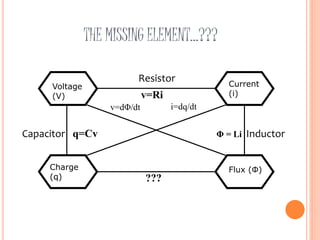
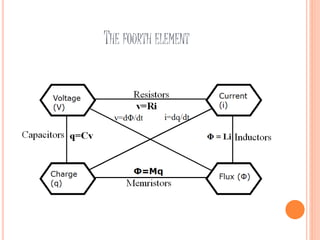
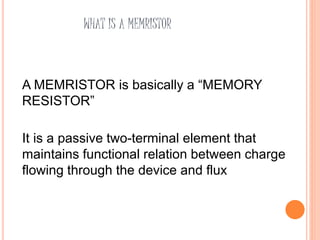
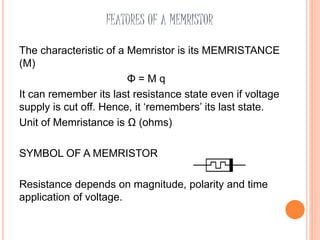
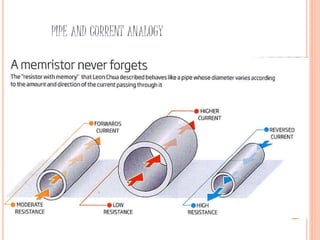
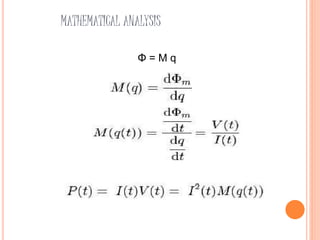
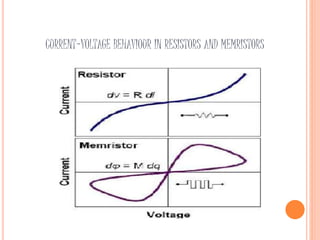
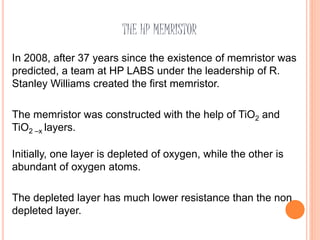
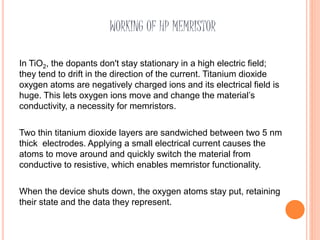
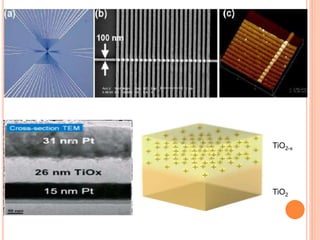




This document discusses memristors, a fourth fundamental circuit element predicted in 1971 and realized in 2008. Memristors are two-terminal devices whose resistance depends on the history of applied voltages. The first memristor was created at HP Labs using a thin film of titanium dioxide sandwiched between platinum electrodes. By drifting oxygen ions with an electric field, the device's resistance could be switched to represent binary data states. Memristors could replace other non-volatile memory types and even mimic neural behaviors, with potential applications in memory, programmable logic, and neuromorphic computing.


