Prepared
By
K.Sivaranjani
 Introduction
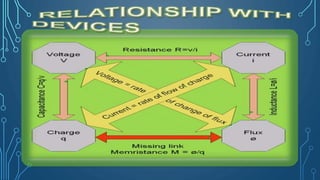
 Relationship with devices
 History
 Construction & working
 Applications
 Benefits
 What sets Memristor apart
 Conclusion
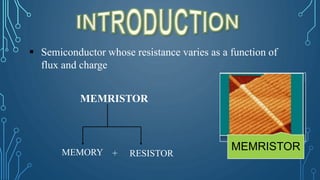
 Semiconductor whose resistance varies as a function of
flux and charge
MEMRISTOR
MEMORY RESISTOR+
MEMRISTOR
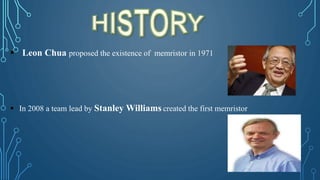
 Leon Chua proposed the existence of memristor in 1971
 In 2008 a team lead by Stanley Williams created the first memristor
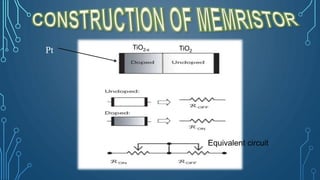
TiO2-x TiO2Pt
Equivalent circuit
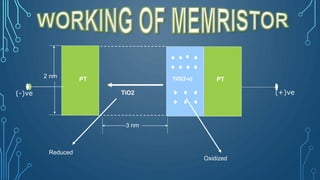
PT PTTiO(2-x)
TiO2
3 nm
2 nm
Oxidized
Reduced
(-)ve (+)ve
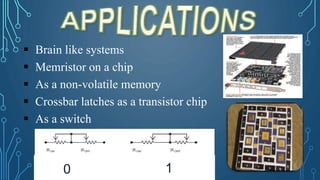
 Brain like systems
 Memristor on a chip
 As a non-volatile memory
 Crossbar latches as a transistor chip
 As a switch
10
 Would allow for a quicker boot up since information is not lost
when the device is turned off.
 Uses less energy and produces less heat.
 Eliminates the need to write computer programs that replicate small
parts of the brain.
 Density allows for more information to be stored.
 Conventional devices use only 0 and 1; Memristor can use
anything between 0 and 1.
 Faster than Flash memory.
• Allow digital cameras to take pictures with no delay in
between.
 Innovating nanotechnology due to the fact that it performs better
the smaller it becomes.
 Memristor will change circuit design in the 21st century
Finally as Leon O Chua
mentioned
“It’s time to rewrite
all the EE textbooks”
Modified Memristor

Modified Memristor

  • 1.
  • 2.
     Introduction  Relationshipwith devices  History  Construction & working  Applications  Benefits  What sets Memristor apart  Conclusion
  • 3.
     Semiconductor whoseresistance varies as a function of flux and charge MEMRISTOR MEMORY RESISTOR+ MEMRISTOR
  • 5.
     Leon Chuaproposed the existence of memristor in 1971  In 2008 a team lead by Stanley Williams created the first memristor
  • 6.
  • 7.
    PT PTTiO(2-x) TiO2 3 nm 2nm Oxidized Reduced (-)ve (+)ve
  • 8.
     Brain likesystems  Memristor on a chip  As a non-volatile memory  Crossbar latches as a transistor chip  As a switch 10
  • 9.
     Would allowfor a quicker boot up since information is not lost when the device is turned off.  Uses less energy and produces less heat.  Eliminates the need to write computer programs that replicate small parts of the brain.  Density allows for more information to be stored.
  • 10.
     Conventional devicesuse only 0 and 1; Memristor can use anything between 0 and 1.  Faster than Flash memory. • Allow digital cameras to take pictures with no delay in between.  Innovating nanotechnology due to the fact that it performs better the smaller it becomes.
  • 11.
     Memristor willchange circuit design in the 21st century Finally as Leon O Chua mentioned “It’s time to rewrite all the EE textbooks”