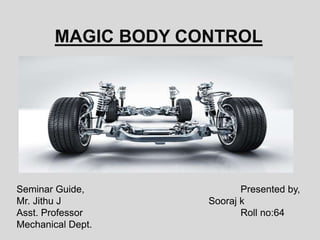
MAGIC BODY CONTROL
Seminar Guide, Presented by,
Mr. Jithu J Sooraj k
Asst. Professor Roll no:64
Mechanical Dept.
SCHEME OF PRESENTATION
 Introduction
 Classification
 Magic body control
 Components
 Working
 Driving modes
 Comparison
 Vehicle performance
 Equipped vehicles
 Merits and demerits
 References 2
INTRODUCTION
 What is suspension system?
 System which isolating automobile from road
shocks
 Consist of springs, dampers, Tires
 Objective of suspension system
 To prevent the road shocks transmitted
 To safeguard occupants and passengers from
road shock
 To preserve stability 3
CLASSIFICATION
SUSPENSION
SYSTEM
PASSIVE
ADAPTIVE
ACTIVE
4
WHY MAGIC BODY CONTROL?
 With the world’s first suspension system with
“eyes”.
 Like riding on a flying carpet.
 Satisfying all requirements.
 A magical combination.
5
6
o Magic body control suspension system is an
electronically controlled active suspension system
o A stereo camera on the wind screen continually monitor the
road surface.
oTogether with the information on the driving conditions, the
control unit continually calculates the best control strategy for
dealing with unevenness in the road
o Created by Mercedes-Benz
o Project Manager is Stefan Cytrynski.
COMPONENTS
 Electronic control unit(ECU)
 Stereo camera
 Reservoir
 Sensors
 Hydraulic servo mechanism
 Coil springs and Shock absorbers
7
8
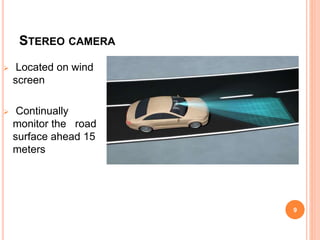
STEREO CAMERA
9
 Located on wind
screen
 Continually
monitor the road
surface ahead 15
meters
ELECTRONIC CONTROL UNIT (ECU)
 Calculates the current driving status
 Independent controlling of shock absorbers
10
RESERVOIR
 Used to store oil
 Supplies the oil to the servomechanism as per
the command of ECU
SENSORS
 The sensors continually monitor body movement
and vehicle level and supply the controller with new
data every ten milliseconds
 Four level sensors, one at each wheel measure the
ride level of the vehicle
11
12
 Three acceleration sensors called longitudinal,
lateral, vertical acceleration sensors
 The Longitudinal Acceleration Sensor reports
acceleration and deceleration.
 The Lateral Acceleration Sensor detects
transverse or side-to-side movements.
 Three Vertical Acceleration Sensors detect lifting
motion and pitch and roll of the body.
HYDRAULIC SERVO MECHANISM
 It is a mechanism that uses automatic feedback
and hydraulics to correct the performance of a
machine
 ECU directs the hydraulic servomechanisms on
how to correct the car's positioning.
13
COIL SPRINGS AND SHOCK ABSORBERS
 Coil spring is the most common type of
spring found on modern vehicles
 Low cost and compact size
 Shock absorber keeps the suspension from
continuing to bounce after spring
compression and extension
14
15
WORKING
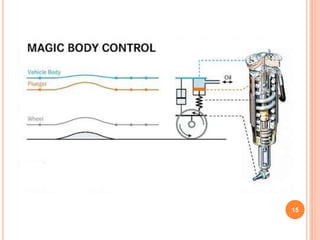
 The stereo camera scan the road surface and
provide corresponding signals to the ECU.
 ECU determines the amount of pressure to be built
in servo mechanism according to various signals
from sensors
16
17
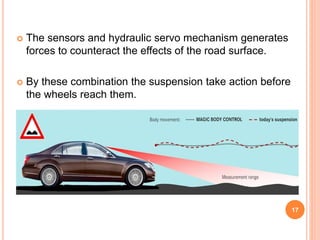
 The sensors and hydraulic servo mechanism generates
forces to counteract the effects of the road surface.
 By these combination the suspension take action before
the wheels reach them.
DRIVING MODES
18
 Comfort
 sport
COMFORT MODE
 Sensitive response and soft damping characteristics
 The suspension level is automatically adjusted
depending on the road speed.
 Vehicle is lowered by ten millimeters at speeds over
120 km/h
19
SPORT MODE
 Shock absorbers have more stiffer response than
comfort mode
 Vehicle is lowered by10 millimeters at speeds below
120km/h
 Besides these driving modes driver is able to select a
suspension setting raised by 30 millimeters.
20
COMPARISON
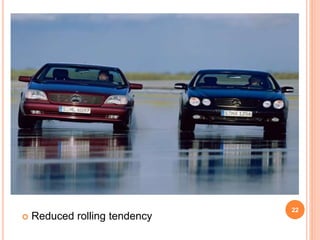
21 Reduced pitching
22
 Reduced rolling tendency
VEHICLE PERFORMANCE
23
EQUIPPED VEHICLES
 Mercedes-Benz S class
 Rolls Royce Ghost
24
25
MERITS
 Stability at all time
 High level of ride comfort
 Minimizing uncomfortable body movements
 Successful elimination of roll and pitch
DEMERITS
High initial cost
Malfunctioning can lead to a big collapse
Require super quick micro-computers
REFERENCES
 “Automobile engineering” by Dr. Kripal Singh
 “Fast track” magazine
 A journal on modern suspension systems by Ishan
Raghava
 www.mercedes-benz.com
 www.automobilemag.com
 https://media.daimler.com/dcmedia
26

Magic body control

  • 1.
    MAGIC BODY CONTROL SeminarGuide, Presented by, Mr. Jithu J Sooraj k Asst. Professor Roll no:64 Mechanical Dept.
  • 2.
    SCHEME OF PRESENTATION Introduction  Classification  Magic body control  Components  Working  Driving modes  Comparison  Vehicle performance  Equipped vehicles  Merits and demerits  References 2
  • 3.
    INTRODUCTION  What issuspension system?  System which isolating automobile from road shocks  Consist of springs, dampers, Tires  Objective of suspension system  To prevent the road shocks transmitted  To safeguard occupants and passengers from road shock  To preserve stability 3
  • 4.
  • 5.
    WHY MAGIC BODYCONTROL?  With the world’s first suspension system with “eyes”.  Like riding on a flying carpet.  Satisfying all requirements.  A magical combination. 5
  • 6.
    6 o Magic bodycontrol suspension system is an electronically controlled active suspension system o A stereo camera on the wind screen continually monitor the road surface. oTogether with the information on the driving conditions, the control unit continually calculates the best control strategy for dealing with unevenness in the road o Created by Mercedes-Benz o Project Manager is Stefan Cytrynski.
  • 7.
    COMPONENTS  Electronic controlunit(ECU)  Stereo camera  Reservoir  Sensors  Hydraulic servo mechanism  Coil springs and Shock absorbers 7
  • 8.
  • 9.
    STEREO CAMERA 9  Locatedon wind screen  Continually monitor the road surface ahead 15 meters
  • 10.
    ELECTRONIC CONTROL UNIT(ECU)  Calculates the current driving status  Independent controlling of shock absorbers 10 RESERVOIR  Used to store oil  Supplies the oil to the servomechanism as per the command of ECU
  • 11.
    SENSORS  The sensorscontinually monitor body movement and vehicle level and supply the controller with new data every ten milliseconds  Four level sensors, one at each wheel measure the ride level of the vehicle 11
  • 12.
    12  Three accelerationsensors called longitudinal, lateral, vertical acceleration sensors  The Longitudinal Acceleration Sensor reports acceleration and deceleration.  The Lateral Acceleration Sensor detects transverse or side-to-side movements.  Three Vertical Acceleration Sensors detect lifting motion and pitch and roll of the body.
  • 13.
    HYDRAULIC SERVO MECHANISM It is a mechanism that uses automatic feedback and hydraulics to correct the performance of a machine  ECU directs the hydraulic servomechanisms on how to correct the car's positioning. 13
  • 14.
    COIL SPRINGS ANDSHOCK ABSORBERS  Coil spring is the most common type of spring found on modern vehicles  Low cost and compact size  Shock absorber keeps the suspension from continuing to bounce after spring compression and extension 14
  • 15.
  • 16.
    WORKING  The stereocamera scan the road surface and provide corresponding signals to the ECU.  ECU determines the amount of pressure to be built in servo mechanism according to various signals from sensors 16
  • 17.
    17  The sensorsand hydraulic servo mechanism generates forces to counteract the effects of the road surface.  By these combination the suspension take action before the wheels reach them.
  • 18.
  • 19.
    COMFORT MODE  Sensitiveresponse and soft damping characteristics  The suspension level is automatically adjusted depending on the road speed.  Vehicle is lowered by ten millimeters at speeds over 120 km/h 19
  • 20.
    SPORT MODE  Shockabsorbers have more stiffer response than comfort mode  Vehicle is lowered by10 millimeters at speeds below 120km/h  Besides these driving modes driver is able to select a suspension setting raised by 30 millimeters. 20
  • 21.
  • 22.
  • 23.
  • 24.
    EQUIPPED VEHICLES  Mercedes-BenzS class  Rolls Royce Ghost 24
  • 25.
    25 MERITS  Stability atall time  High level of ride comfort  Minimizing uncomfortable body movements  Successful elimination of roll and pitch DEMERITS High initial cost Malfunctioning can lead to a big collapse Require super quick micro-computers
  • 26.
    REFERENCES  “Automobile engineering”by Dr. Kripal Singh  “Fast track” magazine  A journal on modern suspension systems by Ishan Raghava  www.mercedes-benz.com  www.automobilemag.com  https://media.daimler.com/dcmedia 26