Automotive Chassis (AE0303)
Unit 4
Submitted by:- 1111110040-1111110053
INDEX
1. Need of Suspension System
2. Types of Suspension Systems
3. Suspension Springs
4. Construction details and characteristics of
1. Leaf Spring
2. Coil Spring
3. Torsion Bar Springs
5. Independent suspension
6. Rubber Suspension
7. Hydro Elastic Suspension
8. Shock absorbers
9. Vibration And driving comfort
NEED OF SUSPENSION SYSTEM
 Provide vertical compliance so the wheels can follow the
uneven road, isolating the chassis from roughness in the
road.
 Maintain the wheels in the proper steer and camber
attitudes to the road surface.
 Resist roll of the chassis. (Roll is the motion of vehicle
along
 Keep the tires in contact with the road with minimal load
variations.
TYPES OF SUSPENSION SYSTEM
 The various suspension springs may be classified as follows
1. Steel Spring
A. Leaf spring
B. Tapered leaf spring
C. Coil Sprig
D. Torsion Bar
2. Rubber Springs
A. Compression Spring
B. Compression-shear spring
C. Steel-reinforced spring
D. Progressive Spring
E. Face-shear spring
F. Torsional shear spring
3. Plastic spring
4. Air Spring
5. Hydraulic spring
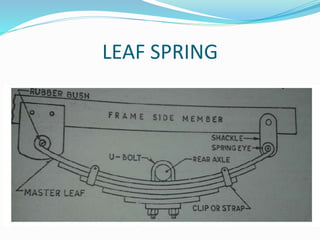
LEAF SPRING
CONSTRUCTION and CHARACTERISTICS
DETAILS
 Spring consists of no. of leaves termed as blades
 The lengthiest blade is known as the MASTER LEAF
 Spring is supported at front and rear axle by means of
a U-bolt. The other end is supported by a pin and
other wit a shackle, which provides it flexibility
 Considering fig, High camber springs provide soft
suspension, but increase the tendency to YAW
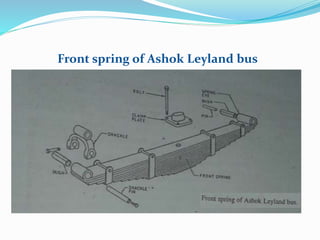
Front spring of Ashok Leyland bus
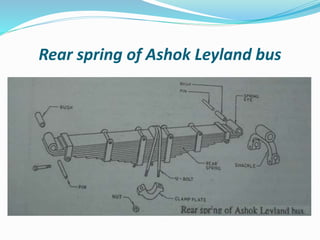
Rear spring of Ashok Leyland bus
CONSTRUCTION and CHARACTERISTICS
DETAILS (cont.…)
 Spring eyes for heavy vehicle are usually bushed with
phosphor bronze bushes, for cars and vans; rubber is used
 Life of a spring can be increased by SHOT PEENING for top
surface of each leaf introducing compressive residual
stress, avoiding stress concentration
 Moisture leads to inter leaf friction. So to reduce this,
Phosphate paints are used
 Regular lubrication to the leaves is required say 1000km
and SAE 140 oil is used
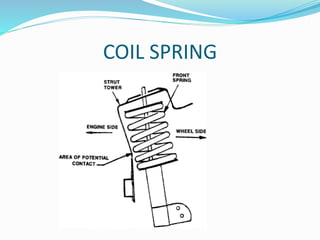
COIL SPRING
COIL SPRINGS (THEORY)
 Generally used inn independent suspension
 Can also be used in conventional rigid axle
suspension
 Energy stored per unit volume is almost double in
case of coil springs than the leaf spring
 Coil springs do not have noise problems, nor do
they have static friction as in leaf spring
 This spring can bear shear stress as well as bending
stress
 They cannot take torque reaction and side thrust. A
helper coil spring is also sometimes used to provide
progressive stiffness against increasing load
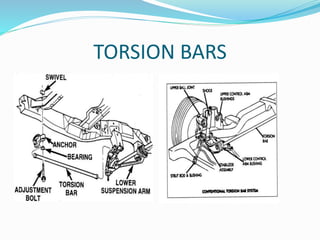
TORSION BARS
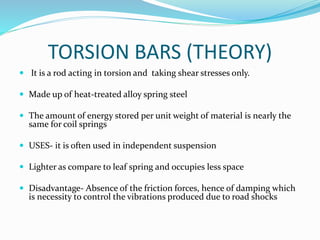
TORSION BARS (THEORY)
 It is a rod acting in torsion and taking shear stresses only.
 Made up of heat-treated alloy spring steel
 The amount of energy stored per unit weight of material is nearly the
same for coil springs
 USES- it is often used in independent suspension
 Lighter as compare to leaf spring and occupies less space
 Disadvantage- Absence of the friction forces, hence of damping which
is necessity to control the vibrations produced due to road shocks
INDEPENDENT SUSPENSION
 INTRODUCTION
 So-named because the front wheel's suspension
systems are independent of each other (except where
joined by an antiroll bar) These came into existence
around 1930 and have been in use in one form or
another pretty much ever since then.
•This is currently, without doubt, the most widely used front suspension system in
cars of European origin.
•It is simplicity itself.
•The system basically comprises of a strut-type spring and shock absorber combo,
which pivots on a ball joint on the single, lower arm.
•At the top end there is a needle roller bearing on some more sophisticated systems.
•The strut itself is the load-bearing member in this assembly, with the spring and
shock absorber merely performing their duty as oppose to actually holding the car up.
In the rendered image here, you can't see the shock absorber because it is encased
in the blue strut tower, inside the spring. The steering gear is either connected
directly to the lower shock absorber housing, or to an arm from the front or back of
the spindle (in this case). When you steer, it physically twists the shock absorber
housing (and consequently the spring) to turn the wheel. Simple.
•The spring is seated in a special plate at the top of the assembly which allows this
twisting to take place.
•If the spring or this plate are worn, you'll get a loud 'clonk' on full lock as the
spring frees up and jumps into place.
This is sometimes confused for CV joint knock.
Macpherson strut
Macpherson strut
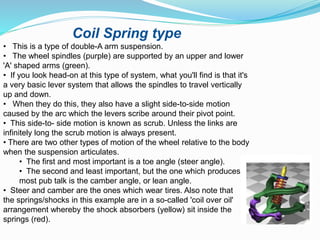
Coil Spring type
• This is a type of double-A arm suspension.
• The wheel spindles (purple) are supported by an upper and lower
'A' shaped arms (green).
• If you look head-on at this type of system, what you'll find is that it's
a very basic lever system that allows the spindles to travel vertically
up and down.
• When they do this, they also have a slight side-to-side motion
caused by the arc which the levers scribe around their pivot point.
• This side-to- side motion is known as scrub. Unless the links are
infinitely long the scrub motion is always present.
• There are two other types of motion of the wheel relative to the body
when the suspension articulates.
• The first and most important is a toe angle (steer angle).
• The second and least important, but the one which produces
most pub talk is the camber angle, or lean angle.
• Steer and camber are the ones which wear tires. Also note that
the springs/shocks in this example are in a so-called 'coil over oil'
arrangement whereby the shock absorbers (yellow) sit inside the
springs (red).
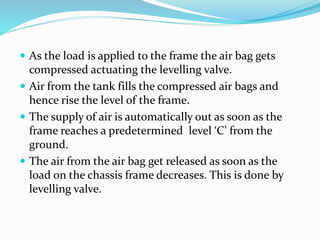
Levelling
valve
Air tank
Air suspension
Air reservoir
Chassis frame
Air tank
Air springs bellows
Air
compressor
run by IC
engine
Constant at all
circumstances
‘C’
Levelling valve
lever
 The above air suspension of a compressor supplying air
to an air tank to maintain a pressure between
5.6kg/sq.cm to 7kg/sq.cm,
 A levelling valve to maintain a fix distance ‘C’ between
the chassis frame and ground
 Four number of air bag, each bag is filled with
compressed air and supports the weight of the vehicle.
 The air bag is placed between the chassis frame and
the axle beam
Air suspension
 As the load is applied to the frame the air bag gets
compressed actuating the levelling valve.
 Air from the tank fills the compressed air bags and
hence rise the level of the frame.
 The supply of air is automatically out as soon as the
frame reaches a predetermined level ‘C’ from the
ground.
 The air from the air bag get released as soon as the
load on the chassis frame decreases. This is done by
levelling valve.
Advantages of air suspension
 Maintain a constant frequency of vibration
whether the vehicle is loaded or unloaded.
 The stiffness of the system increases with the
increase of deflection.
 No need to adjust the head light
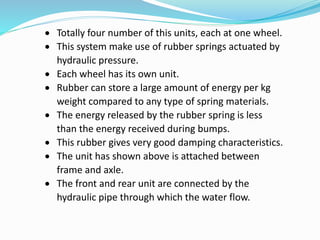
 Totally four number of this units, each at one wheel.
 This system make use of rubber springs actuated by
hydraulic pressure.
 Each wheel has its own unit.
 Rubber can store a large amount of energy per kg
weight compared to any type of spring materials.
 The energy released by the rubber spring is less
than the energy received during bumps.
 This rubber gives very good damping characteristics.
 The unit has shown above is attached between
frame and axle.
 The front and rear unit are connected by the
hydraulic pipe through which the water flow.
 When the road wheels encounter bumps, the tapered system of hydro
elastic unit moves upwards ,pushing rubber diaphragm therefore the
fluid between the separator plate and through the rear wheels unit
through a 2-way valve .” the resistance of this valve provides the damping
effect.
 The fluid pressure in turn pushes the diaphragm of the rear suspension
unit raising the rear end.
 Therefore the level of the frame from the road surface is maintained.

 After the Can has passed the bump the fluid return from the rear unit to
the front unit restoring the original position.
 Similarly the rear wheels meet a bump the front position of the can is
raised up.
 These hydro elastic units can connected to the upper front suspension
and rear suspension arms.
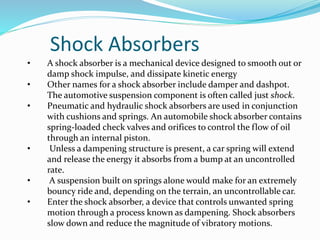
Shock Absorbers
• A shock absorber is a mechanical device designed to smooth out or
damp shock impulse, and dissipate kinetic energy
• Other names for a shock absorber include damper and dashpot.
The automotive suspension component is often called just shock.
• Pneumatic and hydraulic shock absorbers are used in conjunction
with cushions and springs. An automobile shock absorber contains
spring-loaded check valves and orifices to control the flow of oil
through an internal piston.
• Unless a dampening structure is present, a car spring will extend
and release the energy it absorbs from a bump at an uncontrolled
rate.
• A suspension built on springs alone would make for an extremely
bouncy ride and, depending on the terrain, an uncontrollable car.
• Enter the shock absorber, a device that controls unwanted spring
motion through a process known as dampening. Shock absorbers
slow down and reduce the magnitude of vibratory motions.
• A shock absorber is basically an oil pump placed between the frame of the
car and the wheels. The upper mount of the shock connects to the frame,
while the lower mount connects to the axle, near the wheel.
• In a twin-tube design, one of the most common types of shock absorbers,
the upper mount is connected to a piston rod, which in turn is connected to
a piston, which in turn sits in a tube filled with hydraulic fluid. The inner
tube is known as the pressure tube, and the outer tube is known as the
reserve tube. The reserve tube stores excess hydraulic fluid.
• Shock absorbers work in two cycles -- the compression cycle and the
extension cycle. The compression cycle occurs as the piston moves
downward, compressing the hydraulic fluid in the chamber below the
piston.
• The extension cycle occurs as the piston moves toward the top of the
pressure tube, compressing the fluid in the chamber above the piston.
• All modern shock absorbers are velocity-sensitive the faster the suspension
moves, the more resistance the shock absorber provides. This enables
shocks to adjust to road conditions and to control all of the unwanted
motions that can occur in a moving vehicle, including bounce, sway, brake
dive and acceleration squat.
• Strangely enough, absorb shocks.
•They're really called dampers, because they actually dampen the vertical motion
induced by driving your car along a rough surface.
•If your car only had springs, it would boat and wallow along the road until you got
physically sick and had to get out.
•Or at least until it fell apart. Shock absorbers perform two functions. Firstly, they
absorb any larger-than-average bumps in the road so that the shock isn't
transmitted to the car chassis. Secondly, they keep the suspension at as full a
travel as possible for the given road conditions.
•Shock absorbers keep your wheels planted on the road. Without them, your car
would be a traveling deathtrap.
•Technically, they are actually dampers. Even more technically, they are velocity-
sensitive hydraulic damping devices - in other words, the faster they move, the
more resistance there is to that movement.
•They work in conjunction with the springs.
•The spring allows movement of the wheel to allow the energy in the road shock to
be transformed into kinetic energy of the unsprung mass, whereupon it is
dissipated by the damper.
Shock Absorbers
Vehicle or ride comfort
 Vehicle is subjected to its passenger both to
 Bounce
 roll or sway when connected to pitch when front wheel are
suddenly lifted.
 Dropped in relation to rear axle ,pitch also occurs, when
vehicle is accelerated or braked.
Uncomfortable ride
 Large tyres absorbs some of the road irregularities but it is
necessary to introduce a suspension system to reduce
shock to passenger.
 Efficiency of suspension is directly proportional to the
unsprung weight relative to spring.
Vehicle comfort factors
•Large wheel movement for small deflection force.
•Maintain good contact between wheel and road.
•Shock absorbers , dampers damp the tendency of the spring to
oscillate rapidly and would otherwise cause wheels and body to
bounce.
•
•To keep the body at reasonable constant level and allow the wheel
to follow the road.
Compression Spring
COMPRESSION SPRINGS are open-coil helical springs wound or
constructed to oppose compression along the axis of wind. Helical
Compression Springs are the most common metal spring
configuration
Compression Shear Spring
It is designed to operate with a compression shear load is applied, so
the spring gets twisted as the torsion is applied to it.
Steel reinforced spring
PVC vacuum hose is steel wire reinforced with a temp range from
20 to 150F. Resistant to chemicals, non-marking, non-toxic,
silicone-free, is flexible and developed for mechanical vacuum
pumps. Fastens with hose clamps and stainless steel PVC
adapters.
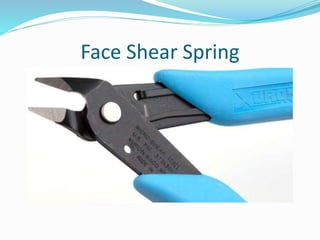
Face Shear Spring
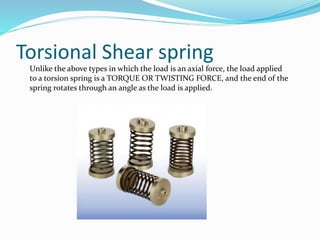
Torsional Shear spring
Unlike the above types in which the load is an axial force, the load applied
to a torsion spring is a TORQUE OR TWISTING FORCE, and the end of the
spring rotates through an angle as the load is applied.
Leaf Spring
A flat spring used in vehicle suspensions, electrical switches,
and bows.
THE END

unit4(suspension system).pptx

  • 1.
    Automotive Chassis (AE0303) Unit4 Submitted by:- 1111110040-1111110053
  • 2.
    INDEX 1. Need ofSuspension System 2. Types of Suspension Systems 3. Suspension Springs 4. Construction details and characteristics of 1. Leaf Spring 2. Coil Spring 3. Torsion Bar Springs 5. Independent suspension 6. Rubber Suspension 7. Hydro Elastic Suspension 8. Shock absorbers 9. Vibration And driving comfort
  • 3.
    NEED OF SUSPENSIONSYSTEM  Provide vertical compliance so the wheels can follow the uneven road, isolating the chassis from roughness in the road.  Maintain the wheels in the proper steer and camber attitudes to the road surface.  Resist roll of the chassis. (Roll is the motion of vehicle along  Keep the tires in contact with the road with minimal load variations.
  • 4.
    TYPES OF SUSPENSIONSYSTEM  The various suspension springs may be classified as follows 1. Steel Spring A. Leaf spring B. Tapered leaf spring C. Coil Sprig D. Torsion Bar 2. Rubber Springs A. Compression Spring B. Compression-shear spring C. Steel-reinforced spring D. Progressive Spring E. Face-shear spring F. Torsional shear spring 3. Plastic spring 4. Air Spring 5. Hydraulic spring
  • 5.
  • 6.
    CONSTRUCTION and CHARACTERISTICS DETAILS Spring consists of no. of leaves termed as blades  The lengthiest blade is known as the MASTER LEAF  Spring is supported at front and rear axle by means of a U-bolt. The other end is supported by a pin and other wit a shackle, which provides it flexibility  Considering fig, High camber springs provide soft suspension, but increase the tendency to YAW
  • 7.
    Front spring ofAshok Leyland bus
  • 8.
    Rear spring ofAshok Leyland bus
  • 9.
    CONSTRUCTION and CHARACTERISTICS DETAILS(cont.…)  Spring eyes for heavy vehicle are usually bushed with phosphor bronze bushes, for cars and vans; rubber is used  Life of a spring can be increased by SHOT PEENING for top surface of each leaf introducing compressive residual stress, avoiding stress concentration  Moisture leads to inter leaf friction. So to reduce this, Phosphate paints are used  Regular lubrication to the leaves is required say 1000km and SAE 140 oil is used
  • 10.
  • 11.
    COIL SPRINGS (THEORY) Generally used inn independent suspension  Can also be used in conventional rigid axle suspension  Energy stored per unit volume is almost double in case of coil springs than the leaf spring  Coil springs do not have noise problems, nor do they have static friction as in leaf spring  This spring can bear shear stress as well as bending stress  They cannot take torque reaction and side thrust. A helper coil spring is also sometimes used to provide progressive stiffness against increasing load
  • 12.
  • 13.
    TORSION BARS (THEORY) It is a rod acting in torsion and taking shear stresses only.  Made up of heat-treated alloy spring steel  The amount of energy stored per unit weight of material is nearly the same for coil springs  USES- it is often used in independent suspension  Lighter as compare to leaf spring and occupies less space  Disadvantage- Absence of the friction forces, hence of damping which is necessity to control the vibrations produced due to road shocks
  • 14.
    INDEPENDENT SUSPENSION  INTRODUCTION So-named because the front wheel's suspension systems are independent of each other (except where joined by an antiroll bar) These came into existence around 1930 and have been in use in one form or another pretty much ever since then.
  • 15.
    •This is currently,without doubt, the most widely used front suspension system in cars of European origin. •It is simplicity itself. •The system basically comprises of a strut-type spring and shock absorber combo, which pivots on a ball joint on the single, lower arm. •At the top end there is a needle roller bearing on some more sophisticated systems. •The strut itself is the load-bearing member in this assembly, with the spring and shock absorber merely performing their duty as oppose to actually holding the car up. In the rendered image here, you can't see the shock absorber because it is encased in the blue strut tower, inside the spring. The steering gear is either connected directly to the lower shock absorber housing, or to an arm from the front or back of the spindle (in this case). When you steer, it physically twists the shock absorber housing (and consequently the spring) to turn the wheel. Simple. •The spring is seated in a special plate at the top of the assembly which allows this twisting to take place. •If the spring or this plate are worn, you'll get a loud 'clonk' on full lock as the spring frees up and jumps into place. This is sometimes confused for CV joint knock. Macpherson strut
  • 16.
  • 17.
    Coil Spring type •This is a type of double-A arm suspension. • The wheel spindles (purple) are supported by an upper and lower 'A' shaped arms (green). • If you look head-on at this type of system, what you'll find is that it's a very basic lever system that allows the spindles to travel vertically up and down. • When they do this, they also have a slight side-to-side motion caused by the arc which the levers scribe around their pivot point. • This side-to- side motion is known as scrub. Unless the links are infinitely long the scrub motion is always present. • There are two other types of motion of the wheel relative to the body when the suspension articulates. • The first and most important is a toe angle (steer angle). • The second and least important, but the one which produces most pub talk is the camber angle, or lean angle. • Steer and camber are the ones which wear tires. Also note that the springs/shocks in this example are in a so-called 'coil over oil' arrangement whereby the shock absorbers (yellow) sit inside the springs (red).
  • 18.
    Levelling valve Air tank Air suspension Airreservoir Chassis frame Air tank Air springs bellows Air compressor run by IC engine Constant at all circumstances ‘C’ Levelling valve lever
  • 19.
     The aboveair suspension of a compressor supplying air to an air tank to maintain a pressure between 5.6kg/sq.cm to 7kg/sq.cm,  A levelling valve to maintain a fix distance ‘C’ between the chassis frame and ground  Four number of air bag, each bag is filled with compressed air and supports the weight of the vehicle.  The air bag is placed between the chassis frame and the axle beam Air suspension
  • 20.
     As theload is applied to the frame the air bag gets compressed actuating the levelling valve.  Air from the tank fills the compressed air bags and hence rise the level of the frame.  The supply of air is automatically out as soon as the frame reaches a predetermined level ‘C’ from the ground.  The air from the air bag get released as soon as the load on the chassis frame decreases. This is done by levelling valve.
  • 21.
    Advantages of airsuspension  Maintain a constant frequency of vibration whether the vehicle is loaded or unloaded.  The stiffness of the system increases with the increase of deflection.  No need to adjust the head light
  • 24.
     Totally fournumber of this units, each at one wheel.  This system make use of rubber springs actuated by hydraulic pressure.  Each wheel has its own unit.  Rubber can store a large amount of energy per kg weight compared to any type of spring materials.  The energy released by the rubber spring is less than the energy received during bumps.  This rubber gives very good damping characteristics.  The unit has shown above is attached between frame and axle.  The front and rear unit are connected by the hydraulic pipe through which the water flow.
  • 25.
     When theroad wheels encounter bumps, the tapered system of hydro elastic unit moves upwards ,pushing rubber diaphragm therefore the fluid between the separator plate and through the rear wheels unit through a 2-way valve .” the resistance of this valve provides the damping effect.  The fluid pressure in turn pushes the diaphragm of the rear suspension unit raising the rear end.  Therefore the level of the frame from the road surface is maintained.  After the Can has passed the bump the fluid return from the rear unit to the front unit restoring the original position.  Similarly the rear wheels meet a bump the front position of the can is raised up.  These hydro elastic units can connected to the upper front suspension and rear suspension arms.
  • 26.
    Shock Absorbers • Ashock absorber is a mechanical device designed to smooth out or damp shock impulse, and dissipate kinetic energy • Other names for a shock absorber include damper and dashpot. The automotive suspension component is often called just shock. • Pneumatic and hydraulic shock absorbers are used in conjunction with cushions and springs. An automobile shock absorber contains spring-loaded check valves and orifices to control the flow of oil through an internal piston. • Unless a dampening structure is present, a car spring will extend and release the energy it absorbs from a bump at an uncontrolled rate. • A suspension built on springs alone would make for an extremely bouncy ride and, depending on the terrain, an uncontrollable car. • Enter the shock absorber, a device that controls unwanted spring motion through a process known as dampening. Shock absorbers slow down and reduce the magnitude of vibratory motions.
  • 28.
    • A shockabsorber is basically an oil pump placed between the frame of the car and the wheels. The upper mount of the shock connects to the frame, while the lower mount connects to the axle, near the wheel. • In a twin-tube design, one of the most common types of shock absorbers, the upper mount is connected to a piston rod, which in turn is connected to a piston, which in turn sits in a tube filled with hydraulic fluid. The inner tube is known as the pressure tube, and the outer tube is known as the reserve tube. The reserve tube stores excess hydraulic fluid. • Shock absorbers work in two cycles -- the compression cycle and the extension cycle. The compression cycle occurs as the piston moves downward, compressing the hydraulic fluid in the chamber below the piston. • The extension cycle occurs as the piston moves toward the top of the pressure tube, compressing the fluid in the chamber above the piston. • All modern shock absorbers are velocity-sensitive the faster the suspension moves, the more resistance the shock absorber provides. This enables shocks to adjust to road conditions and to control all of the unwanted motions that can occur in a moving vehicle, including bounce, sway, brake dive and acceleration squat.
  • 29.
    • Strangely enough,absorb shocks. •They're really called dampers, because they actually dampen the vertical motion induced by driving your car along a rough surface. •If your car only had springs, it would boat and wallow along the road until you got physically sick and had to get out. •Or at least until it fell apart. Shock absorbers perform two functions. Firstly, they absorb any larger-than-average bumps in the road so that the shock isn't transmitted to the car chassis. Secondly, they keep the suspension at as full a travel as possible for the given road conditions. •Shock absorbers keep your wheels planted on the road. Without them, your car would be a traveling deathtrap. •Technically, they are actually dampers. Even more technically, they are velocity- sensitive hydraulic damping devices - in other words, the faster they move, the more resistance there is to that movement. •They work in conjunction with the springs. •The spring allows movement of the wheel to allow the energy in the road shock to be transformed into kinetic energy of the unsprung mass, whereupon it is dissipated by the damper. Shock Absorbers
  • 31.
    Vehicle or ridecomfort  Vehicle is subjected to its passenger both to  Bounce  roll or sway when connected to pitch when front wheel are suddenly lifted.  Dropped in relation to rear axle ,pitch also occurs, when vehicle is accelerated or braked. Uncomfortable ride  Large tyres absorbs some of the road irregularities but it is necessary to introduce a suspension system to reduce shock to passenger.  Efficiency of suspension is directly proportional to the unsprung weight relative to spring.
  • 32.
    Vehicle comfort factors •Largewheel movement for small deflection force. •Maintain good contact between wheel and road. •Shock absorbers , dampers damp the tendency of the spring to oscillate rapidly and would otherwise cause wheels and body to bounce. • •To keep the body at reasonable constant level and allow the wheel to follow the road.
  • 33.
    Compression Spring COMPRESSION SPRINGSare open-coil helical springs wound or constructed to oppose compression along the axis of wind. Helical Compression Springs are the most common metal spring configuration
  • 34.
    Compression Shear Spring Itis designed to operate with a compression shear load is applied, so the spring gets twisted as the torsion is applied to it.
  • 35.
    Steel reinforced spring PVCvacuum hose is steel wire reinforced with a temp range from 20 to 150F. Resistant to chemicals, non-marking, non-toxic, silicone-free, is flexible and developed for mechanical vacuum pumps. Fastens with hose clamps and stainless steel PVC adapters.
  • 36.
  • 37.
    Torsional Shear spring Unlikethe above types in which the load is an axial force, the load applied to a torsion spring is a TORQUE OR TWISTING FORCE, and the end of the spring rotates through an angle as the load is applied.
  • 38.
    Leaf Spring A flatspring used in vehicle suspensions, electrical switches, and bows.
  • 39.