MAGAZINE/FRONT
COVER ANALYSIS
Robert Henderson
Introduction
As I’m creating a magazine front cover to promote my A2 media production ‘End Process’, I will
be doing some research in to magazines in general, which includes an analysis of 3 front covers,
and their contents. This will include: what context the magazines are released in in terms of
publication; Why particular features of the front cover are used; How language in general is used
within a magazine and how effective the main anchor image is. I will be looking at a variety of
different magazines which appeal to different target audiences. I’ve also decided to analyse briefly
contents pages and also look at theories surrounding how gender is represented in magazine as
this will give me broader understanding of how magazines are used which will in turn help me
make a more conventional magazine cover.
Magazine 1-
Love of
Knitting
The Publication of the ‘Love of Knitting’
This magazine itself is about a rather niche hobby meaning it doesn’t have mainstream appeal like
other magazines which involve around gossip and lifestyle. This therefore means that this
magazine will be more focused around distribution through people being subscribed to the
magazine. This can somewhat be seen within the front cover as it doesn’t try to oversell itself with
bright colours, but rather has a more subtle appeal so it does not deter the people in which it’s
targeting. However, this does include a bar code suggesting this might get some limited
distribution through some stores, but only in ones with large amounts of varied magazines.
◦ Masthead: Clearly show to the audience that this magazine is about knitting making it more eye catching.
◦ Tag line: Helps reinsure what the masthead stood for and allows the audience to understand more greatly what is covered in
the magazine.
◦ Skyline: used as a sell point and can be clearly seen as the eyes typically look at the top of the magazine and work down;
makes it more eye-catching and a more worthwhile purchase.
◦ Main cover line: Helps make it more appealing or worthwhile for the knitting aficionados amongst us.
◦ Main image/anchorage: showing of the potential knitting goods the reader can create. The woman acts as like eye candy,
possibly suggesting the knitter will look as good as the model if they have the same scarf.
◦ Puff/pug: Makes it seem as if the thing in the circle is a bonus extra and that you’re getting more for your money. It also
brings emphasis to the celebrities name so you’re more likely to buy the magazine.
◦ Cover lines: Informs the consumer about what’s in the magazine. The use of the adjective ‘irresistible’ makes it more
appealing.
◦ Buzzwords: Makes it more down to earth so it can appeal to its demographic more.
◦ Barcode/price: So it can be scanned so the purchase can be tracked.
Why does the knitting magazine do
what it do?
Evaluation of the Knitting Magazine
I overall like this magazine cover due to its subtle approach to target its target audience. Its
effectiveness is seen through the good use of different features such as puff/pug and an
aesthetically appealing main image. However, I will be creating a move magazine front cover to
promote therefore meaning that I would personally have be more selling and mainstream with my
cover lines as magazines about film are read by more people than ones about knitting generally.
However, I will try to use things such as puff/pugs as I believe this to be very effective in appealing
to a target audience and to also generally make it more eyecatching.
Magazine 2-
Hello!
The Publication of ‘Hello!’
This particular magazine is intended to target a more mainstream audience with it surrounding
the topic of lifestyle and gossip, which most people can relate to. This therefore means that this
magazine would have been distributed widely through a variety of shops. This magazine is quite
dated meaning that some of these features would be more obvious and elaborate now a days due
to the increased competition with other magazines. However, even with this addition being old,
the use of celebrities and cliff hanging quotes shows that it stills trying the grab peoples attention
so people would be more inclined to buy it, rather than the knitting one which relies on targeting
a niche so doesn’t waste its time to appeal to a mass market.
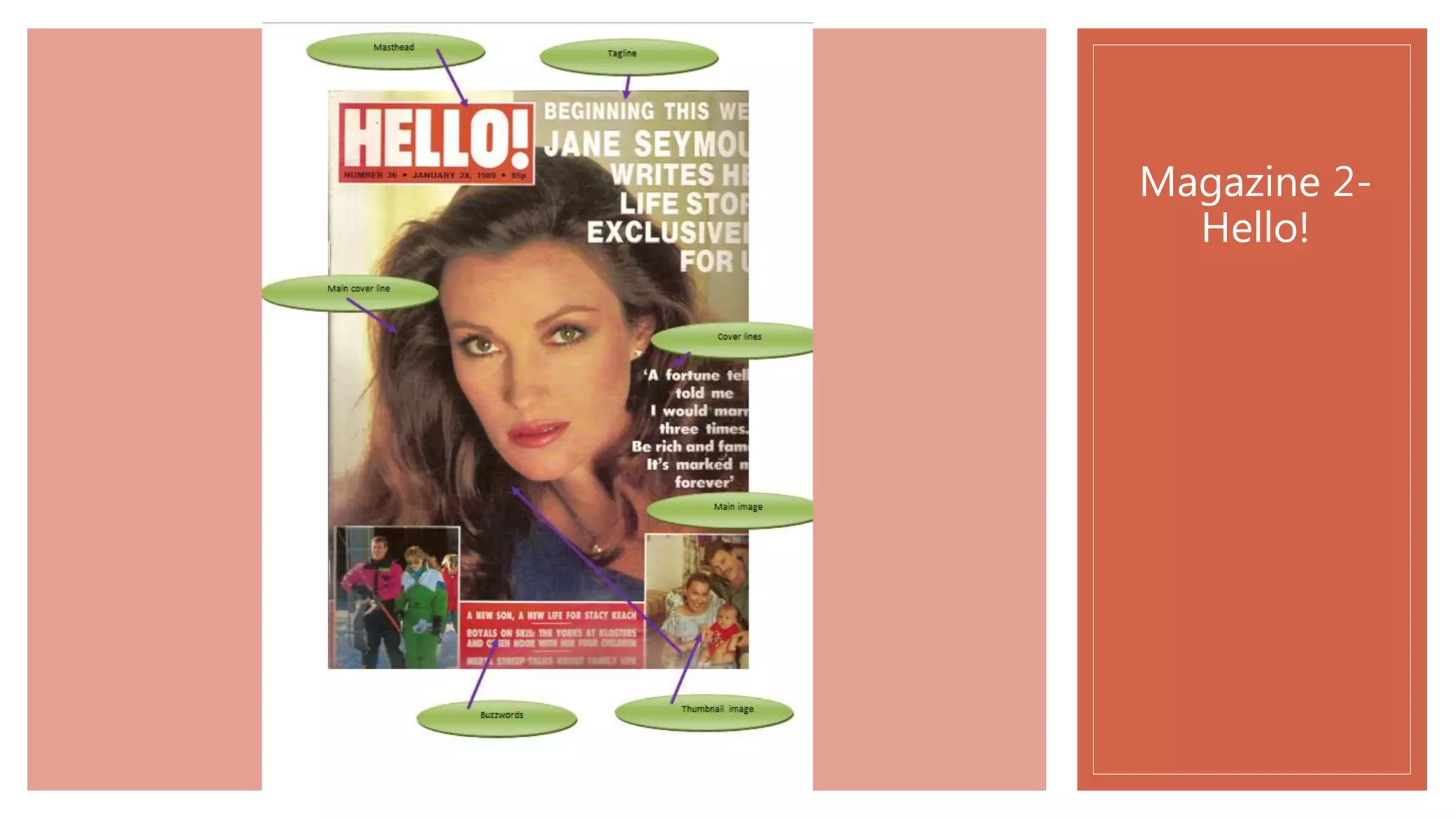
◦ Masthead: As this magazine is a well established the logo is kept in a bright bold to make sure that the
consumer can easily identify this magazine.
◦ Tag line: Helps the audience understand that this magazine is infect an up to date, regularly updated magazine,
which is what is desired with a gossip magazine.
◦ Main cover line: This includes text about a celebrity who has written something exclusive for Hello, which helps
the buyer both understand that this celebrity focuses on celebrity gossip and also make the more to appeal to
purchase this magazine due to its relation to the celebrity.
◦ Main image/anchorage: Includes an image of a celebrity so people can understand that this magazine is about
celebrity gossip. Will entice people who know of the celebrity.
◦ Cover lines: Includes a quote from one of the articles which leads the reader on a cliff hanger after reading it
which would make people curious about the conclusion of this story so would therefore purchase it to find out
more.
◦ Buzzwords: Words such as ‘royal’ help people understand that there is celebrity gossip about the royal family
within this magazine.
Why does Hello magazine do what it
do?
Evaluation of the Knitting Magazine
Overall I don’t like this magazine cover too much due to its lack of really enticing features like a
puff/pug. The magazines appealing is quite bland with it lacking varying colours and really bold
text. However, it does make sure to keep the cover lines and the whole magazine in general
concise and always targeting the target audience, and for this reason I will make sure that I do the
same within my own magazine front cover as I believe it makes it more appealing to the target
audience.
I will be analysing ‘Heat Magazine’ in terms of looking
at the language. This particular magazines appeals to a
more female working class demographic meaning the
lexis would change because of it. The particular article
is about celebrities and relationship gossip, a common
topic for this particular magazine. I am going to focus
on specifically the title and the selling line as these are
two common features which are also used for a
magazine front cover
Analysing language used within a
magazine
The first use of language used in this article to relate to the audience is the title ‘Frankie bags a footballer’.
Firstly, the first clear use is through not using a formal title for Frankie, but rather a more casual and
friendly first name. This assumes that that reader knows who this Frankie is but not only this, it also makes
it seem less of an article title but more of a statement made by a friend in a conversation. This would
appeal to the audience this articles is trying to appeal to as it makes it seem more informal and gossipy
which would be more appealing to reader. Secondly, the verb ‘bags’ is a rather interesting and colloquial.
The lexis choice of this word over something such as ‘obtained’ is used for a couple reasons. It firstly
appeals more to the dedicated demographic of working class woman as the phrase is commonly known
and a monosyllabic word such as bags is not hard to understand. It also heightens and glorifies her date,
making her seem like she got lucky in some way.
Language within the Heading
The header is spliced up with the selling line, with the selling acting as a second half. This acts a selling line
as it adds extra spice to the original title, ‘but she doesn’t even fancy him’. This contradiction with the word
‘bag’ which has connotation with the idea of bagging someone to be ‘lucky’ makes Frankie seem like a
person who doesn’t know how lucky they are. The use of the word fancy rather than another synonym also
links once again to the audience as it’s a common colloquial term used by working class people. The use of
the pre-modifying adverb ‘even’ suggests the idea once again that Frankie is still not aware of how lucky
she is to have the potential to be a wag.
Language within the selling line
After analysing some of the language within an article for
heat magazine, it gives me a picture of the demographic
that it being targeted by this magazine. Firstly, it seems to
appeal to a more female audience through the focus on a
relationship a female is having with another man. The actual
footballer is not mentioned in the title as this audience
would not care for
Conclusion of language analysis
them, but rather would only care for the other celebrity singer. Also, another impression that is made is that
it appeals to a more working class audience. This can be seen by the Lexi’s choice used within the article:
short, monosyllabic adjectives and subtle colloquialisms are understood more by a working class
demographic.
The Representation of gender within
magazines
By definition, all media texts are re-presentations of reality. This means that they are intentionally
composed, lit, written, framed, cropped, captioned, branded, targeted and censored by their
producers, and that they are entirely artificial versions of the reality we perceive around us. All
magazines have a formula that is used to determine their identity, and hence market appeal. The
effect of this is to create an image for the magazine that excludes certain representations while
focusing on others. The traditional formulas for women’s magazines can be broken down into
three basic types: all-age general (e.g. Women’s Weekly); over-eighteen glamour (e.g Elle) and
Teenage (e.g Bliss)
◦ Magazines that adopt the general interest woman’s formula contain most of all of the following
elements:
◦ Famous people – the royal family, TV personalities, politicians and their spouses, sporting celebrities and
people in the news
◦ Fashion – clothes to buy and (often) to make
◦ Babies and children – child care and common problems
◦ Home improvement – decorating ideas
◦ Food – diets and recipes
◦ Exercise – home fitness programmes
◦ Fiction – short story romances or personal problem situations
◦ Travel – usually within this country
Woman magazine formula
◦ After browsing through Heat’s seven hundred and seventy seventh issue, I noticed that it follows the
formula quite well. It contains several celebrities and famous people with them being the catalyst for
other features for the formula such as stories, gossip and fashion. Living etc however focus entirely on
home improvement, meaning it’s more niche. ‘Closer’ was very similar top Heat but instead was more
general with less of a focus on celebrities, it did however still have some. Closer was the only magazine
out of the three I looked at that completely followed the formula expect for travel
Woman magazine analysis
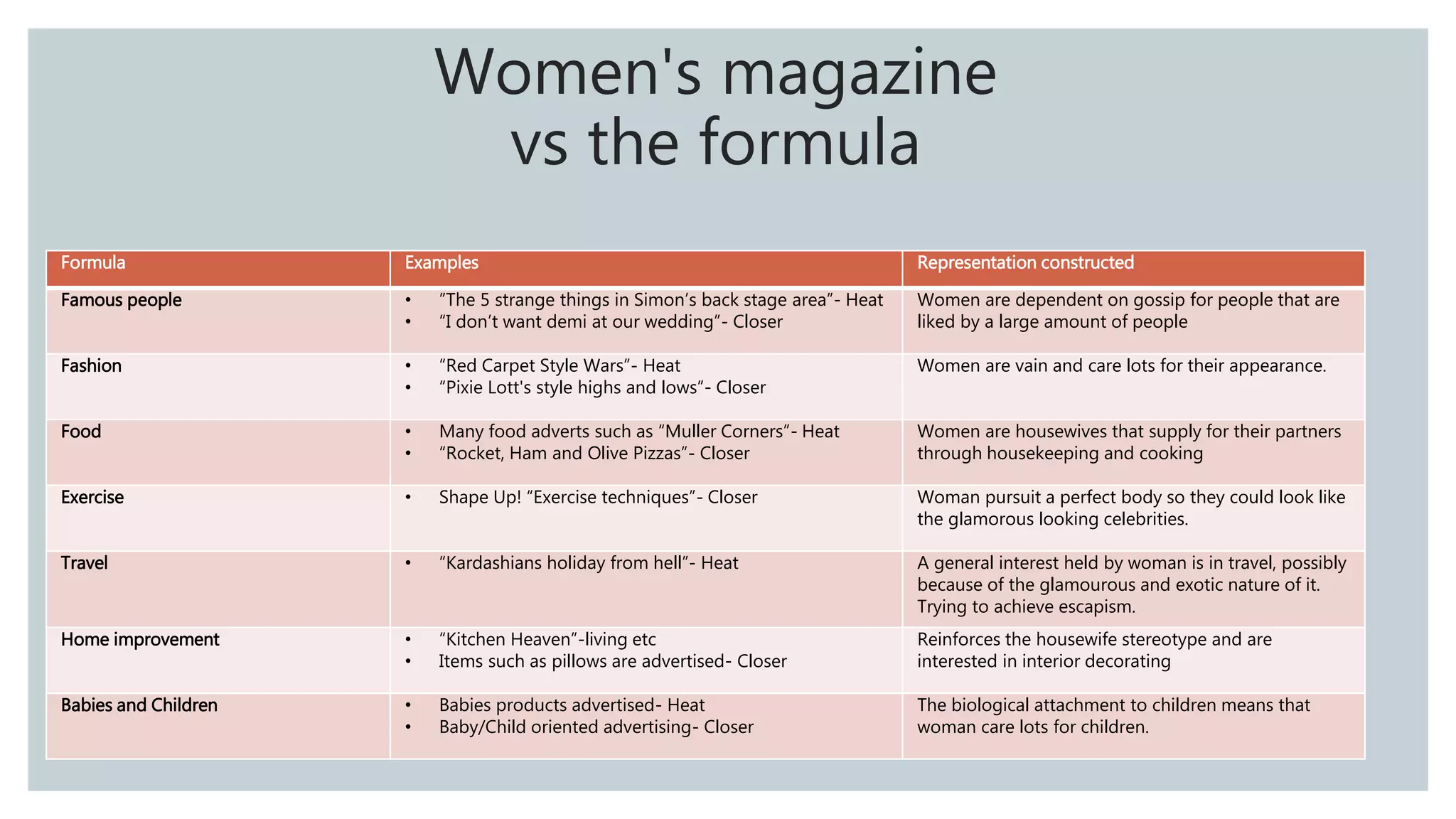
Women's magazine
vs the formula
Formula Examples Representation constructed
Famous people • ”The 5 strange things in Simon’s back stage area”- Heat
• “I don’t want demi at our wedding”- Closer
Women are dependent on gossip for people that are
liked by a large amount of people
Fashion • “Red Carpet Style Wars”- Heat
• “Pixie Lott's style highs and lows”- Closer
Women are vain and care lots for their appearance.
Food • Many food adverts such as “Muller Corners”- Heat
• “Rocket, Ham and Olive Pizzas”- Closer
Women are housewives that supply for their partners
through housekeeping and cooking
Exercise • Shape Up! “Exercise techniques”- Closer Woman pursuit a perfect body so they could look like
the glamorous looking celebrities.
Travel • “Kardashians holiday from hell”- Heat A general interest held by woman is in travel, possibly
because of the glamourous and exotic nature of it.
Trying to achieve escapism.
Home improvement • “Kitchen Heaven”-living etc
• Items such as pillows are advertised- Closer
Reinforces the housewife stereotype and are
interested in interior decorating
Babies and Children • Babies products advertised- Heat
• Baby/Child oriented advertising- Closer
The biological attachment to children means that
woman care lots for children.
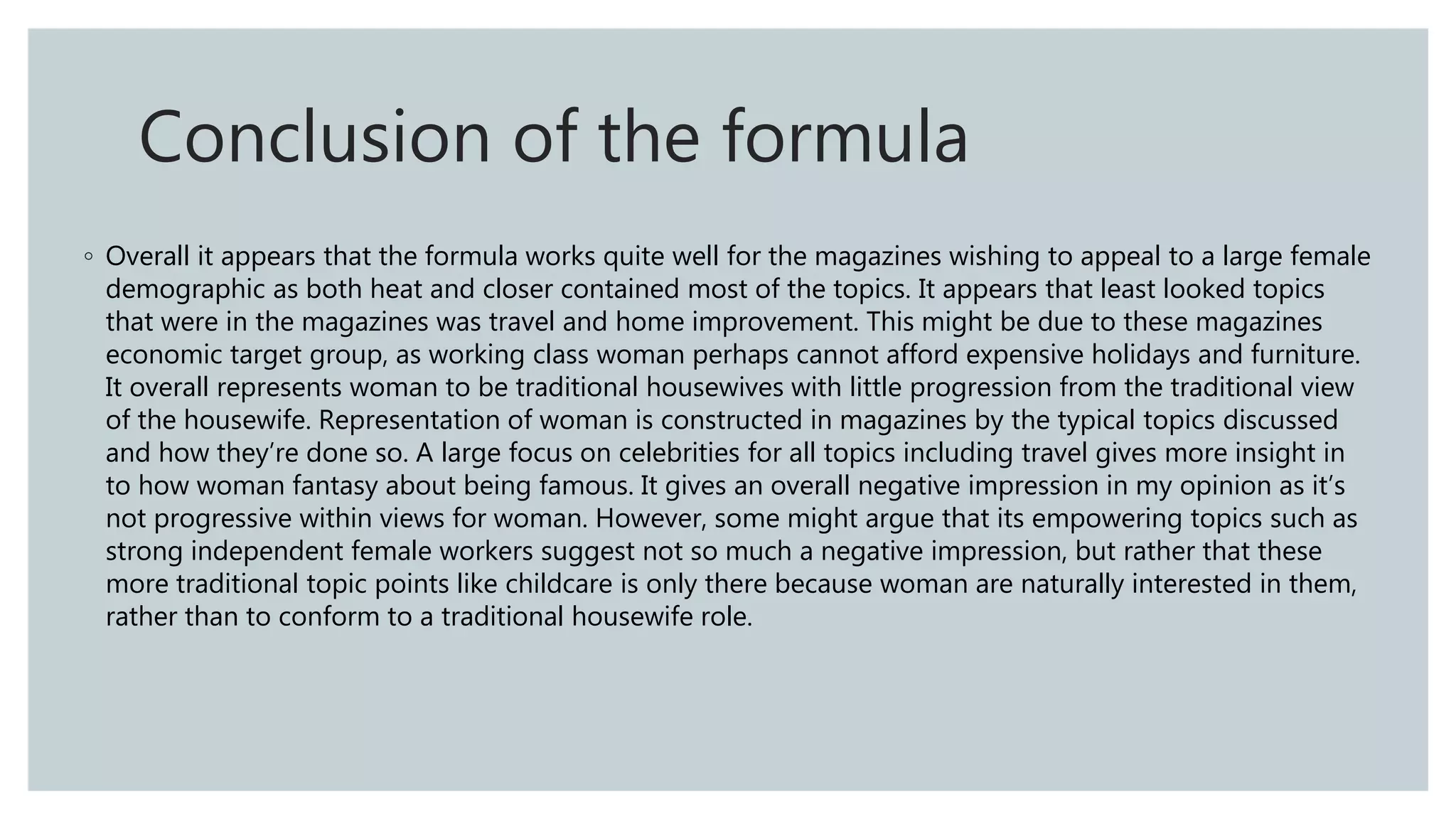
◦ Overall it appears that the formula works quite well for the magazines wishing to appeal to a large female
demographic as both heat and closer contained most of the topics. It appears that least looked topics
that were in the magazines was travel and home improvement. This might be due to these magazines
economic target group, as working class woman perhaps cannot afford expensive holidays and furniture.
It overall represents woman to be traditional housewives with little progression from the traditional view
of the housewife. Representation of woman is constructed in magazines by the typical topics discussed
and how they’re done so. A large focus on celebrities for all topics including travel gives more insight in
to how woman fantasy about being famous. It gives an overall negative impression in my opinion as it’s
not progressive within views for woman. However, some might argue that its empowering topics such as
strong independent female workers suggest not so much a negative impression, but rather that these
more traditional topic points like childcare is only there because woman are naturally interested in them,
rather than to conform to a traditional housewife role.
Conclusion of the formula
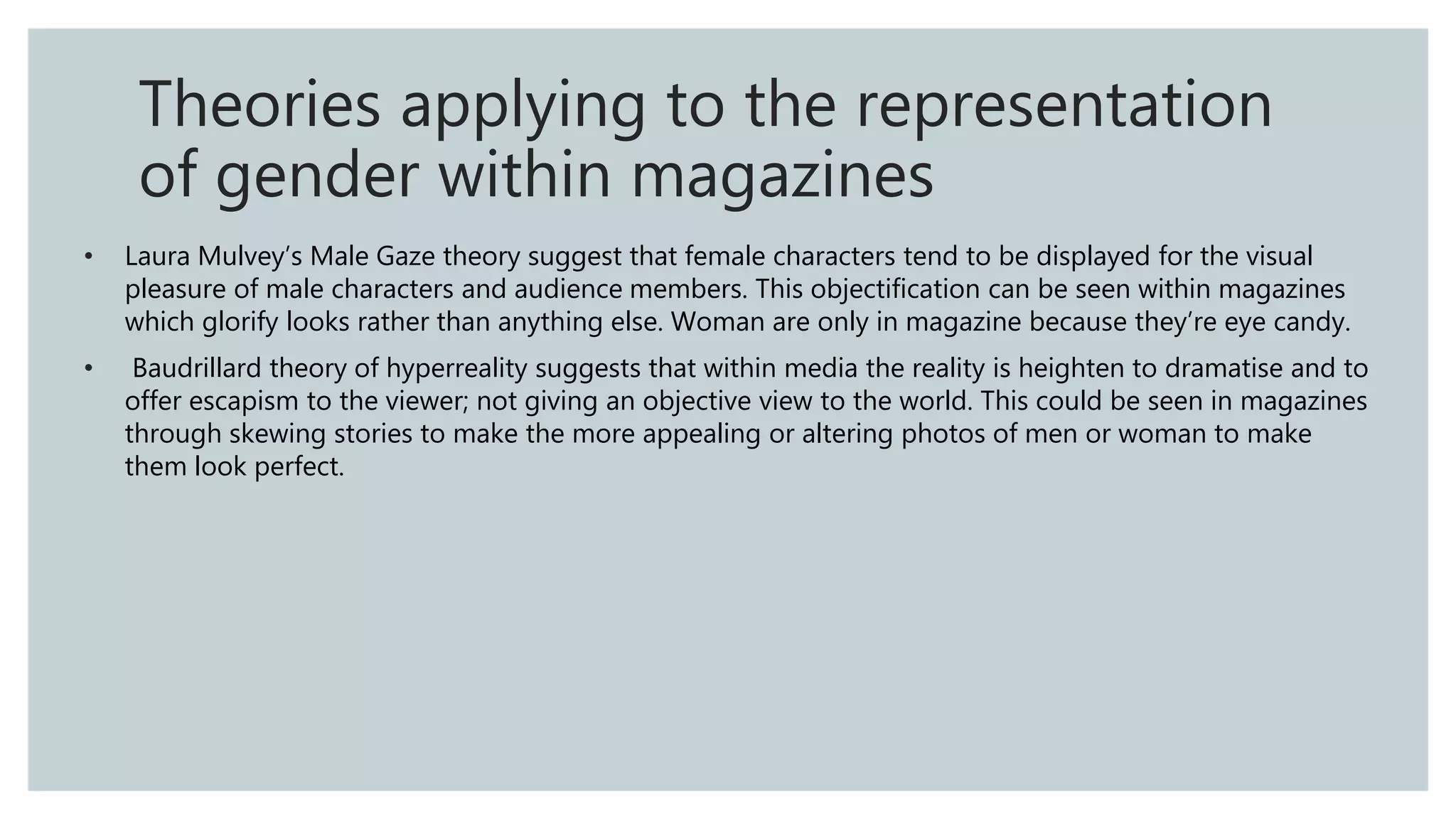
• Laura Mulvey’s Male Gaze theory suggest that female characters tend to be displayed for the visual
pleasure of male characters and audience members. This objectification can be seen within magazines
which glorify looks rather than anything else. Woman are only in magazine because they’re eye candy.
• Baudrillard theory of hyperreality suggests that within media the reality is heighten to dramatise and to
offer escapism to the viewer; not giving an objective view to the world. This could be seen in magazines
through skewing stories to make the more appealing or altering photos of men or woman to make
them look perfect.
Theories applying to the representation
of gender within magazines
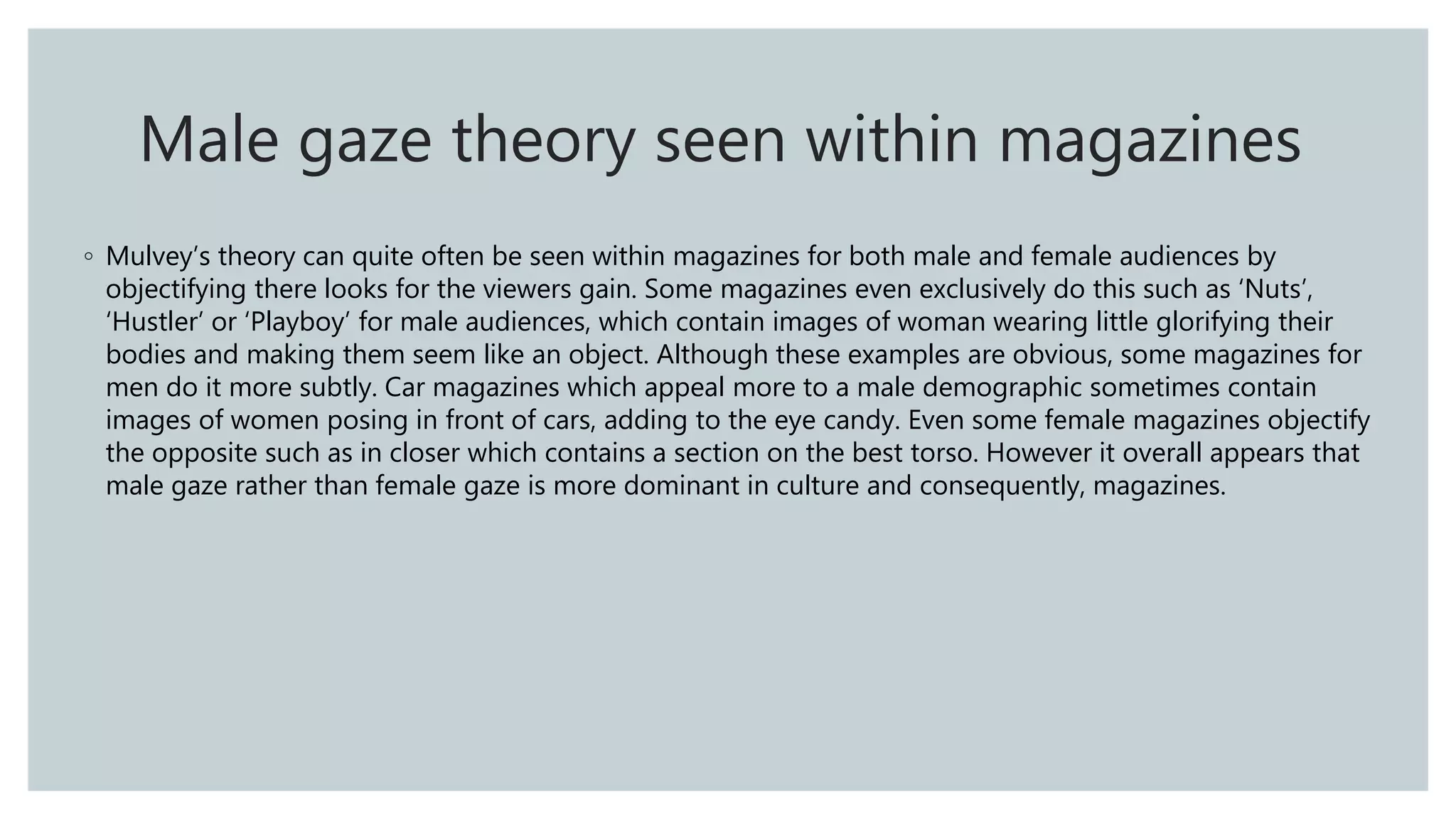
◦ Mulvey’s theory can quite often be seen within magazines for both male and female audiences by
objectifying there looks for the viewers gain. Some magazines even exclusively do this such as ‘Nuts’,
‘Hustler’ or ‘Playboy’ for male audiences, which contain images of woman wearing little glorifying their
bodies and making them seem like an object. Although these examples are obvious, some magazines for
men do it more subtly. Car magazines which appeal more to a male demographic sometimes contain
images of women posing in front of cars, adding to the eye candy. Even some female magazines objectify
the opposite such as in closer which contains a section on the best torso. However it overall appears that
male gaze rather than female gaze is more dominant in culture and consequently, magazines.
Male gaze theory seen within magazines
◦ For the representation of gender, this is mostly commonly seen with images, which are enhanced and
altered to portray a perfect looking person. Marie Claire magazines contains this lots within ads showing
perfect looking woman setting an unreachable standards for woman which makes the products more
appealing. Even stories can be altered to show a certain biased towards a certain sex. This hyper realty
can represent gender in an negative light therefore.
Hyperreality theory seen within
magazines
◦ These theories does give a greater insight in to the representation of gender in magazines as an
objectification of particular sex’s is present when considering the male gaze theory and also looks and
bias towards different genders is seen through using the hyperreality theory. However, the male gaze
theory only applies to men objectifying women within the media, and not the other way round. This
therefore shows a flaw in opposite examples brought up the previously. However, even with this
suggested equality of sexualisation, men appear to still be dominant ones, with woman objectified more.
Evaluation of the theories within
magazines
Contents page analysis
◦ Gives the reader an idea of other stories/ information within the magazine and what page
numbers you can find it on.
◦ Entices the reader to want to read more
◦ Needs to be easy to read and follow
◦ Needs to incorporate the colour scheme is usually similar if not the same to the front cover; it
follows the house style of the magazine.
Masthead
Selling line
Main image/
subject Footer
Article highlights
Articles
◦ Masthead: Allows the reader to still understand that this magazine’s contents page is by Jazzwise. It acts
as branding for Jazzwise. It also allows people to recognise what the magazine still is without the
magazine cover as it’s quite common for them to fall off.
◦ Selling line: Allows readers to understand what page they’re on and what issue the magazine is on.
◦ Main image/subject: relate to the magazine cover and an article. Makes it more visually appealing.
◦ Footer: used for self promotion for Jazzwise. Gives more important information which most readers need
but is too boring to be on front cover.
◦ Articles: give titles of articles featured in the magazine and the pages these articles appear on. Also
include a short description.
◦ Article highlights: Some articles are more obvious that others by having bigger font. Used to make people
see the more appealing articles quicker.
What does the jazz wise contents page
do what it do?
Masthead
Main image
Puff/pugSelling line
Articles
The use of typical house
style makes it more
visually appealing. The
main image and the
articles being structured in
columns is conventional
for magazine contents
pages.
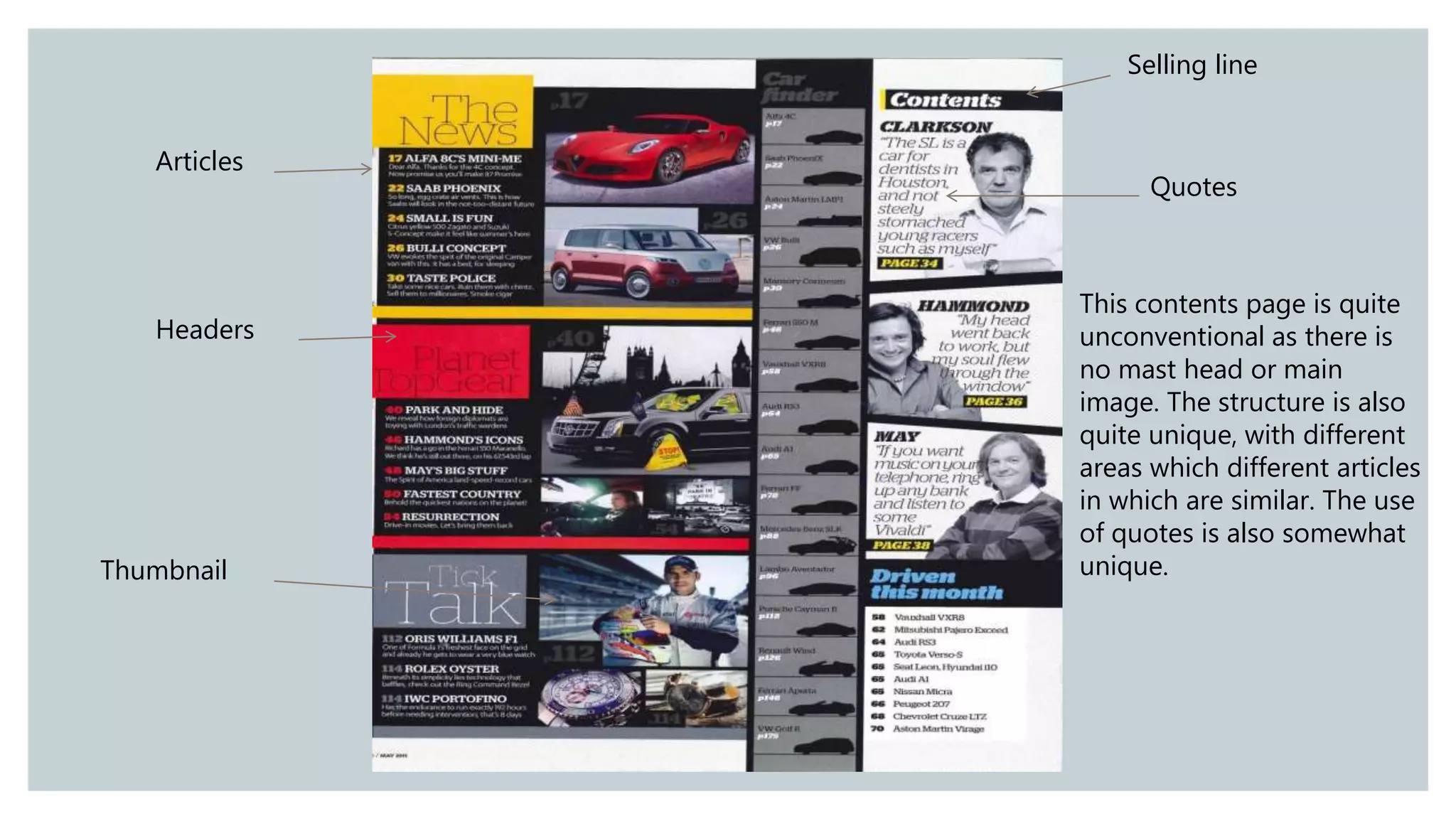
Articles
Headers
Quotes
Thumbnail
Selling line
This contents page is quite
unconventional as there is
no mast head or main
image. The structure is also
quite unique, with different
areas which different articles
in which are similar. The use
of quotes is also somewhat
unique.

Magazine cover analysis of similar texts

  • 1.
  • 2.
    Introduction As I’m creatinga magazine front cover to promote my A2 media production ‘End Process’, I will be doing some research in to magazines in general, which includes an analysis of 3 front covers, and their contents. This will include: what context the magazines are released in in terms of publication; Why particular features of the front cover are used; How language in general is used within a magazine and how effective the main anchor image is. I will be looking at a variety of different magazines which appeal to different target audiences. I’ve also decided to analyse briefly contents pages and also look at theories surrounding how gender is represented in magazine as this will give me broader understanding of how magazines are used which will in turn help me make a more conventional magazine cover.
  • 3.
  • 4.
    The Publication ofthe ‘Love of Knitting’ This magazine itself is about a rather niche hobby meaning it doesn’t have mainstream appeal like other magazines which involve around gossip and lifestyle. This therefore means that this magazine will be more focused around distribution through people being subscribed to the magazine. This can somewhat be seen within the front cover as it doesn’t try to oversell itself with bright colours, but rather has a more subtle appeal so it does not deter the people in which it’s targeting. However, this does include a bar code suggesting this might get some limited distribution through some stores, but only in ones with large amounts of varied magazines.
  • 5.
    ◦ Masthead: Clearlyshow to the audience that this magazine is about knitting making it more eye catching. ◦ Tag line: Helps reinsure what the masthead stood for and allows the audience to understand more greatly what is covered in the magazine. ◦ Skyline: used as a sell point and can be clearly seen as the eyes typically look at the top of the magazine and work down; makes it more eye-catching and a more worthwhile purchase. ◦ Main cover line: Helps make it more appealing or worthwhile for the knitting aficionados amongst us. ◦ Main image/anchorage: showing of the potential knitting goods the reader can create. The woman acts as like eye candy, possibly suggesting the knitter will look as good as the model if they have the same scarf. ◦ Puff/pug: Makes it seem as if the thing in the circle is a bonus extra and that you’re getting more for your money. It also brings emphasis to the celebrities name so you’re more likely to buy the magazine. ◦ Cover lines: Informs the consumer about what’s in the magazine. The use of the adjective ‘irresistible’ makes it more appealing. ◦ Buzzwords: Makes it more down to earth so it can appeal to its demographic more. ◦ Barcode/price: So it can be scanned so the purchase can be tracked. Why does the knitting magazine do what it do?
  • 6.
    Evaluation of theKnitting Magazine I overall like this magazine cover due to its subtle approach to target its target audience. Its effectiveness is seen through the good use of different features such as puff/pug and an aesthetically appealing main image. However, I will be creating a move magazine front cover to promote therefore meaning that I would personally have be more selling and mainstream with my cover lines as magazines about film are read by more people than ones about knitting generally. However, I will try to use things such as puff/pugs as I believe this to be very effective in appealing to a target audience and to also generally make it more eyecatching.
  • 7.
  • 8.
    The Publication of‘Hello!’ This particular magazine is intended to target a more mainstream audience with it surrounding the topic of lifestyle and gossip, which most people can relate to. This therefore means that this magazine would have been distributed widely through a variety of shops. This magazine is quite dated meaning that some of these features would be more obvious and elaborate now a days due to the increased competition with other magazines. However, even with this addition being old, the use of celebrities and cliff hanging quotes shows that it stills trying the grab peoples attention so people would be more inclined to buy it, rather than the knitting one which relies on targeting a niche so doesn’t waste its time to appeal to a mass market.
  • 9.
    ◦ Masthead: Asthis magazine is a well established the logo is kept in a bright bold to make sure that the consumer can easily identify this magazine. ◦ Tag line: Helps the audience understand that this magazine is infect an up to date, regularly updated magazine, which is what is desired with a gossip magazine. ◦ Main cover line: This includes text about a celebrity who has written something exclusive for Hello, which helps the buyer both understand that this celebrity focuses on celebrity gossip and also make the more to appeal to purchase this magazine due to its relation to the celebrity. ◦ Main image/anchorage: Includes an image of a celebrity so people can understand that this magazine is about celebrity gossip. Will entice people who know of the celebrity. ◦ Cover lines: Includes a quote from one of the articles which leads the reader on a cliff hanger after reading it which would make people curious about the conclusion of this story so would therefore purchase it to find out more. ◦ Buzzwords: Words such as ‘royal’ help people understand that there is celebrity gossip about the royal family within this magazine. Why does Hello magazine do what it do?
  • 10.
    Evaluation of theKnitting Magazine Overall I don’t like this magazine cover too much due to its lack of really enticing features like a puff/pug. The magazines appealing is quite bland with it lacking varying colours and really bold text. However, it does make sure to keep the cover lines and the whole magazine in general concise and always targeting the target audience, and for this reason I will make sure that I do the same within my own magazine front cover as I believe it makes it more appealing to the target audience.
  • 11.
    I will beanalysing ‘Heat Magazine’ in terms of looking at the language. This particular magazines appeals to a more female working class demographic meaning the lexis would change because of it. The particular article is about celebrities and relationship gossip, a common topic for this particular magazine. I am going to focus on specifically the title and the selling line as these are two common features which are also used for a magazine front cover Analysing language used within a magazine
  • 12.
    The first useof language used in this article to relate to the audience is the title ‘Frankie bags a footballer’. Firstly, the first clear use is through not using a formal title for Frankie, but rather a more casual and friendly first name. This assumes that that reader knows who this Frankie is but not only this, it also makes it seem less of an article title but more of a statement made by a friend in a conversation. This would appeal to the audience this articles is trying to appeal to as it makes it seem more informal and gossipy which would be more appealing to reader. Secondly, the verb ‘bags’ is a rather interesting and colloquial. The lexis choice of this word over something such as ‘obtained’ is used for a couple reasons. It firstly appeals more to the dedicated demographic of working class woman as the phrase is commonly known and a monosyllabic word such as bags is not hard to understand. It also heightens and glorifies her date, making her seem like she got lucky in some way. Language within the Heading
  • 13.
    The header isspliced up with the selling line, with the selling acting as a second half. This acts a selling line as it adds extra spice to the original title, ‘but she doesn’t even fancy him’. This contradiction with the word ‘bag’ which has connotation with the idea of bagging someone to be ‘lucky’ makes Frankie seem like a person who doesn’t know how lucky they are. The use of the word fancy rather than another synonym also links once again to the audience as it’s a common colloquial term used by working class people. The use of the pre-modifying adverb ‘even’ suggests the idea once again that Frankie is still not aware of how lucky she is to have the potential to be a wag. Language within the selling line
  • 14.
    After analysing someof the language within an article for heat magazine, it gives me a picture of the demographic that it being targeted by this magazine. Firstly, it seems to appeal to a more female audience through the focus on a relationship a female is having with another man. The actual footballer is not mentioned in the title as this audience would not care for Conclusion of language analysis them, but rather would only care for the other celebrity singer. Also, another impression that is made is that it appeals to a more working class audience. This can be seen by the Lexi’s choice used within the article: short, monosyllabic adjectives and subtle colloquialisms are understood more by a working class demographic.
  • 15.
    The Representation ofgender within magazines By definition, all media texts are re-presentations of reality. This means that they are intentionally composed, lit, written, framed, cropped, captioned, branded, targeted and censored by their producers, and that they are entirely artificial versions of the reality we perceive around us. All magazines have a formula that is used to determine their identity, and hence market appeal. The effect of this is to create an image for the magazine that excludes certain representations while focusing on others. The traditional formulas for women’s magazines can be broken down into three basic types: all-age general (e.g. Women’s Weekly); over-eighteen glamour (e.g Elle) and Teenage (e.g Bliss)
  • 16.
    ◦ Magazines thatadopt the general interest woman’s formula contain most of all of the following elements: ◦ Famous people – the royal family, TV personalities, politicians and their spouses, sporting celebrities and people in the news ◦ Fashion – clothes to buy and (often) to make ◦ Babies and children – child care and common problems ◦ Home improvement – decorating ideas ◦ Food – diets and recipes ◦ Exercise – home fitness programmes ◦ Fiction – short story romances or personal problem situations ◦ Travel – usually within this country Woman magazine formula
  • 17.
    ◦ After browsingthrough Heat’s seven hundred and seventy seventh issue, I noticed that it follows the formula quite well. It contains several celebrities and famous people with them being the catalyst for other features for the formula such as stories, gossip and fashion. Living etc however focus entirely on home improvement, meaning it’s more niche. ‘Closer’ was very similar top Heat but instead was more general with less of a focus on celebrities, it did however still have some. Closer was the only magazine out of the three I looked at that completely followed the formula expect for travel Woman magazine analysis
  • 18.
    Women's magazine vs theformula Formula Examples Representation constructed Famous people • ”The 5 strange things in Simon’s back stage area”- Heat • “I don’t want demi at our wedding”- Closer Women are dependent on gossip for people that are liked by a large amount of people Fashion • “Red Carpet Style Wars”- Heat • “Pixie Lott's style highs and lows”- Closer Women are vain and care lots for their appearance. Food • Many food adverts such as “Muller Corners”- Heat • “Rocket, Ham and Olive Pizzas”- Closer Women are housewives that supply for their partners through housekeeping and cooking Exercise • Shape Up! “Exercise techniques”- Closer Woman pursuit a perfect body so they could look like the glamorous looking celebrities. Travel • “Kardashians holiday from hell”- Heat A general interest held by woman is in travel, possibly because of the glamourous and exotic nature of it. Trying to achieve escapism. Home improvement • “Kitchen Heaven”-living etc • Items such as pillows are advertised- Closer Reinforces the housewife stereotype and are interested in interior decorating Babies and Children • Babies products advertised- Heat • Baby/Child oriented advertising- Closer The biological attachment to children means that woman care lots for children.
  • 19.
    ◦ Overall itappears that the formula works quite well for the magazines wishing to appeal to a large female demographic as both heat and closer contained most of the topics. It appears that least looked topics that were in the magazines was travel and home improvement. This might be due to these magazines economic target group, as working class woman perhaps cannot afford expensive holidays and furniture. It overall represents woman to be traditional housewives with little progression from the traditional view of the housewife. Representation of woman is constructed in magazines by the typical topics discussed and how they’re done so. A large focus on celebrities for all topics including travel gives more insight in to how woman fantasy about being famous. It gives an overall negative impression in my opinion as it’s not progressive within views for woman. However, some might argue that its empowering topics such as strong independent female workers suggest not so much a negative impression, but rather that these more traditional topic points like childcare is only there because woman are naturally interested in them, rather than to conform to a traditional housewife role. Conclusion of the formula
  • 20.
    • Laura Mulvey’sMale Gaze theory suggest that female characters tend to be displayed for the visual pleasure of male characters and audience members. This objectification can be seen within magazines which glorify looks rather than anything else. Woman are only in magazine because they’re eye candy. • Baudrillard theory of hyperreality suggests that within media the reality is heighten to dramatise and to offer escapism to the viewer; not giving an objective view to the world. This could be seen in magazines through skewing stories to make the more appealing or altering photos of men or woman to make them look perfect. Theories applying to the representation of gender within magazines
  • 21.
    ◦ Mulvey’s theorycan quite often be seen within magazines for both male and female audiences by objectifying there looks for the viewers gain. Some magazines even exclusively do this such as ‘Nuts’, ‘Hustler’ or ‘Playboy’ for male audiences, which contain images of woman wearing little glorifying their bodies and making them seem like an object. Although these examples are obvious, some magazines for men do it more subtly. Car magazines which appeal more to a male demographic sometimes contain images of women posing in front of cars, adding to the eye candy. Even some female magazines objectify the opposite such as in closer which contains a section on the best torso. However it overall appears that male gaze rather than female gaze is more dominant in culture and consequently, magazines. Male gaze theory seen within magazines
  • 22.
    ◦ For therepresentation of gender, this is mostly commonly seen with images, which are enhanced and altered to portray a perfect looking person. Marie Claire magazines contains this lots within ads showing perfect looking woman setting an unreachable standards for woman which makes the products more appealing. Even stories can be altered to show a certain biased towards a certain sex. This hyper realty can represent gender in an negative light therefore. Hyperreality theory seen within magazines
  • 23.
    ◦ These theoriesdoes give a greater insight in to the representation of gender in magazines as an objectification of particular sex’s is present when considering the male gaze theory and also looks and bias towards different genders is seen through using the hyperreality theory. However, the male gaze theory only applies to men objectifying women within the media, and not the other way round. This therefore shows a flaw in opposite examples brought up the previously. However, even with this suggested equality of sexualisation, men appear to still be dominant ones, with woman objectified more. Evaluation of the theories within magazines
  • 24.
    Contents page analysis ◦Gives the reader an idea of other stories/ information within the magazine and what page numbers you can find it on. ◦ Entices the reader to want to read more ◦ Needs to be easy to read and follow ◦ Needs to incorporate the colour scheme is usually similar if not the same to the front cover; it follows the house style of the magazine.
  • 25.
    Masthead Selling line Main image/ subjectFooter Article highlights Articles
  • 26.
    ◦ Masthead: Allowsthe reader to still understand that this magazine’s contents page is by Jazzwise. It acts as branding for Jazzwise. It also allows people to recognise what the magazine still is without the magazine cover as it’s quite common for them to fall off. ◦ Selling line: Allows readers to understand what page they’re on and what issue the magazine is on. ◦ Main image/subject: relate to the magazine cover and an article. Makes it more visually appealing. ◦ Footer: used for self promotion for Jazzwise. Gives more important information which most readers need but is too boring to be on front cover. ◦ Articles: give titles of articles featured in the magazine and the pages these articles appear on. Also include a short description. ◦ Article highlights: Some articles are more obvious that others by having bigger font. Used to make people see the more appealing articles quicker. What does the jazz wise contents page do what it do?
  • 27.
    Masthead Main image Puff/pugSelling line Articles Theuse of typical house style makes it more visually appealing. The main image and the articles being structured in columns is conventional for magazine contents pages.
  • 28.
    Articles Headers Quotes Thumbnail Selling line This contentspage is quite unconventional as there is no mast head or main image. The structure is also quite unique, with different areas which different articles in which are similar. The use of quotes is also somewhat unique.