


an emerging mode of business
Submitted To :- Submitted By :-
Vaishali Sankhla
Contents
• Introduction
• Meaning & Types of e-business
• Opportunities of e-business
• Security Problems
• Resources required for successful
implementation of E-business
• Limitations
• Despite limitations, E-business is the way
• Conclusion
Modern world is the era of Globalisation,
change and technology. In response to
this, business throughout the world is
changing its organisation, way of working
and use of technology, business process
are being redesigned
The major change in mode of business is
emergence of E-BUSINESS, E-COMMERCE
and B.P.O
Introduction
Meaning of e-
businessE-business refers to “carrying on business
activities through internet”. Business activities
comprise of industry, trade and commerce.
The process & tools that allow an organization
to use internet based technologies &
infrastructure, both internally & externally to
conduct day to day business process
operations.
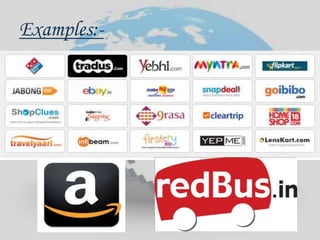
Examples:-
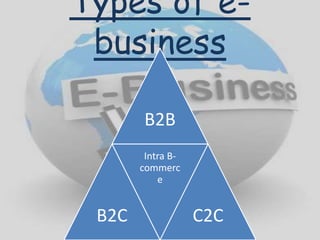
Types of e-
business
B2B
B2C
Intra B-
commerc
e
C2C
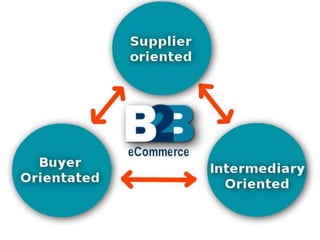
B2b commerce
 Transaction taking place between business units
are known as B2B commerce.
 B2B transactions may involve:-
(a) Creation of utilities
(b) Collaborations
(c) Commercial negotiations
(d) Inviting tenders
(e) Distribution of goods etc.
Examples:-
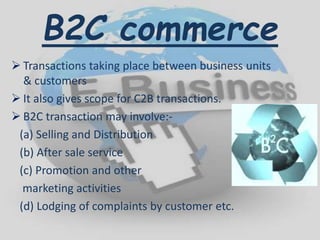
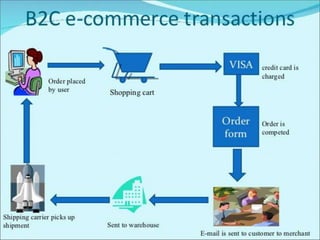
B2C commerce
 Transactions taking place between business units
& customers
 It also gives scope for C2B transactions.
 B2C transaction may involve:-
(a) Selling and Distribution
(b) After sale service
(c) Promotion and other
marketing activities
(d) Lodging of complaints by customer etc.
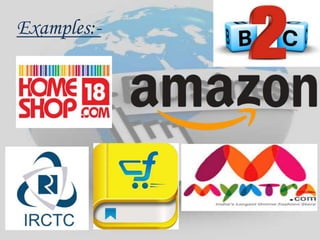
Examples:-
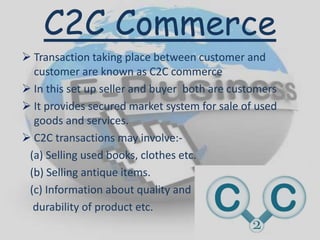
C2C Commerce
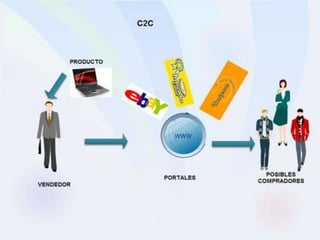
 Transaction taking place between customer and
customer are known as C2C commerce
 In this set up seller and buyer both are customers
 It provides secured market system for sale of used
goods and services.
 C2C transactions may involve:-
(a) Selling used books, clothes etc.
(b) Selling antique items.
(c) Information about quality and
durability of product etc.
Examples:-
Intra B-
commerce This refers to transaction between the parties or persons who
are the part of the firm only
 The firms dealing with suppliers, customers, employees etc. are
called INTRA B-COMMERCE interactions.
 These transactions may involve:-
(a) Interaction between any two department on one firm.
(b) Placing order and giving instruction to suppliers.
(c) Communication of information in whole organisation.
(d) Reporting by employees to their managers etc.
Flow Chart
•
•
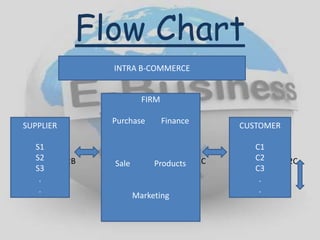
• B2B B2C B2C C2C C2C
SUPPLIER
S1
S2
S3
.
.
FIRM
Purchase Finance
Sale Products
Marketing
CUSTOMER
C1
C2
C3
.
.
INTRA B-COMMERCE
Opportunities
Easy to form and lower investment required.
Convenience
Global reach
Cost saving
Speed
Moving towards a paperless society
Security
problems Transactional risks:
• Default on order taking/giving
• Default on delivery
• Default on payment
 Data storage risks:-
• Virus
• Hacking
 Risk of threat to Intellectual Property & Privacy
Resources required
for successful
implementation of E-
business
 Computer Hardware
 Technically Qualified Staff
 Computerized System of Receiving Payment
 Well Designed Website
 Telecommunications Facilities
Limitations
Low Personal Touch
Delay in Delivery
Requirement of Hardware
Risk
Low ethics
Despite limitations, E-
business is the way
 Websites are becoming more & more interactive to
overcome the problem of low personal touch.
 The speed & the quality of communication is
improving. Various communication telecentres are
set up in villages with the involvement of
Government, NGOs & International Institutions.
 India has undertaken 150 such projects to diffuse e-
commerce in all corners.
Conclusion
From the mentioned points we can
conclude that inspite of limitations, E-
BUSINESS is going to stay. So we must
familiarise ourselves as to how e-
business is conducted.
Made by shub v

Made by shub v

  • 1.
    an emerging modeof business Submitted To :- Submitted By :- Vaishali Sankhla
  • 2.
    Contents • Introduction • Meaning& Types of e-business • Opportunities of e-business • Security Problems • Resources required for successful implementation of E-business • Limitations • Despite limitations, E-business is the way • Conclusion
  • 3.
    Modern world isthe era of Globalisation, change and technology. In response to this, business throughout the world is changing its organisation, way of working and use of technology, business process are being redesigned The major change in mode of business is emergence of E-BUSINESS, E-COMMERCE and B.P.O Introduction
  • 4.
    Meaning of e- businessE-businessrefers to “carrying on business activities through internet”. Business activities comprise of industry, trade and commerce. The process & tools that allow an organization to use internet based technologies & infrastructure, both internally & externally to conduct day to day business process operations.
  • 5.
  • 6.
  • 7.
    B2b commerce  Transactiontaking place between business units are known as B2B commerce.  B2B transactions may involve:- (a) Creation of utilities (b) Collaborations (c) Commercial negotiations (d) Inviting tenders (e) Distribution of goods etc.
  • 9.
  • 10.
    B2C commerce  Transactionstaking place between business units & customers  It also gives scope for C2B transactions.  B2C transaction may involve:- (a) Selling and Distribution (b) After sale service (c) Promotion and other marketing activities (d) Lodging of complaints by customer etc.
  • 12.
  • 13.
    C2C Commerce  Transactiontaking place between customer and customer are known as C2C commerce  In this set up seller and buyer both are customers  It provides secured market system for sale of used goods and services.  C2C transactions may involve:- (a) Selling used books, clothes etc. (b) Selling antique items. (c) Information about quality and durability of product etc.
  • 15.
  • 16.
    Intra B- commerce Thisrefers to transaction between the parties or persons who are the part of the firm only  The firms dealing with suppliers, customers, employees etc. are called INTRA B-COMMERCE interactions.  These transactions may involve:- (a) Interaction between any two department on one firm. (b) Placing order and giving instruction to suppliers. (c) Communication of information in whole organisation. (d) Reporting by employees to their managers etc.
  • 17.
    Flow Chart • • • B2BB2C B2C C2C C2C SUPPLIER S1 S2 S3 . . FIRM Purchase Finance Sale Products Marketing CUSTOMER C1 C2 C3 . . INTRA B-COMMERCE
  • 18.
    Opportunities Easy to formand lower investment required. Convenience Global reach Cost saving Speed Moving towards a paperless society
  • 19.
    Security problems Transactional risks: •Default on order taking/giving • Default on delivery • Default on payment  Data storage risks:- • Virus • Hacking  Risk of threat to Intellectual Property & Privacy
  • 20.
    Resources required for successful implementationof E- business  Computer Hardware  Technically Qualified Staff  Computerized System of Receiving Payment  Well Designed Website  Telecommunications Facilities
  • 21.
    Limitations Low Personal Touch Delayin Delivery Requirement of Hardware Risk Low ethics
  • 22.
    Despite limitations, E- businessis the way  Websites are becoming more & more interactive to overcome the problem of low personal touch.  The speed & the quality of communication is improving. Various communication telecentres are set up in villages with the involvement of Government, NGOs & International Institutions.  India has undertaken 150 such projects to diffuse e- commerce in all corners.
  • 23.
    Conclusion From the mentionedpoints we can conclude that inspite of limitations, E- BUSINESS is going to stay. So we must familiarise ourselves as to how e- business is conducted.