Presented by
Bijay kumar shaw
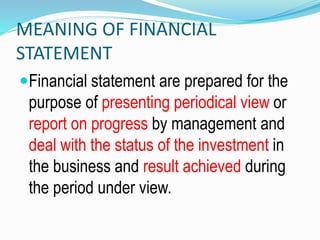
MEANING OF FINANCIAL
STATEMENT
Financial statement are prepared for the
purpose of presenting periodical view or
report on progress by management and
deal with the status of the investment in
the business and result achieved during
the period under view.
USERS
 Shareholders
 Creditors
 Stock exchange
 Bankers
 Management
 Investors
 Government
 Research Association
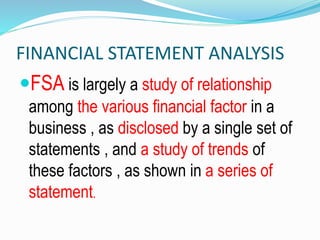
FINANCIAL STATEMENT ANALYSIS
FSA is largely a study of relationship
among the various financial factor in a
business , as disclosed by a single set of
statements , and a study of trends of
these factors , as shown in a series of
statement.
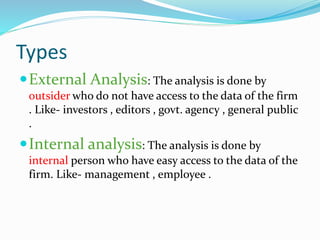
Types
External Analysis: The analysis is done by
outsider who do not have access to the data of the firm
. Like- investors , editors , govt. agency , general public
.
Internal analysis: The analysis is done by
internal person who have easy access to the data of the
firm. Like- management , employee .
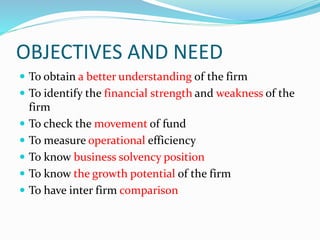
OBJECTIVES AND NEED
 To obtain a better understanding of the firm
 To identify the financial strength and weakness of the
firm
 To check the movement of fund
 To measure operational efficiency
 To know business solvency position
 To know the growth potential of the firm
 To have inter firm comparison
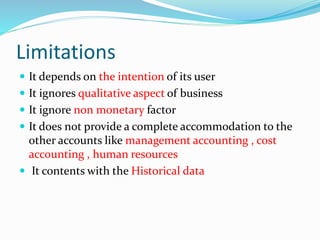
Limitations
 It depends on the intention of its user
 It ignores qualitative aspect of business
 It ignore non monetary factor
 It does not provide a complete accommodation to the
other accounts like management accounting , cost
accounting , human resources
 It contents with the Historical data
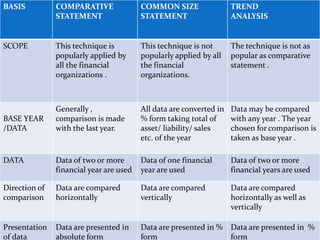
BASIS COMPARATIVE
STATEMENT
COMMON SIZE
STATEMENT
TREND
ANALYSIS
SCOPE This technique is
popularly applied by
all the financial
organizations .
This technique is not
popularly applied by all
the financial
organizations.
The technique is not as
popular as comparative
statement .
BASE YEAR
/DATA
Generally ,
comparison is made
with the last year.
All data are converted in
% form taking total of
asset/ liability/ sales
etc. of the year
Data may be compared
with any year . The year
chosen for comparison is
taken as base year .
DATA Data of two or more
financial year are used
Data of one financial
year are used
Data of two or more
financial years are used
Direction of
comparison
Data are compared
horizontally
Data are compared
vertically
Data are compared
horizontally as well as
vertically
Presentation
of data
Data are presented in
absolute form
Data are presented in %
form
Data are presented in %
form
Financial statement analysis by BIJAY KUMAR SHAW

Financial statement analysis by BIJAY KUMAR SHAW

  • 1.
  • 2.
    MEANING OF FINANCIAL STATEMENT Financialstatement are prepared for the purpose of presenting periodical view or report on progress by management and deal with the status of the investment in the business and result achieved during the period under view.
  • 3.
    USERS  Shareholders  Creditors Stock exchange  Bankers  Management  Investors  Government  Research Association
  • 4.
    FINANCIAL STATEMENT ANALYSIS FSAis largely a study of relationship among the various financial factor in a business , as disclosed by a single set of statements , and a study of trends of these factors , as shown in a series of statement.
  • 5.
    Types External Analysis: Theanalysis is done by outsider who do not have access to the data of the firm . Like- investors , editors , govt. agency , general public . Internal analysis: The analysis is done by internal person who have easy access to the data of the firm. Like- management , employee .
  • 6.
    OBJECTIVES AND NEED To obtain a better understanding of the firm  To identify the financial strength and weakness of the firm  To check the movement of fund  To measure operational efficiency  To know business solvency position  To know the growth potential of the firm  To have inter firm comparison
  • 7.
    Limitations  It dependson the intention of its user  It ignores qualitative aspect of business  It ignore non monetary factor  It does not provide a complete accommodation to the other accounts like management accounting , cost accounting , human resources  It contents with the Historical data
  • 8.
    BASIS COMPARATIVE STATEMENT COMMON SIZE STATEMENT TREND ANALYSIS SCOPEThis technique is popularly applied by all the financial organizations . This technique is not popularly applied by all the financial organizations. The technique is not as popular as comparative statement . BASE YEAR /DATA Generally , comparison is made with the last year. All data are converted in % form taking total of asset/ liability/ sales etc. of the year Data may be compared with any year . The year chosen for comparison is taken as base year . DATA Data of two or more financial year are used Data of one financial year are used Data of two or more financial years are used Direction of comparison Data are compared horizontally Data are compared vertically Data are compared horizontally as well as vertically Presentation of data Data are presented in absolute form Data are presented in % form Data are presented in % form