





Leveraging Open Innovation
Joel West
November 15, 2016
http://slideshare.net/joelwest
Road Map
• Today’s question
• The value of innovation
• What is open innovation?
• Different types of open innovation
• Examples of how firms leverage open
innovation
2
About Me
Two careers (so far):
•Software engineer and entrepreneur
– Columnist, MacWEEK, Byte, MacTutor
– President, Palomar Software (1987-2002)
•Innovation professor and researcher
– San José State University
– Keck Graduate Institute, Claremont Colleges
– Two books, 30 articles on innovation strategy
•Research focus: openness strategies by firms
3
Today’s question
How can openness help
firm innovation?
4
Open Innovation
5
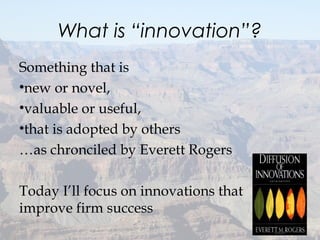
What is “innovation”?
Something that is
•new or novel,
•valuable or useful,
•that is adopted by others
…as chronciled by Everett Rogers
Today I’ll focus on innovations that
improve firm success
6
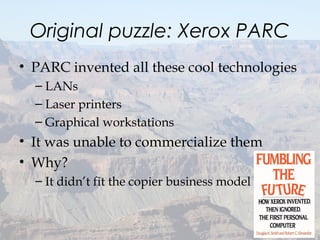
Original puzzle: Xerox PARC
• PARC invented all these cool technologies
– LANs
– Laser printers
– Graphical workstations
• It was unable to commercialize them
• Why?
– It didn’t fit the copier business model
7
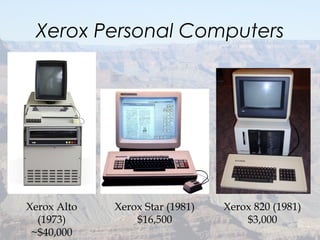
Xerox Personal Computers
8Xerox Alto
(1973)
~$40,000
Xerox Star (1981)
$16,500
Xerox 820 (1981)
$3,000
Role of the business model
“The inherent value of a technology
remains latent until it is commercialized in
some way.
“A business model unlocks that latent
value, mediating between technical and
economic domains.”
– Chesbrough & Rosenbloom (2002)
Origins of open innovation
• Term coined by Chesbrough (2003)
• Based on actions of IBM, Intel, P&G etc.
• Cognitive paradigm
– Combines traditional, open approaches
• Explosion of industry, academic interest
Initial Insights
• Firms have technology they can’t
commercialize
– Risk of false negative (Type II error)
– Others might see value even if we don’t
• Firms need technology beyond what they
can develop internally
– Other sources of ideas
– Other ways to solve a problem
What is “open innovation”?
“Open innovation is the use of purposive
inflows and outflows of knowledge to
accelerate internal innovation, and expand
the markets for external use of innovation,
respectively.”
— Henry Chesbrough, 2006
12
What is “openness”?
Openness is changing a firm’s mindset:
•Porous firm boundaries
•Outward orientation
•Markets rather than firm control
•Cooperation not just competition
13
Innovation flows
How does the knowledge flow?
•Inbound: from outside to firm
•Outbound: from firm to outside
•Coupled: bidirectional flows
– Collaboration with specific organization
– Collaborations with network of organizations
14
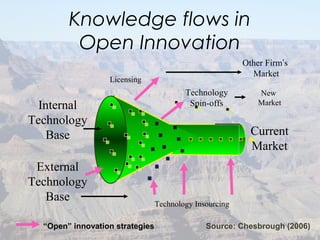
Source: Chesbrough (2006)
Current
Market
Internal
Technology
Base
Technology Insourcing
New
Market
Technology
Spin-offs
External
Technology
Base
Other Firm’s
Market
Licensing
“Open” innovation strategies
Knowledge flows in
Open Innovation
Inbound Open innovation
16
“Not all the smart people in the
world can work in one place.”
Bill Joy
co-founder
Sun Microsystems
Why should firms be open?
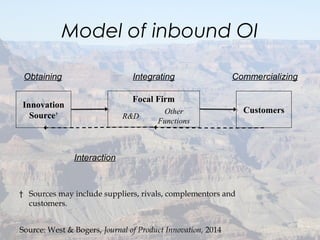
Model of inbound OI
Innovation
Source†
Customers
CommercializingObtaining Integrating
Interaction
Focal Firm
R&D
Other
Functions
† Sources may include suppliers, rivals, complementors and
customers.
Source: West & Bogers, Journal of Product Innovation, 2014
Inbound challenges
1. Obtaining technology
– Searching & sourcing
– Selecting/evaluating
– Acquiring
1. Integrating technology into the firm
– Overcoming “not invented here”
1. Bringing products to market
19
Example: P&G
• Connect + Develop established 1999
• Solicits outside technologies to support
product lines
• One-third of product have external
technologies
– Swiffer duster
– Mr Clean eraser
– Printing images on Pringles®
20
Outbound Open innovation
21
Role of the business model
• Firms best able to commercialize
technology aligned to business model
• A successful business model allows firms
to create and capture value
– Can be cognitive trap: excludes other paths
– Example: Xerox good at copiers, bad at PCs
• Firms should outlicense or spin-off rather
than leave technology on the shelf
22
Outbound challenges
• Arrow “information paradox”
– Buyers want to evaluate a technology
– Disclosure obviates need to acquire IP
– Works only with effective IPR
• Availability of markets to match buyers
and sellers
23
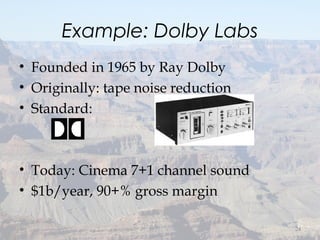
Example: Dolby Labs
• Founded in 1965 by Ray Dolby
• Originally: tape noise reduction
• Standard:
• Today: Cinema 7+1 channel sound
• $1b/year, 90+% gross margin
24
Collaborative openness
• Often openness is collaborative
– Combines inbound & outbound flows
– Quid pro quo
– Pooling knowledge
– Jointly (co-creating) creating
• Different degrees of openness
– Truly open (e.g. open source)
– Club (walled garden)
25
Examples: leveraging OI
26
1. Standards Consortia
Internet Engineering Task Force
•First meeting in 1986
•Individuals sponsored by firms
•Proposes, votes on new protocols
•Defined essential Internet protocols
– SMTP, http, https, IP V6
•Made Internet possible
27
2. R&D Consortia
• More than 200 pharma industry consortia
• Example: Extractables and Leachables
Safety Information Exchange (ELSIE)
– Founded 2007
– Maintains data on drug/packaging
interaction
– Data only available to members
– 13/30 top pharma companies are members
28
3. Open Source Software
What is OSS?
1.A standard form of open IP license
– Sets terms for perpetual sharing
1.Cooperative development process
– Specific tools for virtual collaboration
1.Form of shared governance
– Independent or firm-dominated
1.A pool of shared technology
2.A culture and set of norms
29
Open Source Software
• Risks: info leakage, license restrictions
• Many benefits of coopetition
– Pooling R&D costs
– Development of shared infrastructure
– Standardization in multi-vendor env’ts
• How do you make money?
– Tacit knowledge/transient advantage
– Commodity technology+proprietary add-ons
30
4. Crowdsourcing
• Putting out a problem to large group
– Usually an “open call” to any and all
– Generally people you don’t know already
– Self-selected participants who compete
• Leverage the “wisdom of the crowd”
– Benefit from heterogeneous knowledge
• Typically compete for prize
• Example: innovation contests
31
Crowdsourcing Intermediaries
• Consultants run innovation contests
• Paid by “seekers”: firms with a problem
– Help firms define a problem
– Manage disclosure, IP issues
• Attract a large pool of “solvers”
– Value added: matching 2-sided market
• Examples: InnoCentive, NineSigma,
Yet2.com
32
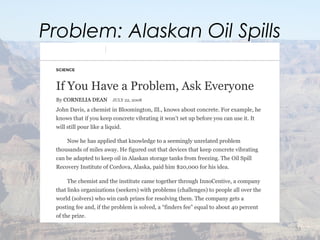
Problem: Alaskan Oil Spills
33
11/4/16, 12:39 AMIf You Have a Problem, Use Innocentive to Ask Everyone - The New York Times
SCIENCE
If You Have a Problem, Ask Everyone
By CORNELIA DEAN JULY 22, 2008
John Davis, a chemist in Bloomington, Ill., knows about concrete. For example, he
knows that if you keep concrete vibrating it won’t set up before you can use it. It
will still pour like a liquid.
Now he has applied that knowledge to a seemingly unrelated problem
thousands of miles away. He figured out that devices that keep concrete vibrating
can be adapted to keep oil in Alaskan storage tanks from freezing. The Oil Spill
Recovery Institute of Cordova, Alaska, paid him $20,000 for his idea.
The chemist and the institute came together through InnoCentive, a company
that links organizations (seekers) with problems (challenges) to people all over the
world (solvers) who win cash prizes for resolving them. The company gets a
posting fee and, if the problem is solved, a “finders fee” equal to about 40 percent
of the prize.
The process, according to John Seely Brown, a theorist of information
5. Internal Crowdsourcing
• Goal: seek contributions from internal
crowd
• Combines elements of crowdsourcing,
suggestion boxes, internal venturing
• Challenges
– Limits of internal knowledge pool
– Fair evaluation process
– Desire for internal anonymity
34
Conclusion
35
Conclusions
• Open innovation changes the role of the
firm
– Less about control
– More about orchestrating cooperation
• Supplements existing strategies
• Most firms begin with experiments
– How can OI address unsolved problems?
36
Thank you!
http://slideshare.net/joelwest

Leveraging Open Innovation

  • 1.
    Leveraging Open Innovation JoelWest November 15, 2016 http://slideshare.net/joelwest
  • 2.
    Road Map • Today’squestion • The value of innovation • What is open innovation? • Different types of open innovation • Examples of how firms leverage open innovation 2
  • 3.
    About Me Two careers(so far): •Software engineer and entrepreneur – Columnist, MacWEEK, Byte, MacTutor – President, Palomar Software (1987-2002) •Innovation professor and researcher – San José State University – Keck Graduate Institute, Claremont Colleges – Two books, 30 articles on innovation strategy •Research focus: openness strategies by firms 3
  • 4.
    Today’s question How canopenness help firm innovation? 4
  • 5.
  • 6.
    What is “innovation”? Somethingthat is •new or novel, •valuable or useful, •that is adopted by others …as chronciled by Everett Rogers Today I’ll focus on innovations that improve firm success 6
  • 7.
    Original puzzle: XeroxPARC • PARC invented all these cool technologies – LANs – Laser printers – Graphical workstations • It was unable to commercialize them • Why? – It didn’t fit the copier business model 7
  • 8.
    Xerox Personal Computers 8XeroxAlto (1973) ~$40,000 Xerox Star (1981) $16,500 Xerox 820 (1981) $3,000
  • 9.
    Role of thebusiness model “The inherent value of a technology remains latent until it is commercialized in some way. “A business model unlocks that latent value, mediating between technical and economic domains.” – Chesbrough & Rosenbloom (2002)
  • 10.
    Origins of openinnovation • Term coined by Chesbrough (2003) • Based on actions of IBM, Intel, P&G etc. • Cognitive paradigm – Combines traditional, open approaches • Explosion of industry, academic interest
  • 11.
    Initial Insights • Firmshave technology they can’t commercialize – Risk of false negative (Type II error) – Others might see value even if we don’t • Firms need technology beyond what they can develop internally – Other sources of ideas – Other ways to solve a problem
  • 12.
    What is “openinnovation”? “Open innovation is the use of purposive inflows and outflows of knowledge to accelerate internal innovation, and expand the markets for external use of innovation, respectively.” — Henry Chesbrough, 2006 12
  • 13.
    What is “openness”? Opennessis changing a firm’s mindset: •Porous firm boundaries •Outward orientation •Markets rather than firm control •Cooperation not just competition 13
  • 14.
    Innovation flows How doesthe knowledge flow? •Inbound: from outside to firm •Outbound: from firm to outside •Coupled: bidirectional flows – Collaboration with specific organization – Collaborations with network of organizations 14
  • 15.
    Source: Chesbrough (2006) Current Market Internal Technology Base TechnologyInsourcing New Market Technology Spin-offs External Technology Base Other Firm’s Market Licensing “Open” innovation strategies Knowledge flows in Open Innovation
  • 16.
  • 17.
    “Not all thesmart people in the world can work in one place.” Bill Joy co-founder Sun Microsystems Why should firms be open?
  • 18.
    Model of inboundOI Innovation Source† Customers CommercializingObtaining Integrating Interaction Focal Firm R&D Other Functions † Sources may include suppliers, rivals, complementors and customers. Source: West & Bogers, Journal of Product Innovation, 2014
  • 19.
    Inbound challenges 1. Obtainingtechnology – Searching & sourcing – Selecting/evaluating – Acquiring 1. Integrating technology into the firm – Overcoming “not invented here” 1. Bringing products to market 19
  • 20.
    Example: P&G • Connect+ Develop established 1999 • Solicits outside technologies to support product lines • One-third of product have external technologies – Swiffer duster – Mr Clean eraser – Printing images on Pringles® 20
  • 21.
  • 22.
    Role of thebusiness model • Firms best able to commercialize technology aligned to business model • A successful business model allows firms to create and capture value – Can be cognitive trap: excludes other paths – Example: Xerox good at copiers, bad at PCs • Firms should outlicense or spin-off rather than leave technology on the shelf 22
  • 23.
    Outbound challenges • Arrow“information paradox” – Buyers want to evaluate a technology – Disclosure obviates need to acquire IP – Works only with effective IPR • Availability of markets to match buyers and sellers 23
  • 24.
    Example: Dolby Labs •Founded in 1965 by Ray Dolby • Originally: tape noise reduction • Standard: • Today: Cinema 7+1 channel sound • $1b/year, 90+% gross margin 24
  • 25.
    Collaborative openness • Oftenopenness is collaborative – Combines inbound & outbound flows – Quid pro quo – Pooling knowledge – Jointly (co-creating) creating • Different degrees of openness – Truly open (e.g. open source) – Club (walled garden) 25
  • 26.
  • 27.
    1. Standards Consortia InternetEngineering Task Force •First meeting in 1986 •Individuals sponsored by firms •Proposes, votes on new protocols •Defined essential Internet protocols – SMTP, http, https, IP V6 •Made Internet possible 27
  • 28.
    2. R&D Consortia •More than 200 pharma industry consortia • Example: Extractables and Leachables Safety Information Exchange (ELSIE) – Founded 2007 – Maintains data on drug/packaging interaction – Data only available to members – 13/30 top pharma companies are members 28
  • 29.
    3. Open SourceSoftware What is OSS? 1.A standard form of open IP license – Sets terms for perpetual sharing 1.Cooperative development process – Specific tools for virtual collaboration 1.Form of shared governance – Independent or firm-dominated 1.A pool of shared technology 2.A culture and set of norms 29
  • 30.
    Open Source Software •Risks: info leakage, license restrictions • Many benefits of coopetition – Pooling R&D costs – Development of shared infrastructure – Standardization in multi-vendor env’ts • How do you make money? – Tacit knowledge/transient advantage – Commodity technology+proprietary add-ons 30
  • 31.
    4. Crowdsourcing • Puttingout a problem to large group – Usually an “open call” to any and all – Generally people you don’t know already – Self-selected participants who compete • Leverage the “wisdom of the crowd” – Benefit from heterogeneous knowledge • Typically compete for prize • Example: innovation contests 31
  • 32.
    Crowdsourcing Intermediaries • Consultantsrun innovation contests • Paid by “seekers”: firms with a problem – Help firms define a problem – Manage disclosure, IP issues • Attract a large pool of “solvers” – Value added: matching 2-sided market • Examples: InnoCentive, NineSigma, Yet2.com 32
  • 33.
    Problem: Alaskan OilSpills 33 11/4/16, 12:39 AMIf You Have a Problem, Use Innocentive to Ask Everyone - The New York Times SCIENCE If You Have a Problem, Ask Everyone By CORNELIA DEAN JULY 22, 2008 John Davis, a chemist in Bloomington, Ill., knows about concrete. For example, he knows that if you keep concrete vibrating it won’t set up before you can use it. It will still pour like a liquid. Now he has applied that knowledge to a seemingly unrelated problem thousands of miles away. He figured out that devices that keep concrete vibrating can be adapted to keep oil in Alaskan storage tanks from freezing. The Oil Spill Recovery Institute of Cordova, Alaska, paid him $20,000 for his idea. The chemist and the institute came together through InnoCentive, a company that links organizations (seekers) with problems (challenges) to people all over the world (solvers) who win cash prizes for resolving them. The company gets a posting fee and, if the problem is solved, a “finders fee” equal to about 40 percent of the prize. The process, according to John Seely Brown, a theorist of information
  • 34.
    5. Internal Crowdsourcing •Goal: seek contributions from internal crowd • Combines elements of crowdsourcing, suggestion boxes, internal venturing • Challenges – Limits of internal knowledge pool – Fair evaluation process – Desire for internal anonymity 34
  • 35.
  • 36.
    Conclusions • Open innovationchanges the role of the firm – Less about control – More about orchestrating cooperation • Supplements existing strategies • Most firms begin with experiments – How can OI address unsolved problems? 36
  • 37.

Editor's Notes

  • #7 Everett Rogers books from 1962-2003
  • #16 Idea of the permeable organization suggested by Chesbrough — and my prior interest in open source software and open standards — has sparked my interest in how firms use openness as a business strategy
  • #19 4-phase model
  • #25 Facebook’s margin is 84%, Google / Alphabet 61%. Netscout 65% in March 31 2016
  • #34 The Oil Spill Recovery Institute – based in Alaska – had a problem: when oil spilled in alaska, it would freeze, making it hard to skim off the surface of the ocean . It turns out a technique for keep concrete from setting — from a chemist — would help oil recovery barges keep the oil liquid so that it could be extracted