The objective of the course is to make the student understand the
latest trends in electronic business and the information technology
involved in running e-business
Unit – 1
Introduction to E-Business – Definitions – Types of E-
Business, Benefits of Business – Limitations of E-
Business – Impact of E-Commerce – Electronic Market
Structure – Business Model of Electronic Marketing –
Procedure for Internet Shopping: Consumer Perspective
– Aiding Comparison Shopping
The Cycle of Electronic Commerce
• Electronic Business includes the tasks that
support the buying and selling of goods and
services, and interactions among these tasks
Definition of Electronic Commerce
• Electronic Business is defined as the
conducting of business transactions over
electronic networks instead of paper,
telephones, couriers, tracks, planes and other
means of moving products and information.
Definitions of E-Commerce
• According to Lou Gerster, IBM’s CEO – “E
Business is all about cycle time, speed,
globalization, enhanced productivity,
reaching new customers and sharing
knowledge across institutions for competitive
advantage.”
Why E-Business
• Lack of time at public or Consumers
• Flexibility in timings
• Easy delivery at door steps
• Planning for payment
• Safe Transactions
Introduction to Electronic Business
• According to Albert Gore Jr. “We are on the verge of
a revolution that is just as profound as the change in
the economy that came with the industrial
revolution. Soon electronic networks will allow
people to transcend the barriers of time and distance
and take advantage of global markets and business
opportunities not even imaginable today, opening up
a new world of economic possibility and progress”.
Introduction to Electronic Business
• Electronic commerce describes the manner in which
transactions take place over networks, mostly the Internet.
• It is the process of electronically buying and selling goods,
services, and information. Certain Electronic commerce
applications, such as buying and selling stocks or books on
the internet, are growing at a rate of several hundred
percent every year.
• Electronic Commerce could have an impact on significant
portion of the world on businesses, professions, and of
course on people.
• However, the impact of Electronic Commerce is not just the
creation of web-based corporations. It is the building of new
Industrial order.
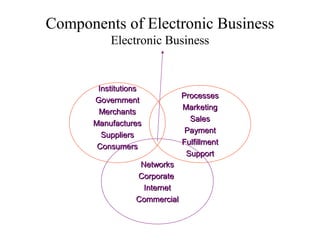
Components of Electronic Business
Electronic Business
NetworksNetworks
CorporateCorporate
InternetInternet
CommercialCommercial
InstitutionsInstitutions
GovernmentGovernment
MerchantsMerchants
ManufacturesManufactures
SuppliersSuppliers
ConsumersConsumers
ProcessesProcesses
MarketingMarketing
SalesSales
PaymentPayment
FulfillmentFulfillment
SupportSupport
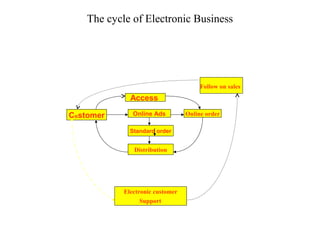
The cycle of Electronic Business
Access
Follow on sales
Customer Online Ads Online order
Standard order
Distribution
Electronic customer
Support
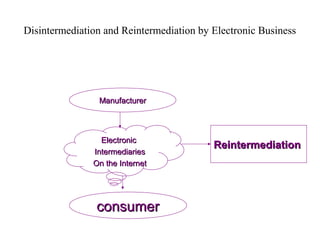
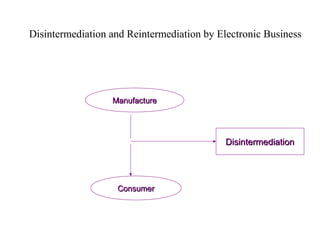
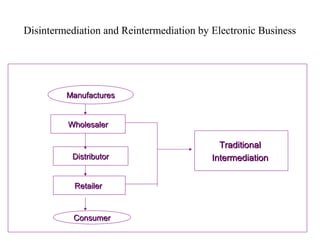
Disintermediation and Reintermediation by Electronic
Business
Eliminations of traditional intermediation is called
disintermediation. Incorporation of new electronic
intermediaries (such as Electronic-malls,electronic-
catalogues/directory, search engine services and product
selection agents) are called reintermediation
Disintermediation and Reintermediation by Electronic Business
ManufacturerManufacturer
ElectronicElectronic
IntermediariesIntermediaries
On the InternetOn the Internet
consumerconsumer
ReintermediationReintermediation
Elements of E-Business
• Direct to Consumer from Manufacturer
• Electronic payment system
• Negotiation at online
• Flexibility in Delivery of the product
• Saving the time and cost
Disadvantages of E-Business
• Can not test the product
• Disadvantage in Price and quality
• Legal Problems and jurisdiction
Disintermediation and Reintermediation by Electronic Business
ManufactureManufacture
DisintermediationDisintermediation
ConsumerConsumer
Disintermediation and Reintermediation by Electronic Business
ManufacturesManufactures
WholesalerWholesaler
DistributorDistributor
RetailerRetailer
ConsumerConsumer
TraditionalTraditional
IntermediationIntermediation
Components of Electronic Business
Electronic Business can facilitate Internal department
interactions, improve customer relations and
eliminate the constraints of time and place.
A significant synergy has formed between the use of
digital information, computerized business practices
and the Internet. This synergy is what enables
electronic commerce more efficient and effective
Types of E-Business
a common Classification of E-Commerce is by the nature of transaction.
• Business-to-consumers (B2C)
• Business-to-business (B2B)
• Consumer-to-consumer (C2C)
• Consumer to Business (C2B)
• Non-Business EC
• Intrabusiness (organizational) EC
Types of EB (Continued)
• Mobile Commerce (m-commerce)
refers to e-commerce that is conducted
in a wireless environment. i.e. using cell
phone to shop over the Internet
• Business model is the method by which
a company generates revenue to
sustain itself.
Classification of Electronic Business Applications
Types of interorganizational
systems.
• Electronic Data Interchange (EDI), which
provides secured B2B connection over Value-
added-networks (VANs)
• Extranets, which provide secured B2B
connection over the Internet
• Electronic funds transfer
• Electronic forms
Types of Interorganisational systems
• Integrated messaging delivery of e-mail and fax
documents through a single electronic transmission
system that can combine EDI, e-mail, and electronic
forms
• Shared databases – information stored in repositories
is shared between trading partners and is accessible to
all.
• Supply Chain Management – cooperation between a
company and its suppliers and/or customers regarding
demand forecasting, inventory management and
orders fulfillment can reduce inventories, speed
shipments, and enable just-in-time manufacturing.
Classification of Electronic Business Applications
Interorganizational Systems (IOS)
An IOS involves information flow among two or
more organizations. Its major objective is efficient
transaction processing. Such as transmitting orders,
bills, and payments using Electronic Data Interchange
(EDI) or extranets.
Interorganizational systems are used exclusively
for Business to Business (B2B) applications, whereas
electronic markets exist in both the B2B and Business
to Consumer (B2C) cases.
Interorganisational system
A typical IOS will include a company and its
suppliers and/or customers. Through IOS,
buyers and sellers arrange routine business
transactions. Information is exchanged over
communications networks using prearranged
formats.
Classification of Electronic Business Applications
What is internet, intranet and extranet?
1. Computers connected to a global networked environment
known as the Internet.
1. Computers connected to a global networked environment
and its counterpart within organizations, called an intranet.
An intranet is a corporate network that functions with
Internet technologies, such as browsers, using Internet
protocols.
1. An extranet, a network that links the intranets of business
partners over the Internet.
Classification of Electronic Commerce Applications
Electronic Markets
Electronic Market is a network-based location where business
interactions occurs. Where information, products, services, and payments
are exchanged. The Electronic Market is place where shoppers and
sellers meet. The Electronic Market handles all the necessary
transactions, including the transfer of money between banks. In
Electronic Markets the principal participants are transaction handlers,
buyers, brokers, and sellers.
Classification of Electronic Business Applications
Application of EC are divided into 3 categories
1. Buying and selling goods and services. These are usually
referred to as Electronic Markets
2. Facilitating Inter and Intra-organization flow of information.
Communication and collaboration. These are sometimes
referred to as Interorganizational Systems (IOS).
3. Providing customer services.
Business-to-Consumers (B2C)
These are retailing transactions with
individual shopper. The typical shopper at
Amazon.com is a consumer, or customer.
Woolworths of Australia with home
shopping site (www.woolworths.com.au) is
designed with freshness in mind and all the
fresh food is available for delivery.
Business-to-Consumers (B2C) cont…
• Electronic Storefront has its own URL at which
buyers can place orders.
• Electronic Malls (Cybermall or e-mall) is a collection
of individual shops under one Internet address.
– Referral malls in which you are transferred to a
participating storefront
– Electronic shopping cart enables you to gather
items from various vendors and pay for them in
one transaction.
Business-to-business (B2B)
Most of Electronic Business
today is of this type. It includes the IOS transactions
(An IOS involves information flow among two or more organizations.
Its major objective is efficient transaction processing, such as
transmitting order, bills and payments using Electronic Data Interchange
(EDI) and Electronic Market transactions between organizations.)
• Sell-side marketplaces are where organizations attempt to
sell their products or services to other organizations
electronically from their own private e-marketplace.
• Buy-side marketplaces are where organizations attempt to
buy needed products or services from other organizations
electronically.
Business-to-business (B2B) cont…
• E-Procurement is using electronic support to
purchase goods and materials, sourcing,
negotiating with suppliers, paying for goods
and making delivery arrangements.
• Group purchasing is when the orders of
many buyers are combined so that they
constitute a large volume.
Consumer-to-Consumer (C2C)
In this category consumer sells directly to consumers.
Examples are individuals selling in classified ads (
www.classified2000.com) and selling residential
property, cars and so on. Advertising personal services
on the Internet and selling knowledge and expertise is
an other example of C2C
Consumer to Business (C2B)
This category includes individuals who sell
products or services to organizations, as well
as individuals who seek sellers, interact with
them and conclude a transaction.
Non-business Electronic Business
An increased number of non-business
institutions such as academic institutions,
non-profit organizations, religious
organizations, social organizations and
government agencies are using various types
of Electronic Commerce to reduce their
expenses. e.g. improve purchasing or to
improve their operations and customer
services
Intrabusiness (organizational) EC
In this category we include all internal
organizational activities, usually performed
on intranets, that involve exchange of goods,
services or information. Activities can range
from selling corporate products to
employees to online training and cost-
reduction activities.
BENEFITS OF ELECTRONIC Business
The global nature of the Technology, low cost,
opportunity to reach hundreds of millions of people,
interactive nature, variety of possibilities, and
resourcefulness and rapid growth of the supporting
infrastructures (especially the web) result in many
potential benefits to:
1)1) OrganizationsOrganizations
2)2) ConsumersConsumers
3)3) SocietySociety
BENEFITS OF ELECTRONIC Business
Benefits to organizations
1) Provide opportunity to expends the marketplace to
national and international markets. With minimal
capital outlay, a company can easily and quickly
locate more customers, the best suppliers and most
suitable business partners worldwide.
1) Decreases the operating cost. EC decreases the cost
of creating, processing, distributing, storing, and
retrieving paper-based information. For example, by
introducing an electronic procurement system,
companies can cut the purchasing administrative
costs by as much as 85 per cent.
BENEFITS OF ELECTRONIC BUSINESS
Benefits to organizations
• Provide new platform for specialized business. For
example, dog toys which can be purchased only in pet
shops or discount stores in the physical world, are sold
now in a specialized www.dogtoys.com
• Reduces inventories and overhead by facilitating “pull”
type Supply Chain Management (SCM). In this system the
process starts from customer orders and uses Just-in-time
manufacturing. The pull-type processing enables
expensive customization of products and services which
provides competitive advantage to its implementers. A
class example is DELL Computer Corporation.
BENEFITS OF ELECTRONIC BUSINESS Benefits to organizations
• Reduces the time between the outlay of capital and the receipt
of products and services.
• Initiates business processes reengineering projects. By
changing processes productivity of salespeople, knowledge
workers and administrators can increase 100% or more.
• Improved image, customer services, new-found business
partners, simplified processes, compressed cycle and delivery
time, increased productivity, eliminating paper, expediting
access to information, reduced transportation costs and
increased flexibility.
BENEFITS OF ELECTRONIC BUSINESS Benefits to
consumers
1. No restriction on shopping time. EC enables customers to
shop or do other transactions 24 hours a day, thought-out the
year and from almost any location.
2. Increased choices, EC provides customers with more choices:
they can select from many vendors and from move products.
3. Easy to get less expensive product or services. EC frequently
provides with less expensive products and services by
allowing them to shop in many places and conduct quick
comparisons.
BENEFITS OF ELECTRONIC BUSINESS Benefits to
consumers
4. EC provides quick delivery of products
( in case of digitized products)
5. Transformation of information from
manufacture or services provider to
customers in seconds of time, rather than
days or weeks.
Benefits to Consumer
6. Provides customers to participate in virtual
auctions.
7. Customers can interact with other customers
in electronic communities and exchange ideas
as well as compare experiences.
8. Facilities competition, which results in
substantial discounts.

Introduction to e business unit

  • 1.
    The objective ofthe course is to make the student understand the latest trends in electronic business and the information technology involved in running e-business Unit – 1 Introduction to E-Business – Definitions – Types of E- Business, Benefits of Business – Limitations of E- Business – Impact of E-Commerce – Electronic Market Structure – Business Model of Electronic Marketing – Procedure for Internet Shopping: Consumer Perspective – Aiding Comparison Shopping
  • 2.
    The Cycle ofElectronic Commerce • Electronic Business includes the tasks that support the buying and selling of goods and services, and interactions among these tasks
  • 3.
    Definition of ElectronicCommerce • Electronic Business is defined as the conducting of business transactions over electronic networks instead of paper, telephones, couriers, tracks, planes and other means of moving products and information.
  • 4.
    Definitions of E-Commerce •According to Lou Gerster, IBM’s CEO – “E Business is all about cycle time, speed, globalization, enhanced productivity, reaching new customers and sharing knowledge across institutions for competitive advantage.”
  • 5.
    Why E-Business • Lackof time at public or Consumers • Flexibility in timings • Easy delivery at door steps • Planning for payment • Safe Transactions
  • 6.
    Introduction to ElectronicBusiness • According to Albert Gore Jr. “We are on the verge of a revolution that is just as profound as the change in the economy that came with the industrial revolution. Soon electronic networks will allow people to transcend the barriers of time and distance and take advantage of global markets and business opportunities not even imaginable today, opening up a new world of economic possibility and progress”.
  • 7.
    Introduction to ElectronicBusiness • Electronic commerce describes the manner in which transactions take place over networks, mostly the Internet. • It is the process of electronically buying and selling goods, services, and information. Certain Electronic commerce applications, such as buying and selling stocks or books on the internet, are growing at a rate of several hundred percent every year. • Electronic Commerce could have an impact on significant portion of the world on businesses, professions, and of course on people. • However, the impact of Electronic Commerce is not just the creation of web-based corporations. It is the building of new Industrial order.
  • 8.
    Components of ElectronicBusiness Electronic Business NetworksNetworks CorporateCorporate InternetInternet CommercialCommercial InstitutionsInstitutions GovernmentGovernment MerchantsMerchants ManufacturesManufactures SuppliersSuppliers ConsumersConsumers ProcessesProcesses MarketingMarketing SalesSales PaymentPayment FulfillmentFulfillment SupportSupport
  • 9.
    The cycle ofElectronic Business Access Follow on sales Customer Online Ads Online order Standard order Distribution Electronic customer Support
  • 10.
    Disintermediation and Reintermediationby Electronic Business Eliminations of traditional intermediation is called disintermediation. Incorporation of new electronic intermediaries (such as Electronic-malls,electronic- catalogues/directory, search engine services and product selection agents) are called reintermediation
  • 11.
    Disintermediation and Reintermediationby Electronic Business ManufacturerManufacturer ElectronicElectronic IntermediariesIntermediaries On the InternetOn the Internet consumerconsumer ReintermediationReintermediation
  • 12.
    Elements of E-Business •Direct to Consumer from Manufacturer • Electronic payment system • Negotiation at online • Flexibility in Delivery of the product • Saving the time and cost
  • 13.
    Disadvantages of E-Business •Can not test the product • Disadvantage in Price and quality • Legal Problems and jurisdiction
  • 14.
    Disintermediation and Reintermediationby Electronic Business ManufactureManufacture DisintermediationDisintermediation ConsumerConsumer
  • 15.
    Disintermediation and Reintermediationby Electronic Business ManufacturesManufactures WholesalerWholesaler DistributorDistributor RetailerRetailer ConsumerConsumer TraditionalTraditional IntermediationIntermediation
  • 16.
    Components of ElectronicBusiness Electronic Business can facilitate Internal department interactions, improve customer relations and eliminate the constraints of time and place. A significant synergy has formed between the use of digital information, computerized business practices and the Internet. This synergy is what enables electronic commerce more efficient and effective
  • 17.
    Types of E-Business acommon Classification of E-Commerce is by the nature of transaction. • Business-to-consumers (B2C) • Business-to-business (B2B) • Consumer-to-consumer (C2C) • Consumer to Business (C2B) • Non-Business EC • Intrabusiness (organizational) EC
  • 18.
    Types of EB(Continued) • Mobile Commerce (m-commerce) refers to e-commerce that is conducted in a wireless environment. i.e. using cell phone to shop over the Internet • Business model is the method by which a company generates revenue to sustain itself.
  • 19.
    Classification of ElectronicBusiness Applications Types of interorganizational systems. • Electronic Data Interchange (EDI), which provides secured B2B connection over Value- added-networks (VANs) • Extranets, which provide secured B2B connection over the Internet • Electronic funds transfer • Electronic forms
  • 20.
    Types of Interorganisationalsystems • Integrated messaging delivery of e-mail and fax documents through a single electronic transmission system that can combine EDI, e-mail, and electronic forms • Shared databases – information stored in repositories is shared between trading partners and is accessible to all. • Supply Chain Management – cooperation between a company and its suppliers and/or customers regarding demand forecasting, inventory management and orders fulfillment can reduce inventories, speed shipments, and enable just-in-time manufacturing.
  • 21.
    Classification of ElectronicBusiness Applications Interorganizational Systems (IOS) An IOS involves information flow among two or more organizations. Its major objective is efficient transaction processing. Such as transmitting orders, bills, and payments using Electronic Data Interchange (EDI) or extranets. Interorganizational systems are used exclusively for Business to Business (B2B) applications, whereas electronic markets exist in both the B2B and Business to Consumer (B2C) cases.
  • 22.
    Interorganisational system A typicalIOS will include a company and its suppliers and/or customers. Through IOS, buyers and sellers arrange routine business transactions. Information is exchanged over communications networks using prearranged formats.
  • 23.
    Classification of ElectronicBusiness Applications What is internet, intranet and extranet? 1. Computers connected to a global networked environment known as the Internet. 1. Computers connected to a global networked environment and its counterpart within organizations, called an intranet. An intranet is a corporate network that functions with Internet technologies, such as browsers, using Internet protocols. 1. An extranet, a network that links the intranets of business partners over the Internet.
  • 24.
    Classification of ElectronicCommerce Applications Electronic Markets Electronic Market is a network-based location where business interactions occurs. Where information, products, services, and payments are exchanged. The Electronic Market is place where shoppers and sellers meet. The Electronic Market handles all the necessary transactions, including the transfer of money between banks. In Electronic Markets the principal participants are transaction handlers, buyers, brokers, and sellers.
  • 25.
    Classification of ElectronicBusiness Applications Application of EC are divided into 3 categories 1. Buying and selling goods and services. These are usually referred to as Electronic Markets 2. Facilitating Inter and Intra-organization flow of information. Communication and collaboration. These are sometimes referred to as Interorganizational Systems (IOS). 3. Providing customer services.
  • 26.
    Business-to-Consumers (B2C) These areretailing transactions with individual shopper. The typical shopper at Amazon.com is a consumer, or customer. Woolworths of Australia with home shopping site (www.woolworths.com.au) is designed with freshness in mind and all the fresh food is available for delivery.
  • 27.
    Business-to-Consumers (B2C) cont… •Electronic Storefront has its own URL at which buyers can place orders. • Electronic Malls (Cybermall or e-mall) is a collection of individual shops under one Internet address. – Referral malls in which you are transferred to a participating storefront – Electronic shopping cart enables you to gather items from various vendors and pay for them in one transaction.
  • 28.
    Business-to-business (B2B) Most ofElectronic Business today is of this type. It includes the IOS transactions (An IOS involves information flow among two or more organizations. Its major objective is efficient transaction processing, such as transmitting order, bills and payments using Electronic Data Interchange (EDI) and Electronic Market transactions between organizations.) • Sell-side marketplaces are where organizations attempt to sell their products or services to other organizations electronically from their own private e-marketplace. • Buy-side marketplaces are where organizations attempt to buy needed products or services from other organizations electronically.
  • 29.
    Business-to-business (B2B) cont… •E-Procurement is using electronic support to purchase goods and materials, sourcing, negotiating with suppliers, paying for goods and making delivery arrangements. • Group purchasing is when the orders of many buyers are combined so that they constitute a large volume.
  • 30.
    Consumer-to-Consumer (C2C) In thiscategory consumer sells directly to consumers. Examples are individuals selling in classified ads ( www.classified2000.com) and selling residential property, cars and so on. Advertising personal services on the Internet and selling knowledge and expertise is an other example of C2C
  • 31.
    Consumer to Business(C2B) This category includes individuals who sell products or services to organizations, as well as individuals who seek sellers, interact with them and conclude a transaction.
  • 32.
    Non-business Electronic Business Anincreased number of non-business institutions such as academic institutions, non-profit organizations, religious organizations, social organizations and government agencies are using various types of Electronic Commerce to reduce their expenses. e.g. improve purchasing or to improve their operations and customer services
  • 33.
    Intrabusiness (organizational) EC Inthis category we include all internal organizational activities, usually performed on intranets, that involve exchange of goods, services or information. Activities can range from selling corporate products to employees to online training and cost- reduction activities.
  • 34.
    BENEFITS OF ELECTRONICBusiness The global nature of the Technology, low cost, opportunity to reach hundreds of millions of people, interactive nature, variety of possibilities, and resourcefulness and rapid growth of the supporting infrastructures (especially the web) result in many potential benefits to: 1)1) OrganizationsOrganizations 2)2) ConsumersConsumers 3)3) SocietySociety
  • 35.
    BENEFITS OF ELECTRONICBusiness Benefits to organizations 1) Provide opportunity to expends the marketplace to national and international markets. With minimal capital outlay, a company can easily and quickly locate more customers, the best suppliers and most suitable business partners worldwide. 1) Decreases the operating cost. EC decreases the cost of creating, processing, distributing, storing, and retrieving paper-based information. For example, by introducing an electronic procurement system, companies can cut the purchasing administrative costs by as much as 85 per cent.
  • 36.
    BENEFITS OF ELECTRONICBUSINESS Benefits to organizations • Provide new platform for specialized business. For example, dog toys which can be purchased only in pet shops or discount stores in the physical world, are sold now in a specialized www.dogtoys.com • Reduces inventories and overhead by facilitating “pull” type Supply Chain Management (SCM). In this system the process starts from customer orders and uses Just-in-time manufacturing. The pull-type processing enables expensive customization of products and services which provides competitive advantage to its implementers. A class example is DELL Computer Corporation.
  • 37.
    BENEFITS OF ELECTRONICBUSINESS Benefits to organizations • Reduces the time between the outlay of capital and the receipt of products and services. • Initiates business processes reengineering projects. By changing processes productivity of salespeople, knowledge workers and administrators can increase 100% or more. • Improved image, customer services, new-found business partners, simplified processes, compressed cycle and delivery time, increased productivity, eliminating paper, expediting access to information, reduced transportation costs and increased flexibility.
  • 38.
    BENEFITS OF ELECTRONICBUSINESS Benefits to consumers 1. No restriction on shopping time. EC enables customers to shop or do other transactions 24 hours a day, thought-out the year and from almost any location. 2. Increased choices, EC provides customers with more choices: they can select from many vendors and from move products. 3. Easy to get less expensive product or services. EC frequently provides with less expensive products and services by allowing them to shop in many places and conduct quick comparisons.
  • 39.
    BENEFITS OF ELECTRONICBUSINESS Benefits to consumers 4. EC provides quick delivery of products ( in case of digitized products) 5. Transformation of information from manufacture or services provider to customers in seconds of time, rather than days or weeks.
  • 40.
    Benefits to Consumer 6.Provides customers to participate in virtual auctions. 7. Customers can interact with other customers in electronic communities and exchange ideas as well as compare experiences. 8. Facilities competition, which results in substantial discounts.