What is MacularDegeneration?
Macular Degeneration is a group
of progressive eye conditions
which involve deterioration of the
macula, the central region of the
retina.
Partial list of types of
Macular Degeneration:
• Age-Related Macular Degeneration
• Juvenile Macular Degeneration or
Macular Dystrophy
• Stargardt’s Disease, a type of
Juvenile Macular Degeneration
3.
RISK FACTORS
for
MACULAR DEGENERATION
•Smoking
• Family history of the disease
• Obesity
• High blood pressure
• Having a lighter eye color
• Possible side effect of some drugs
4.
SOCIETAL IMPACT
• Age-RelatedMacular Degeneration
(ARMD or AMD) is the most common
cause of irreversible vision loss in
Americans over the age of 60.
• Estimations say 10 million Americans
will experience ARMD during their
lifetime.
5.
There are twogeneral types of
Age-Related Macular Degeneration:
• “Dry” (non-neovascular or atrophic)
– Early stage, less severe
– 85%-95% of cases
– Most common symptom is burry vision
– 3 Stages: Early, Intermediate, & Advanced
• “Wet” (neovascular or exudative)
– More severe than “Dry” ARMD
– Early symptom: Straight lines appear wavy
– Central vision blind spots develop
– Two sub-types: Occult & Classic
6.
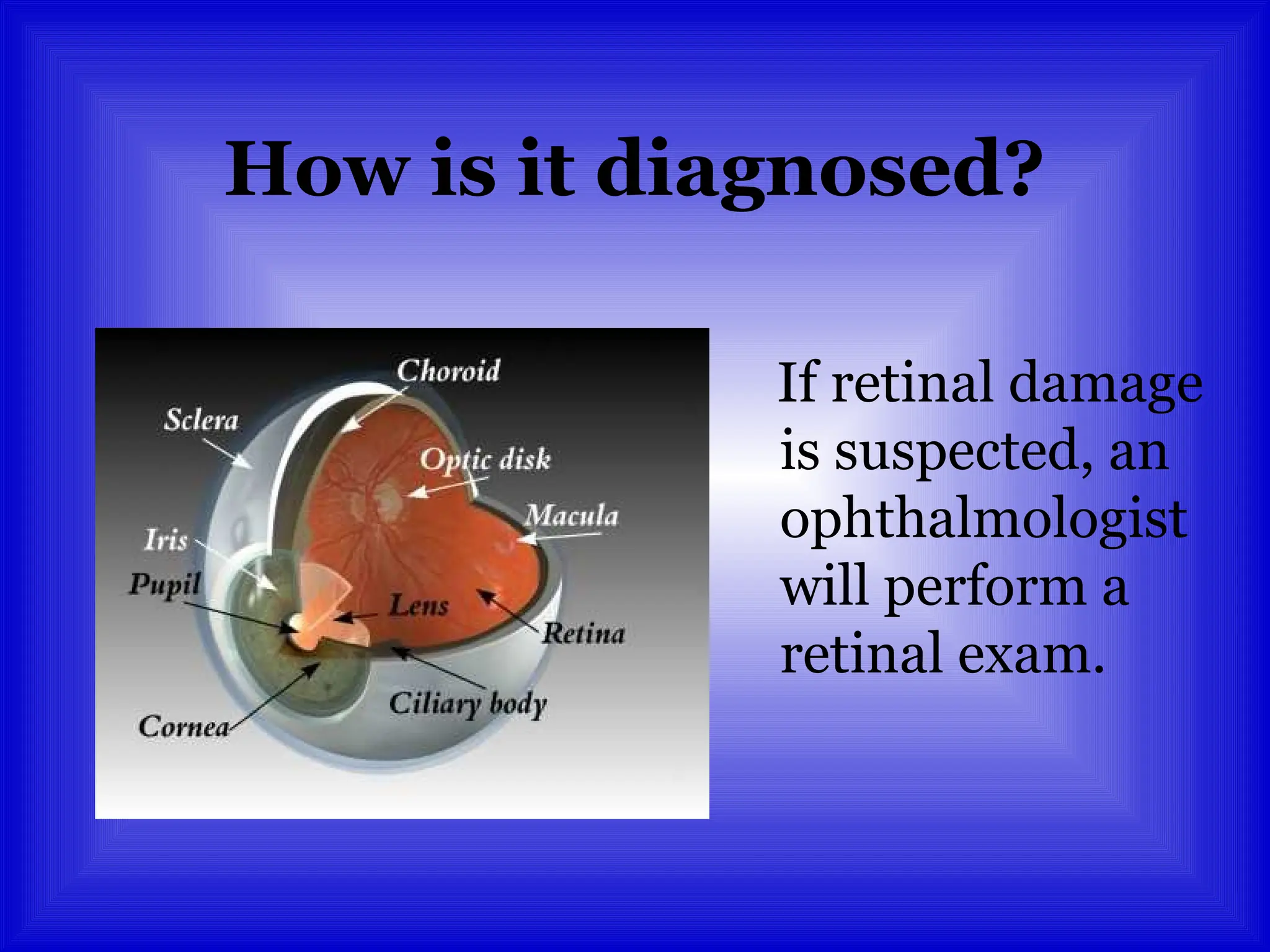
How is itdiagnosed?
If retinal damage
is suspected, an
ophthalmologist
will perform a
retinal exam.
7.
Fluorescein angiography isused to
examine the retinal blood vessels.
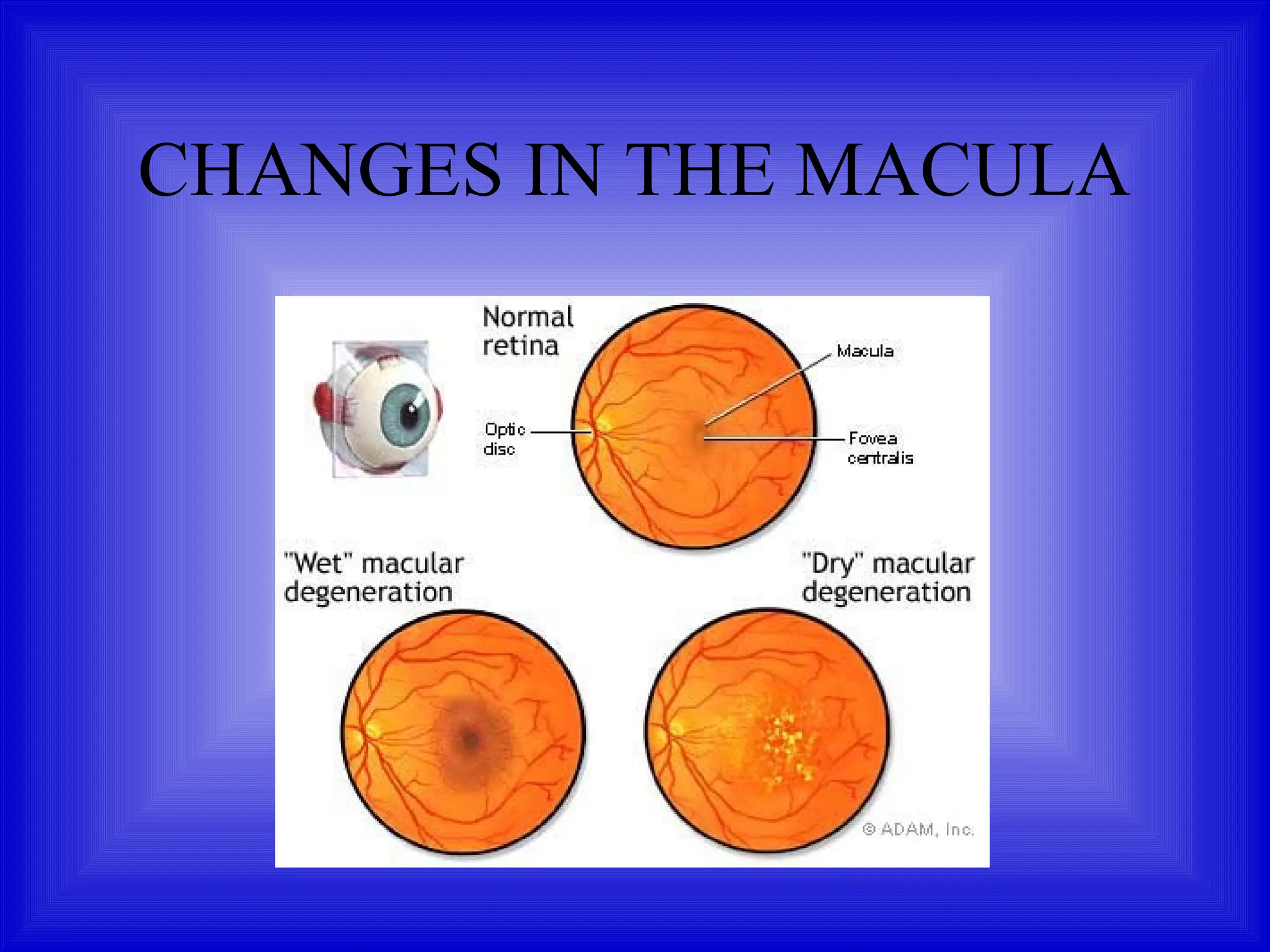
In “Wet” ARMD unwanted,
proliferating blood vessels
leak blood & fluid causing
permanent damage to light-
sensitive retinal cells.
In “Dry” ARMD yellowish
waste deposits, called
drusen form on the retina.
8.
An Amsler grid
assistswith diagnosis
An Amsler grid
is a tool that
eye doctors use to
detect vision
problems resulting
from damage to
the macula.
The lines may look
wavy if you have
Early “Dry” ARMD.
Small blind spots may
appear in your vision as
dry macular degeneration
progresses.
What impact doesARMD
have on the vision?
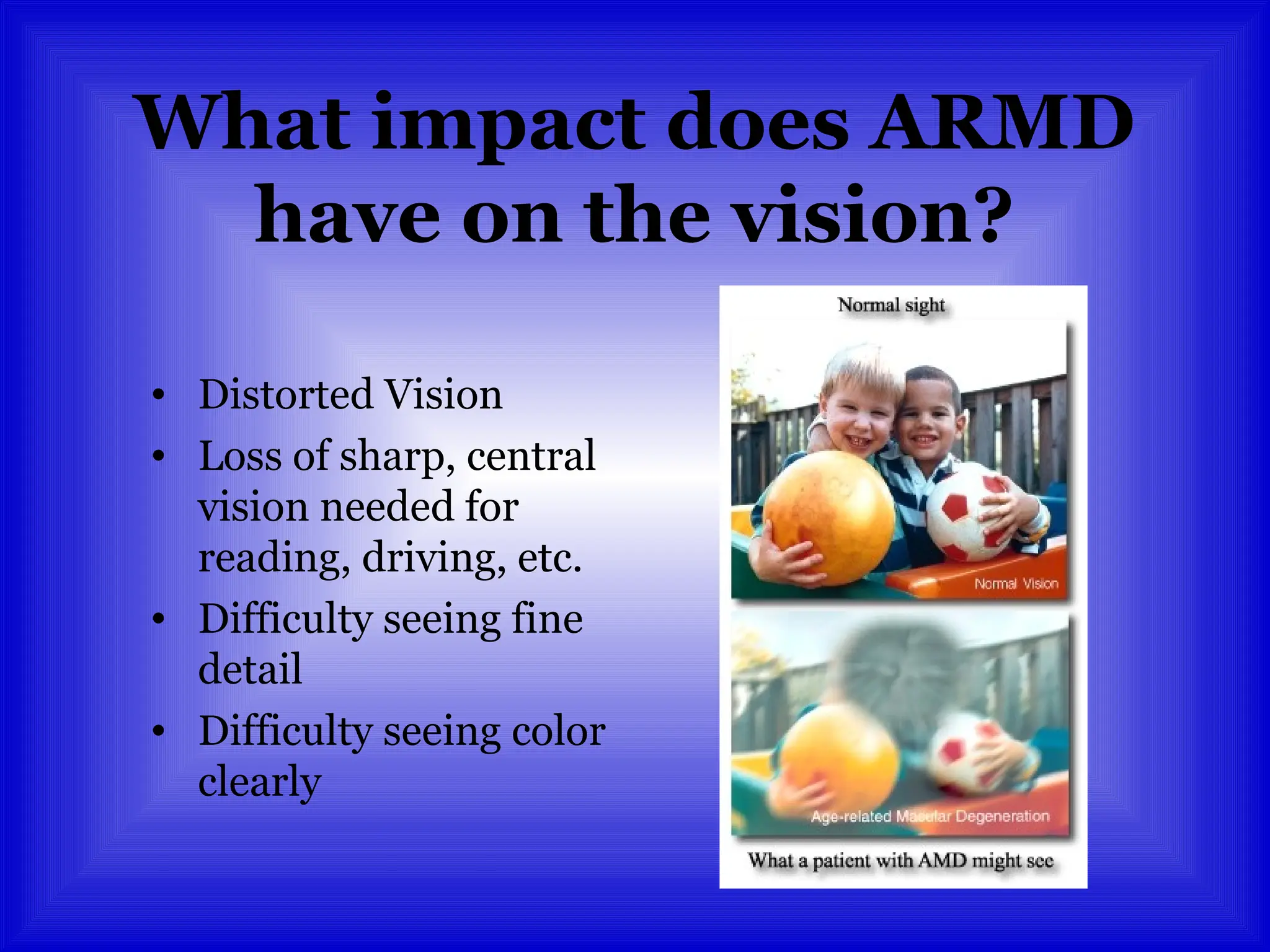
• Distorted Vision
• Loss of sharp, central
vision needed for
reading, driving, etc.
• Difficulty seeing fine
detail
• Difficulty seeing color
clearly
11.
Common Treatments
• Thereis no cure for “Dry”
or “Wet” ARMD at this
point in time.
• No FDA-approved
treatments exist for “Dry”
ARMD.
• Studies indicate taking
vitamins A, C, and E, zinc,
lutein, antioxidants, &
Omega-3 oils may help
prevent or slow “Dry”
Macular Degeneration.
12.
Common Treatments
Various FDAapproved drugs are
used to slow down the
progression of “Wet” ARMD.
• Lucentis, Macugen
• Visudyne used with
Photodynamic Therapy or PDT
13.
What will improvethe lives of
individuals with ARMD?
• Low vision aids such as
magnifiers
• UV protected
sunglasses
• Proper lighting for near
tasks
• Regular visits to your
ophthalmologist or
optometrist
14.
References
• 1. AboutAMD. Retrieved July 25, 2009, from http://www.eyeonamd.com/EyeOnAMD/about-amd.html
• 2. Age-Related Macular Degeneration. Retrieved July 25, 2009, from http://
www.nei.nih.gov/health/maculardegen/armd_facts.asp
• 3. American Macular Degeneration Foundation. Stargardt’s Disease. Retrieved on July 26, 2009, from
http://www.macular.org/stargardts.html
• 4. Dictionary of Eye Terminology 5th Edition. Barbara Cassin and Melin L. Rubin, Editor. 2006. Gainesville,
Fl, pg 167.
• 5. Ken Moses, Ph. D. The Impact of Childhood Disability: The Parent’s Struggle. Retrieved July 26, 2009 from
http://docs.google.com/gview?a=v&q=cache:FVUA1bWMnmAJ:www.dsact.com/images/docs/thei
mpact08.pdf+ken+moses+disabled&hl=en&gl=us
• 6. Liz Segre. Amsler Grid: Test for Macular Degeneration or Other Vision Problems. Retrieved July 25, 2009,
from http://www.allaboutvision.com/conditions/amsler-grid.htm
• 7. Marika Veisson. Depression Symptoms and Emotional States in Parents of Disabled and Non-Disabled
Children. Retrieved July 26, 2009, from http://findarticles.com/p/articles/mi_qa3852/is_199901/ai_n8851290/
• 8. Marilyn Maddrill. Macular Degeneration. Retrieved July 25, 2009, from
http://www.allaboutvision.com/conditions/amd.htm
• 9. Marilyn Maddrill. Stargardt's Disease (Fundus Flavimaculatus).
Retrieved July 26, 2009, from http://www.allaboutvision.com/conditions/stargardts.htm
• 10. Richard L. Windsor, O.D., F.A.A.O. and Laura K. Windsor, O.D., F.A.A.O. Understanding Stargardt’s
Disease. Retrieved July 26, 2009, from http://www.lowvision.org/stargardts.htm