Emerging treatments on
Neovascular Age Related
Macular Degeneration
Narciso F. Atienza, Jr. MD, DPBO
 Cardinal Santos Medical Center
 St. Luke’s Medical Center, QC
 Legaspi Eye Center
FINANCIAL DISCLOSURE


Novartis
Bausch and Lomb Pharmaceuticals
Acknowledgements

Pravin Dugel, MD
Allen Ho, MD
Michael Tolentino, MD
Baruch Kupperman, MD
Age Related Macular
Degeneration
Age Related Macular
   Degeneration
Progressive eye disease, where photoreceptors loss
function and die
Common in patients 55 years old or above
More common in Caucasians, rare in Negroes
2 broad types
  Neovascular (Wet type - Exudative)
  Non-neovascular (Dry type - Non exudative)
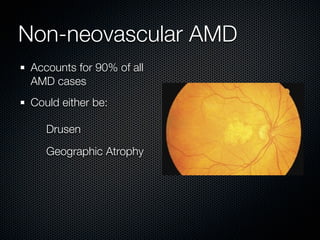
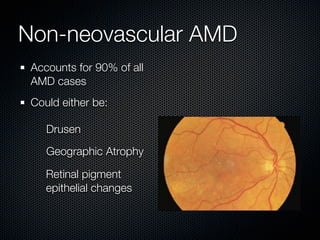
Non-neovascular AMD
Non-neovascular AMD
 Accounts for 90% of all
 AMD cases
 Could either be:
Non-neovascular AMD
 Accounts for 90% of all
 AMD cases
 Could either be:

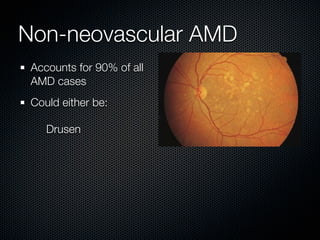
    Drusen
Non-neovascular AMD
 Accounts for 90% of all
 AMD cases
 Could either be:

    Drusen
Non-neovascular AMD
 Accounts for 90% of all
 AMD cases
 Could either be:

    Drusen
Non-neovascular AMD
 Accounts for 90% of all
 AMD cases
 Could either be:

    Drusen
    Geographic Atrophy
Non-neovascular AMD
 Accounts for 90% of all
 AMD cases
 Could either be:

    Drusen
    Geographic Atrophy
Non-neovascular AMD
 Accounts for 90% of all
 AMD cases
 Could either be:

    Drusen
    Geographic Atrophy
Non-neovascular AMD
 Accounts for 90% of all
 AMD cases
 Could either be:

    Drusen
    Geographic Atrophy

    Retinal pigment
    epithelial changes
Non-neovascular AMD
 Accounts for 90% of all
 AMD cases
 Could either be:

    Drusen
    Geographic Atrophy

    Retinal pigment
    epithelial changes
Natural course of AMD (dry)
Majority retain useful vision
10-15% progress to
neovascular AMD
  (Risk factors for progression)
    Soft drusen
    Areas of hyperpigmentation
    Presence of CNV on fellow
    eye
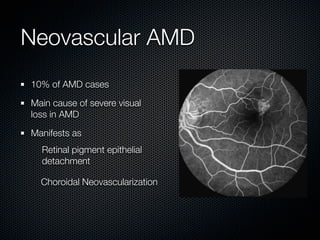
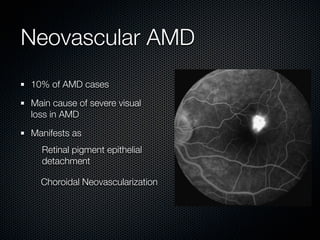
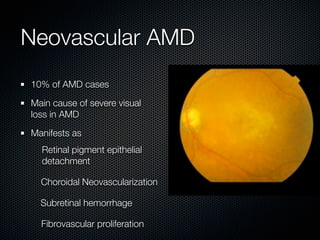
Neovascular AMD
Neovascular AMD
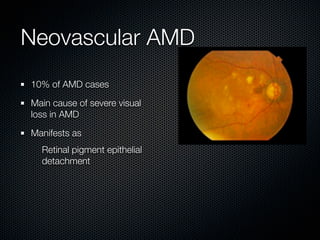
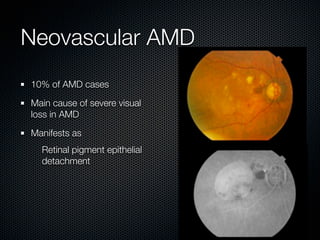
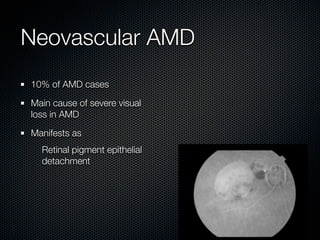
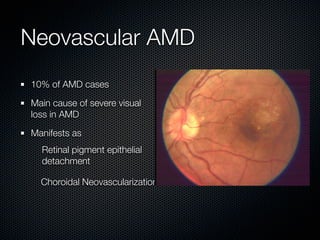
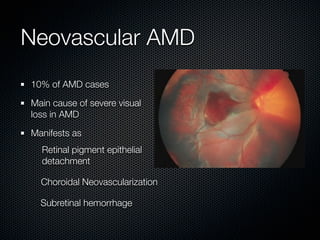
10% of AMD cases

Main cause of severe visual
loss in AMD

Manifests as
Neovascular AMD
10% of AMD cases

Main cause of severe visual
loss in AMD

Manifests as
  Retinal pigment epithelial
  detachment
Neovascular AMD
10% of AMD cases

Main cause of severe visual
loss in AMD

Manifests as
  Retinal pigment epithelial
  detachment
Neovascular AMD
10% of AMD cases

Main cause of severe visual
loss in AMD

Manifests as
  Retinal pigment epithelial
  detachment
Neovascular AMD
10% of AMD cases

Main cause of severe visual
loss in AMD

Manifests as
  Retinal pigment epithelial
  detachment
Neovascular AMD
10% of AMD cases

Main cause of severe visual
loss in AMD

Manifests as
  Retinal pigment epithelial
  detachment
Neovascular AMD
10% of AMD cases

Main cause of severe visual
loss in AMD

Manifests as
  Retinal pigment epithelial
  detachment

  Choroidal Neovascularization
Neovascular AMD
10% of AMD cases

Main cause of severe visual
loss in AMD

Manifests as
  Retinal pigment epithelial
  detachment

  Choroidal Neovascularization
Neovascular AMD
10% of AMD cases

Main cause of severe visual
loss in AMD

Manifests as
  Retinal pigment epithelial
  detachment

  Choroidal Neovascularization
Neovascular AMD
10% of AMD cases

Main cause of severe visual
loss in AMD

Manifests as
  Retinal pigment epithelial
  detachment

  Choroidal Neovascularization
Neovascular AMD
10% of AMD cases

Main cause of severe visual
loss in AMD

Manifests as
  Retinal pigment epithelial
  detachment

  Choroidal Neovascularization
Neovascular AMD
10% of AMD cases

Main cause of severe visual
loss in AMD

Manifests as
  Retinal pigment epithelial
  detachment

  Choroidal Neovascularization
Neovascular AMD
10% of AMD cases

Main cause of severe visual
loss in AMD

Manifests as
  Retinal pigment epithelial
  detachment

  Choroidal Neovascularization
Neovascular AMD
10% of AMD cases

Main cause of severe visual
loss in AMD

Manifests as
  Retinal pigment epithelial
  detachment

  Choroidal Neovascularization

  Subretinal hemorrhage
Neovascular AMD
10% of AMD cases

Main cause of severe visual
loss in AMD

Manifests as
  Retinal pigment epithelial
  detachment

  Choroidal Neovascularization

  Subretinal hemorrhage
Neovascular AMD
10% of AMD cases

Main cause of severe visual
loss in AMD

Manifests as
  Retinal pigment epithelial
  detachment

  Choroidal Neovascularization

  Subretinal hemorrhage
Neovascular AMD
10% of AMD cases

Main cause of severe visual
loss in AMD

Manifests as
  Retinal pigment epithelial
  detachment

  Choroidal Neovascularization

  Subretinal hemorrhage

  Fibrovascular proliferation
Neovascular AMD
10% of AMD cases

Main cause of severe visual
loss in AMD

Manifests as
  Retinal pigment epithelial
  detachment

  Choroidal Neovascularization

  Subretinal hemorrhage

  Fibrovascular proliferation
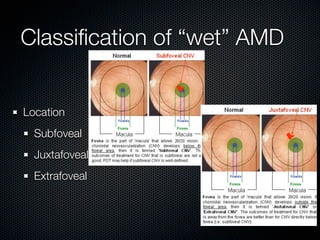
Classification of “wet” AMD


Location
  Subfoveal
  Juxtafoveal
  Extrafoveal
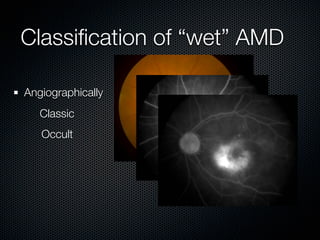
Classification of “wet” AMD

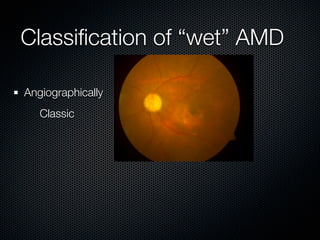
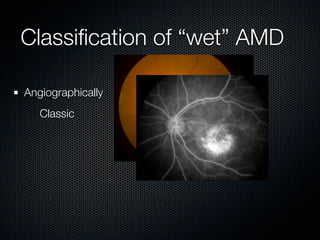
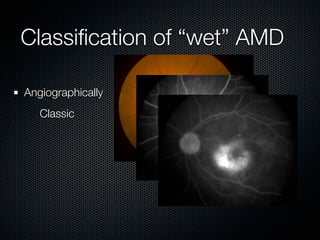
Angiographically
Classification of “wet” AMD

Angiographically
   Classic
Classification of “wet” AMD

Angiographically
   Classic
Classification of “wet” AMD

Angiographically
   Classic
Classification of “wet” AMD

Angiographically
   Classic
Classification of “wet” AMD

Angiographically
   Classic
   Occult
Classification of “wet” AMD

Angiographically
   Classic
   Occult
Classification of “wet” AMD

Angiographically
   Classic
   Occult
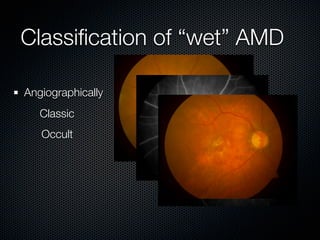
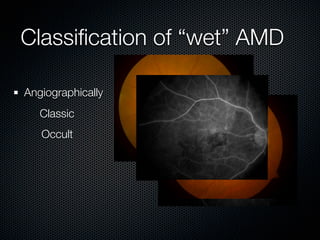
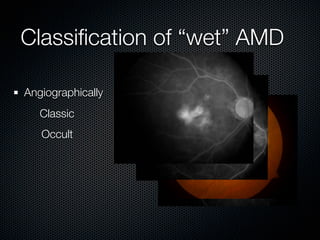
Classification of “wet” AMD

Angiographically
   Classic
   Occult
What has been done.........

Macular Photocoagulation Study (MPS)
What has been done.........

Macular Photocoagulation Study (MPS)
Photodynamic Therapy (VIP - Verteforfin in Photodynamic
Therapy. TAP - Treatment Of Age-Related Macular
Degeneration With Photodynamic Therapy)
What has been done.........

Macular Photocoagulation Study (MPS)
Photodynamic Therapy (VIP - Verteforfin in Photodynamic
Therapy. TAP - Treatment Of Age-Related Macular
Degeneration With Photodynamic Therapy)
Pegaptanib (Macugen)
What has been done.........

Macular Photocoagulation Study (MPS)
Photodynamic Therapy (VIP - Verteforfin in Photodynamic
Therapy. TAP - Treatment Of Age-Related Macular
Degeneration With Photodynamic Therapy)
Pegaptanib (Macugen)
  V.I.S.I.O.N. - (VEGF Inhibition Study in Ocular
  Neovascularization)
Ranibizumab (Lucentis)
  M.A.R.I.N.A - Minimally classic/occult trial of the Anti-
  VEGF antibody Ranibizumab (Lucentis) In the
  treatment of Neovascular AMD
Ranibizumab (Lucentis)
  M.A.R.I.N.A - Minimally classic/occult trial of the Anti-
  VEGF antibody Ranibizumab (Lucentis) In the
  treatment of Neovascular AMD
  ANCHOR (ANti-VEGF Antibody for the Treatment of
  Predominantly Classic CHORoidal
  Neovascularization in AMD)
Submacular Surgery Trials (SST)
Limited Macular Translocation/360 Macular
Translocation (LMT/TMT)
Submacular Surgery Trials (SST)
Limited Macular Translocation/360 Macular
Translocation (LMT/TMT)
Anecortave (Retaane) - Alcon
Submacular Surgery Trials (SST)
Limited Macular Translocation/360 Macular
Translocation (LMT/TMT)
Anecortave (Retaane) - Alcon
Bevasiranib - OPKO Health - Si-RNA inhibitor
Present thrust of research

 Combination therapy
Present thrust of research

 Combination therapy
   Anti-VEGF + PDT +/- Steroids
Present thrust of research

 Combination therapy
   Anti-VEGF + PDT +/- Steroids
 Epimacular Brachytherapy (Radiation)
Present thrust of research

 Combination therapy
   Anti-VEGF + PDT +/- Steroids
 Epimacular Brachytherapy (Radiation)
 Complement immune system alteration / modulation
Combination therapy
Combination therapy

Combining treatment modalities:
Combination therapy

Combining treatment modalities:
  anti-VEGF antibodies (Lucentis, Macugen, Avastin)
Combination therapy

Combining treatment modalities:
  anti-VEGF antibodies (Lucentis, Macugen, Avastin)
  microvascular occlusion (Visudyne)
Combination therapy

Combining treatment modalities:
  anti-VEGF antibodies (Lucentis, Macugen, Avastin)
  microvascular occlusion (Visudyne)
  inflammatory control (Dexamethasone)
What’s on the horizon
RADICAL (Reduced fluence visudyne Anti-VEGF-
Dexamethasone In Combination for AMD Lesions).
What’s on the horizon
RADICAL (Reduced fluence visudyne Anti-VEGF-
Dexamethasone In Combination for AMD Lesions).
SUMMIT (PDT + Ranibizumab)
What’s on the horizon
RADICAL (Reduced fluence visudyne Anti-VEGF-
Dexamethasone In Combination for AMD Lesions).
SUMMIT (PDT + Ranibizumab)
  Mont Blanc (European arm) - Standard fluence
What’s on the horizon
RADICAL (Reduced fluence visudyne Anti-VEGF-
Dexamethasone In Combination for AMD Lesions).
SUMMIT (PDT + Ranibizumab)
  Mont Blanc (European arm) - Standard fluence
  DENALI (North American arm) - Reduced fluence
  arm
What’s on the horizon
RADICAL (Reduced fluence visudyne Anti-VEGF-
Dexamethasone In Combination for AMD Lesions).
SUMMIT (PDT + Ranibizumab)
  Mont Blanc (European arm) - Standard fluence
  DENALI (North American arm) - Reduced fluence
  arm
  Everest (Asia arm) - done on polypoidal vasculopathy
Schimidt, Retina Congress, 2009, NYC
Preliminary results


                  Schimidt, Retina Congress, 2009, NYC
Preliminary results

 Mont Blanc study:


                     Schimidt, Retina Congress, 2009, NYC
Preliminary results

 Mont Blanc study:
   Primary objective - Combination therapy is non-
   inferior v.s. Monotherapy (+2.5 v.s. 4.4 letters). At 3
   months (+4.6 v.s. 7.1 letters)


                                   Schimidt, Retina Congress, 2009, NYC
Preliminary results

 Mont Blanc study:
   Primary objective - Combination therapy is non-
   inferior v.s. Monotherapy (+2.5 v.s. 4.4 letters). At 3
   months (+4.6 v.s. 7.1 letters)
   Secondary objective - Retreatment rates -
   combination (1.8 and 0.7) vs monotherapy (2.1 and
   0.9)

                                   Schimidt, Retina Congress, 2009, NYC
VEGF Trap
VEGF Trap
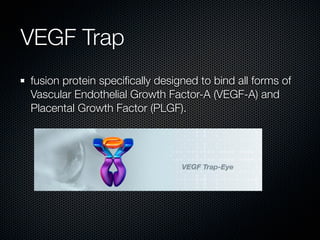
fusion protein specifically designed to bind all forms of
Vascular Endothelial Growth Factor-A (VEGF-A) and
Placental Growth Factor (PLGF).
VEGF Trap
fusion protein specifically designed to bind all forms of
Vascular Endothelial Growth Factor-A (VEGF-A) and
Placental Growth Factor (PLGF).
VEGF TRAP-EYE
VEGF TRAP-EYE


        Nguyen QD, Shah SM, Browning DJ, Hudson H, Sonkin P, Hariprasad SM, Kaiser P, Slakter JS, Haller
        J, Do DV, Mieler WF, Chu K, Yang K, Ingerman A, Vitti RL, Berliner AJ, Cedarbaum JM, Campochiaro
        PA.A phase I study of intravitreal vascular endothelial growth factor
        trap-eye in patients with neovascular age-related macular
        degeneration.
        Ophthalmology. 2009 Nov;116(11):2141-8.e1. Epub 2009 Aug 22.
VEGF TRAP-EYE
Doses are as follows: 0.05 mg, 0.15 mg , 0.5 mg, 1
mg, 2 mg, or 4 mg.


                    Nguyen QD, Shah SM, Browning DJ, Hudson H, Sonkin P, Hariprasad SM, Kaiser P, Slakter JS, Haller
                    J, Do DV, Mieler WF, Chu K, Yang K, Ingerman A, Vitti RL, Berliner AJ, Cedarbaum JM, Campochiaro
                    PA.A phase I study of intravitreal vascular endothelial growth factor
                    trap-eye in patients with neovascular age-related macular
                    degeneration.
                    Ophthalmology. 2009 Nov;116(11):2141-8.e1. Epub 2009 Aug 22.
VEGF TRAP-EYE
Doses are as follows: 0.05 mg, 0.15 mg , 0.5 mg, 1
mg, 2 mg, or 4 mg.
Decreased foveal thickness average - 104.5 um


                    Nguyen QD, Shah SM, Browning DJ, Hudson H, Sonkin P, Hariprasad SM, Kaiser P, Slakter JS, Haller
                    J, Do DV, Mieler WF, Chu K, Yang K, Ingerman A, Vitti RL, Berliner AJ, Cedarbaum JM, Campochiaro
                    PA.A phase I study of intravitreal vascular endothelial growth factor
                    trap-eye in patients with neovascular age-related macular
                    degeneration.
                    Ophthalmology. 2009 Nov;116(11):2141-8.e1. Epub 2009 Aug 22.
VEGF TRAP-EYE
Doses are as follows: 0.05 mg, 0.15 mg , 0.5 mg, 1
mg, 2 mg, or 4 mg.
Decreased foveal thickness average - 104.5 um
Mean increase in VA - 4.43 letters. Higher doses have
13.5 letters improvement (3 lines)
                    Nguyen QD, Shah SM, Browning DJ, Hudson H, Sonkin P, Hariprasad SM, Kaiser P, Slakter JS, Haller
                    J, Do DV, Mieler WF, Chu K, Yang K, Ingerman A, Vitti RL, Berliner AJ, Cedarbaum JM, Campochiaro
                    PA.A phase I study of intravitreal vascular endothelial growth factor
                    trap-eye in patients with neovascular age-related macular
                    degeneration.
                    Ophthalmology. 2009 Nov;116(11):2141-8.e1. Epub 2009 Aug 22.
VEGF TRAP-
EYE(Regeneron, Bayer)
VEGF TRAP-
EYE(Regeneron, Bayer)
A Randomized, Double Masked, Active Controlled
Phase III Study of the Efficacy, Safety, and Tolerability of
Repeated Doses of Intravitreal VEGF Trap in Subjects
With Neovascular Age-Related Macular Degeneration.
VEGF TRAP-
EYE(Regeneron, Bayer)
A Randomized, Double Masked, Active Controlled
Phase III Study of the Efficacy, Safety, and Tolerability of
Repeated Doses of Intravitreal VEGF Trap in Subjects
With Neovascular Age-Related Macular Degeneration.
VIEW 1 - US, CANADA
VEGF TRAP-
EYE(Regeneron, Bayer)
A Randomized, Double Masked, Active Controlled
Phase III Study of the Efficacy, Safety, and Tolerability of
Repeated Doses of Intravitreal VEGF Trap in Subjects
With Neovascular Age-Related Macular Degeneration.
VIEW 1 - US, CANADA
VIEW 2 - Europe, Asia, South America
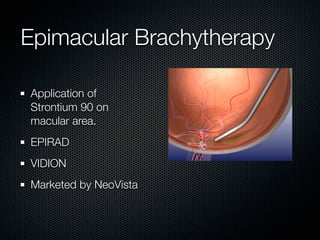
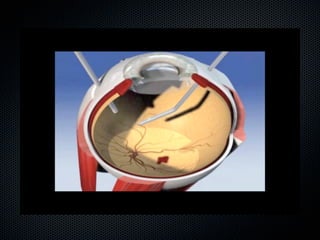
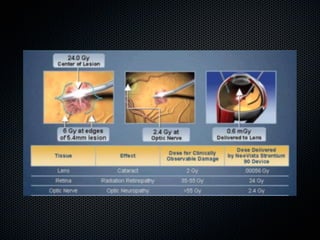
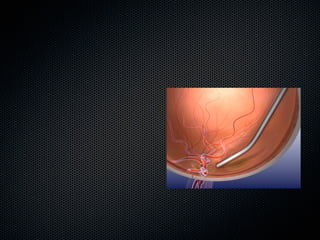
Epimacular Brachytherapy

Application of
Strontium 90 on
macular area.
Epimacular Brachytherapy

Application of
Strontium 90 on
macular area.
EPIRAD
Epimacular Brachytherapy

Application of
Strontium 90 on
macular area.
EPIRAD
VIDION
Epimacular Brachytherapy

Application of
Strontium 90 on
macular area.
EPIRAD
VIDION
Marketed by NeoVista
Epimacular Brachytherapy

Application of
Strontium 90 on
macular area.
EPIRAD
VIDION
Marketed by NeoVista
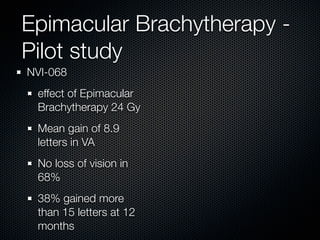
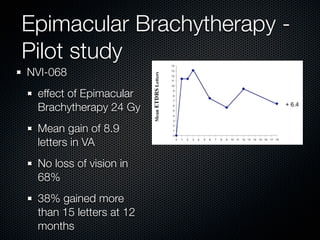
Epimacular Brachytherapy -
Pilot study
Epimacular Brachytherapy -
Pilot study
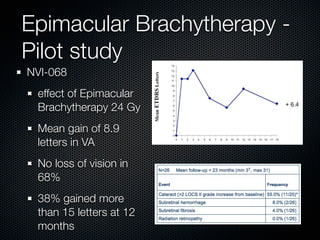
NVI-068
 effect of Epimacular
 Brachytherapy 24 Gy
 Mean gain of 8.9
 letters in VA
 No loss of vision in
 68%
 38% gained more
 than 15 letters at 12
 months
Epimacular Brachytherapy -
Pilot study
NVI-068
 effect of Epimacular
 Brachytherapy 24 Gy
 Mean gain of 8.9
 letters in VA
 No loss of vision in
 68%
 38% gained more
 than 15 letters at 12
 months
Epimacular Brachytherapy -
Pilot study
NVI-068
 effect of Epimacular
 Brachytherapy 24 Gy
 Mean gain of 8.9
 letters in VA
 No loss of vision in
 68%
 38% gained more
 than 15 letters at 12
 months
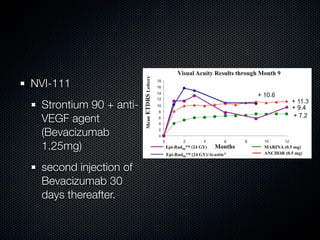
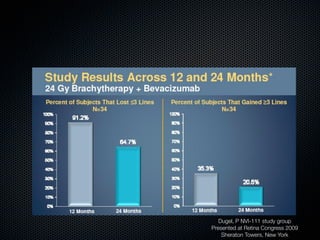
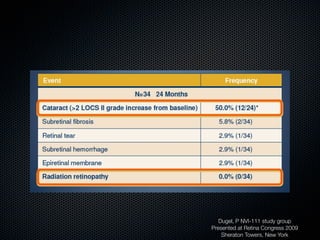
NVI-111
 Strontium 90 + anti-
 VEGF agent
 (Bevacizumab
 1.25mg)
 second injection of
 Bevacizumab 30
 days thereafter.
NVI-111
 Strontium 90 + anti-
 VEGF agent
 (Bevacizumab
 1.25mg)
 second injection of
 Bevacizumab 30
 days thereafter.
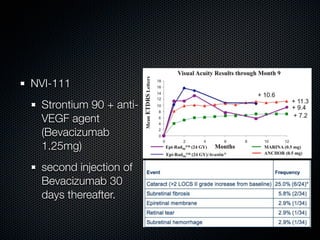
NVI-111
 Strontium 90 + anti-
 VEGF agent
 (Bevacizumab
 1.25mg)
 second injection of
 Bevacizumab 30
 days thereafter.
Dugel, P NVI-111 study group
Presented at Retina Congress 2009
    Sheraton Towers, New York
Dugel, P NVI-111 study group
Presented at Retina Congress 2009
    Sheraton Towers, New York
Dugel, P NVI-111 study group
Presented at Retina Congress 2009
    Sheraton Towers, New York
Dugel, P NVI-111 study group
Presented at Retina Congress 2009
    Sheraton Towers, New York
Dugel, P NVI-111 study group
Presented at Retina Congress 2009
    Sheraton Towers, New York
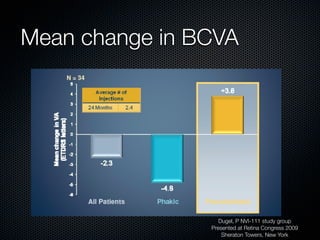
Mean change in BCVA


                   Dugel, P NVI-111 study group
                Presented at Retina Congress 2009
                    Sheraton Towers, New York
Mean change in BCVA


                   Dugel, P NVI-111 study group
                Presented at Retina Congress 2009
                    Sheraton Towers, New York
Dugel, P NVI-111 study group
Presented at Retina Congress 2009
    Sheraton Towers, New York
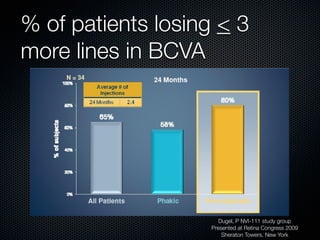
% of patients losing < 3
more lines in BCVA


                       Dugel, P NVI-111 study group
                    Presented at Retina Congress 2009
                        Sheraton Towers, New York
% of patients losing < 3
more lines in BCVA


                       Dugel, P NVI-111 study group
                    Presented at Retina Congress 2009
                        Sheraton Towers, New York
Dugel, P NVI-111 study group
Presented at Retina Congress 2009
    Sheraton Towers, New York
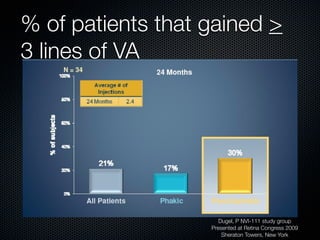
% of patients that gained >
3 lines of VA


                      Dugel, P NVI-111 study group
                   Presented at Retina Congress 2009
                       Sheraton Towers, New York
% of patients that gained >
3 lines of VA


                      Dugel, P NVI-111 study group
                   Presented at Retina Congress 2009
                       Sheraton Towers, New York
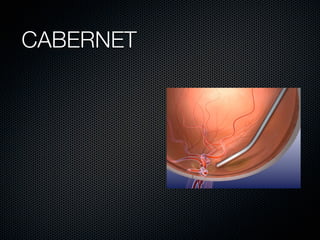
CABERNET
CABERNET
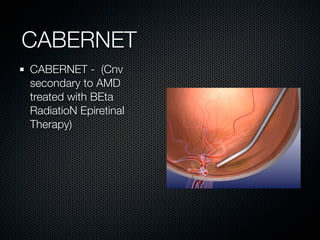
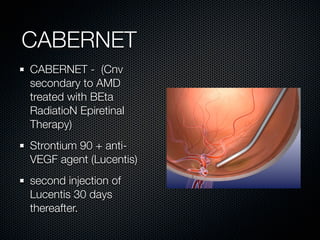
CABERNET - (Cnv
secondary to AMD
treated with BEta
RadiatioN Epiretinal
Therapy)
CABERNET
CABERNET - (Cnv
secondary to AMD
treated with BEta
RadiatioN Epiretinal
Therapy)
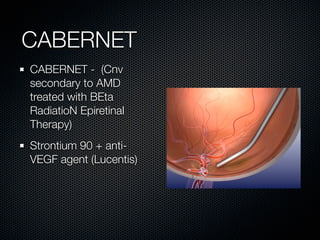
Strontium 90 + anti-
VEGF agent (Lucentis)
CABERNET
CABERNET - (Cnv
secondary to AMD
treated with BEta
RadiatioN Epiretinal
Therapy)
Strontium 90 + anti-
VEGF agent (Lucentis)
second injection of
Lucentis 30 days
thereafter.
Off-shoots of the
CABERNET study
Off-shoots of the
CABERNET study
Off-shoots of the
CABERNET study
MERLOT (Macular EpiRetinal Brachytherapy versus
Lucentis Only Treatment)
Evaluate safety and efficacy of focal delivery of radiation
for the treatment of subfoveal CNV associated with wet
AMD previously treated with anti-VEGF therapy.
MERITAGE - still in feasibility.
Evaluate epiretinal beta radiation therapy when used to
treat wet AMD drug persistence in those patients who
have received anti-VEGF therapy.
MERITAGE - still in feasibility.
Evaluate epiretinal beta radiation therapy when used to
treat wet AMD drug persistence in those patients who
have received anti-VEGF therapy.
MERITAGE - still in feasibility.
Evaluate epiretinal beta radiation therapy when used to
treat wet AMD drug persistence in those patients who
have received anti-VEGF therapy.

ROSE - still in feasibility.
determine the safety and efficacy of epiretinal beta
radiation therapy in those who do not respond to
treatment with anti-VEGF medication.
Comparison of Age Related Macular
Degeneration Treatment Trials
Comparison of Age Related Macular
Degeneration Treatment Trials
Comparison of Age Related Macular
Degeneration Treatment Trials

  Head on comparison between Ranibizumab v.s.
  Bevacizumab
Comparison of Age Related Macular
Degeneration Treatment Trials

  Head on comparison between Ranibizumab v.s.
  Bevacizumab
  Issues on difference in costs
Comparison of Age Related Macular
Degeneration Treatment Trials

  Head on comparison between Ranibizumab v.s.
  Bevacizumab
  Issues on difference in costs
    $2000 v.s. $50-100 injection
Comparison of Age Related Macular
Degeneration Treatment Trials

  Head on comparison between Ranibizumab v.s.
  Bevacizumab
  Issues on difference in costs
    $2000 v.s. $50-100 injection
  Resistance from Genentech
Regimen
Regimen
Lucentis on a fixed schedule of every 4 weeks for 1
year; at 1 year, re-randomization to Lucentis every 4
weeks or to variable dosing.
Avastin on a fixed schedule of every 4 weeks for 1
year; at 1 year, re-randomization to Avastin every 4
weeks or to variable dosing.
Lucentis on variable dosing for 2 years; i.e., after initial
treatment, monthly evaluation for treatment based on
signs of lesion activity.
Avastin on variable dosing for 2 years; i.e., after initial
treatment, monthly evaluation for treatment based on
signs of lesion activity.
C.A.T.T
C.A.T.T
C.A.T.T


Recruitment has been finished last July 2009
Preliminary results will come out in 1 year
47 centers in the US/Canada
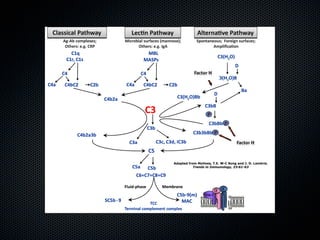
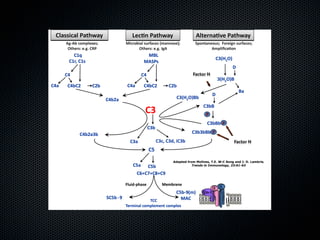
Complement in AMD
Complement in AMD


Complement factor H (CFH) gene.
  variant Y402H polymorphism significantly increases
  the risk for AMD.
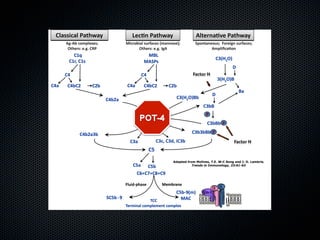
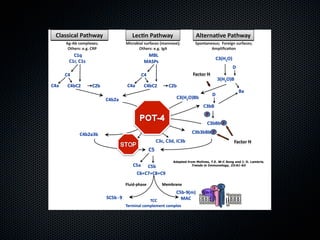
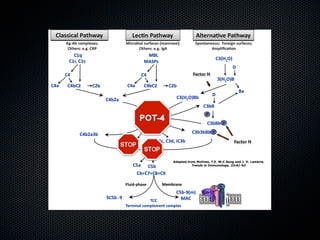
Complement 3 inhibitor
POT-4 - derived from Compstatin
Complement 3 inhibitor
POT-4 - derived from Compstatin
Potentia Pharmaceuticals
Complement 3 inhibitor
POT-4 - derived from Compstatin
Potentia Pharmaceuticals
ASaP trial (Assessment of Safety of POT-4) - Phase 1
clinical trials.
Complement 3 inhibitor
POT-4 - derived from Compstatin
Potentia Pharmaceuticals
ASaP trial (Assessment of Safety of POT-4) - Phase 1
clinical trials.
Well tolerated after a single intra-vitreal dose (1050 ug/
mL)
Complement 3 inhibitor
POT-4 - derived from Compstatin
Potentia Pharmaceuticals
ASaP trial (Assessment of Safety of POT-4) - Phase 1
clinical trials.
Well tolerated after a single intra-vitreal dose (1050 ug/
mL)
Now being partnered with Alcon
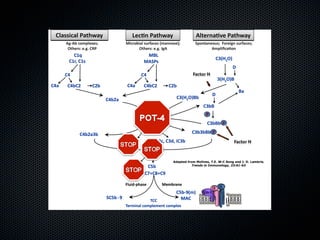
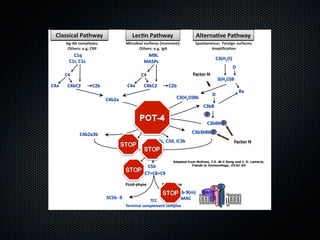
Complement 5 inhibitor
ARC1905 Phase I
Complement 5 inhibitor
ARC1905 Phase I
   Ophthotech Corp.
Complement 5 inhibitor
ARC1905 Phase I
   Ophthotech Corp.
   used with concomitance with Ranibizumab
Complement 5 inhibitor
ARC1905 Phase I
   Ophthotech Corp.
   used with concomitance with Ranibizumab
   Preliminary reports showed a 9.5 letters
   improvement and decrease in central macular
   thickness by 104 um in 1 month.
Complement 5 inhibitor
ARC1905 Phase I
   Ophthotech Corp.
   used with concomitance with Ranibizumab
   Preliminary reports showed a 9.5 letters
   improvement and decrease in central macular
   thickness by 104 um in 1 month.
   No retinal toxicity
Other targets for AMD
treatment
Other targets for AMD
treatment
Platelet derived growth factor inhibition with E10030
(anti-PDGF aptamer)
  Phase 1 - with ranibizumab
  59% of subjects gained > 15 lines in 12 weeks
  +14 letters at 12 weeks from baseline
  Mean change in in OCT was 157 um
  FA shows decrease in CNV area in 12 weeks by
  86%
CCR3 - chemokine receptor specifically expressed on
the choroidal endothelium.
CCR3 - chemokine receptor specifically expressed on
the choroidal endothelium.
Maybe a more specific target compared to VEGF A
CCR3 - chemokine receptor specifically expressed on
the choroidal endothelium.
Maybe a more specific target compared to VEGF A
Can be used as a screening and therapeutic target in
the future.
Adenovirus Associated Gene Transfer Vector in murine
equivalent
Adenovirus Associated Gene Transfer Vector in murine
equivalent
Maybe used to continually synthesize Bevacizumab in
one single intraocular injection
Remicade:
Remicade:
 Tumor Necrosis factor antibody
Remicade:
 Tumor Necrosis factor antibody
 Not well tolerated for intra-vitreal use.
AMD advances
AMD advances

Sustained growth in numbers of patients
AMD advances

Sustained growth in numbers of patients
Billion dollar industry
AMD advances

Sustained growth in numbers of patients
Billion dollar industry
Treatment now entails vision improvement and not
just vision preservation
AMD advances

Sustained growth in numbers of patients
Billion dollar industry
Treatment now entails vision improvement and not
just vision preservation
Multifaceted approach may work best in treatment.
Thank you

Amd lecture pao 2009

  • 1.
    Emerging treatments on NeovascularAge Related Macular Degeneration Narciso F. Atienza, Jr. MD, DPBO Cardinal Santos Medical Center St. Luke’s Medical Center, QC Legaspi Eye Center
  • 2.
  • 3.
    Acknowledgements Pravin Dugel, MD AllenHo, MD Michael Tolentino, MD Baruch Kupperman, MD
  • 4.
  • 5.
    Age Related Macular Degeneration Progressive eye disease, where photoreceptors loss function and die Common in patients 55 years old or above More common in Caucasians, rare in Negroes 2 broad types Neovascular (Wet type - Exudative) Non-neovascular (Dry type - Non exudative)
  • 6.
  • 7.
    Non-neovascular AMD Accountsfor 90% of all AMD cases Could either be:
  • 8.
    Non-neovascular AMD Accountsfor 90% of all AMD cases Could either be: Drusen
  • 9.
    Non-neovascular AMD Accountsfor 90% of all AMD cases Could either be: Drusen
  • 10.
    Non-neovascular AMD Accountsfor 90% of all AMD cases Could either be: Drusen
  • 11.
    Non-neovascular AMD Accountsfor 90% of all AMD cases Could either be: Drusen Geographic Atrophy
  • 12.
    Non-neovascular AMD Accountsfor 90% of all AMD cases Could either be: Drusen Geographic Atrophy
  • 13.
    Non-neovascular AMD Accountsfor 90% of all AMD cases Could either be: Drusen Geographic Atrophy
  • 14.
    Non-neovascular AMD Accountsfor 90% of all AMD cases Could either be: Drusen Geographic Atrophy Retinal pigment epithelial changes
  • 15.
    Non-neovascular AMD Accountsfor 90% of all AMD cases Could either be: Drusen Geographic Atrophy Retinal pigment epithelial changes
  • 16.
  • 17.
    Natural course ofAMD (dry) Majority retain useful vision 10-15% progress to neovascular AMD (Risk factors for progression) Soft drusen Areas of hyperpigmentation Presence of CNV on fellow eye
  • 18.
  • 19.
    Neovascular AMD 10% ofAMD cases Main cause of severe visual loss in AMD Manifests as
  • 20.
    Neovascular AMD 10% ofAMD cases Main cause of severe visual loss in AMD Manifests as Retinal pigment epithelial detachment
  • 21.
    Neovascular AMD 10% ofAMD cases Main cause of severe visual loss in AMD Manifests as Retinal pigment epithelial detachment
  • 22.
    Neovascular AMD 10% ofAMD cases Main cause of severe visual loss in AMD Manifests as Retinal pigment epithelial detachment
  • 23.
    Neovascular AMD 10% ofAMD cases Main cause of severe visual loss in AMD Manifests as Retinal pigment epithelial detachment
  • 24.
    Neovascular AMD 10% ofAMD cases Main cause of severe visual loss in AMD Manifests as Retinal pigment epithelial detachment
  • 25.
    Neovascular AMD 10% ofAMD cases Main cause of severe visual loss in AMD Manifests as Retinal pigment epithelial detachment Choroidal Neovascularization
  • 26.
    Neovascular AMD 10% ofAMD cases Main cause of severe visual loss in AMD Manifests as Retinal pigment epithelial detachment Choroidal Neovascularization
  • 27.
    Neovascular AMD 10% ofAMD cases Main cause of severe visual loss in AMD Manifests as Retinal pigment epithelial detachment Choroidal Neovascularization
  • 28.
    Neovascular AMD 10% ofAMD cases Main cause of severe visual loss in AMD Manifests as Retinal pigment epithelial detachment Choroidal Neovascularization
  • 29.
    Neovascular AMD 10% ofAMD cases Main cause of severe visual loss in AMD Manifests as Retinal pigment epithelial detachment Choroidal Neovascularization
  • 30.
    Neovascular AMD 10% ofAMD cases Main cause of severe visual loss in AMD Manifests as Retinal pigment epithelial detachment Choroidal Neovascularization
  • 31.
    Neovascular AMD 10% ofAMD cases Main cause of severe visual loss in AMD Manifests as Retinal pigment epithelial detachment Choroidal Neovascularization
  • 32.
    Neovascular AMD 10% ofAMD cases Main cause of severe visual loss in AMD Manifests as Retinal pigment epithelial detachment Choroidal Neovascularization Subretinal hemorrhage
  • 33.
    Neovascular AMD 10% ofAMD cases Main cause of severe visual loss in AMD Manifests as Retinal pigment epithelial detachment Choroidal Neovascularization Subretinal hemorrhage
  • 34.
    Neovascular AMD 10% ofAMD cases Main cause of severe visual loss in AMD Manifests as Retinal pigment epithelial detachment Choroidal Neovascularization Subretinal hemorrhage
  • 35.
    Neovascular AMD 10% ofAMD cases Main cause of severe visual loss in AMD Manifests as Retinal pigment epithelial detachment Choroidal Neovascularization Subretinal hemorrhage Fibrovascular proliferation
  • 36.
    Neovascular AMD 10% ofAMD cases Main cause of severe visual loss in AMD Manifests as Retinal pigment epithelial detachment Choroidal Neovascularization Subretinal hemorrhage Fibrovascular proliferation
  • 37.
    Classification of “wet”AMD Location Subfoveal Juxtafoveal Extrafoveal
  • 38.
  • 39.
    Classification of “wet”AMD Angiographically
  • 40.
    Classification of “wet”AMD Angiographically Classic
  • 41.
    Classification of “wet”AMD Angiographically Classic
  • 42.
    Classification of “wet”AMD Angiographically Classic
  • 43.
    Classification of “wet”AMD Angiographically Classic
  • 44.
    Classification of “wet”AMD Angiographically Classic Occult
  • 45.
    Classification of “wet”AMD Angiographically Classic Occult
  • 46.
    Classification of “wet”AMD Angiographically Classic Occult
  • 47.
    Classification of “wet”AMD Angiographically Classic Occult
  • 49.
    What has beendone.........
  • 50.
    What has beendone......... Macular Photocoagulation Study (MPS)
  • 51.
    What has beendone......... Macular Photocoagulation Study (MPS) Photodynamic Therapy (VIP - Verteforfin in Photodynamic Therapy. TAP - Treatment Of Age-Related Macular Degeneration With Photodynamic Therapy)
  • 52.
    What has beendone......... Macular Photocoagulation Study (MPS) Photodynamic Therapy (VIP - Verteforfin in Photodynamic Therapy. TAP - Treatment Of Age-Related Macular Degeneration With Photodynamic Therapy) Pegaptanib (Macugen)
  • 53.
    What has beendone......... Macular Photocoagulation Study (MPS) Photodynamic Therapy (VIP - Verteforfin in Photodynamic Therapy. TAP - Treatment Of Age-Related Macular Degeneration With Photodynamic Therapy) Pegaptanib (Macugen) V.I.S.I.O.N. - (VEGF Inhibition Study in Ocular Neovascularization)
  • 55.
  • 56.
    Ranibizumab (Lucentis) M.A.R.I.N.A - Minimally classic/occult trial of the Anti- VEGF antibody Ranibizumab (Lucentis) In the treatment of Neovascular AMD
  • 57.
    Ranibizumab (Lucentis) M.A.R.I.N.A - Minimally classic/occult trial of the Anti- VEGF antibody Ranibizumab (Lucentis) In the treatment of Neovascular AMD ANCHOR (ANti-VEGF Antibody for the Treatment of Predominantly Classic CHORoidal Neovascularization in AMD)
  • 59.
  • 60.
    Submacular Surgery Trials(SST) Limited Macular Translocation/360 Macular Translocation (LMT/TMT)
  • 61.
    Submacular Surgery Trials(SST) Limited Macular Translocation/360 Macular Translocation (LMT/TMT) Anecortave (Retaane) - Alcon
  • 62.
    Submacular Surgery Trials(SST) Limited Macular Translocation/360 Macular Translocation (LMT/TMT) Anecortave (Retaane) - Alcon Bevasiranib - OPKO Health - Si-RNA inhibitor
  • 66.
  • 67.
    Present thrust ofresearch Combination therapy
  • 68.
    Present thrust ofresearch Combination therapy Anti-VEGF + PDT +/- Steroids
  • 69.
    Present thrust ofresearch Combination therapy Anti-VEGF + PDT +/- Steroids Epimacular Brachytherapy (Radiation)
  • 70.
    Present thrust ofresearch Combination therapy Anti-VEGF + PDT +/- Steroids Epimacular Brachytherapy (Radiation) Complement immune system alteration / modulation
  • 72.
  • 73.
  • 74.
    Combination therapy Combining treatmentmodalities: anti-VEGF antibodies (Lucentis, Macugen, Avastin)
  • 75.
    Combination therapy Combining treatmentmodalities: anti-VEGF antibodies (Lucentis, Macugen, Avastin) microvascular occlusion (Visudyne)
  • 76.
    Combination therapy Combining treatmentmodalities: anti-VEGF antibodies (Lucentis, Macugen, Avastin) microvascular occlusion (Visudyne) inflammatory control (Dexamethasone)
  • 78.
  • 79.
    What’s on thehorizon RADICAL (Reduced fluence visudyne Anti-VEGF- Dexamethasone In Combination for AMD Lesions).
  • 80.
    What’s on thehorizon RADICAL (Reduced fluence visudyne Anti-VEGF- Dexamethasone In Combination for AMD Lesions). SUMMIT (PDT + Ranibizumab)
  • 81.
    What’s on thehorizon RADICAL (Reduced fluence visudyne Anti-VEGF- Dexamethasone In Combination for AMD Lesions). SUMMIT (PDT + Ranibizumab) Mont Blanc (European arm) - Standard fluence
  • 82.
    What’s on thehorizon RADICAL (Reduced fluence visudyne Anti-VEGF- Dexamethasone In Combination for AMD Lesions). SUMMIT (PDT + Ranibizumab) Mont Blanc (European arm) - Standard fluence DENALI (North American arm) - Reduced fluence arm
  • 83.
    What’s on thehorizon RADICAL (Reduced fluence visudyne Anti-VEGF- Dexamethasone In Combination for AMD Lesions). SUMMIT (PDT + Ranibizumab) Mont Blanc (European arm) - Standard fluence DENALI (North American arm) - Reduced fluence arm Everest (Asia arm) - done on polypoidal vasculopathy
  • 84.
  • 85.
    Preliminary results Schimidt, Retina Congress, 2009, NYC
  • 86.
    Preliminary results MontBlanc study: Schimidt, Retina Congress, 2009, NYC
  • 87.
    Preliminary results MontBlanc study: Primary objective - Combination therapy is non- inferior v.s. Monotherapy (+2.5 v.s. 4.4 letters). At 3 months (+4.6 v.s. 7.1 letters) Schimidt, Retina Congress, 2009, NYC
  • 88.
    Preliminary results MontBlanc study: Primary objective - Combination therapy is non- inferior v.s. Monotherapy (+2.5 v.s. 4.4 letters). At 3 months (+4.6 v.s. 7.1 letters) Secondary objective - Retreatment rates - combination (1.8 and 0.7) vs monotherapy (2.1 and 0.9) Schimidt, Retina Congress, 2009, NYC
  • 90.
  • 91.
    VEGF Trap fusion proteinspecifically designed to bind all forms of Vascular Endothelial Growth Factor-A (VEGF-A) and Placental Growth Factor (PLGF).
  • 92.
    VEGF Trap fusion proteinspecifically designed to bind all forms of Vascular Endothelial Growth Factor-A (VEGF-A) and Placental Growth Factor (PLGF).
  • 94.
  • 95.
    VEGF TRAP-EYE Nguyen QD, Shah SM, Browning DJ, Hudson H, Sonkin P, Hariprasad SM, Kaiser P, Slakter JS, Haller J, Do DV, Mieler WF, Chu K, Yang K, Ingerman A, Vitti RL, Berliner AJ, Cedarbaum JM, Campochiaro PA.A phase I study of intravitreal vascular endothelial growth factor trap-eye in patients with neovascular age-related macular degeneration. Ophthalmology. 2009 Nov;116(11):2141-8.e1. Epub 2009 Aug 22.
  • 96.
    VEGF TRAP-EYE Doses areas follows: 0.05 mg, 0.15 mg , 0.5 mg, 1 mg, 2 mg, or 4 mg. Nguyen QD, Shah SM, Browning DJ, Hudson H, Sonkin P, Hariprasad SM, Kaiser P, Slakter JS, Haller J, Do DV, Mieler WF, Chu K, Yang K, Ingerman A, Vitti RL, Berliner AJ, Cedarbaum JM, Campochiaro PA.A phase I study of intravitreal vascular endothelial growth factor trap-eye in patients with neovascular age-related macular degeneration. Ophthalmology. 2009 Nov;116(11):2141-8.e1. Epub 2009 Aug 22.
  • 97.
    VEGF TRAP-EYE Doses areas follows: 0.05 mg, 0.15 mg , 0.5 mg, 1 mg, 2 mg, or 4 mg. Decreased foveal thickness average - 104.5 um Nguyen QD, Shah SM, Browning DJ, Hudson H, Sonkin P, Hariprasad SM, Kaiser P, Slakter JS, Haller J, Do DV, Mieler WF, Chu K, Yang K, Ingerman A, Vitti RL, Berliner AJ, Cedarbaum JM, Campochiaro PA.A phase I study of intravitreal vascular endothelial growth factor trap-eye in patients with neovascular age-related macular degeneration. Ophthalmology. 2009 Nov;116(11):2141-8.e1. Epub 2009 Aug 22.
  • 98.
    VEGF TRAP-EYE Doses areas follows: 0.05 mg, 0.15 mg , 0.5 mg, 1 mg, 2 mg, or 4 mg. Decreased foveal thickness average - 104.5 um Mean increase in VA - 4.43 letters. Higher doses have 13.5 letters improvement (3 lines) Nguyen QD, Shah SM, Browning DJ, Hudson H, Sonkin P, Hariprasad SM, Kaiser P, Slakter JS, Haller J, Do DV, Mieler WF, Chu K, Yang K, Ingerman A, Vitti RL, Berliner AJ, Cedarbaum JM, Campochiaro PA.A phase I study of intravitreal vascular endothelial growth factor trap-eye in patients with neovascular age-related macular degeneration. Ophthalmology. 2009 Nov;116(11):2141-8.e1. Epub 2009 Aug 22.
  • 100.
  • 101.
    VEGF TRAP- EYE(Regeneron, Bayer) ARandomized, Double Masked, Active Controlled Phase III Study of the Efficacy, Safety, and Tolerability of Repeated Doses of Intravitreal VEGF Trap in Subjects With Neovascular Age-Related Macular Degeneration.
  • 102.
    VEGF TRAP- EYE(Regeneron, Bayer) ARandomized, Double Masked, Active Controlled Phase III Study of the Efficacy, Safety, and Tolerability of Repeated Doses of Intravitreal VEGF Trap in Subjects With Neovascular Age-Related Macular Degeneration. VIEW 1 - US, CANADA
  • 103.
    VEGF TRAP- EYE(Regeneron, Bayer) ARandomized, Double Masked, Active Controlled Phase III Study of the Efficacy, Safety, and Tolerability of Repeated Doses of Intravitreal VEGF Trap in Subjects With Neovascular Age-Related Macular Degeneration. VIEW 1 - US, CANADA VIEW 2 - Europe, Asia, South America
  • 105.
  • 106.
  • 107.
  • 108.
    Epimacular Brachytherapy Application of Strontium90 on macular area. EPIRAD VIDION
  • 109.
    Epimacular Brachytherapy Application of Strontium90 on macular area. EPIRAD VIDION Marketed by NeoVista
  • 110.
    Epimacular Brachytherapy Application of Strontium90 on macular area. EPIRAD VIDION Marketed by NeoVista
  • 115.
  • 116.
    Epimacular Brachytherapy - Pilotstudy NVI-068 effect of Epimacular Brachytherapy 24 Gy Mean gain of 8.9 letters in VA No loss of vision in 68% 38% gained more than 15 letters at 12 months
  • 117.
    Epimacular Brachytherapy - Pilotstudy NVI-068 effect of Epimacular Brachytherapy 24 Gy Mean gain of 8.9 letters in VA No loss of vision in 68% 38% gained more than 15 letters at 12 months
  • 118.
    Epimacular Brachytherapy - Pilotstudy NVI-068 effect of Epimacular Brachytherapy 24 Gy Mean gain of 8.9 letters in VA No loss of vision in 68% 38% gained more than 15 letters at 12 months
  • 120.
    NVI-111 Strontium 90+ anti- VEGF agent (Bevacizumab 1.25mg) second injection of Bevacizumab 30 days thereafter.
  • 121.
    NVI-111 Strontium 90+ anti- VEGF agent (Bevacizumab 1.25mg) second injection of Bevacizumab 30 days thereafter.
  • 122.
    NVI-111 Strontium 90+ anti- VEGF agent (Bevacizumab 1.25mg) second injection of Bevacizumab 30 days thereafter.
  • 123.
    Dugel, P NVI-111study group Presented at Retina Congress 2009 Sheraton Towers, New York
  • 124.
    Dugel, P NVI-111study group Presented at Retina Congress 2009 Sheraton Towers, New York
  • 125.
    Dugel, P NVI-111study group Presented at Retina Congress 2009 Sheraton Towers, New York
  • 126.
    Dugel, P NVI-111study group Presented at Retina Congress 2009 Sheraton Towers, New York
  • 127.
    Dugel, P NVI-111study group Presented at Retina Congress 2009 Sheraton Towers, New York
  • 128.
    Mean change inBCVA Dugel, P NVI-111 study group Presented at Retina Congress 2009 Sheraton Towers, New York
  • 129.
    Mean change inBCVA Dugel, P NVI-111 study group Presented at Retina Congress 2009 Sheraton Towers, New York
  • 130.
    Dugel, P NVI-111study group Presented at Retina Congress 2009 Sheraton Towers, New York
  • 131.
    % of patientslosing < 3 more lines in BCVA Dugel, P NVI-111 study group Presented at Retina Congress 2009 Sheraton Towers, New York
  • 132.
    % of patientslosing < 3 more lines in BCVA Dugel, P NVI-111 study group Presented at Retina Congress 2009 Sheraton Towers, New York
  • 133.
    Dugel, P NVI-111study group Presented at Retina Congress 2009 Sheraton Towers, New York
  • 134.
    % of patientsthat gained > 3 lines of VA Dugel, P NVI-111 study group Presented at Retina Congress 2009 Sheraton Towers, New York
  • 135.
    % of patientsthat gained > 3 lines of VA Dugel, P NVI-111 study group Presented at Retina Congress 2009 Sheraton Towers, New York
  • 137.
  • 138.
    CABERNET CABERNET - (Cnv secondaryto AMD treated with BEta RadiatioN Epiretinal Therapy)
  • 139.
    CABERNET CABERNET - (Cnv secondaryto AMD treated with BEta RadiatioN Epiretinal Therapy) Strontium 90 + anti- VEGF agent (Lucentis)
  • 140.
    CABERNET CABERNET - (Cnv secondaryto AMD treated with BEta RadiatioN Epiretinal Therapy) Strontium 90 + anti- VEGF agent (Lucentis) second injection of Lucentis 30 days thereafter.
  • 141.
  • 142.
  • 143.
    Off-shoots of the CABERNETstudy MERLOT (Macular EpiRetinal Brachytherapy versus Lucentis Only Treatment) Evaluate safety and efficacy of focal delivery of radiation for the treatment of subfoveal CNV associated with wet AMD previously treated with anti-VEGF therapy.
  • 146.
    MERITAGE - stillin feasibility. Evaluate epiretinal beta radiation therapy when used to treat wet AMD drug persistence in those patients who have received anti-VEGF therapy.
  • 147.
    MERITAGE - stillin feasibility. Evaluate epiretinal beta radiation therapy when used to treat wet AMD drug persistence in those patients who have received anti-VEGF therapy.
  • 148.
    MERITAGE - stillin feasibility. Evaluate epiretinal beta radiation therapy when used to treat wet AMD drug persistence in those patients who have received anti-VEGF therapy. ROSE - still in feasibility. determine the safety and efficacy of epiretinal beta radiation therapy in those who do not respond to treatment with anti-VEGF medication.
  • 150.
    Comparison of AgeRelated Macular Degeneration Treatment Trials
  • 151.
    Comparison of AgeRelated Macular Degeneration Treatment Trials
  • 152.
    Comparison of AgeRelated Macular Degeneration Treatment Trials Head on comparison between Ranibizumab v.s. Bevacizumab
  • 153.
    Comparison of AgeRelated Macular Degeneration Treatment Trials Head on comparison between Ranibizumab v.s. Bevacizumab Issues on difference in costs
  • 154.
    Comparison of AgeRelated Macular Degeneration Treatment Trials Head on comparison between Ranibizumab v.s. Bevacizumab Issues on difference in costs $2000 v.s. $50-100 injection
  • 155.
    Comparison of AgeRelated Macular Degeneration Treatment Trials Head on comparison between Ranibizumab v.s. Bevacizumab Issues on difference in costs $2000 v.s. $50-100 injection Resistance from Genentech
  • 156.
  • 157.
    Regimen Lucentis on afixed schedule of every 4 weeks for 1 year; at 1 year, re-randomization to Lucentis every 4 weeks or to variable dosing. Avastin on a fixed schedule of every 4 weeks for 1 year; at 1 year, re-randomization to Avastin every 4 weeks or to variable dosing. Lucentis on variable dosing for 2 years; i.e., after initial treatment, monthly evaluation for treatment based on signs of lesion activity. Avastin on variable dosing for 2 years; i.e., after initial treatment, monthly evaluation for treatment based on signs of lesion activity.
  • 158.
  • 159.
  • 160.
    C.A.T.T Recruitment has beenfinished last July 2009 Preliminary results will come out in 1 year 47 centers in the US/Canada
  • 162.
  • 163.
    Complement in AMD Complementfactor H (CFH) gene. variant Y402H polymorphism significantly increases the risk for AMD.
  • 167.
  • 168.
    Complement 3 inhibitor POT-4- derived from Compstatin
  • 169.
    Complement 3 inhibitor POT-4- derived from Compstatin Potentia Pharmaceuticals
  • 170.
    Complement 3 inhibitor POT-4- derived from Compstatin Potentia Pharmaceuticals ASaP trial (Assessment of Safety of POT-4) - Phase 1 clinical trials.
  • 171.
    Complement 3 inhibitor POT-4- derived from Compstatin Potentia Pharmaceuticals ASaP trial (Assessment of Safety of POT-4) - Phase 1 clinical trials. Well tolerated after a single intra-vitreal dose (1050 ug/ mL)
  • 172.
    Complement 3 inhibitor POT-4- derived from Compstatin Potentia Pharmaceuticals ASaP trial (Assessment of Safety of POT-4) - Phase 1 clinical trials. Well tolerated after a single intra-vitreal dose (1050 ug/ mL) Now being partnered with Alcon
  • 181.
  • 182.
  • 183.
    Complement 5 inhibitor ARC1905Phase I Ophthotech Corp.
  • 184.
    Complement 5 inhibitor ARC1905Phase I Ophthotech Corp. used with concomitance with Ranibizumab
  • 185.
    Complement 5 inhibitor ARC1905Phase I Ophthotech Corp. used with concomitance with Ranibizumab Preliminary reports showed a 9.5 letters improvement and decrease in central macular thickness by 104 um in 1 month.
  • 186.
    Complement 5 inhibitor ARC1905Phase I Ophthotech Corp. used with concomitance with Ranibizumab Preliminary reports showed a 9.5 letters improvement and decrease in central macular thickness by 104 um in 1 month. No retinal toxicity
  • 188.
    Other targets forAMD treatment
  • 189.
    Other targets forAMD treatment Platelet derived growth factor inhibition with E10030 (anti-PDGF aptamer) Phase 1 - with ranibizumab 59% of subjects gained > 15 lines in 12 weeks +14 letters at 12 weeks from baseline Mean change in in OCT was 157 um FA shows decrease in CNV area in 12 weeks by 86%
  • 191.
    CCR3 - chemokinereceptor specifically expressed on the choroidal endothelium.
  • 192.
    CCR3 - chemokinereceptor specifically expressed on the choroidal endothelium. Maybe a more specific target compared to VEGF A
  • 193.
    CCR3 - chemokinereceptor specifically expressed on the choroidal endothelium. Maybe a more specific target compared to VEGF A Can be used as a screening and therapeutic target in the future.
  • 195.
    Adenovirus Associated GeneTransfer Vector in murine equivalent
  • 196.
    Adenovirus Associated GeneTransfer Vector in murine equivalent Maybe used to continually synthesize Bevacizumab in one single intraocular injection
  • 198.
  • 199.
    Remicade: Tumor Necrosisfactor antibody
  • 200.
    Remicade: Tumor Necrosisfactor antibody Not well tolerated for intra-vitreal use.
  • 201.
  • 202.
    AMD advances Sustained growthin numbers of patients
  • 203.
    AMD advances Sustained growthin numbers of patients Billion dollar industry
  • 204.
    AMD advances Sustained growthin numbers of patients Billion dollar industry Treatment now entails vision improvement and not just vision preservation
  • 205.
    AMD advances Sustained growthin numbers of patients Billion dollar industry Treatment now entails vision improvement and not just vision preservation Multifaceted approach may work best in treatment.
  • 206.