The Chemicals of Life cont’d
Proteins – enzymes, hormones, antibodies
Nucleic acids – DNA and RNA
proteins
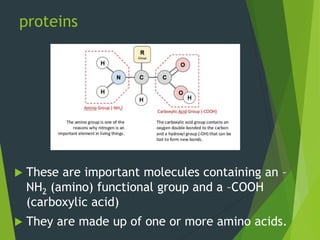
 These are important molecules containing an –
NH2 (amino) functional group and a –COOH
(carboxylic acid)
 They are made up of one or more amino acids.
 Proteins are macromolecules.
 Two amino acids are linked together by peptide bonds.
 There are 20 amino acids, 8 of these are essential because
they cannot be created by the human body.
 Most organisms have thousands of different protein
molecules.
 Each protein has its own structure
 This determines its properties and function
 The number of amino acids in a protein can range in the
10000’s.
Proteins can have many different functions in
organisms:
 Structural _________________________
 Catalyse reactions _________________________
 Contraction _________________________
 Transport _________________________
 Defence _________________________
 Coordination _________________________
 Storage _________________________
Three dimensional protein structure
is directly linked proteins to its
function
They facilitate recognition and binding of specific
molecules (enzymes to substrates) as well as cell
membrane receptors and hormones.
The function of a protein nearly always involves
binding in a specific complementary manner to
another molecule
Song -
http://www.youtube.com/watch?v=ID6KY1QBR5s
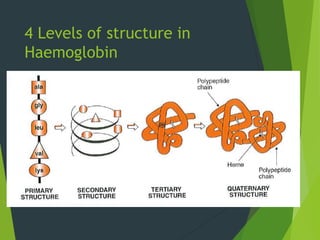
Primary Structure
Specific sequence of amino acids directed by codons on
the mRNA transcribed from a DNA template . A change in
one amino acid can lead to a significantly altered protein
(mutation)
i.e. Haemoglobin sickle cell anaemia
Secondary Structure
Coiling or folding of a polypeptide chain
Tertiary Structure
Three dimensional shape of a polypeptide, forming as
result of attraction and repulsions between various amino
acids. Includes enzymes, antibodies, haemoglobin and
hormones
Quaternary Structure
Arise from the bonding of two or more poly peptides
4 Levels of structure in
Haemoglobin
Sickle cell anemia
 Haemoglobin consists of 4 polypeptide bonds.
 Sickle cell anemia is caused when the 6th
amino acid in one of the chains is changed
from glutamic acid to valine.
 The haemoglobin molecule changes from a
round to long fibrous sticky structure.
 This change means fewer oxygen molecules
that can be carried.
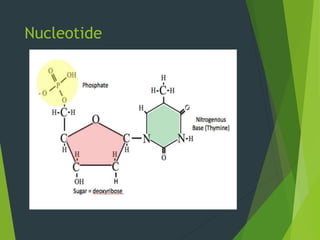
Nucleotides
Nucleic acids are macromolecules which are made up of
subunits, called nucleotides. These are the building blocks
of DNA. Nucleotides consist of
 A 5 carbon sugar (ribose or deoxyribose)
 A phosphate group
 A nitrogenous base
 Weak hydrogen bond will depend on base pairing
There are two types of nucleic acid:
 DNA –Deoxyribose Nucleic Acid
 RNA – Ribose Nucleic Acid
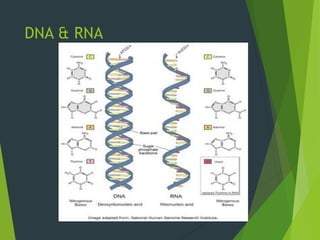
DNA nucleotides contain deoxyribose sugar
RNA nucleotides contain ribose sugar
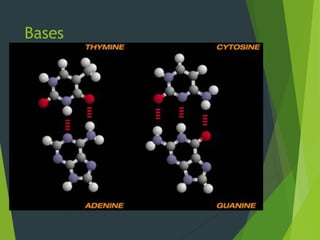
Nitrogenous Bases
DNA and RNA differ in their Nucleotides.
Each has 4 nitrogen bases
DNA
 Adenine (A), Cytosine (C), Guanine (G), Thymine (T)
RNA
 Adenine (A), Cytosine (C), Guanine (G), Uracil (U)
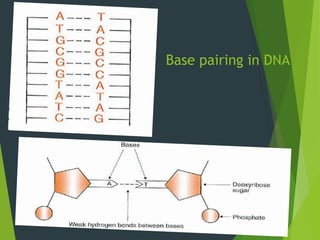
In DNA, Because of the shape of these molecules, they will only
pair in certain ways.
 Adenine – Thymine
 Cytosine – Guanine
Weak hydrogen bonds are formed between DNA bases.
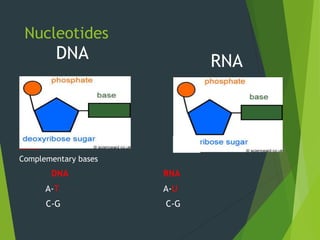
Nucleotides
Complementary bases
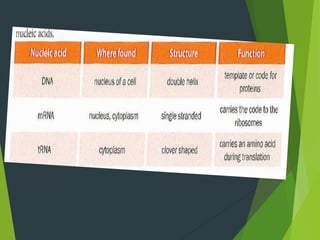
DNA RNA
A-T A-U
C-G C-G
DNA RNA
RNA
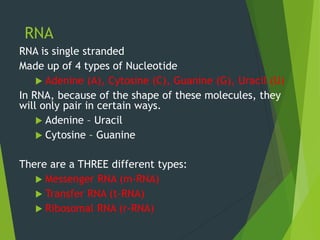
RNA is single stranded
Made up of 4 types of Nucleotide
 Adenine (A), Cytosine (C), Guanine (G), Uracil (U)
In RNA, because of the shape of these molecules, they
will only pair in certain ways.
 Adenine – Uracil
 Cytosine – Guanine
There are a THREE different types:
 Messenger RNA (m-RNA)
 Transfer RNA (t-RNA)
 Ribosomal RNA (r-RNA)
Types of RNA
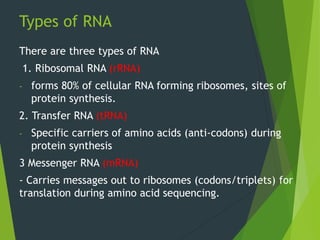
There are three types of RNA
1. Ribosomal RNA (rRNA)
- forms 80% of cellular RNA forming ribosomes, sites of
protein synthesis.
2. Transfer RNA (tRNA)
- Specific carriers of amino acids (anti-codons) during
protein synthesis
3 Messenger RNA (mRNA)
- Carries messages out to ribosomes (codons/triplets) for
translation during amino acid sequencing.
DNA & RNA
Brief History of Discovery of DNA
DNA is the chemical found in all cells that
controls virtually everything that happens
in cells
DNA was first isolated in 1869 by a Swiss
chemist, Fredrich Miescher.
He identified a molecule that was acidic
and contained phosphorous.
Since it was found primarily in the nucleus,
it was named Nucleic Acid.
Brief History of Discovery of DNA
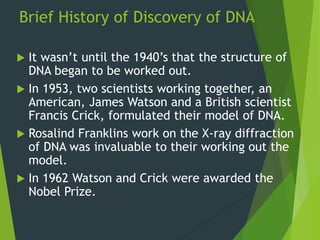
 It wasn’t until the 1940’s that the structure of
DNA began to be worked out.
 In 1953, two scientists working together, an
American, James Watson and a British scientist
Francis Crick, formulated their model of DNA.
 Rosalind Franklins work on the X-ray diffraction
of DNA was invaluable to their working out the
model.
 In 1962 Watson and Crick were awarded the
Nobel Prize.
DNA
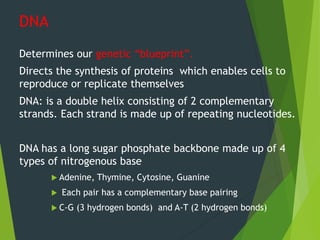
Determines our genetic “blueprint”.
Directs the synthesis of proteins which enables cells to
reproduce or replicate themselves
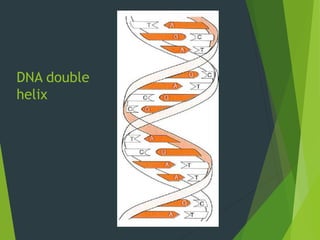
DNA: is a double helix consisting of 2 complementary
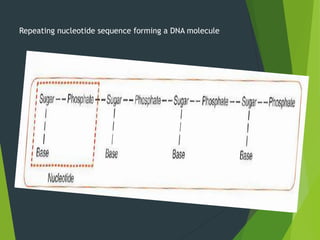
strands. Each strand is made up of repeating nucleotides.
DNA has a long sugar phosphate backbone made up of 4
types of nitrogenous base
 Adenine, Thymine, Cytosine, Guanine
 Each pair has a complementary base pairing
 C-G (3 hydrogen bonds) and A-T (2 hydrogen bonds)
Repeating nucleotide sequence forming a DNA molecule
Base pairing in DNA
Bases
DNA double
helix
Nucleotide
Key Points: DNA
The chemical located in all cells which codes for
and controls all cell activities
Chemical basis of the genes which code for all
characteristics of an organism
Codes for and directs protein synthesis ( the
building up of proteins)
Codes for and regulates cell division, clones (
copies) for repair & growth and reproduction
Built up from sugar phosphate backbone ( ladder
uprights) and complementary pairing of nitrogen
bases ( rungs of ladder)
Chromosomes
Found in nucleus of all eukaryotic cells.
Chromosomes are composed of chromatin which is DNA
and protein molecules.
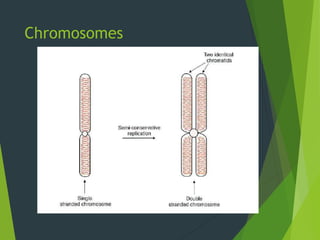
Each chromosome consists of two chromatids joined at
the centromere
DNA in turn is composed of hereditary units call genes.
A genes specific location is termed its locus
There are thousands of such genes on each chromosome
(many are referred to as “junk”)
Chromosomes
Chromosomes
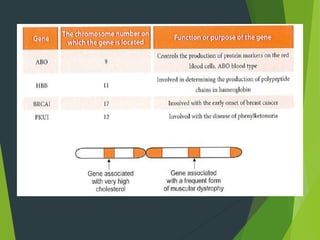
Each gene codes for a specific protein.
The human genome has approx. 25,000 genes and
3 billion DNA bases. In 1990 their “loci” (location)
were mapped out by the Human Genome Project
The Adelaide Women's and Children's Hospital
sequenced the DNA on chromosome 16.
The knowledge of their location and sequencing
has revealed factors and information regarding
many diseases which allow for their treatment
and prevention
Key Points: Chromosomes
 Rod shaped strands of genes
 Composed of chromatin a complex mixture of
protein and DNA
 Each chromosome is a very long strand
composed of many nucleotides
 Human cells contain 23 pairs of homologous
chromosomes ( 46 in all)
 Males contain a shorter y chromosome and X
 Females only have X chromosome ( so the Dad
dictates the gender of offspring)
Note key points
Do focus questions on p19 and 31 and 32
Genes
A gene is:
a segment of chromosomes that contain the code required to
direct the manufacture of a polypeptide or RNA molecule.
The unit of hereditary
The specific location of a gene on a chromosome is termed its
locus
Genes represent sequences of the base A T G and C on
chromosomes
Genes prescribe the features of an organism eg eye colour
In a human with 46 chromosomes there are around 100000
genes with each chromosome containing hundreds or
thousands of genes.
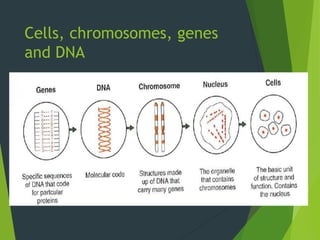
Cells, chromosomes, genes
and DNA
Karotype
Chromosomes are visible when the cell starts to divide.
Human body cells have 46 chromosomes;
23 pairs of chromosomes
one set from the mother and one set from the father
22 pairs of autosomes (non sex chromosomes)
1 pair of sex chromosomes
XX –female XY – male
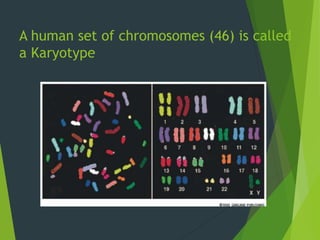
A complete set of chromosomes is called a karyotype.
Each chromosome has genes specific for that
chromosome making it identifiable.
A human set of chromosomes (46) is called
a Karyotype
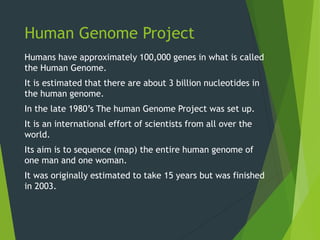
Human Genome Project
Humans have approximately 100,000 genes in what is called
the Human Genome.
It is estimated that there are about 3 billion nucleotides in
the human genome.
In the late 1980’s The human Genome Project was set up.
It is an international effort of scientists from all over the
world.
Its aim is to sequence (map) the entire human genome of
one man and one woman.
It was originally estimated to take 15 years but was finished
in 2003.
Homework
 Read Chapter 1
 Note key points
 Write answers to focus questions 1-5 pg5
M2 The structural unit of information
in the cell is the chromosome
Read Key Ideas
- Note key points
- Do Focus Questions 1-4 page 7
Clickview The Human Genome Project
Homework Do Worksheet 2 page 8-9
Essentials
M2 practical
Enzymes and preferred conditions

Macromolecules continued

  • 1.
    The Chemicals ofLife cont’d Proteins – enzymes, hormones, antibodies Nucleic acids – DNA and RNA
  • 2.
    proteins  These areimportant molecules containing an – NH2 (amino) functional group and a –COOH (carboxylic acid)  They are made up of one or more amino acids.
  • 3.
     Proteins aremacromolecules.  Two amino acids are linked together by peptide bonds.  There are 20 amino acids, 8 of these are essential because they cannot be created by the human body.  Most organisms have thousands of different protein molecules.  Each protein has its own structure  This determines its properties and function  The number of amino acids in a protein can range in the 10000’s.
  • 4.
    Proteins can havemany different functions in organisms:  Structural _________________________  Catalyse reactions _________________________  Contraction _________________________  Transport _________________________  Defence _________________________  Coordination _________________________  Storage _________________________
  • 5.
    Three dimensional proteinstructure is directly linked proteins to its function They facilitate recognition and binding of specific molecules (enzymes to substrates) as well as cell membrane receptors and hormones. The function of a protein nearly always involves binding in a specific complementary manner to another molecule Song - http://www.youtube.com/watch?v=ID6KY1QBR5s
  • 6.
    Primary Structure Specific sequenceof amino acids directed by codons on the mRNA transcribed from a DNA template . A change in one amino acid can lead to a significantly altered protein (mutation) i.e. Haemoglobin sickle cell anaemia Secondary Structure Coiling or folding of a polypeptide chain
  • 7.
    Tertiary Structure Three dimensionalshape of a polypeptide, forming as result of attraction and repulsions between various amino acids. Includes enzymes, antibodies, haemoglobin and hormones Quaternary Structure Arise from the bonding of two or more poly peptides
  • 8.
    4 Levels ofstructure in Haemoglobin
  • 9.
    Sickle cell anemia Haemoglobin consists of 4 polypeptide bonds.  Sickle cell anemia is caused when the 6th amino acid in one of the chains is changed from glutamic acid to valine.  The haemoglobin molecule changes from a round to long fibrous sticky structure.  This change means fewer oxygen molecules that can be carried.
  • 10.
    Nucleotides Nucleic acids aremacromolecules which are made up of subunits, called nucleotides. These are the building blocks of DNA. Nucleotides consist of  A 5 carbon sugar (ribose or deoxyribose)  A phosphate group  A nitrogenous base  Weak hydrogen bond will depend on base pairing There are two types of nucleic acid:  DNA –Deoxyribose Nucleic Acid  RNA – Ribose Nucleic Acid DNA nucleotides contain deoxyribose sugar RNA nucleotides contain ribose sugar
  • 11.
    Nitrogenous Bases DNA andRNA differ in their Nucleotides. Each has 4 nitrogen bases DNA  Adenine (A), Cytosine (C), Guanine (G), Thymine (T) RNA  Adenine (A), Cytosine (C), Guanine (G), Uracil (U) In DNA, Because of the shape of these molecules, they will only pair in certain ways.  Adenine – Thymine  Cytosine – Guanine Weak hydrogen bonds are formed between DNA bases.
  • 12.
  • 13.
    RNA RNA is singlestranded Made up of 4 types of Nucleotide  Adenine (A), Cytosine (C), Guanine (G), Uracil (U) In RNA, because of the shape of these molecules, they will only pair in certain ways.  Adenine – Uracil  Cytosine – Guanine There are a THREE different types:  Messenger RNA (m-RNA)  Transfer RNA (t-RNA)  Ribosomal RNA (r-RNA)
  • 14.
    Types of RNA Thereare three types of RNA 1. Ribosomal RNA (rRNA) - forms 80% of cellular RNA forming ribosomes, sites of protein synthesis. 2. Transfer RNA (tRNA) - Specific carriers of amino acids (anti-codons) during protein synthesis 3 Messenger RNA (mRNA) - Carries messages out to ribosomes (codons/triplets) for translation during amino acid sequencing.
  • 15.
  • 16.
    Brief History ofDiscovery of DNA DNA is the chemical found in all cells that controls virtually everything that happens in cells DNA was first isolated in 1869 by a Swiss chemist, Fredrich Miescher. He identified a molecule that was acidic and contained phosphorous. Since it was found primarily in the nucleus, it was named Nucleic Acid.

  • 17.
    Brief History ofDiscovery of DNA  It wasn’t until the 1940’s that the structure of DNA began to be worked out.  In 1953, two scientists working together, an American, James Watson and a British scientist Francis Crick, formulated their model of DNA.  Rosalind Franklins work on the X-ray diffraction of DNA was invaluable to their working out the model.  In 1962 Watson and Crick were awarded the Nobel Prize.
  • 18.
    DNA Determines our genetic“blueprint”. Directs the synthesis of proteins which enables cells to reproduce or replicate themselves DNA: is a double helix consisting of 2 complementary strands. Each strand is made up of repeating nucleotides. DNA has a long sugar phosphate backbone made up of 4 types of nitrogenous base  Adenine, Thymine, Cytosine, Guanine  Each pair has a complementary base pairing  C-G (3 hydrogen bonds) and A-T (2 hydrogen bonds)
  • 19.
    Repeating nucleotide sequenceforming a DNA molecule
  • 20.
  • 21.
  • 22.
  • 23.
  • 25.
    Key Points: DNA Thechemical located in all cells which codes for and controls all cell activities Chemical basis of the genes which code for all characteristics of an organism Codes for and directs protein synthesis ( the building up of proteins) Codes for and regulates cell division, clones ( copies) for repair & growth and reproduction Built up from sugar phosphate backbone ( ladder uprights) and complementary pairing of nitrogen bases ( rungs of ladder)
  • 26.
    Chromosomes Found in nucleusof all eukaryotic cells. Chromosomes are composed of chromatin which is DNA and protein molecules. Each chromosome consists of two chromatids joined at the centromere DNA in turn is composed of hereditary units call genes. A genes specific location is termed its locus There are thousands of such genes on each chromosome (many are referred to as “junk”)
  • 27.
  • 28.
    Chromosomes Each gene codesfor a specific protein. The human genome has approx. 25,000 genes and 3 billion DNA bases. In 1990 their “loci” (location) were mapped out by the Human Genome Project The Adelaide Women's and Children's Hospital sequenced the DNA on chromosome 16. The knowledge of their location and sequencing has revealed factors and information regarding many diseases which allow for their treatment and prevention
  • 30.
    Key Points: Chromosomes Rod shaped strands of genes  Composed of chromatin a complex mixture of protein and DNA  Each chromosome is a very long strand composed of many nucleotides  Human cells contain 23 pairs of homologous chromosomes ( 46 in all)  Males contain a shorter y chromosome and X  Females only have X chromosome ( so the Dad dictates the gender of offspring)
  • 31.
    Note key points Dofocus questions on p19 and 31 and 32
  • 32.
    Genes A gene is: asegment of chromosomes that contain the code required to direct the manufacture of a polypeptide or RNA molecule. The unit of hereditary The specific location of a gene on a chromosome is termed its locus Genes represent sequences of the base A T G and C on chromosomes Genes prescribe the features of an organism eg eye colour In a human with 46 chromosomes there are around 100000 genes with each chromosome containing hundreds or thousands of genes.
  • 33.
  • 34.
    Karotype Chromosomes are visiblewhen the cell starts to divide. Human body cells have 46 chromosomes; 23 pairs of chromosomes one set from the mother and one set from the father 22 pairs of autosomes (non sex chromosomes) 1 pair of sex chromosomes XX –female XY – male A complete set of chromosomes is called a karyotype. Each chromosome has genes specific for that chromosome making it identifiable.
  • 35.
    A human setof chromosomes (46) is called a Karyotype
  • 36.
    Human Genome Project Humanshave approximately 100,000 genes in what is called the Human Genome. It is estimated that there are about 3 billion nucleotides in the human genome. In the late 1980’s The human Genome Project was set up. It is an international effort of scientists from all over the world. Its aim is to sequence (map) the entire human genome of one man and one woman. It was originally estimated to take 15 years but was finished in 2003.
  • 37.
    Homework  Read Chapter1  Note key points  Write answers to focus questions 1-5 pg5
  • 38.
    M2 The structuralunit of information in the cell is the chromosome Read Key Ideas - Note key points - Do Focus Questions 1-4 page 7 Clickview The Human Genome Project Homework Do Worksheet 2 page 8-9 Essentials
  • 39.
    M2 practical Enzymes andpreferred conditions