Public Expenditures
PUBLIC
- Supported by
money from the
government and
from the
contributors rather
than commercial.
EXPENDITURES
- An amount of
money spent on
something
• The expenditures of the government
are reflected in the national budget
which shows the specific programs and
projects of the government in one year.
Such expenditures
indicate the
emphasis and
direction of the
national economy as
well as its needs and
problems.
In short, public expenditures
mirror the major goals of the
government
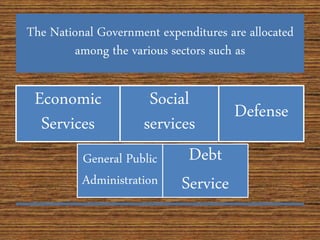
The National Government expenditures are allocated
among the various sectors such as
Economic
Services
Social
services
Defense
General Public
Administration
Debt
Service
Developing countries, which
believe that their peoples
constitute the real key to their
progress provide the biggest
budget for education.
To them, investment in human
resources is the best investment. They
give top priority to the training and
education of their people. A kind of
human resources development which is
relevant to the needs of their economy
and society.
In our case, it has been alleged
that we have a colonial
education which only benefits
the business interests of the
Americans.
Public Expenditures have been increasing tremendously as
shown in our yearly national budgets. There are causes
for such leap in our public expenditures such as inflation,
growth of population, increase in the price of oil, and
the massive infrastructure projects of the government.
We are a nation of 65 million people. This
alone requires huge expenditures on social
services like education, health, housing and
other social services. Our peace and order
problems also need big budget.
EVALUATING
PUBLIC
EXPENDITURES
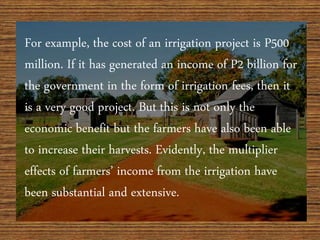
For example, the cost of an irrigation project is P500
million. If it has generated an income of P2 billion for
the government in the form of irrigation fees, then it
is a very good project. But this is not only the
economic benefit but the farmers have also been able
to increase their harvests. Evidently, the multiplier
effects of farmers’ income from the irrigation have
been substantial and extensive.
However, economic profitability is not only the
basis of judging whether a project is good or not.
In the less developed countries, government
programs and projects should be evaluated more on
their social impact of the people.
If such projects or programs have touched the
miserable lives of the masses, then these are
excellent programs or projects.
Social justice should be the first
priority in estimating the benefits of
government expenditures.
Programs which are highly profitable but
benefit only very few are not appropriate
in a country where most people are poor.
A government should provide more funds to
programs and projects which are principally
designed to improve the social and economic
conditions of the poor masses.

Public expenditures

  • 1.
  • 2.
    PUBLIC - Supported by moneyfrom the government and from the contributors rather than commercial. EXPENDITURES - An amount of money spent on something
  • 3.
    • The expendituresof the government are reflected in the national budget which shows the specific programs and projects of the government in one year.
  • 4.
    Such expenditures indicate the emphasisand direction of the national economy as well as its needs and problems.
  • 5.
    In short, publicexpenditures mirror the major goals of the government
  • 6.
    The National Governmentexpenditures are allocated among the various sectors such as Economic Services Social services Defense General Public Administration Debt Service
  • 7.
    Developing countries, which believethat their peoples constitute the real key to their progress provide the biggest budget for education.
  • 8.
    To them, investmentin human resources is the best investment. They give top priority to the training and education of their people. A kind of human resources development which is relevant to the needs of their economy and society.
  • 9.
    In our case,it has been alleged that we have a colonial education which only benefits the business interests of the Americans.
  • 10.
    Public Expenditures havebeen increasing tremendously as shown in our yearly national budgets. There are causes for such leap in our public expenditures such as inflation, growth of population, increase in the price of oil, and the massive infrastructure projects of the government.
  • 11.
    We are anation of 65 million people. This alone requires huge expenditures on social services like education, health, housing and other social services. Our peace and order problems also need big budget.
  • 12.
  • 14.
    For example, thecost of an irrigation project is P500 million. If it has generated an income of P2 billion for the government in the form of irrigation fees, then it is a very good project. But this is not only the economic benefit but the farmers have also been able to increase their harvests. Evidently, the multiplier effects of farmers’ income from the irrigation have been substantial and extensive.
  • 15.
    However, economic profitabilityis not only the basis of judging whether a project is good or not. In the less developed countries, government programs and projects should be evaluated more on their social impact of the people. If such projects or programs have touched the miserable lives of the masses, then these are excellent programs or projects.
  • 16.
    Social justice shouldbe the first priority in estimating the benefits of government expenditures. Programs which are highly profitable but benefit only very few are not appropriate in a country where most people are poor. A government should provide more funds to programs and projects which are principally designed to improve the social and economic conditions of the poor masses.