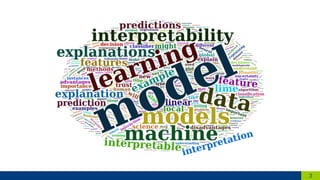
Machine Learning Interpretability
Marcel Spitzer Munich, 20.11.2018
2
Marcel Spitzer
Big Data Scientist @ inovex
● Applied Mathematics, Data Science
● SW Engineering, Data Products
● Big Data, Hadoop, Spark
mspitzer@inovex.de
@mspitzer243
3
4
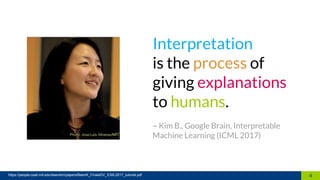
Interpretation
is the process of
giving explanations
to humans.
~ Kim B., Google Brain, Interpretable
Machine Learning (ICML 2017)
https://people.csail.mit.edu/beenkim/papers/BeenK_FinaleDV_ICML2017_tutorial.pdf
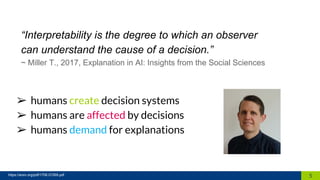
5
“Interpretability is the degree to which an observer
can understand the cause of a decision.”
~ Miller T., 2017, Explanation in AI: Insights from the Social Sciences
➢ humans create decision systems
➢ humans are affected by decisions
➢ humans demand for explanations
https://arxiv.org/pdf/1706.07269.pdf
6
NIPS 2016 workshop on Interpretable Machine
Learning for Complex Systems
ICML 2016 Workshop on Human
Interpretability in Machine Learning
NIPS 2017 Workshop on Interpreting,
Explaining and Visualizing Deep Learning
NIPS 2017 symposium and workshop:
interpretable and Bayesian machine learning
ICML 2017 Workshop on Human
Interpretability in Machine Learning
ICML 2018 Workshop on Human
Interpretability in Machine Learning
https://people.csail.mit.edu/beenkim/papers/BeenK_FinaleDV_ICML2017_tutorial.pdf
7https://arxiv.org/pdf/1606.03490.pdf
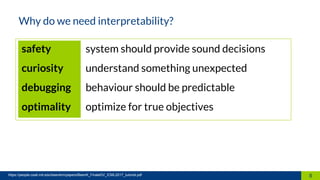
The additional need for interpretability
8
safety system should provide sound decisions
curiosity understand something unexpected
debugging behaviour should be predictable
optimality optimize for true objectives
Why do we need interpretability?
https://people.csail.mit.edu/beenkim/papers/BeenK_FinaleDV_ICML2017_tutorial.pdf
9
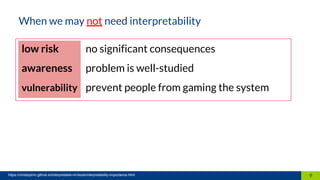
When we may not need interpretability
https://christophm.github.io/interpretable-ml-book/interpretability-importance.html
low risk no significant consequences
awareness problem is well-studied
vulnerability prevent people from gaming the system
10
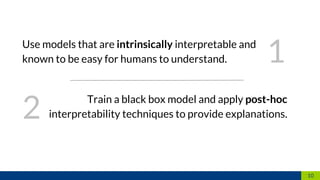
Use models that are intrinsically interpretable and
known to be easy for humans to understand.
Train a black box model and apply post-hoc
interpretability techniques to provide explanations.
1
2
11
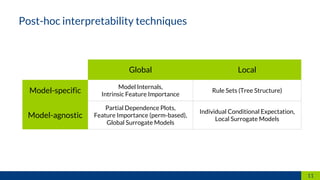
Post-hoc interpretability techniques
Global Local
Model-specific
Model Internals,
Intrinsic Feature Importance
Rule Sets (Tree Structure)
Model-agnostic
Partial Dependence Plots,
Feature Importance (perm-based),
Global Surrogate Models
Individual Conditional Expectation,
Local Surrogate Models
12
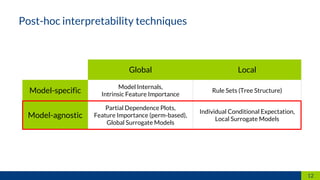
Post-hoc interpretability techniques
Global Local
Model-specific
Model Internals,
Intrinsic Feature Importance
Rule Sets (Tree Structure)
Model-agnostic
Partial Dependence Plots,
Feature Importance (perm-based),
Global Surrogate Models
Individual Conditional Expectation,
Local Surrogate Models
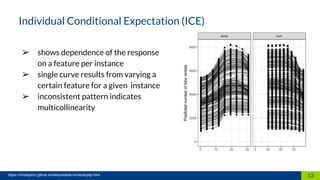
➢ shows dependence of the response
on a feature per instance
➢ single curve results from varying a
certain feature for a given instance
➢ inconsistent pattern indicates
multicollinearity
13
Individual Conditional Expectation (ICE)
https://christophm.github.io/interpretable-ml-book/pdp.html
14
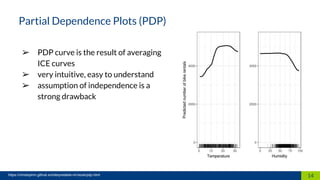
Partial Dependence Plots (PDP)
➢ PDP curve is the result of averaging
ICE curves
➢ very intuitive, easy to understand
➢ assumption of independence is a
strong drawback
https://christophm.github.io/interpretable-ml-book/pdp.html
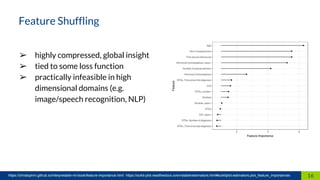
➢ averages degradation measured by a certain loss function after repeatedly
permuting single features
➢ feature is important if the error significantly increases after a shuffle
15
Feature Shuffling
https://amunategui.github.io/variable-importance-shuffler/
➢ highly compressed, global insight
➢ tied to some loss function
➢ practically infeasible in high
dimensional domains (e.g.
image/speech recognition, NLP)
16
Feature Shuffling
https://christophm.github.io/interpretable-ml-book/feature-importance.html https://scikit-plot.readthedocs.io/en/stable/estimators.html#scikitplot.estimators.plot_feature_importances
17
Global Surrogate Models
https://www.oreilly.com/ideas/ideas-on-interpreting-machine-learning
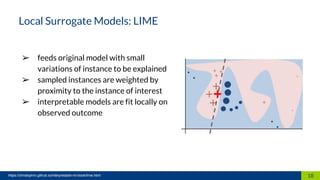
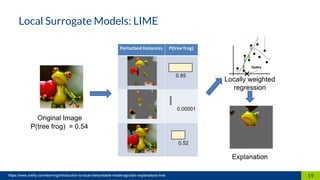
➢ feeds original model with small
variations of instance to be explained
➢ sampled instances are weighted by
proximity to the instance of interest
➢ interpretable models are fit locally on
observed outcome
18
Local Surrogate Models: LIME
https://christophm.github.io/interpretable-ml-book/lime.html
19
Local Surrogate Models: LIME
https://www.oreilly.com/learning/introduction-to-local-interpretable-model-agnostic-explanations-lime
20
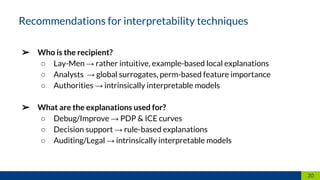
Recommendations for interpretability techniques
➢ Who is the recipient?
○ Lay-Men → rather intuitive, example-based local explanations
○ Analysts → global surrogates, perm-based feature importance
○ Authorities → intrinsically interpretable models
➢ What are the explanations used for?
○ Debug/Improve → PDP & ICE curves
○ Decision support → rule-based explanations
○ Auditing/Legal → intrinsically interpretable models
➢ Molnar C., 2018, Interpretable Machine Learning - A Guide for Making
Black Box Models Explainable
➢ Gill N., Hall P., 2018, An Introduction to Machine Learning Interpretability
➢ Zhao Q., Hastie T., 2017, Causal Interpretations of Black-Box Models
➢ Kim B., Doshi-Velez F., 2017, Interpretable Machine Learning: The fuss,
the concrete and the questions
➢ Ribeiro, M.T., Singh, S. and Guestrin, C., 2016, August. Why should i trust
you? Explaining the predictions of any classifier
21
Resources
Vielen Dank
Marcel Spitzer
Big Data Scientist
mspitzer@inovex.de
inovex GmbH
Schanzenstraße 6-20
Kupferhütte 1.13
51063 Köln

Machine Learning Interpretability

  • 1.
    Machine Learning Interpretability MarcelSpitzer Munich, 20.11.2018
  • 2.
    2 Marcel Spitzer Big DataScientist @ inovex ● Applied Mathematics, Data Science ● SW Engineering, Data Products ● Big Data, Hadoop, Spark mspitzer@inovex.de @mspitzer243
  • 3.
  • 4.
    4 Interpretation is the processof giving explanations to humans. ~ Kim B., Google Brain, Interpretable Machine Learning (ICML 2017) https://people.csail.mit.edu/beenkim/papers/BeenK_FinaleDV_ICML2017_tutorial.pdf
  • 5.
    5 “Interpretability is thedegree to which an observer can understand the cause of a decision.” ~ Miller T., 2017, Explanation in AI: Insights from the Social Sciences ➢ humans create decision systems ➢ humans are affected by decisions ➢ humans demand for explanations https://arxiv.org/pdf/1706.07269.pdf
  • 6.
    6 NIPS 2016 workshopon Interpretable Machine Learning for Complex Systems ICML 2016 Workshop on Human Interpretability in Machine Learning NIPS 2017 Workshop on Interpreting, Explaining and Visualizing Deep Learning NIPS 2017 symposium and workshop: interpretable and Bayesian machine learning ICML 2017 Workshop on Human Interpretability in Machine Learning ICML 2018 Workshop on Human Interpretability in Machine Learning https://people.csail.mit.edu/beenkim/papers/BeenK_FinaleDV_ICML2017_tutorial.pdf
  • 7.
  • 8.
    8 safety system shouldprovide sound decisions curiosity understand something unexpected debugging behaviour should be predictable optimality optimize for true objectives Why do we need interpretability? https://people.csail.mit.edu/beenkim/papers/BeenK_FinaleDV_ICML2017_tutorial.pdf
  • 9.
    9 When we maynot need interpretability https://christophm.github.io/interpretable-ml-book/interpretability-importance.html low risk no significant consequences awareness problem is well-studied vulnerability prevent people from gaming the system
  • 10.
    10 Use models thatare intrinsically interpretable and known to be easy for humans to understand. Train a black box model and apply post-hoc interpretability techniques to provide explanations. 1 2
  • 11.
    11 Post-hoc interpretability techniques GlobalLocal Model-specific Model Internals, Intrinsic Feature Importance Rule Sets (Tree Structure) Model-agnostic Partial Dependence Plots, Feature Importance (perm-based), Global Surrogate Models Individual Conditional Expectation, Local Surrogate Models
  • 12.
    12 Post-hoc interpretability techniques GlobalLocal Model-specific Model Internals, Intrinsic Feature Importance Rule Sets (Tree Structure) Model-agnostic Partial Dependence Plots, Feature Importance (perm-based), Global Surrogate Models Individual Conditional Expectation, Local Surrogate Models
  • 13.
    ➢ shows dependenceof the response on a feature per instance ➢ single curve results from varying a certain feature for a given instance ➢ inconsistent pattern indicates multicollinearity 13 Individual Conditional Expectation (ICE) https://christophm.github.io/interpretable-ml-book/pdp.html
  • 14.
    14 Partial Dependence Plots(PDP) ➢ PDP curve is the result of averaging ICE curves ➢ very intuitive, easy to understand ➢ assumption of independence is a strong drawback https://christophm.github.io/interpretable-ml-book/pdp.html
  • 15.
    ➢ averages degradationmeasured by a certain loss function after repeatedly permuting single features ➢ feature is important if the error significantly increases after a shuffle 15 Feature Shuffling https://amunategui.github.io/variable-importance-shuffler/
  • 16.
    ➢ highly compressed,global insight ➢ tied to some loss function ➢ practically infeasible in high dimensional domains (e.g. image/speech recognition, NLP) 16 Feature Shuffling https://christophm.github.io/interpretable-ml-book/feature-importance.html https://scikit-plot.readthedocs.io/en/stable/estimators.html#scikitplot.estimators.plot_feature_importances
  • 17.
  • 18.
    ➢ feeds originalmodel with small variations of instance to be explained ➢ sampled instances are weighted by proximity to the instance of interest ➢ interpretable models are fit locally on observed outcome 18 Local Surrogate Models: LIME https://christophm.github.io/interpretable-ml-book/lime.html
  • 19.
    19 Local Surrogate Models:LIME https://www.oreilly.com/learning/introduction-to-local-interpretable-model-agnostic-explanations-lime
  • 20.
    20 Recommendations for interpretabilitytechniques ➢ Who is the recipient? ○ Lay-Men → rather intuitive, example-based local explanations ○ Analysts → global surrogates, perm-based feature importance ○ Authorities → intrinsically interpretable models ➢ What are the explanations used for? ○ Debug/Improve → PDP & ICE curves ○ Decision support → rule-based explanations ○ Auditing/Legal → intrinsically interpretable models
  • 21.
    ➢ Molnar C.,2018, Interpretable Machine Learning - A Guide for Making Black Box Models Explainable ➢ Gill N., Hall P., 2018, An Introduction to Machine Learning Interpretability ➢ Zhao Q., Hastie T., 2017, Causal Interpretations of Black-Box Models ➢ Kim B., Doshi-Velez F., 2017, Interpretable Machine Learning: The fuss, the concrete and the questions ➢ Ribeiro, M.T., Singh, S. and Guestrin, C., 2016, August. Why should i trust you? Explaining the predictions of any classifier 21 Resources
  • 22.
    Vielen Dank Marcel Spitzer BigData Scientist mspitzer@inovex.de inovex GmbH Schanzenstraße 6-20 Kupferhütte 1.13 51063 Köln