“Was mit Sprache” gelernt
- Linguistik und Philosophie @unihd
“Was mit Computern” gelernt
- Informatik @hska
Kombination
- Search Engineer @inovex
@findefain
2
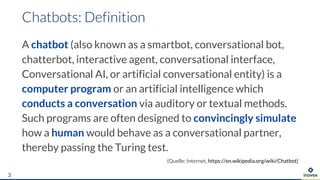
A chatbot (also known as a smartbot, conversational bot,
chatterbot, interactive agent, conversational interface,
Conversational AI, or artificial conversational entity) is a
computer program or an artificial intelligence which
conducts a conversation via auditory or textual methods.
Such programs are often designed to convincingly simulate
how a human would behave as a conversational partner,
thereby passing the Turing test.
(Quelle: Internet, https://en.wikipedia.org/wiki/Chatbot)
3
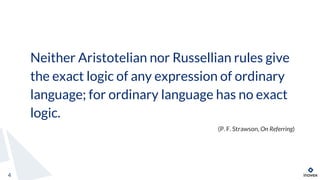
Neither Aristotelian nor Russellian rules give
the exact logic of any expression of ordinary
language; for ordinary language has no exact
logic.
(P. F. Strawson, On Referring)
4
5
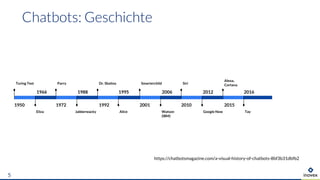
1950
Turing Test
1966
Eliza
1972
Parry
1988
Jabberwacky
1992
Dr. Sbaitso
1995
Alice
2001
Smarterchild
2006
Watson
(IBM)
2010
Siri
2012
Google Now
2015
Alexa,
Cortana
2016
Tay
https://chatbotsmagazine.com/a-visual-history-of-chatbots-8bf3b31dbfb2
6
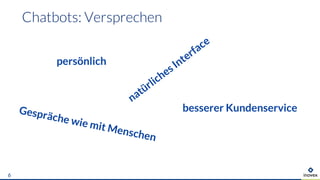
natürliches Interface
Gespräche wie mit Menschen
persönlich
besserer Kundenservice
7
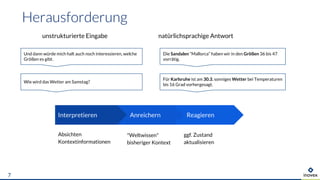
unstrukturierte Eingabe
Und dann würde mich halt auch noch interessieren, welche
Größen es gibt.
Die Sandalen “Mallorca” haben wir in den Größen 36 bis 47
vorrätig.
natürlichsprachige Antwort
Wie wird das Wetter am Samstag?
Für Karlsruhe ist am 30.3. sonniges Wetter bei Temperaturen
bis 16 Grad vorhergesagt.
Interpretieren
Absichten
Kontextinformationen
Anreichern
"Weltwissen"
bisheriger Kontext
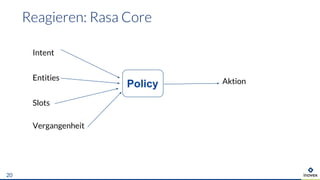
Reagieren
ggf. Zustand
aktualisieren
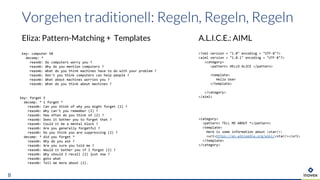
Eliza: Pattern-Matching + Templates
8
key: computer 50
decomp: *
reasmb: Do computers worry you ?
reasmb: Why do you mention computers ?
reasmb: What do you think machines have to do with your problem ?
reasmb: Don't you think computers can help people ?
reasmb: What about machines worries you ?
reasmb: What do you think about machines ?
key: forget 5
decomp: * i forget *
reasmb: Can you think of why you might forget (2) ?
reasmb: Why can't you remember (2) ?
reasmb: How often do you think of (2) ?
reasmb: Does it bother you to forget that ?
reasmb: Could it be a mental block ?
reasmb: Are you generally forgetful ?
reasmb: Do you think you are suppressing (2) ?
decomp: * did you forget *
reasmb: Why do you ask ?
reasmb: Are you sure you told me ?
reasmb: Would it bother you if I forgot (2) ?
reasmb: Why should I recall (2) just now ?
reasmb: goto what
reasmb: Tell me more about (2).
A.L.I.C.E.: AIML
<category>
<pattern> TELL ME ABOUT *</pattern>
<template>
Here is some information about <star/>:
<url>https://en.wikipedia.org/wiki/<star/></url>
</template>
</category>
<?xml version = "1.0" encoding = "UTF-8"?>
<aiml version = "1.0.1" encoding = "UTF-8"?>
<category>
<pattern> HELLO ALICE </pattern>
<template>
Hello User
</template>
</category>
</aiml>
9
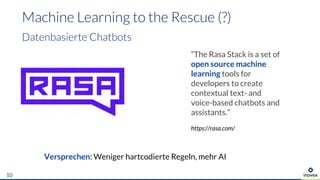
10
“The Rasa Stack is a set of
open source machine
learning tools for
developers to create
contextual text- and
voice-based chatbots and
assistants.”
https://rasa.com/
Versprechen: Weniger hartcodierte Regeln, mehr AI
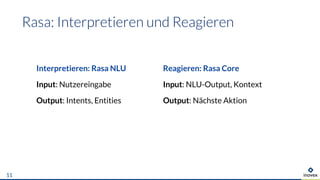
11
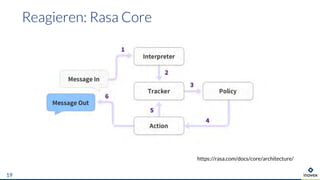
Interpretieren: Rasa NLU Reagieren: Rasa Core
Input: Nutzereingabe Input: NLU-Output, Kontext
Output: Intents, Entities Output: Nächste Aktion
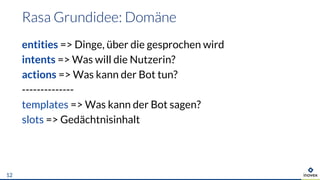
entities => Dinge, über die gesprochen wird
intents => Was will die Nutzerin?
actions => Was kann der Bot tun?
--------------
templates => Was kann der Bot sagen?
slots => Gedächtnisinhalt
12
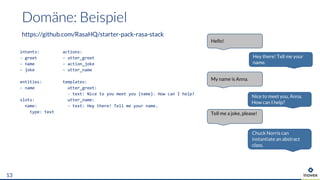
https://github.com/RasaHQ/starter-pack-rasa-stack
13
Hey there! Tell me your
name.
Hello!
My name is Anna.
Nice to meet you, Anna.
How can I help?
Tell me a joke, please!
Chuck Norris can
instantiate an abstract
class.
intents:
- greet
- name
- joke
entities:
- name
slots:
name:
type: text
actions:
- utter_greet
- action_joke
- utter_name
templates:
utter_greet:
- text: Nice to you meet you {name}. How can I help?
utter_name:
- text: Hey there! Tell me your name.
14
language: "en"
pipeline:
- name: "nlp_spacy"
- name: "tokenizer_spacy"
- name: "intent_featurizer_spacy"
- name: "ner_crf"
- name: "intent_classifier_sklearn"
Tokenizer Featurizer NER Intents
My
name is
Anna
{
"intent": {
"name": "name",
"confidence": 0.859506104253725
},
"entities": [
{
"start": 11,
"end": 15,
"value": "anna",
"entity": "name",
"confidence": 0.9516187350992868,
"extractor": "ner_crf"
}
],
"intent_ranking": [
{
"name": "name",
"confidence": 0.859506104253725
},
{
"name": "greet",
"confidence": 0.07173887988512613
},
...
],
"text": "My name is Anna"
}
## intent:greet
- Hi
- Hey
- Hi bot
- Hey bot
## intent:name
- My name is [Juste](name)
- I am [Josh](name)
- I'm [Lucy](name)
- People call me [Greg](name)
15
{
"intent": "name",
"entities": [
{
"start": 15,
"end": 19,
"value": "Greg",
"entity": "name"
}
],
"text": "People call me Greg"
}
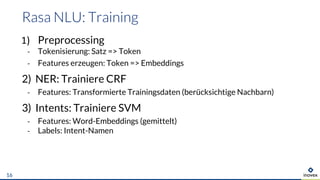
1) Preprocessing
- Tokenisierung: Satz => Token
- Features erzeugen: Token => Embeddings
2) NER: Trainiere CRF
- Features: Transformierte Trainingsdaten (berücksichtige Nachbarn)
3) Intents: Trainiere SVM
- Features: Word-Embeddings (gemittelt)
- Labels: Intent-Namen
16
17
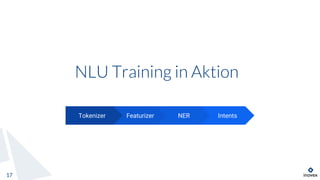
Tokenizer Featurizer NER Intents
{
"intent": {
"name": "name",
"confidence": 0.9501842025598839
},
"entities": [
{
"start": 13,
"end": 17,
"value": "anna",
"entity": "name",
"confidence": 0.9771150313654133,
"extractor": "ner_crf"
}
],
"text": "They call me Anna"
}
18
19
https://rasa.com/docs/core/architecture/
20
Intent
Entities
Slots
Vergangenheit
Policy Aktion
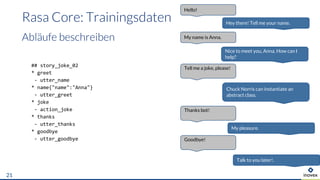
## story_joke_02
* greet
- utter_name
* name{"name":"Anna"}
- utter_greet
* joke
- action_joke
* thanks
- utter_thanks
* goodbye
- utter_goodbye
21
Hey there! Tell me your name.
Hello!
My name is Anna.
Nice to meet you, Anna. How can I
help?
Tell me a joke, please!
Chuck Norris can instantiate an
abstract class.
Thanks bot!
My pleasure.
Goodbye!
Talk to you later!.
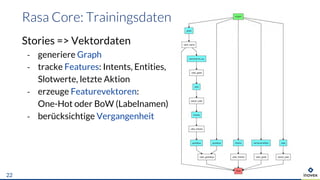
Stories => Vektordaten
- generiere Graph
- tracke Features: Intents, Entities,
Slotwerte, letzte Aktion
- erzeuge Featurevektoren:
One-Hot oder BoW (Labelnamen)
- berücksichtige Vergangenheit
22
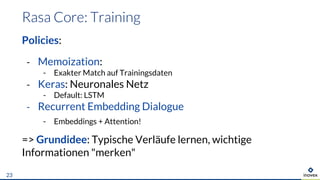
Policies:
- Memoization:
- Exakter Match auf Trainingsdaten
- Keras: Neuronales Netz
- Default: LSTM
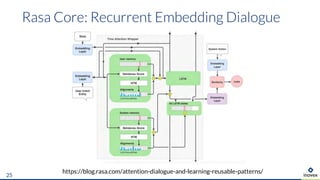
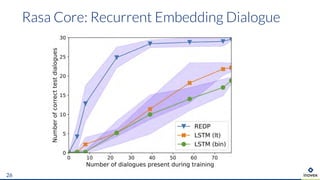
- Recurrent Embedding Dialogue
- Embeddings + Attention!
=> Grundidee: Typische Verläufe lernen, wichtige
Informationen "merken"
23
24
25
https://blog.rasa.com/attention-dialogue-and-learning-reusable-patterns/
26
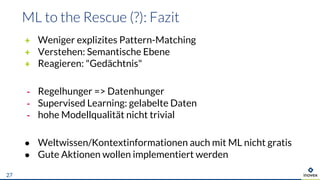
+ Weniger explizites Pattern-Matching
+ Verstehen: Semantische Ebene
+ Reagieren: "Gedächtnis"
- Regelhunger => Datenhunger
- Supervised Learning: gelabelte Daten
- hohe Modellqualität nicht trivial
● Weltwissen/Kontextinformationen auch mit ML nicht gratis
● Gute Aktionen wollen implementiert werden
27
Anna Weißhaar
Search Engineer
inovex GmbH
Ludwig-Erhard-Allee 6
76131 Karlsruhe
anna.weisshaar@inovex.de
0173 3181 097

Talk to me – Chatbots und digitale Assistenten

  • 2.
    “Was mit Sprache”gelernt - Linguistik und Philosophie @unihd “Was mit Computern” gelernt - Informatik @hska Kombination - Search Engineer @inovex @findefain 2
  • 3.
    A chatbot (alsoknown as a smartbot, conversational bot, chatterbot, interactive agent, conversational interface, Conversational AI, or artificial conversational entity) is a computer program or an artificial intelligence which conducts a conversation via auditory or textual methods. Such programs are often designed to convincingly simulate how a human would behave as a conversational partner, thereby passing the Turing test. (Quelle: Internet, https://en.wikipedia.org/wiki/Chatbot) 3
  • 4.
    Neither Aristotelian norRussellian rules give the exact logic of any expression of ordinary language; for ordinary language has no exact logic. (P. F. Strawson, On Referring) 4
  • 5.
    5 1950 Turing Test 1966 Eliza 1972 Parry 1988 Jabberwacky 1992 Dr. Sbaitso 1995 Alice 2001 Smarterchild 2006 Watson (IBM) 2010 Siri 2012 GoogleNow 2015 Alexa, Cortana 2016 Tay https://chatbotsmagazine.com/a-visual-history-of-chatbots-8bf3b31dbfb2
  • 6.
    6 natürliches Interface Gespräche wiemit Menschen persönlich besserer Kundenservice
  • 7.
    7 unstrukturierte Eingabe Und dannwürde mich halt auch noch interessieren, welche Größen es gibt. Die Sandalen “Mallorca” haben wir in den Größen 36 bis 47 vorrätig. natürlichsprachige Antwort Wie wird das Wetter am Samstag? Für Karlsruhe ist am 30.3. sonniges Wetter bei Temperaturen bis 16 Grad vorhergesagt. Interpretieren Absichten Kontextinformationen Anreichern "Weltwissen" bisheriger Kontext Reagieren ggf. Zustand aktualisieren
  • 8.
    Eliza: Pattern-Matching +Templates 8 key: computer 50 decomp: * reasmb: Do computers worry you ? reasmb: Why do you mention computers ? reasmb: What do you think machines have to do with your problem ? reasmb: Don't you think computers can help people ? reasmb: What about machines worries you ? reasmb: What do you think about machines ? key: forget 5 decomp: * i forget * reasmb: Can you think of why you might forget (2) ? reasmb: Why can't you remember (2) ? reasmb: How often do you think of (2) ? reasmb: Does it bother you to forget that ? reasmb: Could it be a mental block ? reasmb: Are you generally forgetful ? reasmb: Do you think you are suppressing (2) ? decomp: * did you forget * reasmb: Why do you ask ? reasmb: Are you sure you told me ? reasmb: Would it bother you if I forgot (2) ? reasmb: Why should I recall (2) just now ? reasmb: goto what reasmb: Tell me more about (2). A.L.I.C.E.: AIML <category> <pattern> TELL ME ABOUT *</pattern> <template> Here is some information about <star/>: <url>https://en.wikipedia.org/wiki/<star/></url> </template> </category> <?xml version = "1.0" encoding = "UTF-8"?> <aiml version = "1.0.1" encoding = "UTF-8"?> <category> <pattern> HELLO ALICE </pattern> <template> Hello User </template> </category> </aiml>
  • 9.
  • 10.
    10 “The Rasa Stackis a set of open source machine learning tools for developers to create contextual text- and voice-based chatbots and assistants.” https://rasa.com/ Versprechen: Weniger hartcodierte Regeln, mehr AI
  • 11.
    11 Interpretieren: Rasa NLUReagieren: Rasa Core Input: Nutzereingabe Input: NLU-Output, Kontext Output: Intents, Entities Output: Nächste Aktion
  • 12.
    entities => Dinge,über die gesprochen wird intents => Was will die Nutzerin? actions => Was kann der Bot tun? -------------- templates => Was kann der Bot sagen? slots => Gedächtnisinhalt 12
  • 13.
    https://github.com/RasaHQ/starter-pack-rasa-stack 13 Hey there! Tellme your name. Hello! My name is Anna. Nice to meet you, Anna. How can I help? Tell me a joke, please! Chuck Norris can instantiate an abstract class. intents: - greet - name - joke entities: - name slots: name: type: text actions: - utter_greet - action_joke - utter_name templates: utter_greet: - text: Nice to you meet you {name}. How can I help? utter_name: - text: Hey there! Tell me your name.
  • 14.
    14 language: "en" pipeline: - name:"nlp_spacy" - name: "tokenizer_spacy" - name: "intent_featurizer_spacy" - name: "ner_crf" - name: "intent_classifier_sklearn" Tokenizer Featurizer NER Intents My name is Anna { "intent": { "name": "name", "confidence": 0.859506104253725 }, "entities": [ { "start": 11, "end": 15, "value": "anna", "entity": "name", "confidence": 0.9516187350992868, "extractor": "ner_crf" } ], "intent_ranking": [ { "name": "name", "confidence": 0.859506104253725 }, { "name": "greet", "confidence": 0.07173887988512613 }, ... ], "text": "My name is Anna" }
  • 15.
    ## intent:greet - Hi -Hey - Hi bot - Hey bot ## intent:name - My name is [Juste](name) - I am [Josh](name) - I'm [Lucy](name) - People call me [Greg](name) 15 { "intent": "name", "entities": [ { "start": 15, "end": 19, "value": "Greg", "entity": "name" } ], "text": "People call me Greg" }
  • 16.
    1) Preprocessing - Tokenisierung:Satz => Token - Features erzeugen: Token => Embeddings 2) NER: Trainiere CRF - Features: Transformierte Trainingsdaten (berücksichtige Nachbarn) 3) Intents: Trainiere SVM - Features: Word-Embeddings (gemittelt) - Labels: Intent-Namen 16
  • 17.
  • 18.
    { "intent": { "name": "name", "confidence":0.9501842025598839 }, "entities": [ { "start": 13, "end": 17, "value": "anna", "entity": "name", "confidence": 0.9771150313654133, "extractor": "ner_crf" } ], "text": "They call me Anna" } 18
  • 19.
  • 20.
  • 21.
    ## story_joke_02 * greet -utter_name * name{"name":"Anna"} - utter_greet * joke - action_joke * thanks - utter_thanks * goodbye - utter_goodbye 21 Hey there! Tell me your name. Hello! My name is Anna. Nice to meet you, Anna. How can I help? Tell me a joke, please! Chuck Norris can instantiate an abstract class. Thanks bot! My pleasure. Goodbye! Talk to you later!.
  • 22.
    Stories => Vektordaten -generiere Graph - tracke Features: Intents, Entities, Slotwerte, letzte Aktion - erzeuge Featurevektoren: One-Hot oder BoW (Labelnamen) - berücksichtige Vergangenheit 22
  • 23.
    Policies: - Memoization: - ExakterMatch auf Trainingsdaten - Keras: Neuronales Netz - Default: LSTM - Recurrent Embedding Dialogue - Embeddings + Attention! => Grundidee: Typische Verläufe lernen, wichtige Informationen "merken" 23
  • 24.
  • 25.
  • 26.
  • 27.
    + Weniger explizitesPattern-Matching + Verstehen: Semantische Ebene + Reagieren: "Gedächtnis" - Regelhunger => Datenhunger - Supervised Learning: gelabelte Daten - hohe Modellqualität nicht trivial ● Weltwissen/Kontextinformationen auch mit ML nicht gratis ● Gute Aktionen wollen implementiert werden 27
  • 28.
    Anna Weißhaar Search Engineer inovexGmbH Ludwig-Erhard-Allee 6 76131 Karlsruhe anna.weisshaar@inovex.de 0173 3181 097