
Machine Learning
Interpretability
The good, the bad, and the ugly
Acknowledgments
Makers: Navdeep Gill, Mark Chan, Doug Deloy, Leland Wilkinson, Megan Kurka, Michal Kurka, Wen
Phan, Sri Satish Ambati, Lingyao Meng, Mathias Müller
Advisors: Trevor Hastie, Rob Tibshirani
Community: O’Reilly Strata and AI (accepted talks and tutorials), FAT/ML Conference (accepted
tutorial), ASA Symposium on Data Science and Statistics (invited talk), Joint Statistical Meetings
(accepted talk)
What is Machine Learning Interpretability?
“The ability to explain or to present in understandable terms to a human.”
-- Finale Doshi-Velez and Been Kim. “Towards a rigorous science of interpretable
machine learning.” arXiv preprint. 2017. https://arxiv.org/pdf/1702.08608.pdf
“When you can stop asking why.”
-- Gilpin, Leilani H., et al. "Explaining Explanations: An Approach to Evaluating
Interpretability of Machine Learning." arXiv preprint arXiv:1806.00069 (2018).
FAT*: https://www.fatml.org/resources/principles-for-accountable-algorithms
XAI: https://www.darpa.mil/program/explainable-artificial-intelligence
Why Should You Care About Machine Learning Interpretability?
“The now-contemplated field of data science amounts to a superset of the fields of statistics and
machine learning, which adds some technology for “scaling up” to “big data.” This chosen superset
is motivated by commercial rather than intellectual developments. Choosing in this way is likely
to miss out on the really important intellectual event of the next 50 years.”
-- David Donoho. “50 years of Data Science.” Tukey Centennial Workshop, 2015. http://bit.ly/2GQOh1J
Social Motivation: Interpretability plays a critical role in the increased convenience, automation, and organization
in our day-to-day lives promised by AI.
Commercial Motivation: Interpretability is required for regulated industry to adopt machine learning.
• Check and balance against accidental or intentional discrimination.
• “Right to explanation.”
• Hacking and adversarial attacks.
• Improved revenue, i.e. Equifax NeuroDecision: https://www.youtube.com/watch?v=9Z_GW9WDS2c
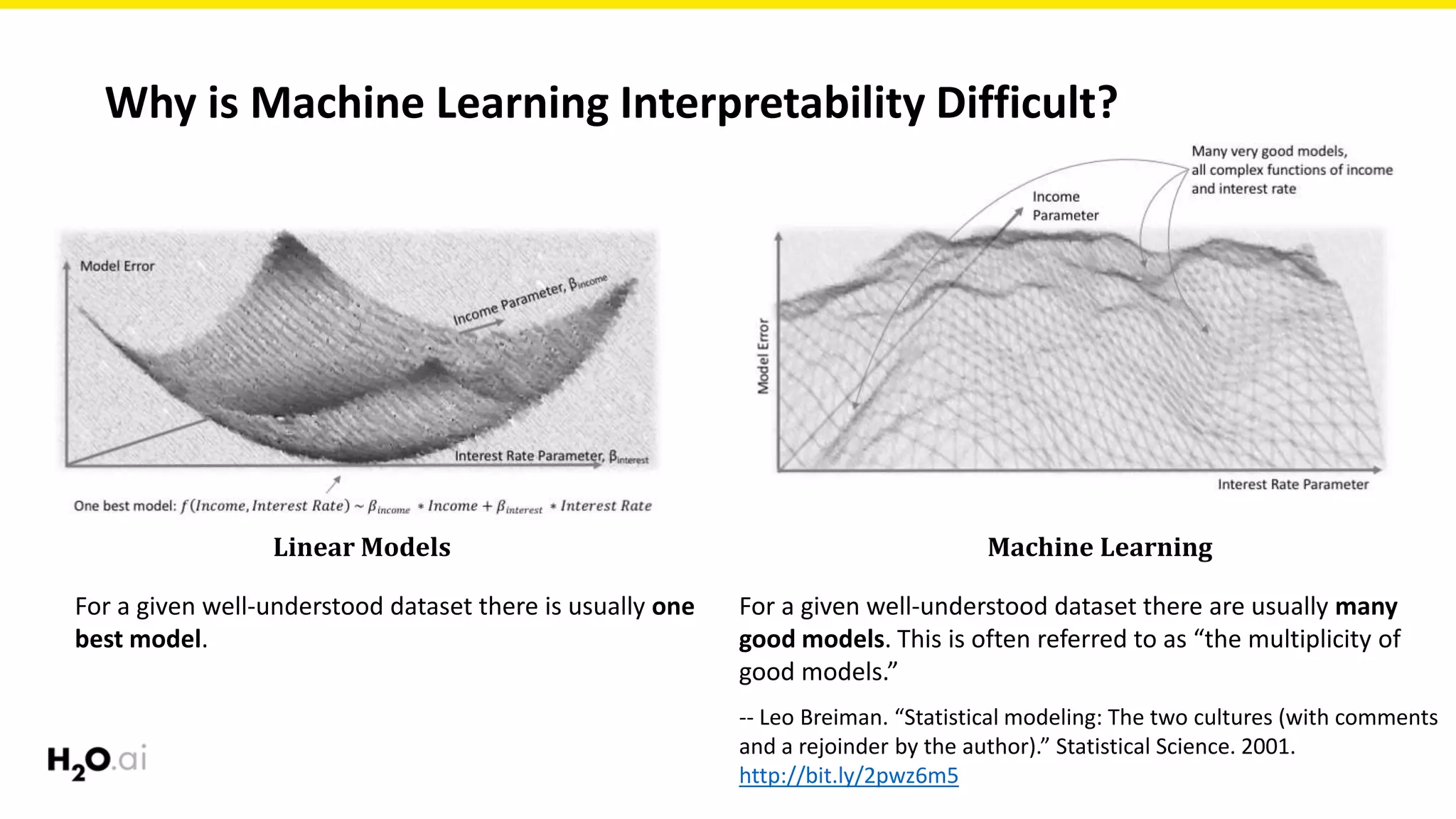
Why is Machine Learning Interpretability Difficult?
https://github.com/jphall663/GWU_data_mining/blob/master/05_neural_networks/notes/cnn-gwu.pdf
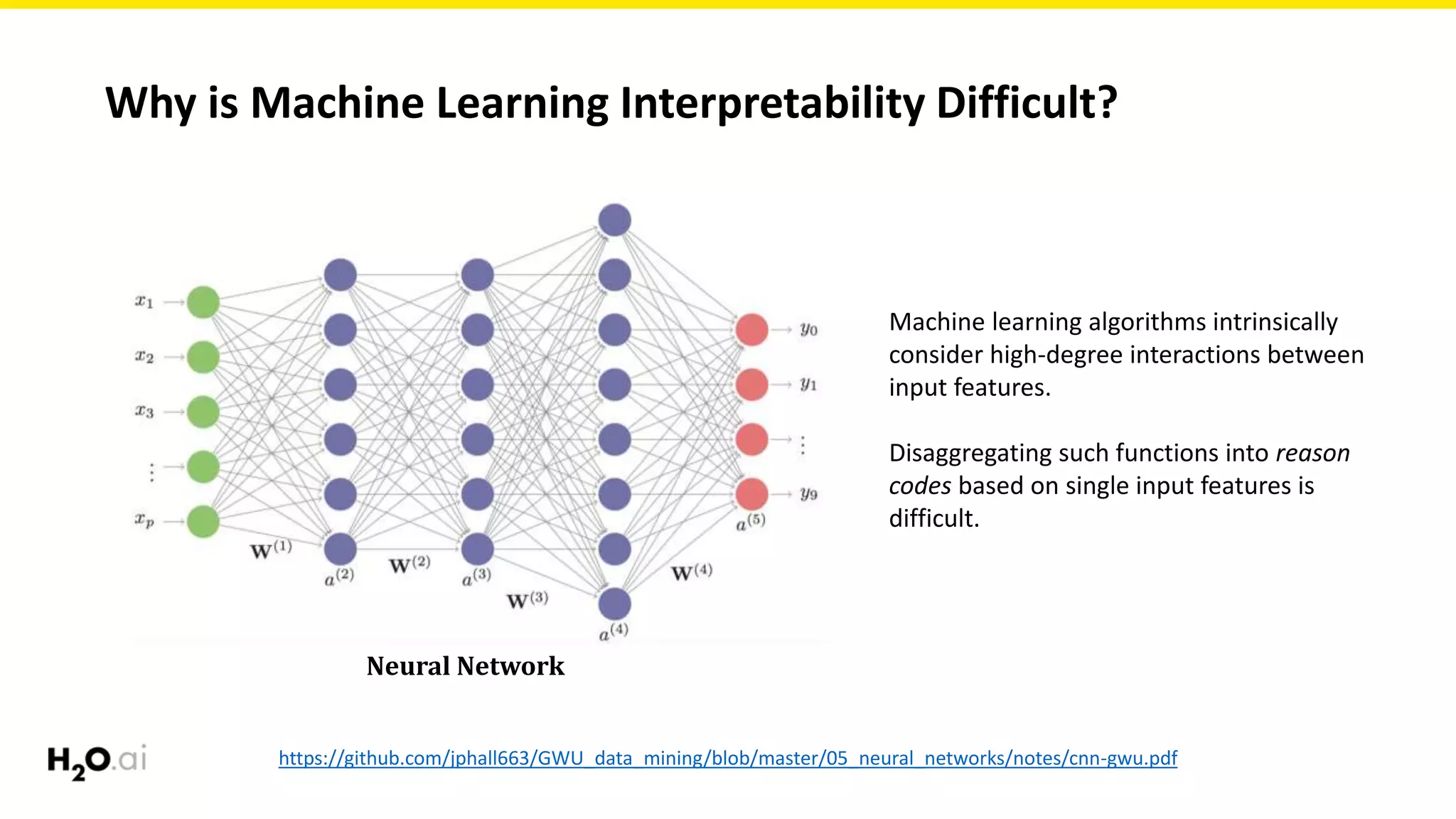
Machine learning algorithms intrinsically
consider high-degree interactions between
input features.
Disaggregating such functions into reason
codes based on single input features is
difficult.
Neural Network
Linear Models Machine Learning
For a given well-understood dataset there is usually one
best model.
For a given well-understood dataset there are usually many
good models. This is often referred to as “the multiplicity of
good models.”
-- Leo Breiman. “Statistical modeling: The two cultures (with comments
and a rejoinder by the author).” Statistical Science. 2001.
http://bit.ly/2pwz6m5
Why is Machine Learning Interpretability Difficult?
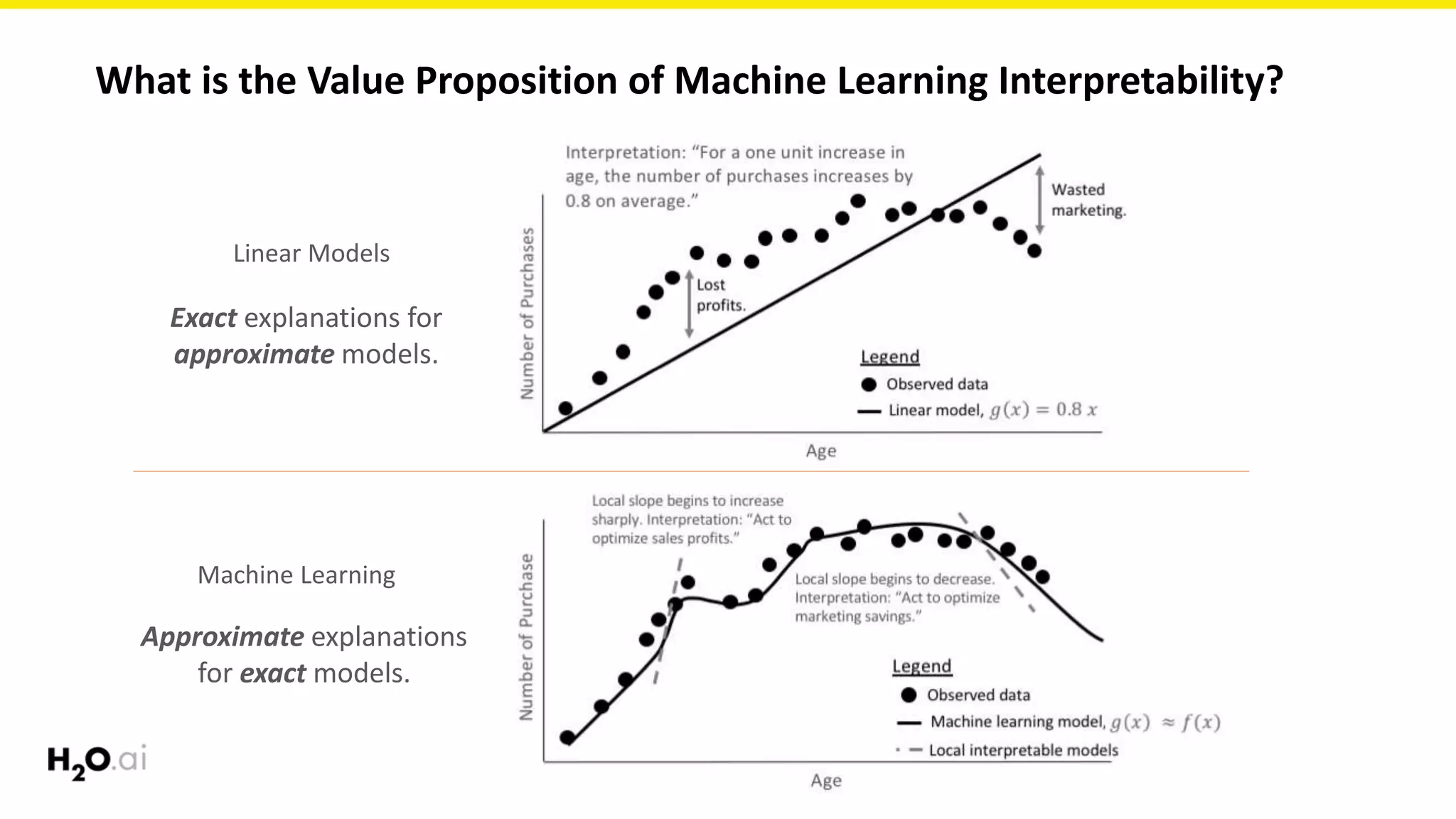
What is the Value Proposition of Machine Learning Interpretability?
Linear Models
Machine Learning
Exact explanations for
approximate models.
Approximate explanations
for exact models.
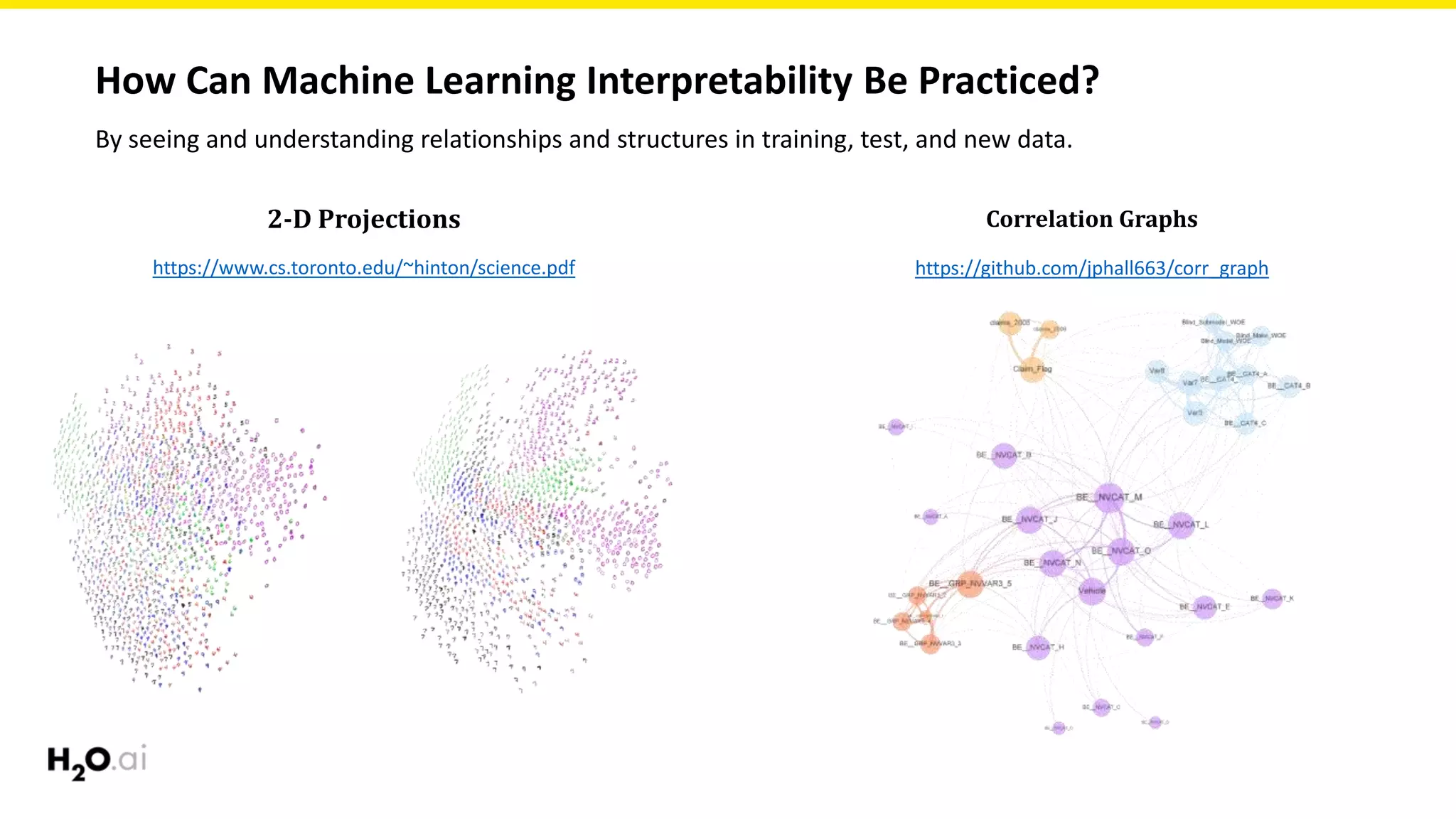
How Can Machine Learning Interpretability Be Practiced?
By seeing and understanding relationships and structures in training, test, and new data.
2-D Projections Correlation Graphs
https://github.com/jphall663/corr_graphhttps://www.cs.toronto.edu/~hinton/science.pdf
How Can Machine Learning Interpretability Be Practiced?
By training interpretable (“white-box”) models.
Decision Trees
• References:
• Breiman, L., J. Friedman, C. J. Stone, and R. A. Olshen. Classification and regression
trees. CRC press, 1984.
• The Elements of Statistical Learning (ESL):
https://web.stanford.edu/~hastie/ElemStatLearn/printings/ESLII_print12.pdf
• OSS:
• rpart: https://cran.r-project.org/web/packages/rpart/index.html
• scikit-learn (various functions): https://github.com/scikit-learn/scikit-learn
Monotonic Gradient Boosted Machines (GBMs)
• Reference: XGBoost Documentation:
http://xgboost.readthedocs.io/en/latest/tutorials/monotonic.html
• OSS: XGBoost: https://github.com/dmlc/xgboost
Logistic, elastic net, GAM, and quantile regression
• References:
• ESL
• Koenker, R. Quantile regression (No. 38). Cambridge University Press, 2005.
• OSS:
• gam: https://cran.r-project.org/web/packages/gam/index.html
• glmnet: https://cran.r-project.org/web/packages/glmnet/index.html
• h2o: https://github.com/h2oai/h2o-3
• quantreg: https://cran.r-project.org/web/packages/quantreg/index.html
• scikit-learn (various functions): https://github.com/scikit-learn/scikit-learn
Rule-based models
• Reference: An Introduction to Data Mining, Chapter 6:
https://www-users.cs.umn.edu/~kumar001/dmbook/ch6.pdf
• OSS:
• RuleFit:
http://statweb.stanford.edu/~jhf/R_RuleFit.html
• arules:
https://cran.r-project.org/web/packages/arules/index.html
• FP-Growth:
http://spark.apache.org/docs/2.2.0/mllib-frequent-pattern-mining.html
Supersparse Linear Integer Models (SLIMs)
• Reference: Supersparse Linear Integer Models for Optimized Medical
Scoring Systems:
https://link.springer.com/content/pdf/10.1007%2Fs10994-015-5528-6.pdf
How Can Machine Learning Interpretability Be Practiced?
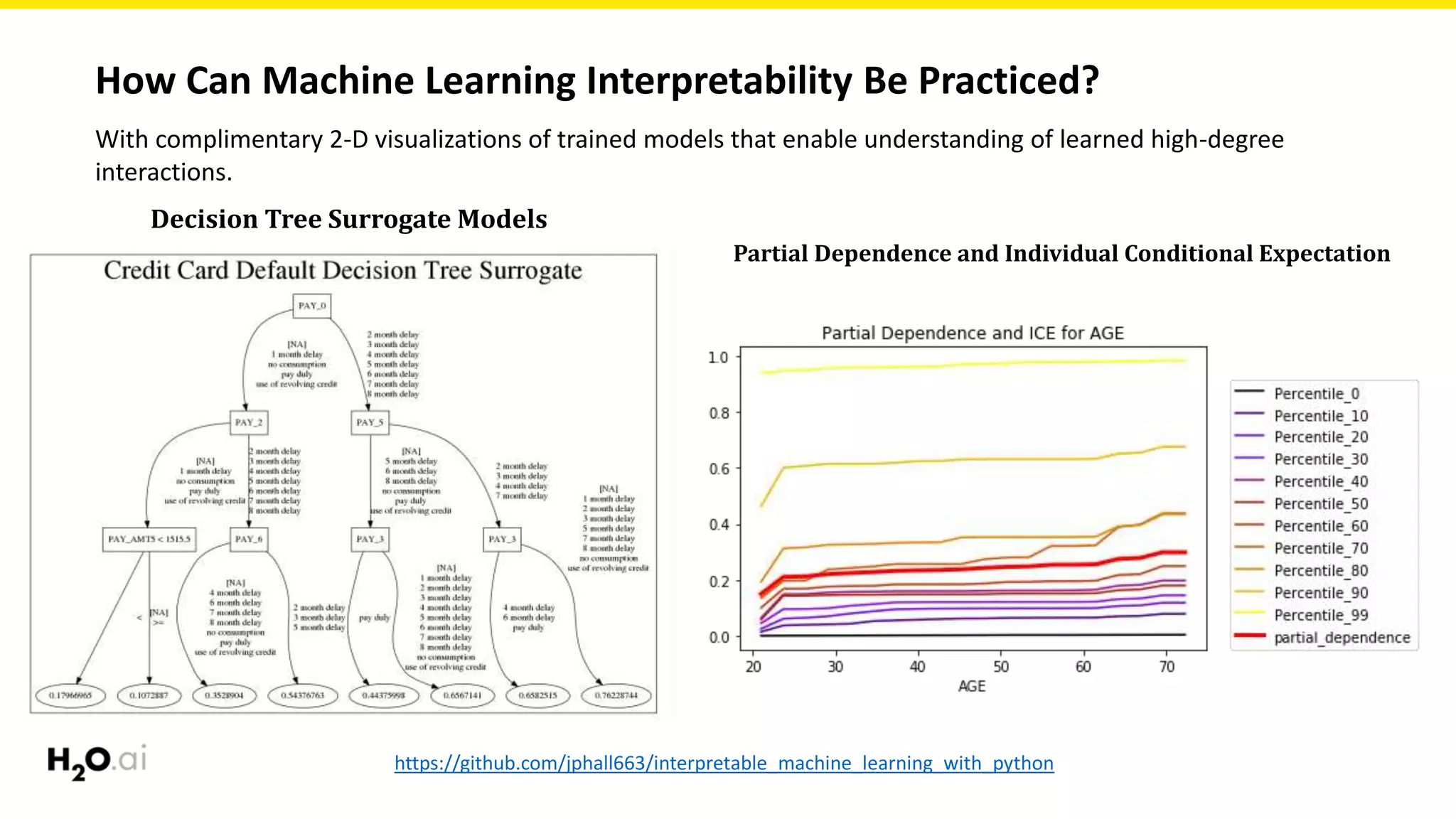
With complimentary 2-D visualizations of trained models that enable understanding of learned high-degree
interactions.
Decision Tree Surrogate Models
Partial Dependence and Individual Conditional Expectation
https://github.com/jphall663/interpretable_machine_learning_with_python
How Can Machine Learning Interpretability Be Practiced?
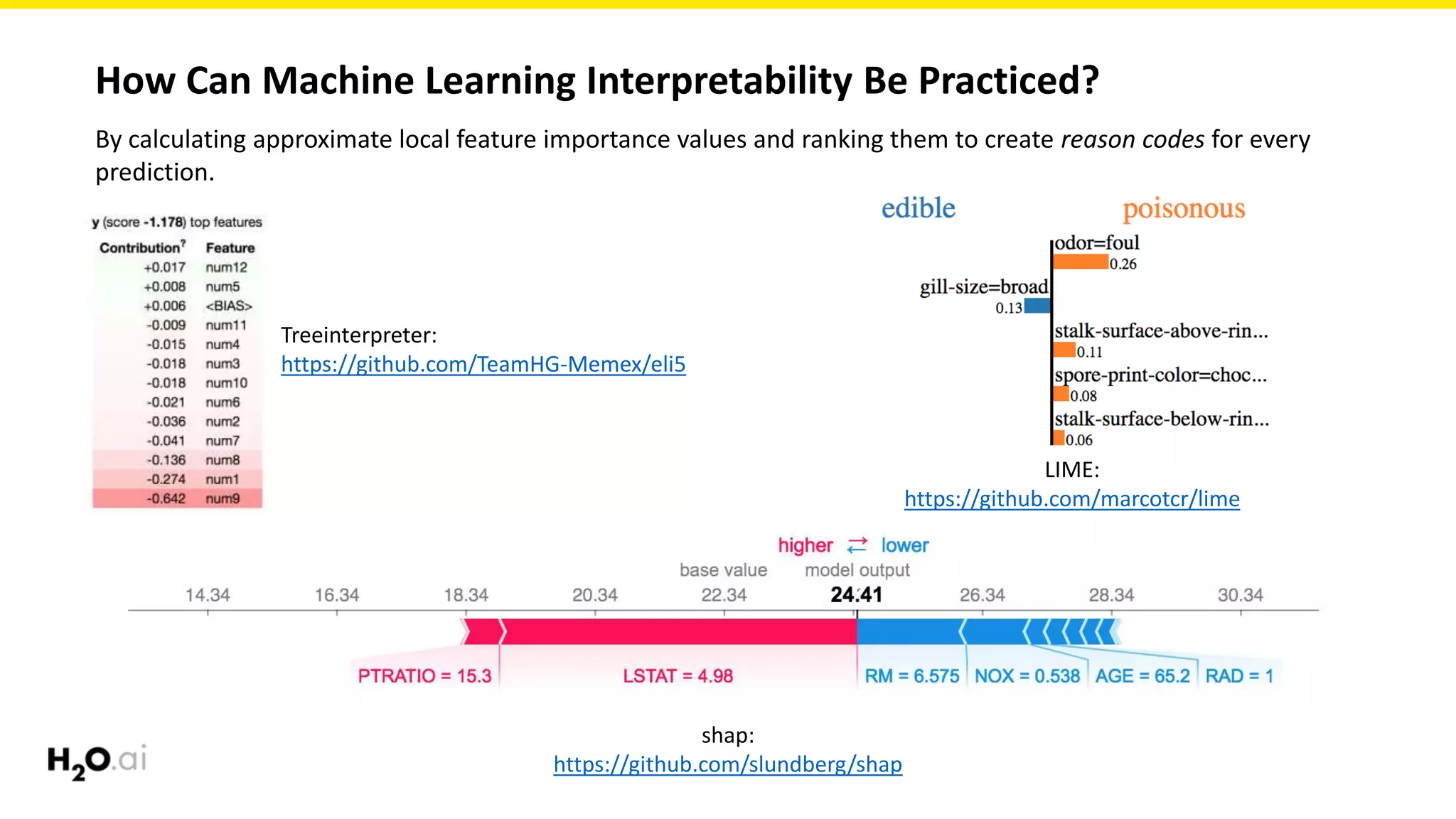
By calculating approximate local feature importance values and ranking them to create reason codes for every
prediction.
Treeinterpreter:
https://github.com/TeamHG-Memex/eli5
LIME:
https://github.com/marcotcr/lime
shap:
https://github.com/slundberg/shap
How Can Machine Learning Interpretability Be Practiced?
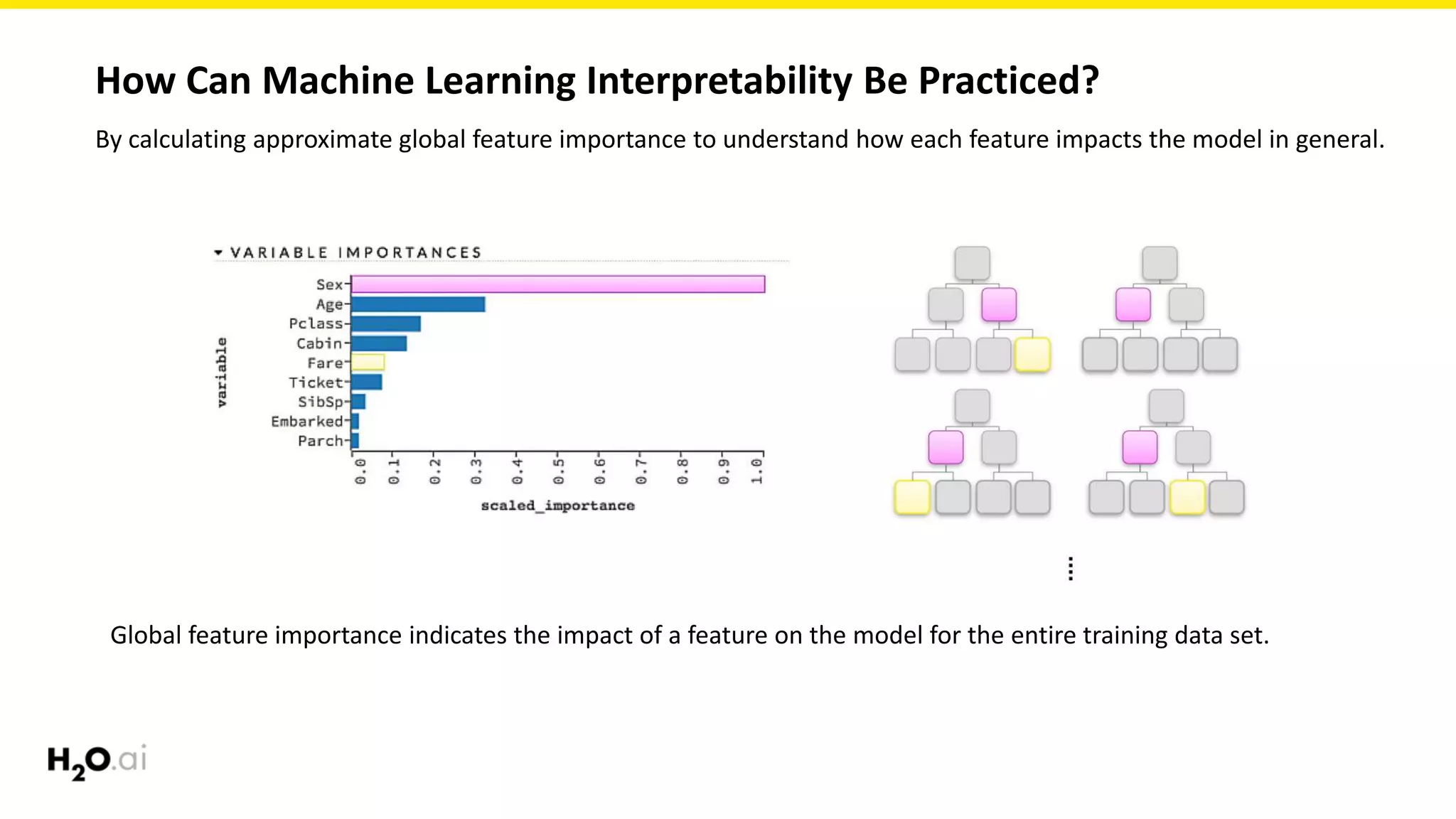
By calculating approximate global feature importance to understand how each feature impacts the model in general.
Global feature importance indicates the impact of a feature on the model for the entire training data set.
How Can Machine Learning Interpretability Be Practiced?
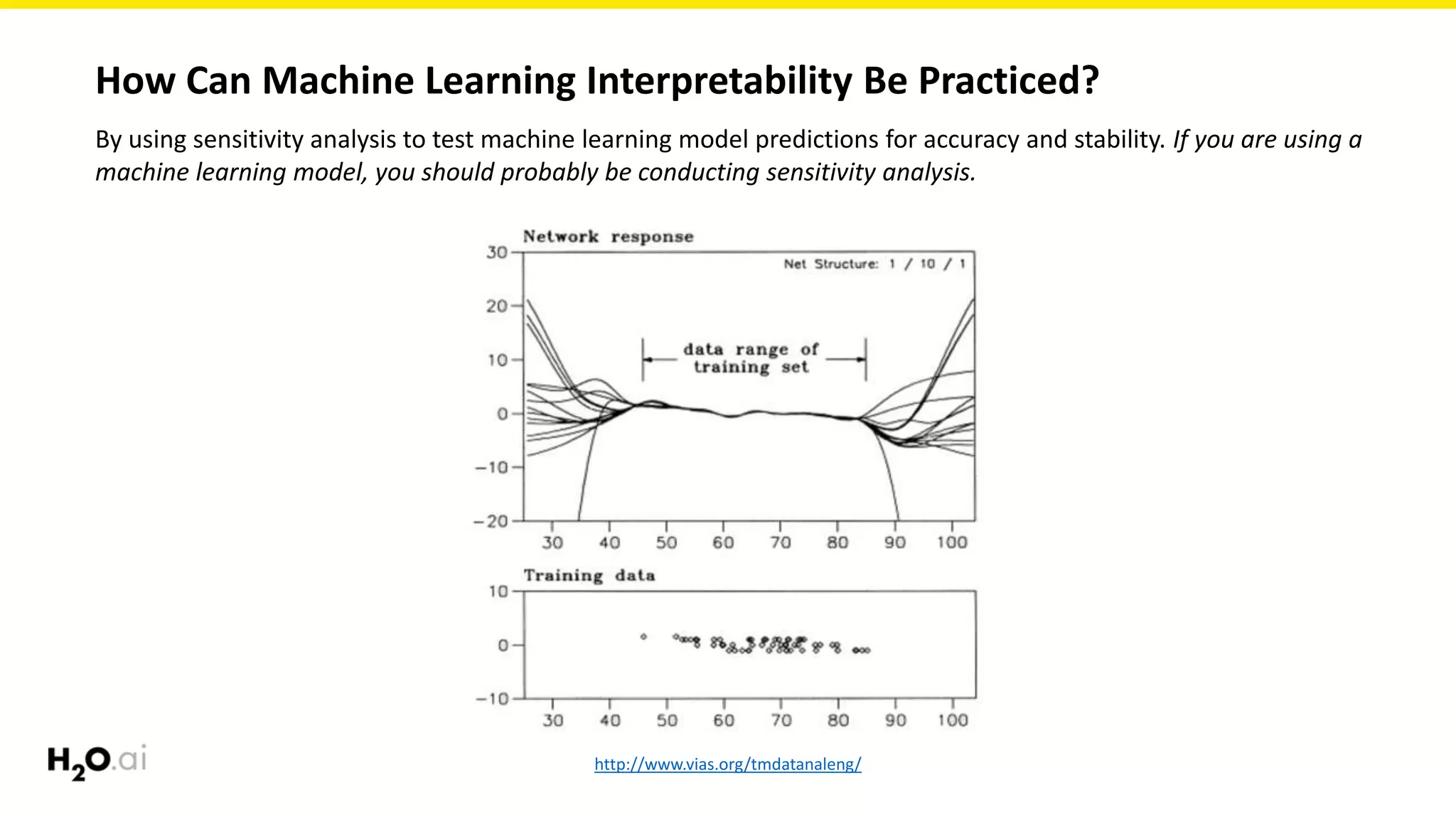
By using sensitivity analysis to test machine learning model predictions for accuracy and stability. If you are using a
machine learning model, you should probably be conducting sensitivity analysis.
http://www.vias.org/tmdatanaleng/
Can Machine Learning Interpretability Be Tested?
Yes. By humans or …
Simulated data
You can use simulated data with known characteristics to test explanations. For instance, models trained on totally random data with
no relationship between a number of input variables and a prediction target should not give strong weight to any input variable nor
generate compelling local explanations or reason codes. Conversely, you can use simulated data with a known signal generating
function to test that explanations accurately represent that known function.
https://github.com/h2oai/mli-resources/tree/master/lime_shap_treeint_compare
Explanation stability under data perturbation
Trustworthy explanations likely should not change drastically for minor changes in input data. You can set and test thresholds for
allowable explanation value changes automatically by perturbing input data. (Explanations or reason code values can also be averaged
across a number of models to create more stable explanations.)
Explanation stability with increased prediction accuracy
If previously known, accurate explanations or reason codes from a simpler linear model are available, you can use them as a reference
for the accuracy of explanations from a related, but more complex and hopefully more accurate, model. You can perform tests to see
how accurate a model can become before its prediction’s reason codes veer away from known standards.
General Recommendations
• Consider deployment.
• A very direct path to interpretable machine learning today is to train a monotonic GBM with XGBoost and to use Shapley
explanations either in XGBoost or with the shap Python package.
(Or just buy H2O Driverless AI https://www.h2o.ai/driverless-ai/ ;)
• Use a combination of local and global explanatory techniques.
• Use low-fidelity (easy to understand) and high-fidelity (hard to understand) explanatory techniques.
• Conduct sensitivity analysis and random data attacks on all machine learning models.
• Test your explanatory software.
• If possible, use model-specific explanatory techniques to generate reason codes.
• Open source explanation packages seem immature.
• Beware of uninterpretable features.
LIME Recommendations/Observations
• LIME can give an indication of its own trustworthiness using fit statistics.
• LIME can fail, particularly in the presence of extreme nonlinearity or high-degree interactions.
• LIME is difficult to deploy, but there are highly deployable variants, e.g. H2O’s K-LIME.
• Reason codes are offsets from a local intercept.
• Note that the intercept in LIME can account for the most important local phenomena.
• Generated LIME samples can contain large proportions of out-of-range data that can lead to
unrealistically high or low intercept values.
• Try LIME on discretized input features and on manually constructed interactions.
• Use cross-validation to construct standard deviations or even confidence intervals for reason code
values.
Treeinterpreter and Shapley Recommendations/Observations
• Treeinterpreter and Shapley explanations do not give an indication of their own trustworthiness. We can
only assume they are trustworthy …
• Treeinterpreter appears to fail when used with regularized (L1/L2) XGBoost models.
• Due to theoretical support and robust implementation, Shapely explanations may be suitable for
regulated applications.
• Reason codes are offsets from a global intercept.
Questions?
References and resources:
https://github.com/h2oai/mli-resources

Machine Learning Interpretability - Mateusz Dymczyk - H2O AI World London 2018

  • 1.
  • 2.
    Acknowledgments Makers: Navdeep Gill,Mark Chan, Doug Deloy, Leland Wilkinson, Megan Kurka, Michal Kurka, Wen Phan, Sri Satish Ambati, Lingyao Meng, Mathias Müller Advisors: Trevor Hastie, Rob Tibshirani Community: O’Reilly Strata and AI (accepted talks and tutorials), FAT/ML Conference (accepted tutorial), ASA Symposium on Data Science and Statistics (invited talk), Joint Statistical Meetings (accepted talk)
  • 3.
    What is MachineLearning Interpretability? “The ability to explain or to present in understandable terms to a human.” -- Finale Doshi-Velez and Been Kim. “Towards a rigorous science of interpretable machine learning.” arXiv preprint. 2017. https://arxiv.org/pdf/1702.08608.pdf “When you can stop asking why.” -- Gilpin, Leilani H., et al. "Explaining Explanations: An Approach to Evaluating Interpretability of Machine Learning." arXiv preprint arXiv:1806.00069 (2018). FAT*: https://www.fatml.org/resources/principles-for-accountable-algorithms XAI: https://www.darpa.mil/program/explainable-artificial-intelligence
  • 4.
    Why Should YouCare About Machine Learning Interpretability? “The now-contemplated field of data science amounts to a superset of the fields of statistics and machine learning, which adds some technology for “scaling up” to “big data.” This chosen superset is motivated by commercial rather than intellectual developments. Choosing in this way is likely to miss out on the really important intellectual event of the next 50 years.” -- David Donoho. “50 years of Data Science.” Tukey Centennial Workshop, 2015. http://bit.ly/2GQOh1J Social Motivation: Interpretability plays a critical role in the increased convenience, automation, and organization in our day-to-day lives promised by AI. Commercial Motivation: Interpretability is required for regulated industry to adopt machine learning. • Check and balance against accidental or intentional discrimination. • “Right to explanation.” • Hacking and adversarial attacks. • Improved revenue, i.e. Equifax NeuroDecision: https://www.youtube.com/watch?v=9Z_GW9WDS2c
  • 5.
    Why is MachineLearning Interpretability Difficult? https://github.com/jphall663/GWU_data_mining/blob/master/05_neural_networks/notes/cnn-gwu.pdf Machine learning algorithms intrinsically consider high-degree interactions between input features. Disaggregating such functions into reason codes based on single input features is difficult. Neural Network
  • 6.
    Linear Models MachineLearning For a given well-understood dataset there is usually one best model. For a given well-understood dataset there are usually many good models. This is often referred to as “the multiplicity of good models.” -- Leo Breiman. “Statistical modeling: The two cultures (with comments and a rejoinder by the author).” Statistical Science. 2001. http://bit.ly/2pwz6m5 Why is Machine Learning Interpretability Difficult?
  • 7.
    What is theValue Proposition of Machine Learning Interpretability? Linear Models Machine Learning Exact explanations for approximate models. Approximate explanations for exact models.
  • 8.
    How Can MachineLearning Interpretability Be Practiced? By seeing and understanding relationships and structures in training, test, and new data. 2-D Projections Correlation Graphs https://github.com/jphall663/corr_graphhttps://www.cs.toronto.edu/~hinton/science.pdf
  • 9.
    How Can MachineLearning Interpretability Be Practiced? By training interpretable (“white-box”) models. Decision Trees • References: • Breiman, L., J. Friedman, C. J. Stone, and R. A. Olshen. Classification and regression trees. CRC press, 1984. • The Elements of Statistical Learning (ESL): https://web.stanford.edu/~hastie/ElemStatLearn/printings/ESLII_print12.pdf • OSS: • rpart: https://cran.r-project.org/web/packages/rpart/index.html • scikit-learn (various functions): https://github.com/scikit-learn/scikit-learn Monotonic Gradient Boosted Machines (GBMs) • Reference: XGBoost Documentation: http://xgboost.readthedocs.io/en/latest/tutorials/monotonic.html • OSS: XGBoost: https://github.com/dmlc/xgboost Logistic, elastic net, GAM, and quantile regression • References: • ESL • Koenker, R. Quantile regression (No. 38). Cambridge University Press, 2005. • OSS: • gam: https://cran.r-project.org/web/packages/gam/index.html • glmnet: https://cran.r-project.org/web/packages/glmnet/index.html • h2o: https://github.com/h2oai/h2o-3 • quantreg: https://cran.r-project.org/web/packages/quantreg/index.html • scikit-learn (various functions): https://github.com/scikit-learn/scikit-learn Rule-based models • Reference: An Introduction to Data Mining, Chapter 6: https://www-users.cs.umn.edu/~kumar001/dmbook/ch6.pdf • OSS: • RuleFit: http://statweb.stanford.edu/~jhf/R_RuleFit.html • arules: https://cran.r-project.org/web/packages/arules/index.html • FP-Growth: http://spark.apache.org/docs/2.2.0/mllib-frequent-pattern-mining.html Supersparse Linear Integer Models (SLIMs) • Reference: Supersparse Linear Integer Models for Optimized Medical Scoring Systems: https://link.springer.com/content/pdf/10.1007%2Fs10994-015-5528-6.pdf
  • 10.
    How Can MachineLearning Interpretability Be Practiced? With complimentary 2-D visualizations of trained models that enable understanding of learned high-degree interactions. Decision Tree Surrogate Models Partial Dependence and Individual Conditional Expectation https://github.com/jphall663/interpretable_machine_learning_with_python
  • 11.
    How Can MachineLearning Interpretability Be Practiced? By calculating approximate local feature importance values and ranking them to create reason codes for every prediction. Treeinterpreter: https://github.com/TeamHG-Memex/eli5 LIME: https://github.com/marcotcr/lime shap: https://github.com/slundberg/shap
  • 12.
    How Can MachineLearning Interpretability Be Practiced? By calculating approximate global feature importance to understand how each feature impacts the model in general. Global feature importance indicates the impact of a feature on the model for the entire training data set.
  • 13.
    How Can MachineLearning Interpretability Be Practiced? By using sensitivity analysis to test machine learning model predictions for accuracy and stability. If you are using a machine learning model, you should probably be conducting sensitivity analysis. http://www.vias.org/tmdatanaleng/
  • 14.
    Can Machine LearningInterpretability Be Tested? Yes. By humans or … Simulated data You can use simulated data with known characteristics to test explanations. For instance, models trained on totally random data with no relationship between a number of input variables and a prediction target should not give strong weight to any input variable nor generate compelling local explanations or reason codes. Conversely, you can use simulated data with a known signal generating function to test that explanations accurately represent that known function. https://github.com/h2oai/mli-resources/tree/master/lime_shap_treeint_compare Explanation stability under data perturbation Trustworthy explanations likely should not change drastically for minor changes in input data. You can set and test thresholds for allowable explanation value changes automatically by perturbing input data. (Explanations or reason code values can also be averaged across a number of models to create more stable explanations.) Explanation stability with increased prediction accuracy If previously known, accurate explanations or reason codes from a simpler linear model are available, you can use them as a reference for the accuracy of explanations from a related, but more complex and hopefully more accurate, model. You can perform tests to see how accurate a model can become before its prediction’s reason codes veer away from known standards.
  • 15.
    General Recommendations • Considerdeployment. • A very direct path to interpretable machine learning today is to train a monotonic GBM with XGBoost and to use Shapley explanations either in XGBoost or with the shap Python package. (Or just buy H2O Driverless AI https://www.h2o.ai/driverless-ai/ ;) • Use a combination of local and global explanatory techniques. • Use low-fidelity (easy to understand) and high-fidelity (hard to understand) explanatory techniques. • Conduct sensitivity analysis and random data attacks on all machine learning models. • Test your explanatory software. • If possible, use model-specific explanatory techniques to generate reason codes. • Open source explanation packages seem immature. • Beware of uninterpretable features.
  • 16.
    LIME Recommendations/Observations • LIMEcan give an indication of its own trustworthiness using fit statistics. • LIME can fail, particularly in the presence of extreme nonlinearity or high-degree interactions. • LIME is difficult to deploy, but there are highly deployable variants, e.g. H2O’s K-LIME. • Reason codes are offsets from a local intercept. • Note that the intercept in LIME can account for the most important local phenomena. • Generated LIME samples can contain large proportions of out-of-range data that can lead to unrealistically high or low intercept values. • Try LIME on discretized input features and on manually constructed interactions. • Use cross-validation to construct standard deviations or even confidence intervals for reason code values.
  • 17.
    Treeinterpreter and ShapleyRecommendations/Observations • Treeinterpreter and Shapley explanations do not give an indication of their own trustworthiness. We can only assume they are trustworthy … • Treeinterpreter appears to fail when used with regularized (L1/L2) XGBoost models. • Due to theoretical support and robust implementation, Shapely explanations may be suitable for regulated applications. • Reason codes are offsets from a global intercept.
  • 18.