



Are you sure about that!?
Uncertainty Quantification in AI
Florian Wilhelm Berlin, October 10th 2019
2
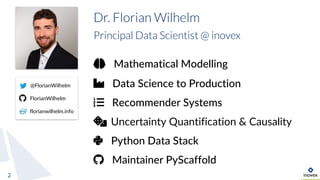
Dr. Florian Wilhelm
Principal Data Scientist @ inovex
@FlorianWilhelm
FlorianWilhelm
florianwilhelm.info
Mathematical Modelling
Data Science to Production
Recommender Systems
Uncertainty Quantification & Causality
Python Data Stack
Maintainer PyScaffold
3
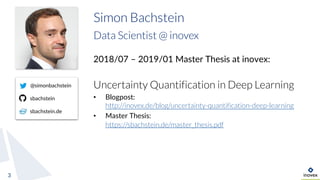
Simon Bachstein
Data Scientist @ inovex
2018/07 – 2019/01 Master Thesis at inovex:
Uncertainty Quantification in Deep Learning
• Blogpost:
http://inovex.de/blog/uncertainty-quantification-deep-learning
• Master Thesis:
https://sbachstein.de/master_thesis.pdf
@simonbachstein
sbachstein
sbachstein.de
1. Motivation
2. Methods
a. Gaussian Processes
b. Monte-Carlo Dropout
c. Deep Ensembles
d. Dropout Ensembles
e. Quantile Regression
3. Experiments
4. Conclusion & Outlook
Agenda
4
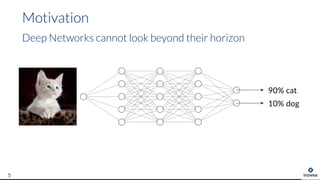
Deep Networks cannot look beyond their horizon
Motivation
5
90% cat
10% dog
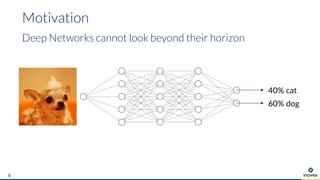
Deep Networks cannot look beyond their horizon
Motivation
6
40% cat
60% dog
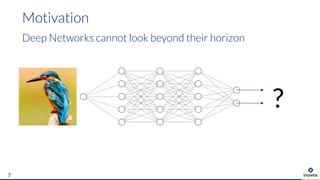
Deep Networks cannot look beyond their horizon
Motivation
7
?
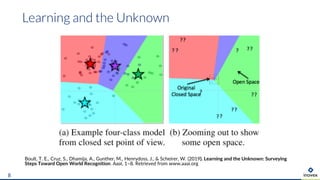
Boult, T. E., Cruz, S., Dhamija, A., Gunther, M., Henrydoss, J., & Scheirer, W. (2019). Learning and the Unknown: Surveying
Steps Toward Open World Recognition. Aaai, 1–8. Retrieved from www.aaai.org
Learning and the Unknown
8
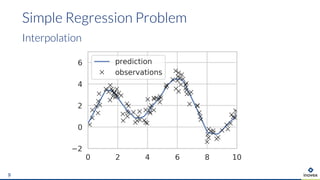
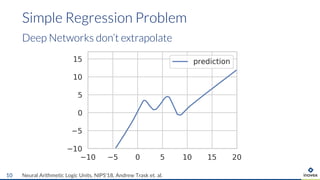
Simple Regression Problem
Interpolation
9
Simple Regression Problem
Deep Networks don’t extrapolate
Neural Arithmetic Logic Units, NIPS'18, Andrew Trask et. al.10
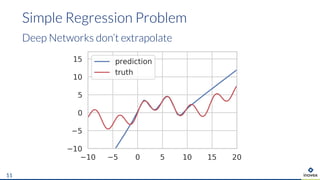
Simple Regression Problem
Deep Networks don’t extrapolate
11
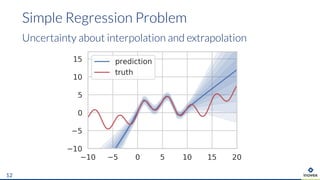
Simple Regression Problem
Uncertainty about interpolation and extrapolation
12
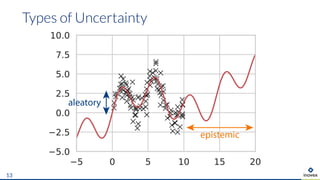
Types of Uncertainty
13
1. Motivation
2. Methods
a. Gaussian Processes
b. Monte-Carlo Dropout
c. Deep Ensembles
d. Dropout Ensembles
e. Quantile Regression
3. Experiments
4. Conclusion & Outlook
Agenda
14
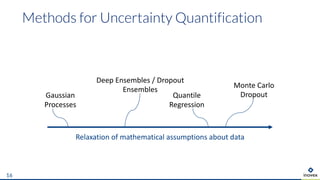
Methods for Uncertainty Quantification
16
Relaxation of mathematical assumptions about data
Gaussian
Processes
Deep Ensembles / Dropout
Ensembles
Quantile
Regression
Monte Carlo
Dropout
1. Motivation
2. Methods
a. Gaussian Processes
b. Monte-Carlo Dropout
c. Deep Ensembles
d. Dropout Ensembles
e. Quantile Regression
3. Experiments
4. Conclusion & Outlook
Agenda
17
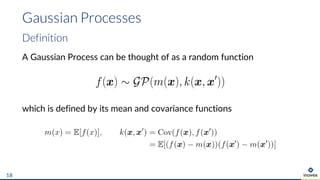
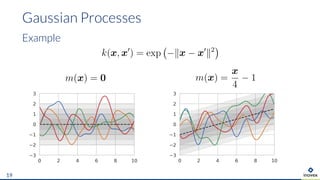
A Gaussian Process can be thought of as a random function
which is defined by its mean and covariance functions
Gaussian Processes
18
Definition
Gaussian Processes
19
Example
Gaussian Processes
20
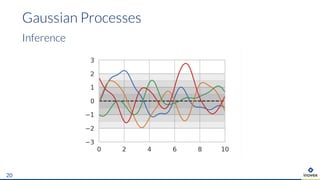
Inference
Gaussian Processes
21
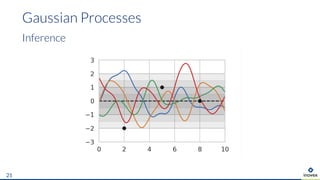
Inference
Gaussian Processes
22
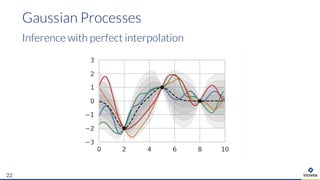
Inference with perfect interpolation
Gaussian Processes
23
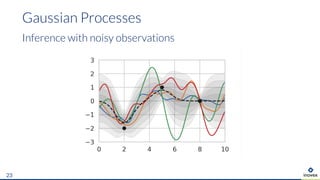
Inference with noisy observations
Gaussian Processes
24
Inference
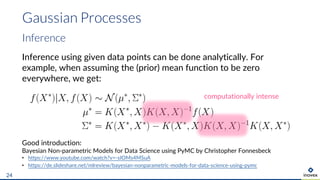
Inference using given data points can be done analytically. For
example, when assuming the (prior) mean function to be zero
everywhere, we get:
Good introduction:
Bayesian Non-parametric Models for Data Science using PyMC by Christopher Fonnesbeck
• https://www.youtube.com/watch?v=-sIOMs4MSuA
• https://de.slideshare.net/mlreview/bayesian-nonparametric-models-for-data-science-using-pymc
computationally intense
1. Motivation
2. Methods
a. Gaussian Processes
b. Monte-Carlo Dropout
c. Deep Ensembles
d. Dropout Ensembles
e. Quantile Regression
3. Experiments
4. Conclusion & Outlook
Agenda
25
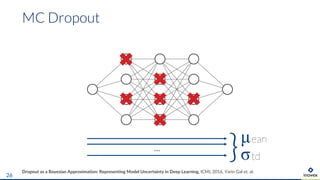
MC Dropout
Dropout as a Bayesian Approximation: Representing Model Uncertainty in Deep Learning, ICML 2016, Yarin Gal et. al.
26
...
1. Motivation
2. Methods
a. Gaussian Processes
b. Monte-Carlo Dropout
c. Deep Ensembles
d. Dropout Ensembles
e. Quantile Regression
3. Experiments
4. Conclusion & Outlook
Agenda
27
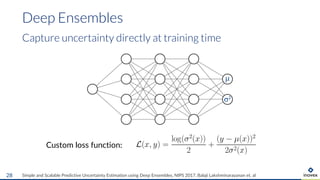
Deep Ensembles
Simple and Scalable Predictive Uncertainty Estimation using Deep Ensembles, NIPS 2017, Balaji Lakshminarayanan et. al28
Custom loss function:
Capture uncertainty directly at training time
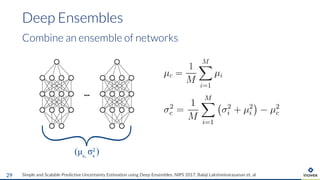
Deep Ensembles
Simple and Scalable Predictive Uncertainty Estimation using Deep Ensembles, NIPS 2017, Balaji Lakshminarayanan et. al29
Combine an ensemble of networks
1. Motivation
2. Methods
a. Gaussian Processes
b. Monte-Carlo Dropout
c. Deep Ensembles
d. Dropout Ensembles
e. Quantile Regression
3. Experiments
4. Conclusion & Outlook
Agenda
30
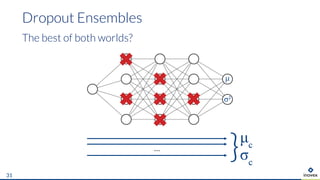
Dropout Ensembles
31
The best of both worlds?
...
1. Motivation
2. Methods
a. Gaussian Processes
b. Monte-Carlo Dropout
c. Deep Ensembles
d. Dropout Ensembles
e. Quantile Regression
3. Experiments
4. Conclusion & Outlook
Agenda
32
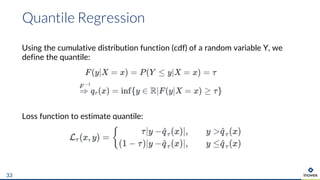
Using the cumulative distribution function (cdf) of a random variable Y, we
define the quantile:
Loss function to estimate quantile:
Quantile Regression
33
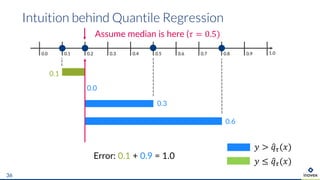
Intuition behind Quantile Regression
34
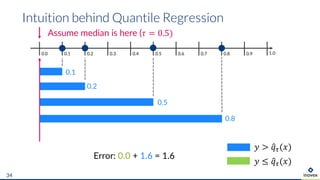
0.0 0.1 0.2 0.90.3 0.4 0.5 0.6 0.7 0.8 1.0
Assume median is here (𝜏 = 0.5)
𝑦 > )𝑞+(𝑥)
𝑦 ≤ )𝑞+(𝑥)
0.1
0.2
0.5
0.8
Error: 0.0 + 1.6 = 1.6
Intuition behind Quantile Regression
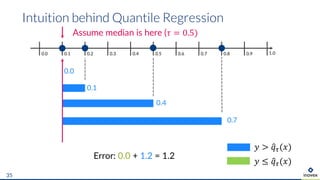
35
0.0 0.1 0.2 0.90.3 0.4 0.5 0.6 0.7 0.8 1.0
Assume median is here (𝜏 = 0.5)
𝑦 > )𝑞+(𝑥)
𝑦 ≤ )𝑞+(𝑥)
0.1
0.4
0.7
Error: 0.0 + 1.2 = 1.2
0.0
Intuition behind Quantile Regression
36
0.0 0.1 0.2 0.90.3 0.4 0.5 0.6 0.7 0.8 1.0
Assume median is here (𝜏 = 0.5)
𝑦 > )𝑞+(𝑥)
𝑦 ≤ )𝑞+(𝑥)
0.1
0.3
0.6
Error: 0.1 + 0.9 = 1.0
0.0
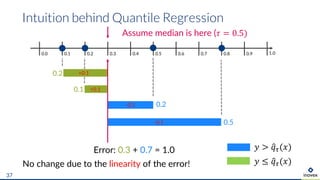
Intuition behind Quantile Regression
37
0.0 0.1 0.2 0.90.3 0.4 0.5 0.6 0.7 0.8 1.0
Assume median is here (𝜏 = 0.5)
𝑦 > )𝑞+(𝑥)
𝑦 ≤ )𝑞+(𝑥)
0.2
0.2
0.5
Error: 0.3 + 0.7 = 1.0
0.1
No change due to the linearity of the error!
+0.1
+0.1
-0.1
-0.1
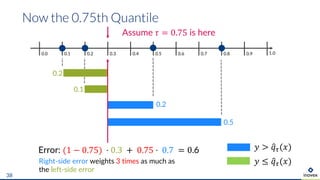
Now the 0.75th Quantile
38
0.0 0.1 0.2 0.90.3 0.4 0.5 0.6 0.7 0.8 1.0
Assume 𝜏 = 0.75 is here
𝑦 > )𝑞+(𝑥)
𝑦 ≤ )𝑞+(𝑥)
0.2
0.2
0.5
0.1
Error: (1 − 0.75) ⋅ 0.3 + 0.75 ⋅ 0.7 = 0.6
Right-side error weights 3 times as much as
the left-side error
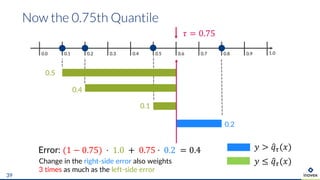
Now the 0.75th Quantile
39
0.0 0.1 0.2 0.90.3 0.4 0.5 0.6 0.7 0.8 1.0
𝜏 = 0.75
𝑦 > )𝑞+(𝑥)
𝑦 ≤ )𝑞+(𝑥)
0.5
0.1
0.2
Error: (1 − 0.75) ⋅ 1.0 + 0.75 ⋅ 0.2 = 0.4
0.4
Change in the right-side error also weights
3 times as much as the left-side error
1. Motivation
2. Methods
a. Gaussian Processes
b. Monte-Carlo Dropout
c. Deep Ensembles
d. Dropout Ensembles
e. Quantile Regression
3. Experiments
4. Conclusion & Outlook
Agenda
40
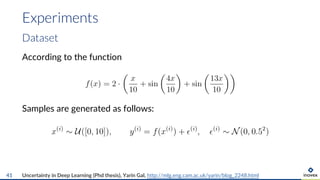
According to the function
Samples are generated as follows:
Experiments
Uncertainty in Deep Learning (Phd thesis), Yarin Gal, http://mlg.eng.cam.ac.uk/yarin/blog_2248.html41
Dataset
Experiments
42
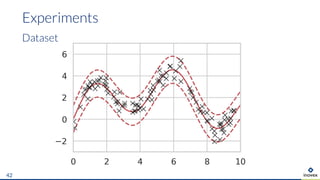
Dataset
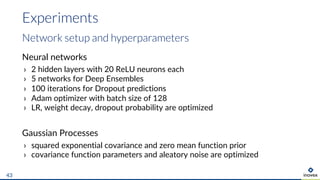
Neural networks
› 2 hidden layers with 20 ReLU neurons each
› 5 networks for Deep Ensembles
› 100 iterations for Dropout predictions
› Adam optimizer with batch size of 128
› LR, weight decay, dropout probability are optimized
Gaussian Processes
› squared exponential covariance and zero mean function prior
› covariance function parameters and aleatory noise are optimized
Experiments
43
Network setup and hyperparameters
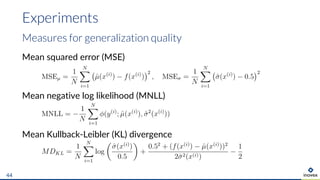
Mean squared error (MSE)
Mean negative log likelihood (MNLL)
Mean Kullback-Leibler (KL) divergence
Experiments
44
Measures for generalization quality
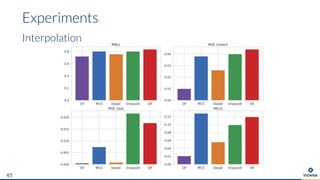
Experiments
45
Interpolation
Experiments
46
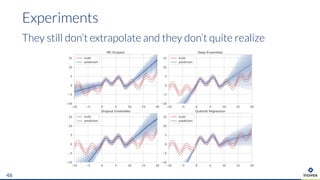
They still don’t extrapolate and they don’t quite realize
Experiments
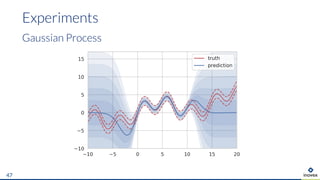
47
Gaussian Process
Experiments
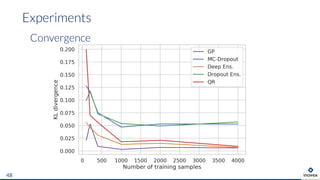
Convergence
48
Experiments
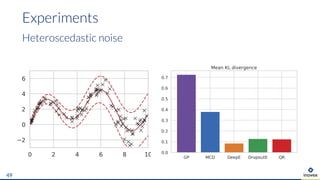
49
Heteroscedastic noise
Experiments
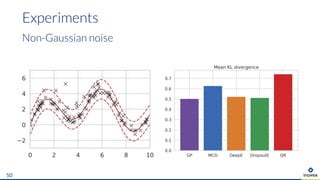
50
Non-Gaussian noise
Experiments
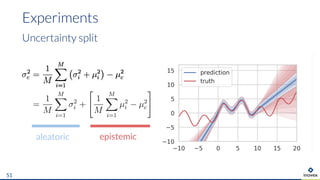
51
Uncertainty split
aleatoric epistemic
Summary
52
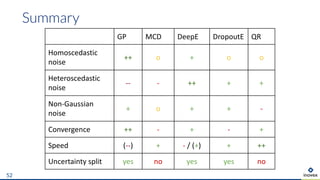
GP MCD DeepE DropoutE QR
Homoscedastic
noise
++ o + o o
Heteroscedastic
noise
-- - ++ + +
Non-Gaussian
noise
+ o + + -
Convergence ++ - + - +
Speed (--) + - / (+) + ++
Uncertainty split yes no yes yes no
1. Motivation
2. Methods
a. Gaussian Processes
b. Monte-Carlo Dropout
c. Deep Ensembles
d. Dropout Ensembles
e. Quantile Regression
3. Experiments
4. Conclusion & Outlook
Agenda
53
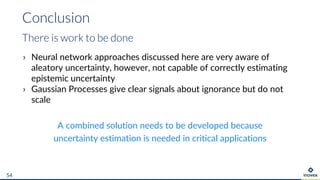
› Neural network approaches discussed here are very aware of
aleatory uncertainty, however, not capable of correctly estimating
epistemic uncertainty
› Gaussian Processes give clear signals about ignorance but do not
scale
A combined solution needs to be developed because
uncertainty estimation is needed in critical applications
Conclusion
54
There is work to be done
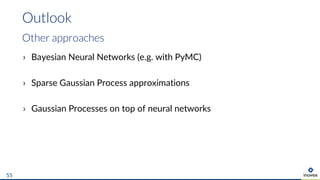
› Bayesian Neural Networks (e.g. with PyMC)
› Sparse Gaussian Process approximations
› Gaussian Processes on top of neural networks
Outlook
55
Other approaches
Thank You!
Florian Wilhelm
Principal Data Scientist
inovex GmbH
Schanzenstraße 6-20
Kupferhütte 1.13
51063 Köln
florian.wilhelm@inovex.de

Are you sure about that?! Uncertainty Quantification in AI

  • 1.
    Are you sureabout that!? Uncertainty Quantification in AI Florian Wilhelm Berlin, October 10th 2019
  • 2.
    2 Dr. Florian Wilhelm PrincipalData Scientist @ inovex @FlorianWilhelm FlorianWilhelm florianwilhelm.info Mathematical Modelling Data Science to Production Recommender Systems Uncertainty Quantification & Causality Python Data Stack Maintainer PyScaffold
  • 3.
    3 Simon Bachstein Data Scientist@ inovex 2018/07 – 2019/01 Master Thesis at inovex: Uncertainty Quantification in Deep Learning • Blogpost: http://inovex.de/blog/uncertainty-quantification-deep-learning • Master Thesis: https://sbachstein.de/master_thesis.pdf @simonbachstein sbachstein sbachstein.de
  • 4.
    1. Motivation 2. Methods a.Gaussian Processes b. Monte-Carlo Dropout c. Deep Ensembles d. Dropout Ensembles e. Quantile Regression 3. Experiments 4. Conclusion & Outlook Agenda 4
  • 5.
    Deep Networks cannotlook beyond their horizon Motivation 5 90% cat 10% dog
  • 6.
    Deep Networks cannotlook beyond their horizon Motivation 6 40% cat 60% dog
  • 7.
    Deep Networks cannotlook beyond their horizon Motivation 7 ?
  • 8.
    Boult, T. E.,Cruz, S., Dhamija, A., Gunther, M., Henrydoss, J., & Scheirer, W. (2019). Learning and the Unknown: Surveying Steps Toward Open World Recognition. Aaai, 1–8. Retrieved from www.aaai.org Learning and the Unknown 8
  • 9.
  • 10.
    Simple Regression Problem DeepNetworks don’t extrapolate Neural Arithmetic Logic Units, NIPS'18, Andrew Trask et. al.10
  • 11.
    Simple Regression Problem DeepNetworks don’t extrapolate 11
  • 12.
    Simple Regression Problem Uncertaintyabout interpolation and extrapolation 12
  • 13.
  • 14.
    1. Motivation 2. Methods a.Gaussian Processes b. Monte-Carlo Dropout c. Deep Ensembles d. Dropout Ensembles e. Quantile Regression 3. Experiments 4. Conclusion & Outlook Agenda 14
  • 15.
    Methods for UncertaintyQuantification 16 Relaxation of mathematical assumptions about data Gaussian Processes Deep Ensembles / Dropout Ensembles Quantile Regression Monte Carlo Dropout
  • 16.
    1. Motivation 2. Methods a.Gaussian Processes b. Monte-Carlo Dropout c. Deep Ensembles d. Dropout Ensembles e. Quantile Regression 3. Experiments 4. Conclusion & Outlook Agenda 17
  • 17.
    A Gaussian Processcan be thought of as a random function which is defined by its mean and covariance functions Gaussian Processes 18 Definition
  • 18.
  • 19.
  • 20.
  • 21.
  • 22.
  • 23.
    Gaussian Processes 24 Inference Inference usinggiven data points can be done analytically. For example, when assuming the (prior) mean function to be zero everywhere, we get: Good introduction: Bayesian Non-parametric Models for Data Science using PyMC by Christopher Fonnesbeck • https://www.youtube.com/watch?v=-sIOMs4MSuA • https://de.slideshare.net/mlreview/bayesian-nonparametric-models-for-data-science-using-pymc computationally intense
  • 24.
    1. Motivation 2. Methods a.Gaussian Processes b. Monte-Carlo Dropout c. Deep Ensembles d. Dropout Ensembles e. Quantile Regression 3. Experiments 4. Conclusion & Outlook Agenda 25
  • 25.
    MC Dropout Dropout asa Bayesian Approximation: Representing Model Uncertainty in Deep Learning, ICML 2016, Yarin Gal et. al. 26 ...
  • 26.
    1. Motivation 2. Methods a.Gaussian Processes b. Monte-Carlo Dropout c. Deep Ensembles d. Dropout Ensembles e. Quantile Regression 3. Experiments 4. Conclusion & Outlook Agenda 27
  • 27.
    Deep Ensembles Simple andScalable Predictive Uncertainty Estimation using Deep Ensembles, NIPS 2017, Balaji Lakshminarayanan et. al28 Custom loss function: Capture uncertainty directly at training time
  • 28.
    Deep Ensembles Simple andScalable Predictive Uncertainty Estimation using Deep Ensembles, NIPS 2017, Balaji Lakshminarayanan et. al29 Combine an ensemble of networks
  • 29.
    1. Motivation 2. Methods a.Gaussian Processes b. Monte-Carlo Dropout c. Deep Ensembles d. Dropout Ensembles e. Quantile Regression 3. Experiments 4. Conclusion & Outlook Agenda 30
  • 30.
    Dropout Ensembles 31 The bestof both worlds? ...
  • 31.
    1. Motivation 2. Methods a.Gaussian Processes b. Monte-Carlo Dropout c. Deep Ensembles d. Dropout Ensembles e. Quantile Regression 3. Experiments 4. Conclusion & Outlook Agenda 32
  • 32.
    Using the cumulativedistribution function (cdf) of a random variable Y, we define the quantile: Loss function to estimate quantile: Quantile Regression 33
  • 33.
    Intuition behind QuantileRegression 34 0.0 0.1 0.2 0.90.3 0.4 0.5 0.6 0.7 0.8 1.0 Assume median is here (𝜏 = 0.5) 𝑦 > )𝑞+(𝑥) 𝑦 ≤ )𝑞+(𝑥) 0.1 0.2 0.5 0.8 Error: 0.0 + 1.6 = 1.6
  • 34.
    Intuition behind QuantileRegression 35 0.0 0.1 0.2 0.90.3 0.4 0.5 0.6 0.7 0.8 1.0 Assume median is here (𝜏 = 0.5) 𝑦 > )𝑞+(𝑥) 𝑦 ≤ )𝑞+(𝑥) 0.1 0.4 0.7 Error: 0.0 + 1.2 = 1.2 0.0
  • 35.
    Intuition behind QuantileRegression 36 0.0 0.1 0.2 0.90.3 0.4 0.5 0.6 0.7 0.8 1.0 Assume median is here (𝜏 = 0.5) 𝑦 > )𝑞+(𝑥) 𝑦 ≤ )𝑞+(𝑥) 0.1 0.3 0.6 Error: 0.1 + 0.9 = 1.0 0.0
  • 36.
    Intuition behind QuantileRegression 37 0.0 0.1 0.2 0.90.3 0.4 0.5 0.6 0.7 0.8 1.0 Assume median is here (𝜏 = 0.5) 𝑦 > )𝑞+(𝑥) 𝑦 ≤ )𝑞+(𝑥) 0.2 0.2 0.5 Error: 0.3 + 0.7 = 1.0 0.1 No change due to the linearity of the error! +0.1 +0.1 -0.1 -0.1
  • 37.
    Now the 0.75thQuantile 38 0.0 0.1 0.2 0.90.3 0.4 0.5 0.6 0.7 0.8 1.0 Assume 𝜏 = 0.75 is here 𝑦 > )𝑞+(𝑥) 𝑦 ≤ )𝑞+(𝑥) 0.2 0.2 0.5 0.1 Error: (1 − 0.75) ⋅ 0.3 + 0.75 ⋅ 0.7 = 0.6 Right-side error weights 3 times as much as the left-side error
  • 38.
    Now the 0.75thQuantile 39 0.0 0.1 0.2 0.90.3 0.4 0.5 0.6 0.7 0.8 1.0 𝜏 = 0.75 𝑦 > )𝑞+(𝑥) 𝑦 ≤ )𝑞+(𝑥) 0.5 0.1 0.2 Error: (1 − 0.75) ⋅ 1.0 + 0.75 ⋅ 0.2 = 0.4 0.4 Change in the right-side error also weights 3 times as much as the left-side error
  • 39.
    1. Motivation 2. Methods a.Gaussian Processes b. Monte-Carlo Dropout c. Deep Ensembles d. Dropout Ensembles e. Quantile Regression 3. Experiments 4. Conclusion & Outlook Agenda 40
  • 40.
    According to thefunction Samples are generated as follows: Experiments Uncertainty in Deep Learning (Phd thesis), Yarin Gal, http://mlg.eng.cam.ac.uk/yarin/blog_2248.html41 Dataset
  • 41.
  • 42.
    Neural networks › 2hidden layers with 20 ReLU neurons each › 5 networks for Deep Ensembles › 100 iterations for Dropout predictions › Adam optimizer with batch size of 128 › LR, weight decay, dropout probability are optimized Gaussian Processes › squared exponential covariance and zero mean function prior › covariance function parameters and aleatory noise are optimized Experiments 43 Network setup and hyperparameters
  • 43.
    Mean squared error(MSE) Mean negative log likelihood (MNLL) Mean Kullback-Leibler (KL) divergence Experiments 44 Measures for generalization quality
  • 44.
  • 45.
    Experiments 46 They still don’textrapolate and they don’t quite realize
  • 46.
  • 47.
  • 48.
  • 49.
  • 50.
  • 51.
    Summary 52 GP MCD DeepEDropoutE QR Homoscedastic noise ++ o + o o Heteroscedastic noise -- - ++ + + Non-Gaussian noise + o + + - Convergence ++ - + - + Speed (--) + - / (+) + ++ Uncertainty split yes no yes yes no
  • 52.
    1. Motivation 2. Methods a.Gaussian Processes b. Monte-Carlo Dropout c. Deep Ensembles d. Dropout Ensembles e. Quantile Regression 3. Experiments 4. Conclusion & Outlook Agenda 53
  • 53.
    › Neural networkapproaches discussed here are very aware of aleatory uncertainty, however, not capable of correctly estimating epistemic uncertainty › Gaussian Processes give clear signals about ignorance but do not scale A combined solution needs to be developed because uncertainty estimation is needed in critical applications Conclusion 54 There is work to be done
  • 54.
    › Bayesian NeuralNetworks (e.g. with PyMC) › Sparse Gaussian Process approximations › Gaussian Processes on top of neural networks Outlook 55 Other approaches
  • 55.
    Thank You! Florian Wilhelm PrincipalData Scientist inovex GmbH Schanzenstraße 6-20 Kupferhütte 1.13 51063 Köln florian.wilhelm@inovex.de