Interpretable Machine Learning:
Methods for Understanding Complex Models
Manojit Nandi
@mnandi92
Rocketrip
What is Interpretability?
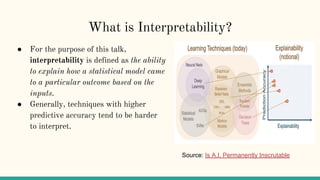
● For the purpose of this talk,
interpretability is defined as the ability
to explain how a statistical model came
to a particular outcome based on the
inputs.
● Generally, techniques with higher
predictive accuracy tend to be harder
to interpret.
Source: Is A.I. Permanently Inscrutable
Fairness, Accountability, and Transparency in ML
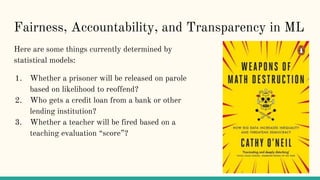
Here are some things currently determined by
statistical models:
1. Whether a prisoner will be released on parole
based on likelihood to reoffend?
2. Who gets a credit loan from a bank or other
lending institution?
3. Whether a teacher will be fired based on a
teaching evaluation “score”?
Why does
Interpretability Matter?
Benefits of Explainable Models
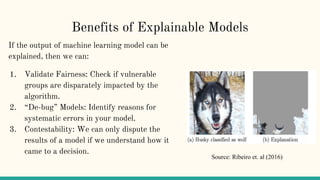
If the output of machine learning model can be
explained, then we can:
1. Validate Fairness: Check if vulnerable
groups are disparately impacted by the
algorithm.
2. “De-bug” Models: Identify reasons for
systematic errors in your model.
3. Contestability: We can only dispute the
results of a model if we understand how it
came to a decision.
Source: Ribeiro et. al (2016)
Article 22 and the “Right to explanation”
● In the EU General Data Protection
Regulations (GDPR), Article 22 states
any EU citizen can opt out of automated
decision-making.
● In addition, Article 12 allows
individuals to inquire as to why a
particular algorithmic decision was
made for them.
LIME:
Locally Interpretable Model-Agnostic Explanations
Marco Tulio Ribeiro Sameer Singh Carlos Guestrin
U. Washington U. Washington U. Washington
Interpretable Models
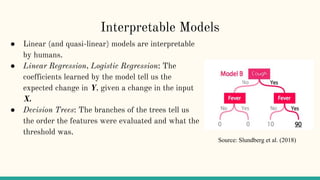
● Linear (and quasi-linear) models are interpretable
by humans.
● Linear Regression, Logistic Regression: The
coefficients learned by the model tell us the
expected change in Y, given a change in the input
X.
● Decision Trees: The branches of the trees tell us
the order the features were evaluated and what the
threshold was.
Source: Slundberg et al. (2018)
Surrogate Models
1. Start with some black-box predictive
model. On some dataset X, get the
predictions ŷ from the model.
2. Train an interpretable model (the models
on the last slide) on the dataset X and the
model predictions ŷ.
3. Measure how well the surrogate model
reproduces the output of the black-box
model.
Black
Box
Surrogate
Model
Data
(X)
Test
Training
ŷ
LIME
● With surrogate models, we use interpretable
linear models to estimate the average effects
of a black-box model (Global
Interpretability).
● Rather than caring about general effects of
different features, we aim to understand why
the model made a particular decision
(Local Interpretability)?
● LIME library allows us to create local
explanations for a test point:
https://github.com/marcotcr/lime
LIME (methodology)
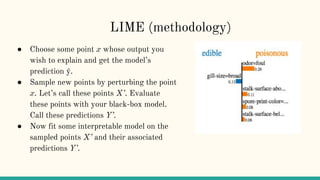
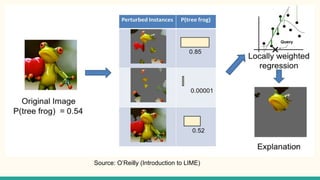
● Choose some point x whose output you
wish to explain and get the model’s
prediction ŷ.
● Sample new points by perturbing the point
x. Let’s call these points X’. Evaluate
these points with your black-box model.
Call these predictions Y’.
● Now fit some interpretable model on the
sampled points X’ and their associated
predictions Y’.
Source: O’Reilly (Introduction to LIME)
SHAP:
SHapley Additive exPlanations
Scott Lundberg Gabriel G. Erion Su-In Lee
U. Washington U. Washington U. Washington
Co-operative Game Theory
● Game Theory: Branch of micro-economics
dealing with interactions between
decision-making agents.
● Cooperative Game Theory: Sub-field of
game theory where players are “working
together” to achieve a common goal.
● With regards to machine learning, we can
view the features of the model as the
“players”, and the outcome of the model as
the “game’s result”.
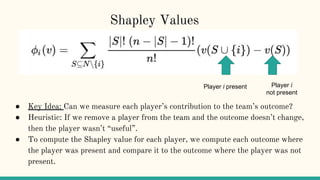
Shapley Values
● Key Idea: Can we measure each player’s contribution to the team’s outcome?
● Heuristic: If we remove a player from the team and the outcome doesn’t change,
then the player wasn’t “useful”.
● To compute the Shapley value for each player, we compute each outcome where
the player was present and compare it to the outcome where the player was not
present.
Player i present Player i
not present
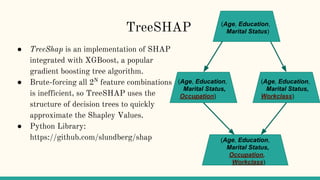
TreeSHAP
● TreeShap is an implementation of SHAP
integrated with XGBoost, a popular
gradient boosting tree algorithm.
● Brute-forcing all 2N
feature combinations
is inefficient, so TreeSHAP uses the
structure of decision trees to quickly
approximate the Shapley Values.
● Python Library:
https://github.com/slundberg/shap
(Age, Education,
Marital Status)
(Age, Education,
Marital Status,
Occupation)
(Age, Education,
Marital Status,
Workclass)
(Age, Education,
Marital Status,
Occupation,
Workclass)
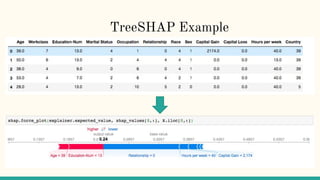
TreeSHAP Example
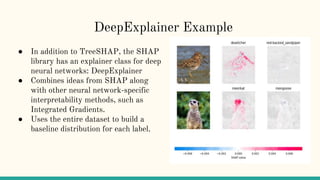
DeepExplainer Example
● In addition to TreeSHAP, the SHAP
library has an explainer class for deep
neural networks: DeepExplainer
● Combines ideas from SHAP along
with other neural network-specific
interpretability methods, such as
Integrated Gradients.
● Uses the entire dataset to build a
baseline distribution for each label.
Recourse Analysis
Berk Ustun Alexander Spangher Yang Liu
Harvard SEAS Carnegie Mellon University Harvard SEAS
Interpretable & Actionable
● We now have covered tools for
understanding why an algorithm made
a particular decision, but this
explanation may not necessarily be
“actionable”.
● For individuals who receive a negative
outcome by some automated
decision-making process, we would
ideally want to be able to recommend
actions they could take to improve their
outcome for next time.
Recourse Analysis
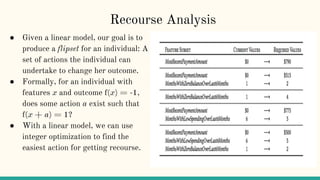
● Given a linear model, our goal is to
produce a flipset for an individual: A
set of actions the individual can
undertake to change her outcome.
● Formally, for an individual with
features x and outcome f(x) = -1,
does some action a exist such that
f(x + a) = 1?
● With a linear model, we can use
integer optimization to find the
easiest action for getting recourse.
Summary
1. Interpretability helps us better understand the behavior of our models.
2. LIME trains a local surrogate model by creating new data points based on an
input point.
3. SHAP use game theory to create a consistent method for identifying features
relevant to a decision.
4. Recourse Analysis allows individuals to take actions that can improve their
outcome for next time; Python Implementation (under active development):
https://github.com/ustunb/actionable-recourse
Further Resources
● Interpretable ML book: https://christophm.github.io/interpretable-ml-book/
● Google What-If Tool: https://pair-code.github.io/what-if-tool/
● FAT ML: http://www.fatml.org/
● DARPA XAI: https://www.darpa.mil/program/explainable-artificial-intelligence
● Data 4 Good Exchange: https://www.bloomberg.com/company/d4gx/
● AI Now Institute: https://ainowinstitute.org/

Interpretable machine learning : Methods for understanding complex models

  • 1.
    Interpretable Machine Learning: Methodsfor Understanding Complex Models Manojit Nandi @mnandi92 Rocketrip
  • 2.
    What is Interpretability? ●For the purpose of this talk, interpretability is defined as the ability to explain how a statistical model came to a particular outcome based on the inputs. ● Generally, techniques with higher predictive accuracy tend to be harder to interpret. Source: Is A.I. Permanently Inscrutable
  • 3.
    Fairness, Accountability, andTransparency in ML Here are some things currently determined by statistical models: 1. Whether a prisoner will be released on parole based on likelihood to reoffend? 2. Who gets a credit loan from a bank or other lending institution? 3. Whether a teacher will be fired based on a teaching evaluation “score”?
  • 4.
  • 5.
    Benefits of ExplainableModels If the output of machine learning model can be explained, then we can: 1. Validate Fairness: Check if vulnerable groups are disparately impacted by the algorithm. 2. “De-bug” Models: Identify reasons for systematic errors in your model. 3. Contestability: We can only dispute the results of a model if we understand how it came to a decision. Source: Ribeiro et. al (2016)
  • 6.
    Article 22 andthe “Right to explanation” ● In the EU General Data Protection Regulations (GDPR), Article 22 states any EU citizen can opt out of automated decision-making. ● In addition, Article 12 allows individuals to inquire as to why a particular algorithmic decision was made for them.
  • 7.
    LIME: Locally Interpretable Model-AgnosticExplanations Marco Tulio Ribeiro Sameer Singh Carlos Guestrin U. Washington U. Washington U. Washington
  • 8.
    Interpretable Models ● Linear(and quasi-linear) models are interpretable by humans. ● Linear Regression, Logistic Regression: The coefficients learned by the model tell us the expected change in Y, given a change in the input X. ● Decision Trees: The branches of the trees tell us the order the features were evaluated and what the threshold was. Source: Slundberg et al. (2018)
  • 9.
    Surrogate Models 1. Startwith some black-box predictive model. On some dataset X, get the predictions ŷ from the model. 2. Train an interpretable model (the models on the last slide) on the dataset X and the model predictions ŷ. 3. Measure how well the surrogate model reproduces the output of the black-box model. Black Box Surrogate Model Data (X) Test Training ŷ
  • 10.
    LIME ● With surrogatemodels, we use interpretable linear models to estimate the average effects of a black-box model (Global Interpretability). ● Rather than caring about general effects of different features, we aim to understand why the model made a particular decision (Local Interpretability)? ● LIME library allows us to create local explanations for a test point: https://github.com/marcotcr/lime
  • 11.
    LIME (methodology) ● Choosesome point x whose output you wish to explain and get the model’s prediction ŷ. ● Sample new points by perturbing the point x. Let’s call these points X’. Evaluate these points with your black-box model. Call these predictions Y’. ● Now fit some interpretable model on the sampled points X’ and their associated predictions Y’.
  • 12.
  • 13.
    SHAP: SHapley Additive exPlanations ScottLundberg Gabriel G. Erion Su-In Lee U. Washington U. Washington U. Washington
  • 14.
    Co-operative Game Theory ●Game Theory: Branch of micro-economics dealing with interactions between decision-making agents. ● Cooperative Game Theory: Sub-field of game theory where players are “working together” to achieve a common goal. ● With regards to machine learning, we can view the features of the model as the “players”, and the outcome of the model as the “game’s result”.
  • 15.
    Shapley Values ● KeyIdea: Can we measure each player’s contribution to the team’s outcome? ● Heuristic: If we remove a player from the team and the outcome doesn’t change, then the player wasn’t “useful”. ● To compute the Shapley value for each player, we compute each outcome where the player was present and compare it to the outcome where the player was not present. Player i present Player i not present
  • 16.
    TreeSHAP ● TreeShap isan implementation of SHAP integrated with XGBoost, a popular gradient boosting tree algorithm. ● Brute-forcing all 2N feature combinations is inefficient, so TreeSHAP uses the structure of decision trees to quickly approximate the Shapley Values. ● Python Library: https://github.com/slundberg/shap (Age, Education, Marital Status) (Age, Education, Marital Status, Occupation) (Age, Education, Marital Status, Workclass) (Age, Education, Marital Status, Occupation, Workclass)
  • 17.
  • 18.
    DeepExplainer Example ● Inaddition to TreeSHAP, the SHAP library has an explainer class for deep neural networks: DeepExplainer ● Combines ideas from SHAP along with other neural network-specific interpretability methods, such as Integrated Gradients. ● Uses the entire dataset to build a baseline distribution for each label.
  • 19.
    Recourse Analysis Berk UstunAlexander Spangher Yang Liu Harvard SEAS Carnegie Mellon University Harvard SEAS
  • 20.
    Interpretable & Actionable ●We now have covered tools for understanding why an algorithm made a particular decision, but this explanation may not necessarily be “actionable”. ● For individuals who receive a negative outcome by some automated decision-making process, we would ideally want to be able to recommend actions they could take to improve their outcome for next time.
  • 21.
    Recourse Analysis ● Givena linear model, our goal is to produce a flipset for an individual: A set of actions the individual can undertake to change her outcome. ● Formally, for an individual with features x and outcome f(x) = -1, does some action a exist such that f(x + a) = 1? ● With a linear model, we can use integer optimization to find the easiest action for getting recourse.
  • 22.
    Summary 1. Interpretability helpsus better understand the behavior of our models. 2. LIME trains a local surrogate model by creating new data points based on an input point. 3. SHAP use game theory to create a consistent method for identifying features relevant to a decision. 4. Recourse Analysis allows individuals to take actions that can improve their outcome for next time; Python Implementation (under active development): https://github.com/ustunb/actionable-recourse
  • 23.
    Further Resources ● InterpretableML book: https://christophm.github.io/interpretable-ml-book/ ● Google What-If Tool: https://pair-code.github.io/what-if-tool/ ● FAT ML: http://www.fatml.org/ ● DARPA XAI: https://www.darpa.mil/program/explainable-artificial-intelligence ● Data 4 Good Exchange: https://www.bloomberg.com/company/d4gx/ ● AI Now Institute: https://ainowinstitute.org/