2
● Applied Mathematics, Data Science
● SW Engineering, Machine Learning
● Big Data, Hadoop, Spark
mspitzer@inovex.de
@mspitzer243
3
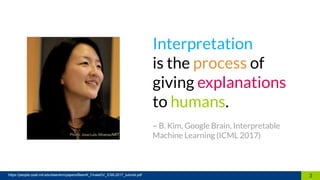
Interpretation
is the process of
giving explanations
to humans.
~ B. Kim, Google Brain, Interpretable
Machine Learning (ICML 2017)
https://people.csail.mit.edu/beenkim/papers/BeenK_FinaleDV_ICML2017_tutorial.pdf
4
“Interpretability is the degree to which an observer
can understand the cause of a decision.”
~ Miller T., 2017, Explanation in AI: Insights from the Social Sciences
● humans create decision systems
● humans are affected by decisions
● humans demand for explanations
https://arxiv.org/pdf/1706.07269.pdf
5
Bias towards Accuracy
Do also consider asking yourself:
● Am I solving the right problem?
● How to make people trust my algorithm?
● Is there any bias? Are the training data representative?
● What is the impact in a real-world setting?
https://bentoml.com/posts/2019-04-19-one-model/
“The machine learning community focuses too much on predictive performance.
But machine learning models are always a small part of a complex system.”
~ C. Molnar, 2019, One Model to Rule Them All
6https://arxiv.org/abs/1602.04938
7https://arxiv.org/pdf/1606.03490.pdf
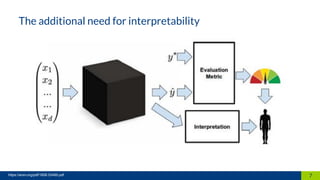
The additional need for interpretability
8https://arxiv.org/pdf/1606.03490.pdf
The additional need for interpretability
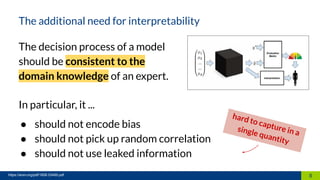
The decision process of a model
should be consistent to the
domain knowledge of an expert.
In particular, it ...
● should not encode bias
● should not pick up random correlation
● should not use leaked information
hard to capture in asingle quantity
9
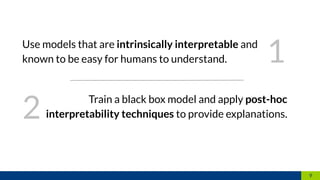
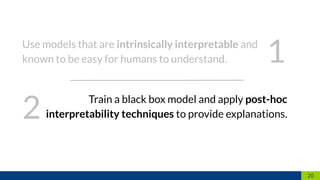
Use models that are intrinsically interpretable and
known to be easy for humans to understand.
Train a black box model and apply post-hoc
interpretability techniques to provide explanations.
1
2
10
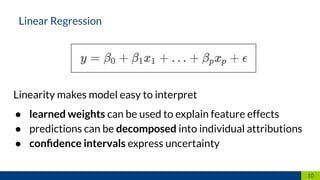
Linear Regression
Linearity makes model easy to interpret
● learned weights can be used to explain feature effects
● predictions can be decomposed into individual attributions
● confidence intervals express uncertainty
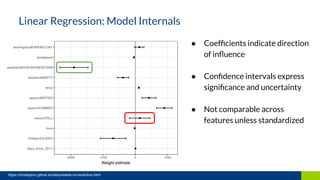
Linear Regression: Model Internals
https://christophm.github.io/interpretable-ml-book/limo.html
● Coefficients indicate direction
of influence
● Confidence intervals express
significance and uncertainty
● Not comparable across
features unless standardized
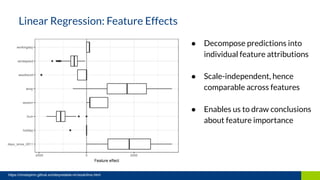
Linear Regression: Feature Effects
https://christophm.github.io/interpretable-ml-book/limo.html
● Decompose predictions into
individual feature attributions
● Scale-independent, hence
comparable across features
● Enables us to draw conclusions
about feature importance
https://christophm.github.io/interpretable-ml-book/limo.html
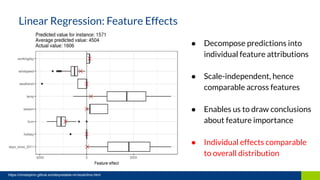
Linear Regression: Feature Effects
● Decompose predictions into
individual feature attributions
● Scale-independent, hence
comparable across features
● Enables us to draw conclusions
about feature importance
● Individual effects comparable
to overall distribution
14
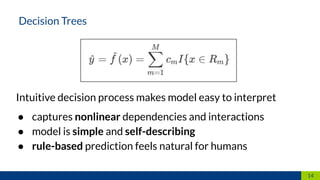
Decision Trees
Intuitive decision process makes model easy to interpret
● captures nonlinear dependencies and interactions
● model is simple and self-describing
● rule-based prediction feels natural for humans
15
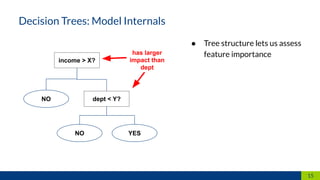
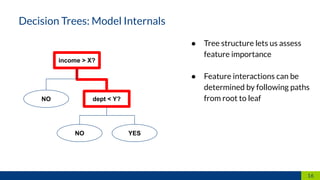
Decision Trees: Model Internals
income > X?
dept < Y?
YESNO
NO
has larger
impact than
dept
● Tree structure lets us assess
feature importance
16
Decision Trees: Model Internals
income > X?
dept < Y?
YESNO
NO
● Tree structure lets us assess
feature importance
● Feature interactions can be
determined by following paths
from root to leaf
17
Decision Trees: Individual Explanations
income > X?
dept < Y?
YESNO
NO
● Tree structure lets us assess
feature importance
● Feature interactions can be
determined by following paths
from root to leaf
● To explain a particular
prediction, just take a look at
the path from root to leaf
18
Wrap Up: Desirable Properties
Intrinsically interpretable models simplify answering:
● Which features are relevant?
● How do they influence predictions?
● How do features interact?
● How certain is a prediction?
Both for the entire model as well as individual predictions
19
Wrap Up: Desirable Properties
Intrinsically interpretable models simplify answering:
● Which features are relevant?
● How do they influence predictions?
● How do features interact?
● How certain is a prediction?
Both for the entire model as well as individual predictions
How to answer these questions
if models were black boxes?
20
Use models that are intrinsically interpretable and
known to be easy for humans to understand.
Train a black box model and apply post-hoc
interpretability techniques to provide explanations.
1
2
21
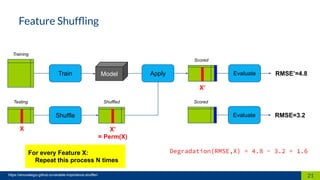
Feature Shuffling
https://amunategui.github.io/variable-importance-shuffler/
Train Model Apply
Shuffle
Evaluate
Training
Testing Shuffled
Scored
RMSE’=4.8
Evaluate
Scored
RMSE=3.2
X
X’
For every Feature X:
Repeat this process N times
X’
= Perm(X)
Degradation(RMSE,X) = 4.8 - 3.2 = 1.6
22
Feature Shuffling
https://christophm.github.io/interpretable-ml-book/feature-importance.html https://scikit-plot.readthedocs.io/en/stable/estimators.html#scikitplot.estimators.plot_feature_importances
● Estimates Feature importance
by averaging degradation
● Tied to certain loss function
● Not applicable in high
dimensional domains
23
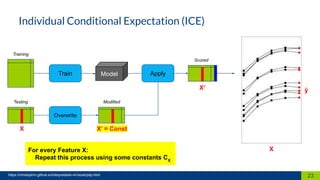
Individual Conditional Expectation (ICE)
https://christophm.github.io/interpretable-ml-book/pdp.html
Train Model
Training
Testing
Overwrite
Modified
X
Apply
Scored
X’
X’ = Const
XFor every Feature X:
Repeat this process using some constants CX
ŷ
24
Individual Conditional Expectation (ICE)
https://christophm.github.io/interpretable-ml-book/pdp.html
25
Individual Conditional Expectation (ICE)
https://christophm.github.io/interpretable-ml-book/pdp.html
26
Individual Conditional Expectation (ICE)
https://christophm.github.io/interpretable-ml-book/pdp.html
27
Global Surrogate Models
https://www.oreilly.com/ideas/ideas-on-interpreting-machine-learning
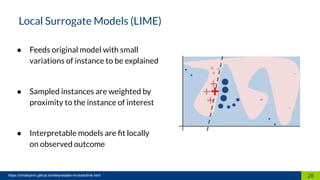
● Feeds original model with small
variations of instance to be explained
● Sampled instances are weighted by
proximity to the instance of interest
● Interpretable models are fit locally
on observed outcome
28
Local Surrogate Models (LIME)
https://christophm.github.io/interpretable-ml-book/lime.html
29
Local Surrogate Models (LIME)
https://www.oreilly.com/learning/introduction-to-local-interpretable-model-agnostic-explanations-lime
30
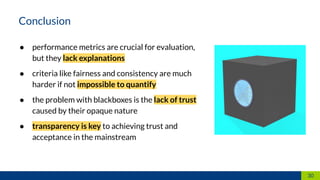
Conclusion
● performance metrics are crucial for evaluation,
but they lack explanations
● criteria like fairness and consistency are much
harder if not impossible to quantify
● the problem with blackboxes is the lack of trust
caused by their opaque nature
● transparency is key to achieving trust and
acceptance in the mainstream
31https://xkcd.com/1838/
Conclusion
don’t end up like this!
● Molnar C., 2018, Interpretable Machine Learning - A Guide for Making
Black Box Models Explainable
● Gill N., Hall P., 2018, An Introduction to Machine Learning Interpretability
● Zhao Q., Hastie T., 2017, Causal Interpretations of Black-Box Models
● Kim B., Doshi-Velez F., 2017, Interpretable Machine Learning: The fuss, the
concrete and the questions
● Ribeiro, M.T., Singh, S. and Guestrin, C., 2016, August. Why should i trust
you? Explaining the predictions of any classifier
32
Resources
33
Marcel Spitzer
Big Data Scientist
mspitzer@inovex.de
inovex GmbH
Schanzenstraße 6-20
Kupferhütte 1.13
51063 Köln

Interpretable Machine Learning

  • 2.
    2 ● Applied Mathematics,Data Science ● SW Engineering, Machine Learning ● Big Data, Hadoop, Spark mspitzer@inovex.de @mspitzer243
  • 3.
    3 Interpretation is the processof giving explanations to humans. ~ B. Kim, Google Brain, Interpretable Machine Learning (ICML 2017) https://people.csail.mit.edu/beenkim/papers/BeenK_FinaleDV_ICML2017_tutorial.pdf
  • 4.
    4 “Interpretability is thedegree to which an observer can understand the cause of a decision.” ~ Miller T., 2017, Explanation in AI: Insights from the Social Sciences ● humans create decision systems ● humans are affected by decisions ● humans demand for explanations https://arxiv.org/pdf/1706.07269.pdf
  • 5.
    5 Bias towards Accuracy Doalso consider asking yourself: ● Am I solving the right problem? ● How to make people trust my algorithm? ● Is there any bias? Are the training data representative? ● What is the impact in a real-world setting? https://bentoml.com/posts/2019-04-19-one-model/ “The machine learning community focuses too much on predictive performance. But machine learning models are always a small part of a complex system.” ~ C. Molnar, 2019, One Model to Rule Them All
  • 6.
  • 7.
  • 8.
    8https://arxiv.org/pdf/1606.03490.pdf The additional needfor interpretability The decision process of a model should be consistent to the domain knowledge of an expert. In particular, it ... ● should not encode bias ● should not pick up random correlation ● should not use leaked information hard to capture in asingle quantity
  • 9.
    9 Use models thatare intrinsically interpretable and known to be easy for humans to understand. Train a black box model and apply post-hoc interpretability techniques to provide explanations. 1 2
  • 10.
    10 Linear Regression Linearity makesmodel easy to interpret ● learned weights can be used to explain feature effects ● predictions can be decomposed into individual attributions ● confidence intervals express uncertainty
  • 11.
    Linear Regression: ModelInternals https://christophm.github.io/interpretable-ml-book/limo.html ● Coefficients indicate direction of influence ● Confidence intervals express significance and uncertainty ● Not comparable across features unless standardized
  • 12.
    Linear Regression: FeatureEffects https://christophm.github.io/interpretable-ml-book/limo.html ● Decompose predictions into individual feature attributions ● Scale-independent, hence comparable across features ● Enables us to draw conclusions about feature importance
  • 13.
    https://christophm.github.io/interpretable-ml-book/limo.html Linear Regression: FeatureEffects ● Decompose predictions into individual feature attributions ● Scale-independent, hence comparable across features ● Enables us to draw conclusions about feature importance ● Individual effects comparable to overall distribution
  • 14.
    14 Decision Trees Intuitive decisionprocess makes model easy to interpret ● captures nonlinear dependencies and interactions ● model is simple and self-describing ● rule-based prediction feels natural for humans
  • 15.
    15 Decision Trees: ModelInternals income > X? dept < Y? YESNO NO has larger impact than dept ● Tree structure lets us assess feature importance
  • 16.
    16 Decision Trees: ModelInternals income > X? dept < Y? YESNO NO ● Tree structure lets us assess feature importance ● Feature interactions can be determined by following paths from root to leaf
  • 17.
    17 Decision Trees: IndividualExplanations income > X? dept < Y? YESNO NO ● Tree structure lets us assess feature importance ● Feature interactions can be determined by following paths from root to leaf ● To explain a particular prediction, just take a look at the path from root to leaf
  • 18.
    18 Wrap Up: DesirableProperties Intrinsically interpretable models simplify answering: ● Which features are relevant? ● How do they influence predictions? ● How do features interact? ● How certain is a prediction? Both for the entire model as well as individual predictions
  • 19.
    19 Wrap Up: DesirableProperties Intrinsically interpretable models simplify answering: ● Which features are relevant? ● How do they influence predictions? ● How do features interact? ● How certain is a prediction? Both for the entire model as well as individual predictions How to answer these questions if models were black boxes?
  • 20.
    20 Use models thatare intrinsically interpretable and known to be easy for humans to understand. Train a black box model and apply post-hoc interpretability techniques to provide explanations. 1 2
  • 21.
    21 Feature Shuffling https://amunategui.github.io/variable-importance-shuffler/ Train ModelApply Shuffle Evaluate Training Testing Shuffled Scored RMSE’=4.8 Evaluate Scored RMSE=3.2 X X’ For every Feature X: Repeat this process N times X’ = Perm(X) Degradation(RMSE,X) = 4.8 - 3.2 = 1.6
  • 22.
  • 23.
    23 Individual Conditional Expectation(ICE) https://christophm.github.io/interpretable-ml-book/pdp.html Train Model Training Testing Overwrite Modified X Apply Scored X’ X’ = Const XFor every Feature X: Repeat this process using some constants CX ŷ
  • 24.
    24 Individual Conditional Expectation(ICE) https://christophm.github.io/interpretable-ml-book/pdp.html
  • 25.
    25 Individual Conditional Expectation(ICE) https://christophm.github.io/interpretable-ml-book/pdp.html
  • 26.
    26 Individual Conditional Expectation(ICE) https://christophm.github.io/interpretable-ml-book/pdp.html
  • 27.
  • 28.
    ● Feeds originalmodel with small variations of instance to be explained ● Sampled instances are weighted by proximity to the instance of interest ● Interpretable models are fit locally on observed outcome 28 Local Surrogate Models (LIME) https://christophm.github.io/interpretable-ml-book/lime.html
  • 29.
    29 Local Surrogate Models(LIME) https://www.oreilly.com/learning/introduction-to-local-interpretable-model-agnostic-explanations-lime
  • 30.
    30 Conclusion ● performance metricsare crucial for evaluation, but they lack explanations ● criteria like fairness and consistency are much harder if not impossible to quantify ● the problem with blackboxes is the lack of trust caused by their opaque nature ● transparency is key to achieving trust and acceptance in the mainstream
  • 31.
  • 32.
    ● Molnar C.,2018, Interpretable Machine Learning - A Guide for Making Black Box Models Explainable ● Gill N., Hall P., 2018, An Introduction to Machine Learning Interpretability ● Zhao Q., Hastie T., 2017, Causal Interpretations of Black-Box Models ● Kim B., Doshi-Velez F., 2017, Interpretable Machine Learning: The fuss, the concrete and the questions ● Ribeiro, M.T., Singh, S. and Guestrin, C., 2016, August. Why should i trust you? Explaining the predictions of any classifier 32 Resources
  • 33.
  • 34.
    Marcel Spitzer Big DataScientist mspitzer@inovex.de inovex GmbH Schanzenstraße 6-20 Kupferhütte 1.13 51063 Köln