Machine Guarding
Rule of Thumb
 Any machine part,
function, or process
that may cause injury
must be safeguarded.
Regulatory Requirements
 Regulatory requirements found in
29 CFR 1910, subpart O
 Applies to specific types of equipment
 Delineates general requirements
Where Mechanical
Hazards Occur
 The point of operation
 In the power transmission apparatus
 Other moving parts
Hazardous Mechanical
Motions
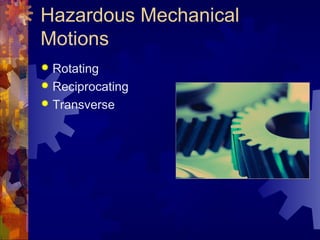
 Rotating
 Reciprocating
 Transverse
Hazardous Actions
 Cutting
 Punching
 Shearing
 Bending
Types of Rotating
Mechanisms
 Collars
 Couplings
 Cams
 Clutches
 Flywheels
 Shaft ends
 Spindles
Nip Points
 Caused by rotating parts
 Causes include
 Parts rotating in opposite directions
 Parts rotating tangentially
 Parts rotating close to a fixed part
Types of Reciprocating
Motions
 Back and forth
 Up and down
Types of Transverse Motions
 Straight and in a continuous line
 Examples include two pulleys and a belt
Cutting Actions
 Include
 Rotating motions
 Reciprocating motions
 Transverse motions
Types of Cutting Mechanisms
 Band saws
 Circular saws
 Boring or
drilling machines
 Lathes
 Milling machines
Types of Punching Actions
 A ram mechanism:
 Blanks
 Draws
 Stamps
 Used on metal or other materials
Types of Punching Equipment
 Power presses
 Iron working equipment
Types of Shearing Actions
 Uses a powered slide or knife
 Done to trim or shear metal or other
materials
Types of Shearing Equipment
 Shears that are operated:
 Hydraulically
 Mechanically
 Pneumatically
Types of Bending Actions
 Power is applied to a slide to:
 Draw
 Stamp
 Used on metal or other materials
Types of Bending Equipment
 Power presses
 Press brakes
 Tubing benders
Requirements for Safeguards
 Minimum general requirements
include:
 Prevent contact
 Secure
 Protect from falling objects
 Create no new hazards
 Create no interference
 Allow for safe lubrication
Classifications of Safeguards
 Guards
 Devices
 Location/distance
 Feeding and ejection methods
 Miscellaneous aids
Types of Guards
 Fixed
 Interlocked
 Adjustable
 Self-adjusting
Types of Devices
 Presence sensing
 Photoelectrical
 Radio frequency
 Electromechanical
 Pullbacks or restraints
Types of Devices (Cont.)
 Safety controls
 Safety trip control
 Pressure-sensitive body
bar
 Safety tripod
 Safety tripwire cable
 Two-hand control
 Two-hand trip
Types of Devices (Cont.)
 Gates
 Interlocked
 Other
Location/distance
 Makes it virtually impossible to contact
moving parts
 Separates operators from the
equipment
 Limited by the available workspace
Feeding and Ejection Methods
 Automatic feed
 Semiautomatic feed
 Automatic ejection
 Semiautomatic ejection
 Robot
Miscellaneous Aids
 Awareness barriers
 Protective shields
 Hand-feeding tools and holding fixtures

Machine Guarding

Editor's Notes

  • #2 Machine guarding is an integral part of any safety and health program. As statistics can demonstrate, it is also one aspect of safety that is too often violated. This program will review the reasons for machine guarding and the various types of guards used in industry. We will also explore some of the different motions and actions that are readily available on equipment routinely used in the workplace.
  • #3 If you can easily contact the moving parts on a machine, the machine must be guarded. Because the OSHA standards are performance oriented with regard to machine guarding, companies have the freedom to design their own guards. However, remember that most equipment built today is designed with guards in place.
  • #4 The OSHA standards provide some specific requirements for various pieces of equipment. But whether or not there are specifics in the standard, simply keep in mind that if there are movements or actions that can affect you when operating the machine, then it must be guarded in some way. In a few moments, we will review some of the ways we can safeguard the equipment.
  • #5 The point of operation is where the work is actually performed on the material. The power transmission apparatus includes all components of the mechanical system that transmit energy to the part of the machine performing the work. These components include flywheels, pulleys, belts, connecting rods, couplings, cams, spindles, chains, cranks, and gears. Other moving parts include all parts of the machine that move while the machine is working.
  • #6 A wide variety of mechanical motions can present hazards. Clearly, any of these that present a danger to the operator or passerby must be guarded. These motions typically create in-running nip points that must be guarded.
  • #7 Hazardous actions are most generally within the point of operation. The further away the operator is from the point of operation, the less hazard created by these motions. Unfortunately, what may be a smooth and quiet piece of equipment may generate thousands of pounds of force. The human body is no match for this type of force, and the equipment cannot differentiate between flesh and metal.
  • #8 These are common types of rotating mechanisms; however, there is added danger when bolts, nicks, abrasions, and protecting keys or set screws are exposed on rotating parts or machinery. Do not overlook these additional hazards as they too are a significant cause of injury.
  • #9 Nips points are often easy to identify but sometimes difficult to safeguard. Nip points are caused when parts are rotating in the opposite direction, tangentially, or close to a fixed point.
  • #10 We can sometimes overlook the reciprocating motions because 50 percent of the time the hazard may not be obvious. For example, a piece of equipment that slides may create a hazard only during the return motion because of the surrounding environment. One example of this would be a sliding table on a stationary bed that can pin an operator against a wall or another piece of equipment.
  • #11 These motions create hazards because a worker may be struck or caught in a pinch or shear point by a moving part.
  • #12 The danger of cutting action exists at the point of operation; where finger, head, and arm injuries can occur and where flying chips or scrap material can strike the eyes or face. These hazards are particularly significant when the point of operation involves cutting wood or metal.
  • #13 These types of equipment are extremely common in industry. Because operators are so accustomed to using these pieces of equipment, it is easier to overlook the hazard or eliminate the safeguard. Operators must be trained on using the safeguards effectively.
  • #14 Punching actions require an incredible amount of force. Therefore, the point of operation guarding is very important. You must be extremely careful not to place any part of your body in harm’s way.
  • #15 Once again, these types of machines are very dangerous because of the forces applied at the point of operation.
  • #16 Shearing actions use a powered slide or knife to trim or shear metal and other materials. The primary hazard on a shearing operation occurs at the point of operation where stock is actually inserted, held, and withdrawn.
  • #17 You will note that these types of energy are all required to be de-energized when locking out a piece of shearing equipment. Gravity can also be a concern with a shear, and therefore, operators should make sure the cycle of the equipment is complete or that the ram mechanism is blocked to prevent movement.
  • #18 Bending actions are where power is applied to draw or stamp metal or other materials. Again, these hazards occur at the point of operation where stock is inserted, held, or withdrawn.
  • #19 Power presses, press brakes, and tubing benders are all types of bending equipment. As with shearing, the force required to bend materials such as metal is extreme, and the human body is no match for it.
  • #20 Safeguards must prevent our limbs or any part of our body from contacting the hazard point. Safeguards should not be easy to remove or defeat. Guards should also ensure that no objects can fall into moving parts, creating additional hazards. If safeguards create an additional hazard such as a pinch point, then they are basically defeating their own purpose. If guards interfere with the typical production process, some operators may have a tendency to remove them. This is a warning that design of the safeguard may need to be reviewed for effectiveness. It is always advantageous to have lubrication points built into the safeguards so that equipment can be serviced without having to remove the guard.
  • #21 There are many ways to safeguard machinery. The type of operation, the size or the shape of the stock, the method of handling, the physical layout of the work area, the type of material, and production requirements or limitations will help to determine the appropriate safeguarding method for the individual machine. These are the five basic classes of safeguards.
  • #22 There are several different types of machine guards, including fixed, interlocked, adjustable, and self-adjusting. As a general rule, power transmission apparatuses are best protected by fixed guards that enclose the danger area. For hazards at the point of operation where moving parts actually perform work on stock, several types are available and effective.
  • #23 Photoelectrical devices use light to detect the presence of an operator, while radio frequency devices use capacitance. Pullbacks and restraints are not used as commonly anymore; however, some old equipment may still incorporate these methods.
  • #24 Safety controls typically rely on the force of the operator leaning against them to trip a microswitch that shuts down the equipment, eliminating the hazard. Two-hand control devices eliminate the possibility of freeing up one hand while operating the equipment with the other. Operators who try to defeat the two-hand control by using what is called a “cheater bar” will face disciplinary action. Gates are commonly found around robots and other operations where the operation of the equipment encompasses a fairly large area and, therefore, requires perimeter guarding. Gates can also be used across openings in a piece of equipment.
  • #25 Safety controls typically rely on the force of the operator leaning against them to trip a microswitch that shuts down the equipment, eliminating the hazard. Two-hand control devices eliminate the possibility of freeing up one hand while operating the equipment with the other. Operators who try to defeat the two-hand control by using what is called a “cheater bar” will face disciplinary action. Gates are commonly found around robots and other operations where the operation of the equipment encompasses a fairly large area and, therefore, requires perimeter guarding. Gates can also be used across openings in a piece of equipment.
  • #26 Keeping distance between you and the equipment you work with virtually eliminates the risk of injury from moving parts. This very effective method is limited by the amount of space available in the work area.
  • #27 Automatic feeding and ejection methods do not require you to place your hands in the danger area. In some cases, no operator involvement is necessary after the machine is set up. In other situations, operators can manually feed the stock with the assistance of a feeding mechanism. Properly designed ejection methods do not require any operator involvement after the machine starts to function. A robot is a good method of automatic feeding and ejection.
  • #28 While these aids do not give complete protection from machine hazards, they may provide you with an extra margin of safety. Sound judgment is needed in their application and usage.