Forklift Operator Training
29 CFR 1910.178
Graves Construction
Safety Training
Presentations
Is Forklift Training Necessary?
 About 100
deaths each year
 About 95,000
accidents each
year
 Bankruptcy
 New OSHA
training standard
Forklift Operating Goals
 Hazards and forklift stability
 Inspecting and operating a forklift
 Quiz
Authorized Operator
 Only trained and authorized personnel are
permitted to operate a forklift. This presentation
does not permit you to operate a forklift.
 Keep unauthorized employees off of forklifts.
 Keep pedestrians away from the operating zone
of a forklift.
 Lock out unsafe lifts as determined in a
preoperational inspection.
Operating Hazards
 Workplace hazards: ramps, railroad
tracks, slippery floors, poor lighting,
congestion
 Loads: large or bulky, uneven
weight, broken pallets, poorly
stacked
 Pedestrians: horseplay, unaware of
forklift areas, not paying attention
Nameplate
 OSHA requires a legible nameplate
 Includes modifications & attachments
 Capacity
 Load center
Center of Gravity
 Balance point
48”
A
B
20” 40”
Distance from the edge of the
item to the item’s center of gravity
Load Center
 Distance from vertical
face of the forks
to the load’s center of
gravity
 A: load center = 24"
 B: load center = 40"
80”
B
48””
A
1 inch = 100 lbs
Important reason for keeping the load
resting against the vertical face of forks
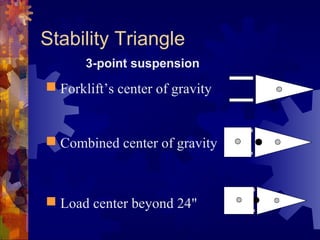
Stability Triangle
3-point suspension
 Forklift’s center of gravity
 Combined center of gravity
 Load center beyond 24"
Combined Actions
 Center of gravity moves
side to side
Center of gravity
moves forward
Center of gravity moves
backward to the thin portion
of the triangle
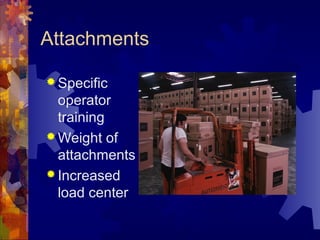
Attachments
 Specific
operator
training
 Weight of
attachments
 Increased
load center
Tipping Over
 Do not jump
 Hold onto the steering wheel
 Brace your feet
 Lean away from the fall
Preoperation Inspection
 As an authorized
operator, it is your
responsibility to make
sure your forklift
functions properly
 OSHA requires
preoperation
inspections
 Graves wants to comply
with OSHA and be sure
equipment is
maintained
Walk Around
 Forklift properly disengaged
 Forks down, key off, neutral gear,
parking brake on
 Left/right side
 Tire condition, tight lug nuts, no debris
around axle, overhead guard is solid, no
debris behind the mast
 Front
 Forks in good shape, fork pins in place,
backrest solid, mast & chains greased,
hoses in good shape
 Rear
 Counterbalance bolt is tight, radiator
clear of debris
In the Seat
 Nonmoving checks
 Gauges, lights, horn, back-up alarm,
blinking warning light, operate the tilt &
lift mechanism, check the parking brake
 Moving checks
 Put on the seat belt, check the running
brakes,
check the steering
 Look for oil or water leaks on the floor
Operating a Lift Truck
 Only trained, authorized operators
 Immediately report forklift-related
accidents
 Seat belts must always be worn
 No person should stand under elevated
portion of lift truck
 Forklift controls operated only from
driver’s seat
 Never block exits or emergency equipment
 Smoking is not permitted
Loading/unloading
 Before raising a load, understand:
 Approximate weight of the load
 Location of the load’s center of gravity
 Inspect load for stability, projections,
damaged pallets before lifting
 Restack unstable loads
 Never place weight on the back of
a lift truck to increase its capacity
 Towing always done from rear towing
pin
Traveling
 Always look in the direction of travel
 Keep body inside the cage
 When moving, the mast must not be raised
 Sound the horn
 Operate at safe speeds
 When turning, watch rear end swing
 Clearance under overhead installations
Traveling (Cont.)
 Avoid loose objects or holes
 If load blocks view, travel in reverse
 Never carry passengers
 Pedestrians always have the right-of-way
 Safe distance from edge of ramps or
docks
 Never eat or drink
 No stunt driving or horseplay
Ramps and Railroads
 Never turn on a ramp
 On ramps the load should be
upgrade
 Ascend or descend ramps slowly
 Railroad tracks are crossed
diagonally
 Never park within 8 feet of the center
of railroad tracks
Docks
 Inspect the dock plate
 Check the trailer floor condition
 Trailer wheels are chocked
 Nose of the trailer is supported
by the tractor or a fixed jack
Parking
 Lower the forks
 Set gear to neutral
 Set the parking brake
 Turn off the key
Propane Refueling
 Propane is a combustible, compressed
gas
 Propane leaks are detected by:
 Distinct odor
 Hissing sound
 Frost on fittings
 PPE: gloves, safety glasses
Battery Charging
 Inspect battery connectors for damage
 No smoking in battery-charging area
 Immediately clean up electrolyte spills
 PPE includes face mask, acid-resistant
gloves, and an apron
Summary
 Facility hazards
 Load center and capacity
 Preoperation inspection
 Rules of the road
 Refueling

Forklift Operator

  • 1.
    Forklift Operator Training 29CFR 1910.178 Graves Construction Safety Training Presentations
  • 2.
    Is Forklift TrainingNecessary?  About 100 deaths each year  About 95,000 accidents each year  Bankruptcy  New OSHA training standard
  • 3.
    Forklift Operating Goals Hazards and forklift stability  Inspecting and operating a forklift  Quiz
  • 4.
    Authorized Operator  Onlytrained and authorized personnel are permitted to operate a forklift. This presentation does not permit you to operate a forklift.  Keep unauthorized employees off of forklifts.  Keep pedestrians away from the operating zone of a forklift.  Lock out unsafe lifts as determined in a preoperational inspection.
  • 5.
    Operating Hazards  Workplacehazards: ramps, railroad tracks, slippery floors, poor lighting, congestion  Loads: large or bulky, uneven weight, broken pallets, poorly stacked  Pedestrians: horseplay, unaware of forklift areas, not paying attention
  • 6.
    Nameplate  OSHA requiresa legible nameplate  Includes modifications & attachments  Capacity  Load center
  • 7.
    Center of Gravity Balance point 48” A B 20” 40” Distance from the edge of the item to the item’s center of gravity
  • 8.
    Load Center  Distancefrom vertical face of the forks to the load’s center of gravity  A: load center = 24"  B: load center = 40" 80” B 48”” A 1 inch = 100 lbs Important reason for keeping the load resting against the vertical face of forks
  • 9.
    Stability Triangle 3-point suspension Forklift’s center of gravity  Combined center of gravity  Load center beyond 24"
  • 10.
    Combined Actions  Centerof gravity moves side to side Center of gravity moves forward Center of gravity moves backward to the thin portion of the triangle
  • 11.
    Attachments  Specific operator training  Weightof attachments  Increased load center
  • 12.
    Tipping Over  Donot jump  Hold onto the steering wheel  Brace your feet  Lean away from the fall
  • 13.
    Preoperation Inspection  Asan authorized operator, it is your responsibility to make sure your forklift functions properly  OSHA requires preoperation inspections  Graves wants to comply with OSHA and be sure equipment is maintained
  • 14.
    Walk Around  Forkliftproperly disengaged  Forks down, key off, neutral gear, parking brake on  Left/right side  Tire condition, tight lug nuts, no debris around axle, overhead guard is solid, no debris behind the mast  Front  Forks in good shape, fork pins in place, backrest solid, mast & chains greased, hoses in good shape  Rear  Counterbalance bolt is tight, radiator clear of debris
  • 15.
    In the Seat Nonmoving checks  Gauges, lights, horn, back-up alarm, blinking warning light, operate the tilt & lift mechanism, check the parking brake  Moving checks  Put on the seat belt, check the running brakes, check the steering  Look for oil or water leaks on the floor
  • 16.
    Operating a LiftTruck  Only trained, authorized operators  Immediately report forklift-related accidents  Seat belts must always be worn  No person should stand under elevated portion of lift truck  Forklift controls operated only from driver’s seat  Never block exits or emergency equipment  Smoking is not permitted
  • 17.
    Loading/unloading  Before raisinga load, understand:  Approximate weight of the load  Location of the load’s center of gravity  Inspect load for stability, projections, damaged pallets before lifting  Restack unstable loads  Never place weight on the back of a lift truck to increase its capacity  Towing always done from rear towing pin
  • 18.
    Traveling  Always lookin the direction of travel  Keep body inside the cage  When moving, the mast must not be raised  Sound the horn  Operate at safe speeds  When turning, watch rear end swing  Clearance under overhead installations
  • 19.
    Traveling (Cont.)  Avoidloose objects or holes  If load blocks view, travel in reverse  Never carry passengers  Pedestrians always have the right-of-way  Safe distance from edge of ramps or docks  Never eat or drink  No stunt driving or horseplay
  • 20.
    Ramps and Railroads Never turn on a ramp  On ramps the load should be upgrade  Ascend or descend ramps slowly  Railroad tracks are crossed diagonally  Never park within 8 feet of the center of railroad tracks
  • 21.
    Docks  Inspect thedock plate  Check the trailer floor condition  Trailer wheels are chocked  Nose of the trailer is supported by the tractor or a fixed jack
  • 22.
    Parking  Lower theforks  Set gear to neutral  Set the parking brake  Turn off the key
  • 23.
    Propane Refueling  Propaneis a combustible, compressed gas  Propane leaks are detected by:  Distinct odor  Hissing sound  Frost on fittings  PPE: gloves, safety glasses
  • 24.
    Battery Charging  Inspectbattery connectors for damage  No smoking in battery-charging area  Immediately clean up electrolyte spills  PPE includes face mask, acid-resistant gloves, and an apron
  • 25.
    Summary  Facility hazards Load center and capacity  Preoperation inspection  Rules of the road  Refueling

Editor's Notes

  • #2 A lift truck is an important piece of equipment that is used to transfer material, products, machinery, etc., through the facility. When used properly, forklifts are a great asset; however, when operated incorrectly, they can cause tremendous damage to the facility and its employees. This class has been designed to help you become a better forklift operator. If you are an experienced driver, maybe this class will point out a habit that needs to be eliminated to become a safer driver. If you are a brand-new operator, this class will show what type of habits need to be developed to become a safe operator. Remember, participating in this class will not make you a good forklift driver. It is up to you to become a safe and responsible forklift operator.
  • #3 The Occupational Safety and Health Administration (OSHA) has found that approximately 100 workplace fatalities occur each year in forklift-related accidents. OSHA has also found that approximately 95,000 forklift-related injury accidents occur each year. The litigation surrounding a forklift-related accident or fatality could cause a company to go bankrupt. OSHA believes that improved training will greatly reduce the number of forklift-related injuries and fatalities, so they issued a new training standard. Some of the requirements include classroom and hands-on training along with written and driving evaluations. This training session complies with the classroom training requirements of the new OSHA standard for sit-down counterbalance lift trucks.
  • #4 The goal of this training session is to make sure you have a complete understanding of: Hazards and forklift stability Inspecting and operating a forklift At the end of this training session, we’ll take a short quiz to test your understanding of the material presented.
  • #5 Authorized operators have the authority and the responsibility to prevent unauthorized operators from even getting on a forklift. The untrained individual can easily hurt or kill someone or damage the facility. Keep pedestrians safely away from the forklift when moving, lifting, etc. If the forklift is found to be unsafe during a preoperation inspection, the authorized driver has the responsibility to lock it out until it is repaired.
  • #6 It is important that you are aware of all the potential hazards of the area in which you will be operating the lift truck. Other hazards include operating on dirt or gravel, working around loading docks, pits in the floor, loads that block the forward vision, pedestrians with poor attitudes, etc.
  • #7 OSHA requires a nameplate that is specific to the lift truck and any attachments that are used. Report any forklift that does not have the proper nameplate. The nameplate contains a lot of information, such as weight of the forklift, tire size and pressure, fuel type, etc. However, the most important information to you is the capacity and load center. Capacity: The specific maximum weight of a load that can safely be lifted to the forklift’s maximum lifting height, assuming the center of gravity of the load is within the rated load center. Load center: The distance between the vertical face of the forks and the center of gravity of the load.
  • #8 Before we talk about about capacity and load center, we need to discuss how to determine a load’s center of gravity. The center of gravity is the exact point on which the entire load will balance. For loads of consistent material, this point will always be near the center of the load. If a load contains materials with different weights or densities, the load center will be on the side containing the heavy material. For example: If a pallet contains bricks on one side and pillows on the other, the center of gravity will obviously be closer to the side of the pallet containing the bricks. The distance from the edge of the load to the center of gravity is very important. If possible, the load must always be picked up on the side that is closest to the center of gravity. This will keep the load’s weight closer to the forklift. The center of gravity of item A above is 24 inches from the edge. Would it be better to pick up item B from the left or right side? The left side, of course, because the center of gravity is closer to the left side.
  • #9 The load center is the distance from the carriage, or vertical face of the forks, to the center of gravity of the load. For example, a pallet full of consistent material (e.g., bricks) usually measures about 4 feet by 4 feet. Therefore, the load center will be about 24 inches. If your forklift is rated for 5,000 pounds at 24 inches, it can safely lift a 5,000-pounds load as long as the center of gravity is 24 inches or less from the front face of the forks. If the load center is greater than 24 inches, it will reduce the lift truck’s capacity. Each forklift is different; however, it is safe to assume that for every additional inch beyond 24 inches, the capacity will be reduced by 100 pounds Try to lift a load that is 80 inches long. The load center is 40 inches, or 16 inches greater than the rated load center of 24 inches. If 100 pounds capacity is lost per inch of extra load center, then the capacity of the lift truck is reduced by 1,600 pounds
  • #10 A sit-down counterbalance lift truck has a three-point suspension with the weight supported at each front tire and the center of the rear axle. This creates a triangle. As long as the combined center of gravity of the load and the forklift remain within this stability triangle, the forklift will not tip over. The center of gravity of an unloaded forklift will be just below the operator’s seat. With a load, the combined center of gravity (black circle) is close to the font edge of the stability triangle. A near-capacity load with a longer load center (e.g., 30 inches) will create a combined center of gravity that has moved beyond the front edge of the triangle. The forklift will tip forward.
  • #11 What causes the center of gravity of a lift truck to move from side to side? Forklift cornering, unbalanced load, tire going into a pothole, sloped surface What causes the center of gravity of a lift truck to move forward? Capacity load, mast tilted forward, stopping abruptly when going forward, quickly accelerating in reverse, driving down a ramp What causes the center of gravity of a lift truck to move backward to the thin portion of the stability triangle? Mast tilted back, stopping abruptly when going in reverse, quickly accelerating forward, driving up a ramp Which of the above actions, when combined, could cause a forklift to tip over? A forklift cornering while driving up a ramp would cause the center of gravity to be back and to the side, thus resulting in a tipover. A forklift moving forward with a raised capacity load could tip forward if forced to stop abruptly. A forklift cornering with an unbalanced load and then hitting a pothole could easily tip over. These are just a few examples of how a forklift can be tipped over.
  • #12 All attachments, such as carton clamps, drum clamps, paper roll clamps, rotators, and push-pull attachments, affect your lift truck’s capacity in two ways: -Adding an attachment is like permanently carrying a load. If the attachment weighs 1,000 pounds, your lift truck’s capacity is automatically reduced by 1,000 pounds -Attachments typically move the load further away from the lift truck, which increases your load center. If the attachment moves the load 8 inches away, it will reduce the capacity by approximately 800 pounds (100 pounds per inch) because loads that normally have a load center of 24" now have a 32" load center.
  • #13 Do not jump. You should be wearing the seat belt so that it would be hard to jump if you had the seat belt secured. Many operators who thought they could jump clear of a tipover have been crushed by the overhead guard or the mast of the forklift. Seat belts must always be worn. Many fatalities have occurred when an unseatbelted operator was thrown clear of the forklift and struck his or her head on a solid object. Brace yourself by holding firmly to the steering wheel and planting your feet. Lean away from the fall.
  • #14 According to OSHA studies, 6 percent of lift truck-related accidents are caused by improper maintenance. A thorough preoperation inspection will catch almost any maintenance issue before it results in an accident. Preoperation inspections must be done for the three reasons listed on the slide: If an accident occurs because of a mechanical failure, it will be the operator’s responsibility if a preoperation inspection was not done. OSHA requires preoperation inspections. We want to demonstrate compliance with OSHA by having documented preoperation inspections conducted.
  • #15 To begin a preoperation inspection, you will need to do a “walk around.” First—be sure the forklift has been properly disengaged. The key should be off, the parking brake on, the forks down, and the gears in neutral. Next walk to either side of the forklift. Check the tires, be sure there is no debris around the axle or behind the mast, and make sure the overhead guard is solid Next, look at the front of the truck—check that the forks and hoses are in good condition, fork pins are in place, the backrest is solid, and the mast and chains are greased. Last, walk to the rear. Check that the counterbalance bolt is tight and the radiator is clear of debris. The hood on propane trucks needs to be lifted so that the engine can be inspected: Engine oil, transmission oil, coolant level, brake fluid, hydraulic fluid, fan belt tight and fan clear of debris, radiator clear of debris. Inspect the propane tank and hose attachment for good condition. Does the propane tank clamp work effectively? Any signs of a propane leak? Electric lift trucks: Inspect the battery to ensure that it is in good condition.
  • #16 When checking the tilt, listen for unusual sounds. When checking the lift mechanism, inspect the hoses and chains and listen for unusual sounds. Check the parking brake by putting the forklift in gear (both forward and reverse) and stepping on the accelerator. The forklift should not move. Check the running brakes by moving forward and backward at a high speed and slamming on the brakes. The lift trucks should quickly stop. Inspect the steering by doing full turns to the right and left; listen for unusual sounds.
  • #17 For the next few slides, we will discuss the rules of the road. These are also outlined in your copy of the Powered Industrial Truck Program. Standing under elevated forks may be deadly if the hydraulic system fails.
  • #18 Placing a weight on the back of a forklift can be extremely dangerous. Some companies might use sandbags, blocks of steel, or even people to keep the rear of the forklift on the ground if lifting the load causes the rear of the forklift to lift off the ground. Obviously, the forklift is trying to lift a load over its capacity if this happens. Also, adding weight to the back of the lift truck does not increase the capacity of the mast, hydraulic system, chains, tilt cylinders, etc. Never drill a hole in the forks to use as a way of towing something or as a place to put a chain hook when hoisting. This ruins the integrity of the forks. Forklifts are equipped with a tow bar in the back for towing. Safe attachments can be purchased for use when hoisting.
  • #19 Remember to always look behind you before backing up. The cage is there to protect your body. Many operators have a bad habit of moving while raising or lowering a load. This can cause an unstable situation and a possible tipover. Sound the horn at corners, crossing aisles, near doorways, etc. A safe speed is a speed at which you can quickly and easily stop if a pedestrian steps out in front of you. Remember, the forklift steers from the rear, so be careful when turning because the rear end swings wide. Watch for overhead installations when lifting your load.
  • #20 Loose objects or holes can cause the forklift to tip over. Obviously, if the load blocks your forward vision, you must drive in reverse. Passengers are never to be carried because they don’t have a seat, there is no seat belt, and their body will be outside the protective cage. Always be aware of pedestrians. Operating too close to an edge is a disaster waiting to happen. Eating and drinking distracts from the job of operating safely. Horseplay does not need explanation.
  • #21 Turning on a ramp is a good way to tip over. Keeping the load upgrade will keep the combined center of gravity in the center of the stability triangle. When not loaded, driving with the forks downgrade will keep the center of gravity toward the front, or wide, part of the stability triangle. Crossing railroad tracks diagonally will help keep the lift truck stable. If you park within 8 feet of the center of railroad tracks, you may be hit by a train when it passes.
  • #22 These four habits are crucial to safety when loading/unloading trailers with a lift truck: Check the dock plate for cracks or signs of wear, and be sure it is properly secured. The trailer floor may have holes that the tire of a forklift could fall into, causing a tipover. Chock the trailer wheels to prevent trailer creep. Support the nose of the trailer.
  • #23 Make sure you do not park in a way that will block exits or access to emergency equipment. To park follow the steps in the slide.
  • #24 Do not smoke around propane. It is a highly combustible gas that can cause a fire or even explode if not handled correctly. Report propane leaks immediately. Leaks can be detected by the distinct odor, a hissing sound, and frost on the fittings. Minimum PPE requirements for propane refueling are gloves and safety glasses. Additional PPE might be goggles or a face shield.
  • #25 Hydrogen gas is released during the recharging process, so smoking in the area is not a good idea. Clean up electrolyte spills with baking soda (acid neutralizer) and water. Never remove battery caps except to add water or take hydrometer readings. Always wear PPE when working with batteries because you never know when the electrolyte might bubble or gas up.