Graves Construction
Safety Training
Presentations
Blood borne Pathogens 29 CFR 1910.1030
Revised OSHA Blood Borne Pathogens
Compliance Directive (CPL2-2.44d)
Could You Contract a
Disease at Work?
 Administering first aid?
 Cleaning the restrooms?
 Using a tool covered with dried blood?
 A co-worker sneezes on you?
Bloodborne Pathogens Goals
 Basics of Bloodborne diseases
 Exposure prevention
 Quiz
Bloodborne Pathogens
 Pathogenic microorganisms present in
human blood that can lead to diseases
 Human immunodeficiency virus (HIV)
 Hepatitis B (HBV)
 Hepatitis C (HCV)
Human Immunodeficiency
Virus (HIV)
 HIV is the virus that leads to AIDS
 HIV depletes the immune system
 HIV does not survive well outside the
body
 Saliva, tears, sweat
Hepatitis B (HBV)
 1—1.25 million
Americans are
chronically infected
 Symptoms include:
jaundice, fatigue,
abdominal pain,
loss of appetite,
intermittent
nausea, vomiting
 May lead to chronic
liver disease, liver
cancer, and death
 Vaccination
available since 1982
 HBV can survive for
at least one week in
dried blood
11006115/0006 Copyright © 2000 Business & Legal Reports, Inc.
Hepatitis C (HCV)
 Hepatitis C is the most common chronic
bloodborne infection in the united states
 Symptoms include: jaundice, fatigue,
abdominal pain, loss of appetite,
intermittent nausea, vomiting
 May lead to chronic liver disease and
death
Potentially Infectious Bodily
Fluids
 Blood
 Saliva, vomit, urine
 Semen or vaginal secretions
 Skin, tissue, cell cultures
 Other body fluids
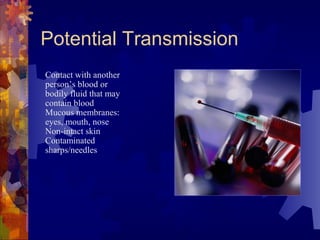
Potential Transmission
Contact with another
person’s blood or
bodily fluid that may
contain blood
Mucous membranes:
eyes, mouth, nose
Non-intact skin
Contaminated
sharps/needles
Potential Exposure
 Industrial accident
 Administering first aid
 Post accident cleanup
 Janitorial or maintenance work
Exposure Control Plan (ECP)
 Potential exposure determination
 Safe work practices
 Decontaminating equipment
 Selecting and using PPE
 Handling biowaste
 Labels and signs
 Training requirements
 Recordkeeping requirements
Who Must Be Trained
 All employees with occupational
exposure to blood or other
potentially infectious material
(OPIM)
 Employees who are trained in first
aid and CPR
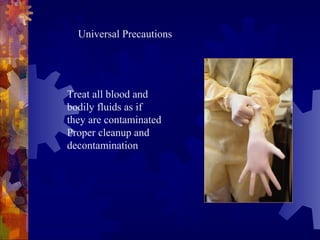
Treat all blood and
bodily fluids as if
they are contaminated
Proper cleanup and
decontamination
Universal Precautions
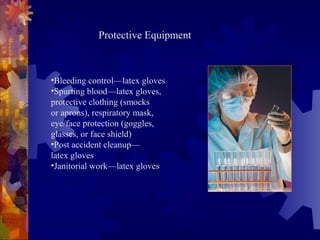
•Bleeding control—latex gloves
•Spurting blood—latex gloves,
protective clothing (smocks
or aprons), respiratory mask,
eye/face protection (goggles,
glasses, or face shield)
•Post accident cleanup—
latex gloves
•Janitorial work—latex gloves
Protective Equipment
Decontamination
 Wear protective gloves
 Disinfectant/cleaner provided in
bodily fluid disposal kit
 Solution of 1/4 cup bleach per gallon
of water
 Properly dispose of contaminated
PPE, towels, rags
Safe Work Practices
 Remove contaminated PPE or
clothing as soon as possible
 Clean and disinfect contaminated
equipment and work surfaces
 Thoroughly wash up immediately
after exposure
 Properly dispose of contaminated
items
Regulated Medical Waste
 Liquid or semi liquid blood or OPIM
(other potentially infectious materials)
 Contaminated items that would
release blood or OPIM when
compressed
 Contaminated sharps
 Pathological and microbiological
waste containing blood or OPIM
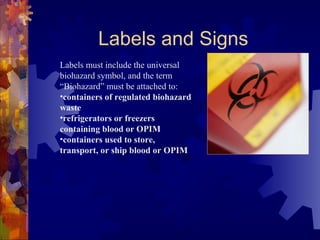
Labels must include the universal
biohazard symbol, and the term
“Biohazard” must be attached to:
•containers of regulated biohazard
waste
•refrigerators or freezers
containing blood or OPIM
•containers used to store,
transport, or ship blood or OPIM
Labels and Signs
Hepatitis B Vaccination
 Strongly endorsed by medical
communities
 Shown to be safe for infants,
children, and adults
 Offered to all potentially exposed
employees
 Provided at no cost to employees
 Declination form
Exposure Incident
 A specific incident of contact with
potentially infectious bodily fluid
 If there are no infiltrations of mucous
membranes
or open skin surfaces, it is not
considered an occupational
exposure
 Report all accidents involving blood
or bodily fluids
 Post exposure medical evaluations
are offered
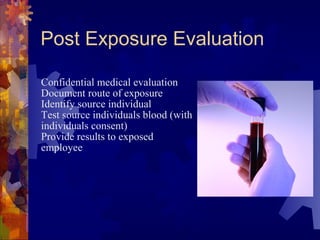
Post Exposure Evaluation
Confidential medical evaluation
Document route of exposure
Identify source individual
Test source individuals blood (with
individuals consent)
Provide results to exposed
employee
Recordkeeping
Medical records include:
 Hepatitis B vaccination status
 Post exposure evaluation and follow-up res
Training records include:
 Training dates
 Contents of the training
 Name and qualifications of trainer
Summary
 Universal precautions
 PPE and safe work practices
 Decontamination
 Exposure incident

Blood Borne Pathogens

  • 1.
    Graves Construction Safety Training Presentations Bloodborne Pathogens 29 CFR 1910.1030 Revised OSHA Blood Borne Pathogens Compliance Directive (CPL2-2.44d)
  • 2.
    Could You Contracta Disease at Work?  Administering first aid?  Cleaning the restrooms?  Using a tool covered with dried blood?  A co-worker sneezes on you?
  • 3.
    Bloodborne Pathogens Goals Basics of Bloodborne diseases  Exposure prevention  Quiz
  • 4.
    Bloodborne Pathogens  Pathogenicmicroorganisms present in human blood that can lead to diseases  Human immunodeficiency virus (HIV)  Hepatitis B (HBV)  Hepatitis C (HCV)
  • 5.
    Human Immunodeficiency Virus (HIV) HIV is the virus that leads to AIDS  HIV depletes the immune system  HIV does not survive well outside the body  Saliva, tears, sweat
  • 6.
    Hepatitis B (HBV) 1—1.25 million Americans are chronically infected  Symptoms include: jaundice, fatigue, abdominal pain, loss of appetite, intermittent nausea, vomiting  May lead to chronic liver disease, liver cancer, and death  Vaccination available since 1982  HBV can survive for at least one week in dried blood 11006115/0006 Copyright © 2000 Business & Legal Reports, Inc.
  • 7.
    Hepatitis C (HCV) Hepatitis C is the most common chronic bloodborne infection in the united states  Symptoms include: jaundice, fatigue, abdominal pain, loss of appetite, intermittent nausea, vomiting  May lead to chronic liver disease and death
  • 8.
    Potentially Infectious Bodily Fluids Blood  Saliva, vomit, urine  Semen or vaginal secretions  Skin, tissue, cell cultures  Other body fluids
  • 9.
    Potential Transmission Contact withanother person’s blood or bodily fluid that may contain blood Mucous membranes: eyes, mouth, nose Non-intact skin Contaminated sharps/needles
  • 10.
    Potential Exposure  Industrialaccident  Administering first aid  Post accident cleanup  Janitorial or maintenance work
  • 11.
    Exposure Control Plan(ECP)  Potential exposure determination  Safe work practices  Decontaminating equipment  Selecting and using PPE  Handling biowaste  Labels and signs  Training requirements  Recordkeeping requirements
  • 12.
    Who Must BeTrained  All employees with occupational exposure to blood or other potentially infectious material (OPIM)  Employees who are trained in first aid and CPR
  • 13.
    Treat all bloodand bodily fluids as if they are contaminated Proper cleanup and decontamination Universal Precautions
  • 14.
    •Bleeding control—latex gloves •Spurtingblood—latex gloves, protective clothing (smocks or aprons), respiratory mask, eye/face protection (goggles, glasses, or face shield) •Post accident cleanup— latex gloves •Janitorial work—latex gloves Protective Equipment
  • 15.
    Decontamination  Wear protectivegloves  Disinfectant/cleaner provided in bodily fluid disposal kit  Solution of 1/4 cup bleach per gallon of water  Properly dispose of contaminated PPE, towels, rags
  • 16.
    Safe Work Practices Remove contaminated PPE or clothing as soon as possible  Clean and disinfect contaminated equipment and work surfaces  Thoroughly wash up immediately after exposure  Properly dispose of contaminated items
  • 17.
    Regulated Medical Waste Liquid or semi liquid blood or OPIM (other potentially infectious materials)  Contaminated items that would release blood or OPIM when compressed  Contaminated sharps  Pathological and microbiological waste containing blood or OPIM
  • 18.
    Labels must includethe universal biohazard symbol, and the term “Biohazard” must be attached to: •containers of regulated biohazard waste •refrigerators or freezers containing blood or OPIM •containers used to store, transport, or ship blood or OPIM Labels and Signs
  • 19.
    Hepatitis B Vaccination Strongly endorsed by medical communities  Shown to be safe for infants, children, and adults  Offered to all potentially exposed employees  Provided at no cost to employees  Declination form
  • 20.
    Exposure Incident  Aspecific incident of contact with potentially infectious bodily fluid  If there are no infiltrations of mucous membranes or open skin surfaces, it is not considered an occupational exposure  Report all accidents involving blood or bodily fluids  Post exposure medical evaluations are offered
  • 21.
    Post Exposure Evaluation Confidentialmedical evaluation Document route of exposure Identify source individual Test source individuals blood (with individuals consent) Provide results to exposed employee
  • 22.
    Recordkeeping Medical records include: Hepatitis B vaccination status  Post exposure evaluation and follow-up res Training records include:  Training dates  Contents of the training  Name and qualifications of trainer
  • 23.
    Summary  Universal precautions PPE and safe work practices  Decontamination  Exposure incident

Editor's Notes

  • #2 I.Background for the Trainer: This training session is intended for employees who are likely to be exposed to potentially infected bodily fluids, including first-aid responders, maintenance personnel, janitorial staff, and any personnel assigned to clean up body fluids after an industrial accident. Other employees can receive the same training for awareness purposes so they understand that they should not touch blood or bodily fluids and they understand to whom they should report a spill of blood or bodily fluids so it can be cleaned up correctly. A written Bloodborne Pathogens Exposure Control Plan (ECP) is required according to the OSHA standard in 29 CFR 1910.1030. This program should be written prior to conducting the training. Writing this program will help you determine which employees are potentially exposed and how you will protect these employees from exposure. A model ECP can be found in Appendix D of the new directive (CPL2-2.44D) that can be found at www.osha.gov. II.Speaker’s Notes: In this session, we will discuss how you might be exposed to bodily fluids in the workplace, how you can protect yourself from exposure, how to clean up bodily fluids, how to manage contaminated waste, and your right to medical evaluations.
  • #3 I.Speaker’s Notes: In today’s training session, we will discuss how you may potentially be infected with a bloodborne pathogen while at work. We will also discuss the many procedures and safe work practices that have been established to prevent your exposure to potentially infectious bodily fluids. We will also attempt to dispel some of the myths surrounding how bloodborne diseases can be contracted in the workplace.
  • #4 I.Speaker’s Notes: We will begin by discussing the basics of bloodborne pathogens, including general information on the diseases, how they are transmitted, and potential exposure at work. Then we will discuss the many ways that the exposure can be prevented. Finally, we will wrap up this training session with a summary and a quiz.
  • #5 I.Background for the Trainer: Pathogens are disease-producing bacteria or microorganisms. II.Speaker’s Notes: OSHA defines bloodborne pathogens as pathogenic microorganisms present in human blood that can lead to diseases. There are many disease-causing pathogenic microorganisms that are covered by this standard; however, the most common and those of primary concern are: Human Immunodeficiency Virus (HIV) Hepatitis B (HBV) Hepatitis C (HCV)
  • #6 I.Background for the Trainer: This information is from the Center for Disease Control and Prevention—HIV and Its Transmission Fact Sheet. II.Speaker’s Notes: HIV is the virus that leads to acquired immunodeficiency syndrome (AIDS). A person can carry HIV for many years and not have symptoms until it turns into full-blown AIDS. AIDS attacks the person’s immune system, which makes it difficult for the body to fight off disease. Scientists and medical authorities agree that HIV does not survive well outside the body. Drying of HIV-infected human blood or other body fluids reduces the risk of environmental transmission to essentially zero. HIV is found in very low quantities in saliva and tears from some AIDS patients. HIV has not been found in the sweat of HIV-infected persons. Contact with saliva, tears, or sweat has never been shown to result in the transmission of HIV.
  • #7 I.Background for the Trainer: This information is from the Center for Disease Control and Prevention—Viral Hepatitis B Fact Sheet available at www.cdc.gov.
  • #8 I.Speaker’s Notes: An estimated 3.9 million Americans have been infected with HCV of whom 2.7 million are chronically infected. Persons chronically infected with HCV may not be aware of it because they are not clinically ill. Sometimes it can take two decades before symptoms are recognized. Chronic liver disease occurs in approximately 70 percent of infected persons. 8,000–10,000 deaths occur each year as a result of the chronic liver disease. There are some drugs that have been licensed for treatment of HCV; however, they are only effective in 10–40 percent of persons.
  • #9 I.Background for the Trainer: Make changes to the slide above to reflect the types of bodily fluids that may be encountered in your workplace. If your facility is a medical hospital/clinic or a laboratory with human cell cultures, you will have more potential exposure to bodily fluids than a general industrial facility would have. II.Speaker’s Notes: The bodily fluids that you are most likely to encounter in the general industrial workplace are blood, saliva, vomit, or urine. If blood is not present in a bodily fluid, bloodborne pathogens cannot be present. Remember, sometimes the blood may be present in microscopic quantities and difficult to see with the naked eye. To be safe, you must assume that all bodily fluids are contaminated with infectious blood. This is called universal precautions. We will discuss this in further detail later.
  • #11 I.Background for the Trainer: The potential exposures listed on the slide are probably typical for most general industrial workplaces. If necessary, change the slide to reflect the potential exposure to bodily fluids at your company. These potential exposures should be the same as those listed in your written Bloodborne Pathogens Exposure Control Plan. II.Speaker’s Notes: The Bloodborne Pathogens standard requires employers to identify the jobs, tasks, and activities that could expose employees to potentially infected blood or bodily fluids. Exposure could occur when near someone who is involved in an industrial accident. Obviously, when administering first aid to someone who is bleeding, you are potentially exposed. Employees expected to clean up work surfaces, equipment, or machinery after an accident are also potentially exposed. Janitorial workers are potentially exposed when cleaning up urine, vomit, sanitary napkins, etc. Maintenance workers might potentially be exposed when repairing the plumbing on a toilet.
  • #12 I.Background for the Trainer: You can either pass out copies of your ECP to the employees in the class or you can just tell them where the ECP is located within your facility. The ECP must be available at all times to all employees. II.Speaker’s Notes: The OSHA Bloodborne Pathogens Standard requires us to have a written ECP. Tell the employees that the ECP is available at all times, and tell them where it is located. The goal of the ECP is to identify potential exposure and define work practices for preventing exposure. The ECP addresses many elements, all of which we will discuss in this training session. In addition to your right to access the ECP, you also have a right to access the OSHA Bloodborne Pathogens Standard. If any of you want to have a copy of the actual standard, all you have to do is ask.
  • #13 I.Background for the Trainer: The Bloodborne Pathogens Standard covers all employers who require employees to perform duties that may expose them to bloodborne pathogens. II.Speaker’s Notes: Training is the next step in preventing potential exposure to bloodborne pathogens. All employees whose jobs, duties, or actions could potentially expose them to blood or contaminated bodily fluids must understand the ECP and be trained at the time of initial assignment and annually thereafter. We have already discussed the jobs that have potential exposure. Also, all employees who are trained first aid and CPR responders obviously must also participate in this training. Remember, the dangers of bloodborne pathogens do not exist in medical or patient care facilities only. Any type of facility that may have potential exposures to bloodborne pathogens must have a written program and must conduct training.
  • #16 I.Background for the Trainer: If your company has a bodily fluid disposal/cleanup kit, does it contain a disinfectant or cleaner? If so, bring in the cleaner/disinfectant for demonstration purposes. Adjust the slide to accurately reflect the disinfectants/cleaners available at your facility. Before decontamination and cleanup can occur, personnel have to be assigned or designated to clean it up. Be sure those responsible for this duty understand their role and are prepared to clean up bodily fluids before an accident actually occurs. II.Speaker’s Notes: An important part of preventing exposure to bloodborne pathogens is proper decontamination and cleanup. As with all bodily fluids, assume contamination (universal precautions) and wear protective gloves. Latex gloves can be found in the first aid kit. The bodily fluid disposal kit contains fluid cleanup materials such as an absorbent powder, a disinfectant solution, and a disposal bag. The powder can be sprinkled on liquid body fluids, such as blood. When the powder absorbs the fluid, it can be scooped up and placed in the disposal bag. If no disinfectant solution is available, it can be substituted with a solution of 1/4 cup of bleach per gallon of water. Wipe down all contaminated surfaces with the disinfectant solution in order to ensure that all bloodborne pathogens are killed. Dispose of all contaminated gloves, towels, rags, absorbent powder, etc. Place it all in the disposal bag. We will discuss how to manage biowaste shortly.
  • #17 I.Speaker’s Notes: These are some commonsense safe work practices that will help prevent exposure. Remove contaminated clothing or PPE as soon as possible. If blood were to splash onto your shoes, pants, or shirt, remove those items as soon as possible. Wash your skin in the area underneath the clothing that was contaminated with the bodily fluid. Remove contaminated PPE, such as gloves, as soon as you are done administering first aid or decontaminating equipment or work surfaces. Cleaning/disinfecting tools, work surfaces, or equipment will prevent the next user from unknowingly coming into contact with potentially infected bodily fluids. Thoroughly wash your hands, face, or any other areas of your skin that may have come into contact with bodily fluids. If you believe that blood or other potentially contaminated bodily fluid was splashed into your eyes, immediately go to an emergency eyewash station and flush your eyes. Properly disposing of contaminated items in appropriately labeled bags or containers will help prevent someone from accidentally being exposed.
  • #18 I.Background for the Trainer: Most industrial facilities can handle blood or bodily fluids by simply absorbing any liquids, double bagging the contaminated items, and disposing in the dumpster. Be sure to clarify your company’s procedures in your written ECP. If you feel that your company does have regulated medical waste that requires proper disposal, contact a medical waste disposal company to set up a program. You can probably find a medical waste disposal company in your local phone book. II.Speaker’s Notes: Regulated medical wastes include blood or other potentially infected bodily fluids that are in a liquid form. If absorbed liquids can be released when compressed (i.e., sponge) it is also a regulated medical waste. As a rule of thumb, items such as Band-Aids or tissues that we would typically throw in the wastebasket are not regulated medical wastes unless you are a medical facility where the amount of this type of waste is extensive. Otherwise, unless you could literally “wring out” the blood, it would not be considered regulated medical biowaste. A good rule to follow is, when in doubt, treat it as regulated waste to avoid violating any EPA laws for proper disposal of biohazard wastes. Make sure all sharps, including needles and broken glass, go in the appropriate sharps container to avoid contamination through impalement or laceration on the sharps. Pathological and microbiological waste containing blood or OPIM, such as from a medical laboratory, is also considered regulated medical waste.
  • #20 I.Background for the Trainer: The Hepatitis B (HBV) vaccination must be offered to all potentially exposed employees within 10 days of their initial assignment. Contact your local occupational health clinic about setting up these shots. If employees decline the shots, they are required by the OSHA standard to sign the record of declination form. Bring copies of this form to the training session. Taking this vaccination is a personal decision, give the employees a few days to decide. If they want the shots, schedule an appointment. If they do not want the shots, have them sign the declination form. II.Speaker’s Notes: The use of the HBV vaccine is strongly endorsed by medical, scientific, and public health communities as a safe and effective way to prevent disease and death. There is no confirmed evidence that indicates the HBV vaccine can cause chronic illness. Reports of unusual illnesses following a vaccine are most often related to other causes and are not related to the vaccine. The hepatitis B vaccination is a series of three injections that are effective in preventing infection with hepatitis B. Currently, there is no requirement for routine boosters; however, this is still being assessed. This vaccination is paid for by the employer. If you decline the hepatitis B vaccination, you will be asked to sign a form that states you waived your opportunity to receive the vaccination. However, even if you sign the form now, you may still change your mind later and accept the vaccination. The form basically states that at this time you do not want to have the shots. The language on the declination form is straight out of the OSHA Bloodborne Pathogens standard.
  • #21 I.Background for the Trainer: Employees must report any exposure to bloodborne pathogens. For example, after an industrial accident, determine if any employees were exposed. If an employee has been exposed, the employee must be offered a post exposure evaluation. Your company should document this determination of exposure and whether or not the exposed employee accepted the offer of a post exposure medical evaluation. II.Speaker’s Notes: An exposure incident is a specific incident of contact with potentially infectious bodily fluid. If there was no infiltration of mucous membranes or open skin surfaces, it is not considered an occupational exposure. If an employee administering first aid on normal bleeding is wearing the appropriate gloves, then an exposure incident does not exist. Be sure to report all incidents involving blood or bodily fluid so the company can determine if an exposure occurred and then offer post exposure medical evaluations if necessary. After each accident, an accident investigation report must be completed. If blood is spilled, documentation of the spill location, who cleaned it up, the cleanup method, and waste disposal location must be kept.
  • #23 I.Background for the Trainer: Medical records must be kept confidential, maintained for employment plus 30 years, available to employees upon request, and made available to authorized agencies such as OSHA or NIOSH. Training records must be maintained for three years. Records must be transferred to successor employers, or if no successor employer, the current employer must ask the director of NIOSH for proper disposition of the records. II.Speaker’s Notes: Medical records are kept confidential; however, they are available to each employee upon request. The records will include your Hepatitis B vaccination status, any post exposure evaluation and follow-up results, and any written opinions or other specific information provided by the health care professionals. Training records include today’s date, content of today’s training, my qualifications as a trainer, and, of course, your names and job titles.
  • #24 I.Speaker’s Notes: Remember to assume that all blood or bodily fluid is infected with bloodborne pathogens such as HIV or HBV. Wear the appropriate PPE as barriers to prevent the transmission of bloodborne pathogens, and use safe work practices such as labeling and proper disposal. Decontaminate yourself by thoroughly washing up and washing any contaminated equipment or tools. Report all incidents involving bodily fluids so they can be evaluated for potential exposure.