Control of Hazardous
Energy (Lockout/tag Out)
Graves Construction
Safety Training
What Is Lockout/Tagout?
 Referred to as LOTO
 Blocks flow of energy from power
source to the equipment
 Provides means of warning (tag)
 29 CFR 1910.147–control of
hazardous energy
 Covers all employees
 Requires training of employees
Regulatory Requirements
Locks
Blocks
Chains
Multi-lock hasps
Wheel valve covers
Ball valve covers
Types of Lockout Devices
Requirements For
Lockout/Tagout Devices
They must be:
 Durable
 Standardized
 Substantial
 Identifiable
Energy Sources
 Electricity
 Hydraulic
 Pneumatic
 Steam
 Thermal
 Chemical
 Gravity
Typical Equipment
Requiring LOTO
 Switches
 Breakers
 Panels
 Transformers
 CAT banks
When Must LOTO Be Used?
When servicing or maintaining
equipment where:
 Hazardous energy exists
 Unexpected start-up could occur
 Either of these could harm an
employee
LOTO Shall Be Used When:
 Employees are required to place any
part
of their body in harm’s way
 Employees are exposed to hazardous
energy
LOTO Exceptions
 Work where hazardous energy does
not exist
 Work on cord-controlled devices
 Hot operations where shutdown
is not feasible and other safety
procedures are in place
Typical LOTO Procedures
 Performing a shutdown
 Isolating equipment
 Applying and removing lockout devices
 Safely releasing stored energy
Affected Employees
Employees who
 Operate
 Work around
 All graves employees
Authorized Employee
Maintains equipment
Services equipment
Is trained to use LOTO
Company Responsibilities
 Ensure de-energization of equipment
 Ensure employee awareness
 Provide appropriate levels of training
 Review program effectiveness
 Maintain and revise program
 Administer appropriate disciplinary
actions
Affected Employee
Responsibilities
 Leave all LOTO devices in place
 Follow all safety rules while operating
the equipment
 Report missing LOTO tags
 Identify tags by sight
Supervisor Responsibilities
 Ensure that all energy sources are
locked out
 Select appropriate tags
 Place a “danger—do not operate” tag
on equipment
 Complete LOTO log
 Remove LOTO tags at end of project
Authorized Employee Responsibilities
Complete LOTO Request
Verify equipment is de-energized
Training Requirements
 Authorized employees—initially and
at least annually
 Affected employees—at least initially
 Authorized and affected—whenever
changes are made to jobs or
procedures
 Authorized and affected—when
program deficiencies are noted
How to Perform LOTO Safely
 Follow company safety procedures for
LOTO
 Refer to procedures on how to lockout
specific equipment
 Keep everyone informed when
equipment is repaired or serviced
 Stay alert
 Use common sense
Authorized
Employee
Identification
 Hard hat stickers for
those persons
authorized to
request LOTO
DANGER
AUTHORIZED
TAGGING
AUTHORITY
Blue, Red, and Black
System Under Operations
 This tag is to be used on equipment
to be locked out that is no longer
under the control of graves.
 The purpose of the tag is to identify:
 To graves employees that the lock
and tag contained on the equipment
belongs to the owner.
 To owner employees that graves
employees MAY be effected by a
change in the LOTO status.
 The tag is only placed with
authorization of the system
operator.
System Locked Out
 This is the standard
LOTO tag. It is to be
placed on most
LOTO requests.
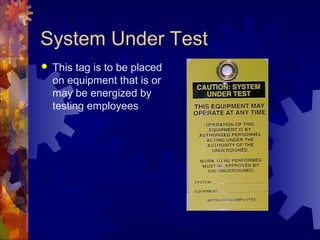
System Under Test
 This tag is to be placed
on equipment that is or
may be energized by
testing employees

Lockout/Tag Out

  • 1.
    Control of Hazardous Energy(Lockout/tag Out) Graves Construction Safety Training
  • 2.
    What Is Lockout/Tagout? Referred to as LOTO  Blocks flow of energy from power source to the equipment  Provides means of warning (tag)
  • 3.
     29 CFR1910.147–control of hazardous energy  Covers all employees  Requires training of employees Regulatory Requirements
  • 4.
    Locks Blocks Chains Multi-lock hasps Wheel valvecovers Ball valve covers Types of Lockout Devices
  • 5.
    Requirements For Lockout/Tagout Devices Theymust be:  Durable  Standardized  Substantial  Identifiable
  • 6.
    Energy Sources  Electricity Hydraulic  Pneumatic  Steam  Thermal  Chemical  Gravity
  • 7.
    Typical Equipment Requiring LOTO Switches  Breakers  Panels  Transformers  CAT banks
  • 8.
    When Must LOTOBe Used? When servicing or maintaining equipment where:  Hazardous energy exists  Unexpected start-up could occur  Either of these could harm an employee
  • 9.
    LOTO Shall BeUsed When:  Employees are required to place any part of their body in harm’s way  Employees are exposed to hazardous energy
  • 10.
    LOTO Exceptions  Workwhere hazardous energy does not exist  Work on cord-controlled devices  Hot operations where shutdown is not feasible and other safety procedures are in place
  • 11.
    Typical LOTO Procedures Performing a shutdown  Isolating equipment  Applying and removing lockout devices  Safely releasing stored energy
  • 12.
    Affected Employees Employees who Operate  Work around  All graves employees
  • 13.
    Authorized Employee Maintains equipment Servicesequipment Is trained to use LOTO
  • 14.
    Company Responsibilities  Ensurede-energization of equipment  Ensure employee awareness  Provide appropriate levels of training  Review program effectiveness  Maintain and revise program  Administer appropriate disciplinary actions
  • 15.
    Affected Employee Responsibilities  Leaveall LOTO devices in place  Follow all safety rules while operating the equipment  Report missing LOTO tags  Identify tags by sight
  • 16.
    Supervisor Responsibilities  Ensurethat all energy sources are locked out  Select appropriate tags  Place a “danger—do not operate” tag on equipment  Complete LOTO log  Remove LOTO tags at end of project
  • 17.
    Authorized Employee Responsibilities CompleteLOTO Request Verify equipment is de-energized
  • 18.
    Training Requirements  Authorizedemployees—initially and at least annually  Affected employees—at least initially  Authorized and affected—whenever changes are made to jobs or procedures  Authorized and affected—when program deficiencies are noted
  • 19.
    How to PerformLOTO Safely  Follow company safety procedures for LOTO  Refer to procedures on how to lockout specific equipment  Keep everyone informed when equipment is repaired or serviced  Stay alert  Use common sense
  • 20.
    Authorized Employee Identification  Hard hatstickers for those persons authorized to request LOTO DANGER AUTHORIZED TAGGING AUTHORITY Blue, Red, and Black
  • 21.
    System Under Operations This tag is to be used on equipment to be locked out that is no longer under the control of graves.  The purpose of the tag is to identify:  To graves employees that the lock and tag contained on the equipment belongs to the owner.  To owner employees that graves employees MAY be effected by a change in the LOTO status.  The tag is only placed with authorization of the system operator.
  • 22.
    System Locked Out This is the standard LOTO tag. It is to be placed on most LOTO requests.
  • 23.
    System Under Test This tag is to be placed on equipment that is or may be energized by testing employees

Editor's Notes

  • #2 I. Speaker’s Notes: Today’s session is on OSHA’s Control of Hazardous Energy Standard, or “lockout/tagout.”
  • #3 I. Background for the Trainer: Discuss the types of equipment the company has that may need to be locked out. Ask if anyone has had an incident or near miss when equipment inadvertently started.
  • #4 I. Speaker’s Notes: This program is required by federal law. All employees are affected by lockout/tagout. Any employee who operates equipment is an “affected” employee. Any employee who maintains or services equipment is an “authorized” employee. Training must be provided for authorized employees initially and at least annually.
  • #6 I. Speaker’s Notes: LOTO devices must be able to withstand the environment in which they are used. They should also be standardized according to color, size, or shape and should be substantial enough so that they cannot be accidentally removed. To be identifiable, they should have a legend that states phrases such as Do Not Operate, Do Not Start, Do Not Energize, etc.
  • #7 I. Speaker’s Notes: There are many different types of energy sources that may need lockout/tagout. Do not overlook any potential source of energy. Many sources are invisible. A job hazard analysis can help identify energy sources. Make sure any and all sources of energy can be effectively isolated.
  • #9 I. Speaker’s Notes: This slide lists when lockout/tagout must be used. If you are unsure to what equipment LOTO applies, perform a hazard analysis. Make sure that all sources of energy are considered. Do not under any circumstances jeopardize an employee by not requiring LOTO—when in doubt, lock it out!!
  • #10 I. Speaker’s Notes: If any of these occur, the equipment must be locked out. If a guard is removed from a piece of equipment, it should be locked out. Basically, any time an employee could be injured by the piece of equipment, it should be de-energized and locked out.
  • #11 I. Speaker’s Notes: No energy means no need for LOTO. If routine adjustments such as those made to a printing press must occur, then the equipment does not have to be locked out. However, it is a good idea to have a second employee nearby a disconnect to shut down the equipment while the other employee works on it. Cord-controlled devices do not require LOTO because it is assumed that for these items, the person performing the repair has control of the plug. Companies do make lockout devices for the male end of an electrical plug. It is always a good idea to use these as needed. Hot tap operations that could conceivably shut down a plant (e.g., boilers) are not subject to LOTO if they will adversely affect the operation of the plant as a whole.
  • #12 I. Background for the Trainer: Distribute examples of these types of procedure. II. Speaker’s Notes: Procedures for appropriate lockout should be documented. It is helpful to post these procedures at the equipment location. These procedures can follow any format that is pertinent to your company. Using these procedures allows for consistency throughout a facility.
  • #13 I. Speaker’s Notes: There are two categories of employees covered by 1910.147: 1. Affected employees 2. Authorized employees Affected employees can be almost anyone in a facility, except office workers. An affected employee can have a significant impact on authorized employees if the affected employee starts the equipment prior to the completion of the work by the authorized employee.
  • #15 I. Speaker’s Notes: It is important that a company lives up to its regulatory responsibility. LOTO is a major cause of industrial fatalities and must be taken seriously. If you intentionally violate LOTO rules, appropriate disciplinary actions will be taken to avoid future incidents. Annual reviews will be conducted to ensure that the written LOTO program is followed.
  • #16 I. Speaker’s Notes: Since affected employees can impact the authorized employees, it is imperative that they follow these rules. Affected employees should not be ultimately responsible for the placement of locks and tags unless they are also working on the equipment. The more that an affected employee knows about the equipment that is being locked out, the safer the lockout operation will be. Proper training is of the utmost importance.
  • #17 I. Speaker’s Notes: Because authorized employees are in harm’s way, they must follow all appropriate procedures to ensure their own protection. If a device cannot be physically locked, the buddy system should be used to ensure that equipment remains de-energized. A second person can keep the emergency stop button or disconnect employed. The tag should be located as close as possible to the control panel so that anyone who tries to operate the equipment is aware of the potential danger.
  • #19 I. Speaker’s Notes: OSHA spells out specific training requirements for LOTO. Every employer is required to provide training in accordance with these regulations. Probably the single most difficult aspect of training is the retraining function, both when deficiencies are noted and on an annual basis for authorized employees.
  • #20 I. Speaker’s Notes: Remember that failure to lockout equipment is a leading cause of injuries and fatalities in industry. Employees must really stay on their toes and avoid shortcuts that could cost them their lives. Ignorance of LOTO procedures cannot be tolerated under any circumstances. Simply put, the program must be in place, the training must be conducted, and evaluations for effectiveness must follow.