PRESENTING
ASAD KHAN
E-BUSINESS
Electronic Business, is the administration of
conducting business via the Internet. This
would include the buying and selling of goods
and services, along with providing technical or
customer support through the Internet.
INTRODUCTION “E-BUSINESS STRATEGY
To grow an e-business and help it succeed, there are a
number of strategies a small business owner can employ.
Falling behind the times in this rapidly changing frontier can
mean risking your company's success in the virtual world.
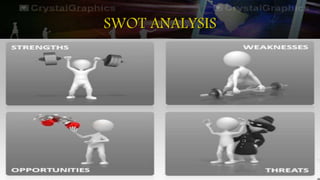
SWOT ANALYSIS
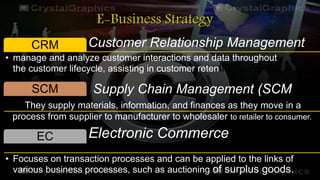
E-Business Strategy
Customer Relationship ManagementCRM
• manage and analyze customer interactions and data throughout
the customer lifecycle, assisting in customer retention and driving ..
Supply Chain Management (SCMSCM
Electronic CommerceEC
• Focuses on transaction processes and can be applied to the links of
various business processes, such as auctioning of surplus goods.
They supply materials, information, and finances as they move in a
process from supplier to manufacturer to wholesaler to retailer to consumer.
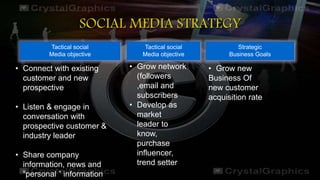
SOCIAL MEDIA STRATEGY
Tactical social
Media objective
Tactical social
Media objective
Strategic
Business Goals
• Grow network
(followers
,email and
subscribers
• Develop as
market
leader to
know,
purchase
influencer,
trend setter
• Connect with existing
customer and new
prospective
• Listen & engage in
conversation with
prospective customer &
industry leader
• Share company
information, news and
“personal ” information
• Grow new
Business Of
new customer
acquisition rate
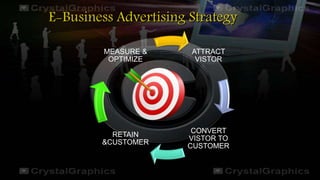
E-Business Advertising Strategy
ATTRACT
VISTOR
CONVERT
VISTOR TO
CUSTOMER
RETAIN
&CUSTOMER
MEASURE &
OPTIMIZE
E-Business Growth Strategy
 Taking advantage of new marketing
opportunities to target a larger audience for
their product
 Creating an affiliate marketing program for
your product or service.
 Continuous improvement in productivity and
profitability.
Entering New Markets
 The ability to reach a global audience
 selling back stock at a discount or finding a new target
market for a new product
 use the Internet in a variety of ways to reach consumers.
 the use of social media and quality content in order to
build a strong foundation for the new market to use
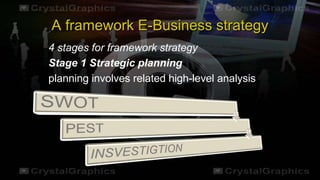
A framework E-Business strategy
4 stages for framework strategy
Stage 1 Strategic planning
planning involves related high-level analysis
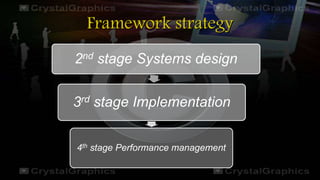
Framework strategy
2nd stage Systems design
3rd stage Implementation
4th stage Performance management
Risk issues
 No strategy wrong strategy
 Poor implementation
 Failing to measure performance
 The strategic plan is incorrectly translated into design so that
key objectives are not met
E-BUSINESS Challenges
 Privacy is among the top concerns of Internet users.
 Companies can track customers’ shopping and viewing
habits through cookies.
 Vising, or voice phishing, involves phone calls to credit
card customers to obtain personal and banking
information.
E-BUSINESS Challenges
 Companies worry about data theft.
 Internet Crime Complaint Center logs more than
200,000 complaints annually.50%
 Phishing is a growing form of Internet fraud that uses e-
mail or pop up messages to get unsuspecting victims
to disclose personal information.
E-Business Solutions
• Web
• Customer relationship management system (CRM):
• Enterprise Resource Planning System (ERP):
• Supply Chain Management (SCM):
• Knowledge Management (KM):
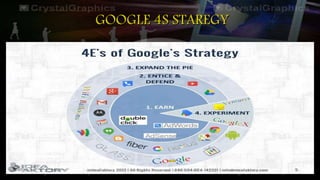
GOOGLE 4S STAREGY
Google Asset Size & Growth
E business strategy

E business strategy

  • 2.
  • 4.
    E-BUSINESS Electronic Business, isthe administration of conducting business via the Internet. This would include the buying and selling of goods and services, along with providing technical or customer support through the Internet.
  • 5.
    INTRODUCTION “E-BUSINESS STRATEGY Togrow an e-business and help it succeed, there are a number of strategies a small business owner can employ. Falling behind the times in this rapidly changing frontier can mean risking your company's success in the virtual world.
  • 6.
  • 7.
    E-Business Strategy Customer RelationshipManagementCRM • manage and analyze customer interactions and data throughout the customer lifecycle, assisting in customer retention and driving .. Supply Chain Management (SCMSCM Electronic CommerceEC • Focuses on transaction processes and can be applied to the links of various business processes, such as auctioning of surplus goods. They supply materials, information, and finances as they move in a process from supplier to manufacturer to wholesaler to retailer to consumer.
  • 8.
    SOCIAL MEDIA STRATEGY Tacticalsocial Media objective Tactical social Media objective Strategic Business Goals • Grow network (followers ,email and subscribers • Develop as market leader to know, purchase influencer, trend setter • Connect with existing customer and new prospective • Listen & engage in conversation with prospective customer & industry leader • Share company information, news and “personal ” information • Grow new Business Of new customer acquisition rate
  • 9.
    E-Business Advertising Strategy ATTRACT VISTOR CONVERT VISTORTO CUSTOMER RETAIN &CUSTOMER MEASURE & OPTIMIZE
  • 10.
    E-Business Growth Strategy Taking advantage of new marketing opportunities to target a larger audience for their product  Creating an affiliate marketing program for your product or service.  Continuous improvement in productivity and profitability.
  • 11.
    Entering New Markets The ability to reach a global audience  selling back stock at a discount or finding a new target market for a new product  use the Internet in a variety of ways to reach consumers.  the use of social media and quality content in order to build a strong foundation for the new market to use
  • 12.
    A framework E-Businessstrategy 4 stages for framework strategy Stage 1 Strategic planning planning involves related high-level analysis
  • 13.
    Framework strategy 2nd stageSystems design 3rd stage Implementation 4th stage Performance management
  • 14.
    Risk issues  Nostrategy wrong strategy  Poor implementation  Failing to measure performance  The strategic plan is incorrectly translated into design so that key objectives are not met
  • 15.
    E-BUSINESS Challenges  Privacyis among the top concerns of Internet users.  Companies can track customers’ shopping and viewing habits through cookies.  Vising, or voice phishing, involves phone calls to credit card customers to obtain personal and banking information.
  • 16.
    E-BUSINESS Challenges  Companiesworry about data theft.  Internet Crime Complaint Center logs more than 200,000 complaints annually.50%  Phishing is a growing form of Internet fraud that uses e- mail or pop up messages to get unsuspecting victims to disclose personal information.
  • 17.
    E-Business Solutions • Web •Customer relationship management system (CRM): • Enterprise Resource Planning System (ERP): • Supply Chain Management (SCM): • Knowledge Management (KM):
  • 18.
  • 19.