E-Payment Methods
Group no. 4
Muhammad Irfan Shahid 12
Rooha Mukhtar 16

Course: Electronic-Commerce
University of Education, Okara Campus
 Electronic Payment is a financial exchange that
takes place online between buyers and sellers. The
content of this exchange is usually some form of
digital financial instrument (such as encrypted credit
card numbers, electronic cheques or digital cash)
that is backed by a bank or an intermediary, or by a
legal tender.
 Electronic payment system is a system which helps
the customer or user to make online payment for
their shopping.
University of Education Okara Campus

2001

What Electronic Payment system is?
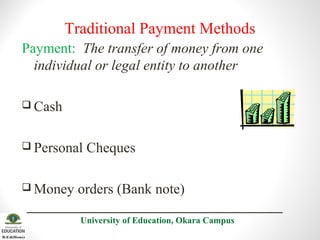
Traditional Payment Methods
Payment: The transfer of money from one
individual or legal entity to another
 Cash
 Personal
 Money

Cheques

orders (Bank note)
University of Education, Okara Campus
Selection of Payment Method
 Based on:

 Convenience
 Trace-ability
 Repudiation
 Financial risk
 Fraud protection

2001

4
University of Education Okara Campus








Credit and Debit card
Digital Currency
E-Wallets
Peer-to-Peer Methods
Smart card
Micro-payments
B2B
University of Education Okara Campus

2001

Various E-Payment Methods
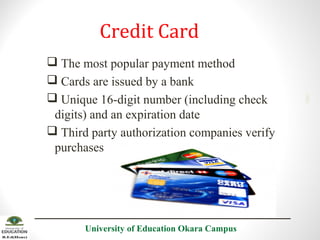
 The most popular payment method
 Cards are issued by a bank
 Unique 16-digit number (including check
digits) and an expiration date
 Third party authorization companies verify
purchases

University of Education Okara Campus

2001

Credit Card
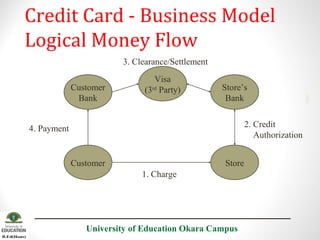
Credit Card - Business Model
Logical Money Flow
Customer
Bank

Visa
(3rd Party)

Store’s
Bank
2. Credit
Authorization

4. Payment

Customer

Store
1. Charge

University of Education Okara Campus

2001

3. Clearance/Settlement
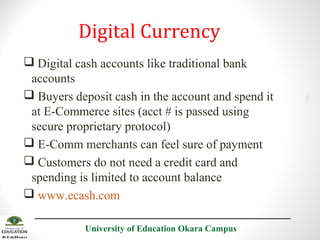
 Digital cash accounts like traditional bank
accounts
 Buyers deposit cash in the account and spend it
at E-Commerce sites (acct # is passed using
secure proprietary protocol)
 E-Comm merchants can feel sure of payment
 Customers do not need a credit card and
spending is limited to account balance
 www.ecash.com
University of Education Okara Campus

2001

Digital Currency
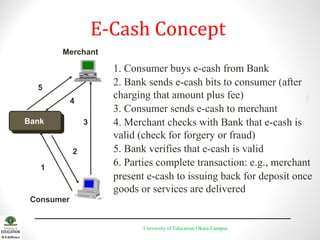
E-Cash Concept
Merchant

2001

5
4
Bank

3

2
1

1. Consumer buys e-cash from Bank
2. Bank sends e-cash bits to consumer (after
charging that amount plus fee)
3. Consumer sends e-cash to merchant
4. Merchant checks with Bank that e-cash is
valid (check for forgery or fraud)
5. Bank verifies that e-cash is valid
6. Parties complete transaction: e.g., merchant
present e-cash to issuing back for deposit once
goods or services are delivered

Consumer

University of Education Okara Campus
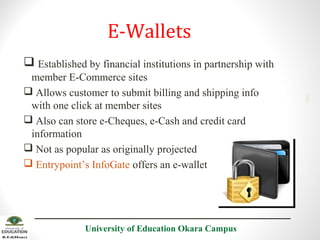
E-Wallets
member E-Commerce sites
 Allows customer to submit billing and shipping info
with one click at member sites
 Also can store e-Cheques, e-Cash and credit card
information
 Not as popular as originally projected
 Entrypoint’s InfoGate offers an e-wallet

University of Education Okara Campus

2001

 Established by financial institutions in partnership with
Peer-to-Peer Methods
 Acts as a trusted third party (e.g. auction purchase)
 To send money:
• Sender sets up an account and requests to send
payment
• Sender places payment into the receivers account by
credit-card
• Reciever is notified of payment via email
• Receiver can transfer funds to bank account or
request a cheque
University of Education Okara Campus

2001

 Digital cash via email (eCash.com)
 PayPal.com – digital payment system
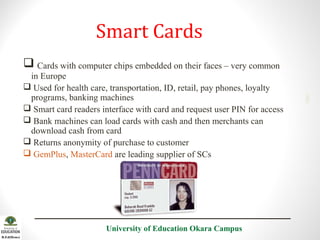
Smart Cards
in Europe
 Used for health care, transportation, ID, retail, pay phones, loyalty
programs, banking machines
 Smart card readers interface with card and request user PIN for access
 Bank machines can load cards with cash and then merchants can
download cash from card
 Returns anonymity of purchase to customer
 GemPlus, MasterCard are leading supplier of SCs

University of Education Okara Campus

2001

 Cards with computer chips embedded on their faces – very common
Micro-Payments
2001

 Long distance phone call charge is an example of
a micro-payment
 Digital Equipment Corporation (DEC) researchers
originally envisioned MPs:
• Payment per newspaper article ($0.005)
• Payment by stock quote ($0.001)
• Payment per click (Qpass, Inc.)

University of Education Okara Campus
 B2B transactions are the fastest area of $ growth
on the web
 B2B transactions are substantially larger than
B2C
 Paymantech is major provider:
 24/7 availability, all manner of EFT supported
 many management tools and reporting methods

 Ecredit.com offers real-time automated credit
approval and financing
 TradeCard offers comprehensive B2B Ecommerce facilities on an international scale
University of Education Okara Campus

2001

B2B
E-Payment Pros/Cons
 Potential for great flexibility
 Low transaction costs
 Rapid and diverse purchase power
 Cons:
 Perfect copying of transactions is possible
 Vulnerability to world-wide attack
 Lack of anonymity, potential for privacy intrusion

University of Education Okara Campus

2001

 Pros:
References

http://www.slideshare.net/Vishalchd11/the-e-payment-systems
http://www.slideshare.net/birubiru/electronic-payment-systems-705132
http://www1.american.edu/initeb/sm4801a/epayment3.htm
http://en.wikipedia.org/wiki/Payment_system
http://www.slideshare.net/birubiru/eps-6953955
http://www.irs.gov/uac/Electronic-Payment-Options-HomePage
• http://www.slideshare.net/VishalSancheti1/e-payment10708085
• http://pages.ebay.com/help/pay/methods.html
2001

•
•
•
•
•
•

University of Education Okara Campus

E Payment Methods

  • 1.
    E-Payment Methods Group no.4 Muhammad Irfan Shahid 12 Rooha Mukhtar 16 Course: Electronic-Commerce University of Education, Okara Campus
  • 2.
     Electronic Paymentis a financial exchange that takes place online between buyers and sellers. The content of this exchange is usually some form of digital financial instrument (such as encrypted credit card numbers, electronic cheques or digital cash) that is backed by a bank or an intermediary, or by a legal tender.  Electronic payment system is a system which helps the customer or user to make online payment for their shopping. University of Education Okara Campus 2001 What Electronic Payment system is?
  • 3.
    Traditional Payment Methods Payment:The transfer of money from one individual or legal entity to another  Cash  Personal  Money Cheques orders (Bank note) University of Education, Okara Campus
  • 4.
    Selection of PaymentMethod  Based on:  Convenience  Trace-ability  Repudiation  Financial risk  Fraud protection 2001 4 University of Education Okara Campus
  • 5.
           Credit and Debitcard Digital Currency E-Wallets Peer-to-Peer Methods Smart card Micro-payments B2B University of Education Okara Campus 2001 Various E-Payment Methods
  • 6.
     The mostpopular payment method  Cards are issued by a bank  Unique 16-digit number (including check digits) and an expiration date  Third party authorization companies verify purchases University of Education Okara Campus 2001 Credit Card
  • 7.
    Credit Card -Business Model Logical Money Flow Customer Bank Visa (3rd Party) Store’s Bank 2. Credit Authorization 4. Payment Customer Store 1. Charge University of Education Okara Campus 2001 3. Clearance/Settlement
  • 8.
     Digital cashaccounts like traditional bank accounts  Buyers deposit cash in the account and spend it at E-Commerce sites (acct # is passed using secure proprietary protocol)  E-Comm merchants can feel sure of payment  Customers do not need a credit card and spending is limited to account balance  www.ecash.com University of Education Okara Campus 2001 Digital Currency
  • 9.
    E-Cash Concept Merchant 2001 5 4 Bank 3 2 1 1. Consumerbuys e-cash from Bank 2. Bank sends e-cash bits to consumer (after charging that amount plus fee) 3. Consumer sends e-cash to merchant 4. Merchant checks with Bank that e-cash is valid (check for forgery or fraud) 5. Bank verifies that e-cash is valid 6. Parties complete transaction: e.g., merchant present e-cash to issuing back for deposit once goods or services are delivered Consumer University of Education Okara Campus
  • 10.
    E-Wallets member E-Commerce sites Allows customer to submit billing and shipping info with one click at member sites  Also can store e-Cheques, e-Cash and credit card information  Not as popular as originally projected  Entrypoint’s InfoGate offers an e-wallet University of Education Okara Campus 2001  Established by financial institutions in partnership with
  • 11.
    Peer-to-Peer Methods  Actsas a trusted third party (e.g. auction purchase)  To send money: • Sender sets up an account and requests to send payment • Sender places payment into the receivers account by credit-card • Reciever is notified of payment via email • Receiver can transfer funds to bank account or request a cheque University of Education Okara Campus 2001  Digital cash via email (eCash.com)  PayPal.com – digital payment system
  • 12.
    Smart Cards in Europe Used for health care, transportation, ID, retail, pay phones, loyalty programs, banking machines  Smart card readers interface with card and request user PIN for access  Bank machines can load cards with cash and then merchants can download cash from card  Returns anonymity of purchase to customer  GemPlus, MasterCard are leading supplier of SCs University of Education Okara Campus 2001  Cards with computer chips embedded on their faces – very common
  • 13.
    Micro-Payments 2001  Long distancephone call charge is an example of a micro-payment  Digital Equipment Corporation (DEC) researchers originally envisioned MPs: • Payment per newspaper article ($0.005) • Payment by stock quote ($0.001) • Payment per click (Qpass, Inc.) University of Education Okara Campus
  • 14.
     B2B transactionsare the fastest area of $ growth on the web  B2B transactions are substantially larger than B2C  Paymantech is major provider:  24/7 availability, all manner of EFT supported  many management tools and reporting methods  Ecredit.com offers real-time automated credit approval and financing  TradeCard offers comprehensive B2B Ecommerce facilities on an international scale University of Education Okara Campus 2001 B2B
  • 15.
    E-Payment Pros/Cons  Potentialfor great flexibility  Low transaction costs  Rapid and diverse purchase power  Cons:  Perfect copying of transactions is possible  Vulnerability to world-wide attack  Lack of anonymity, potential for privacy intrusion University of Education Okara Campus 2001  Pros:
  • 16.