Copyright2013-2014
Copyright2013-2014
m-Commerce Applications
Presentation
on
Presented By:
Gurbaaj (501504027)
Himanshu (501504014)
Mehak (501504036)
Pankaj (501504034)
Rajat (501504028)
Presented To:
Dr. Amit Kumar Bhardwaj
Copyright2013-2014
Outline
• Introduction
• History
• Overview
• Services and Applications
• CLOs
• Advantages
• Disadvantages
Copyright2013-2014
Introduction
What is Commerce
Commerce is a division of trade or production which deals with
the exchange of goods and services from producer to final consumer.
It comprises the trading of economic value such as goods,
services, information, or money between two or more entities.
Copyright2013-2014
What is E-Commerce
Commonly known as Electronic Marketing.
It consist of buying and selling goods and services over an
electronic system such as the internet .
E-Commerce is the purchasing, selling and exchanging goods and
services over computer networks (internet) through which transaction
or terms of sale are performed Electronically.
Contd.
Copyright2013-2014
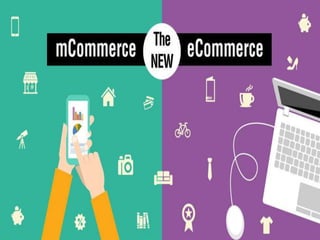
What is m-Commerce:
m-Commerce is also known as Mobile Commerce.
M-Commerce is the buying and selling of goods and services
through wireless handheld devices.
M-Commerce is the process of paying for services using a mobile
phone or personal organizer.
Contd.
Copyright2013-2014
Mobile Commerce Services were first delivered in 1997, when the
first two mobile-phone enabled Coca Cola vending machines were
installed in the Helsinki area in Finland.
The M-Commerce server developed in late 1997 by Kevin Duffey
at Logica.
Since the launch of the iPhone, mobile Commerce has moved
away from SMS systems and into actual applications.
History
Copyright2013-2014
M-Commerce is the ability to conduct Commerce using a mobile
device such as:
1. Smart Phone
2. Personal Digital Assistant(PDA)
Overview
Copyright2013-2014
Mobile Commerce from the Customer‘ s point of view
The customer wants to access information, goods and services any
time and in any place on his mobile device.
He can use his mobile device to purchase tickets for events or
public transport, pay for parking, download content and even order
books and CDs.
He should be offered appropriate payment methods.
Contd.
Copyright2013-2014
Mobile Commerce from the Provider`s point of view
The future development of the mobile telecommunication sector
is heading more and more towards value-added services. Analysts
forecast that soon half of mobile operators‘ revenue will be earned
through mobile Commerce.
Innovative service scenarios will be needed that meet the
customer‘s expectations and business models that satisfy all
partners involved.
Contd.
Copyright2013-2014
Copyright2013-2014
Services and Applications
Mobile ticketing
Mobile Money Transfer
Content purchase and delivery
Information services
Mobile banking
Location Based Services
Mobile Purchase
Mobile marketing and advertising
Copyright2013-2014
Mobile Ticketing:
 Mobile Ticketing is the process where the customers can order,
pay for, obtain and validate tickets from any location and at any
time using Mobile phones .
Tickets can be booked and cancelled on the mobile device with
the help of simple application downloads.
Delivery of tickets to mobile phones can be done in the form of a
SMS or by a MMS.
Copyright2013-2014
Mobile Tickets can be purchased in a variety of ways
including online, via text messaging or in a secure mobile
application.
Mobile Ticketing is used in many applications like:
1. Airline ticketing
2. Cinema ticketing
3. Railway & Bus ticketing
4. Concert/Event ticketing
5. Consumer voucher distribution
 Ex: Bookmyshow, irctc,
redbus etc.
Contd.
Copyright2013-2014
Mobile Money Transfer:
Mobile Money Transfer refers to payment services which are
performed by using a mobile phone.
By using this service we can transfer money from one person to
other by using a mobile phone.
Ex: ICICI bank has started IMPS - Interbank Mobile Payment
Service. It is an interbank electronic instant mobile money transfer
service through mobile phones.
Copyright2013-2014
Copyright2013-2014
Content Purchase and Delivery:
Mobile content purchase and delivery mainly consists of the sale
of ring-tones, wallpapers, and games for mobile phones.
The convergence of mobile phones, portable audio players, and
video players into a single device is increasing the purchase and
delivery of full-length music tracks and video.
The download speeds available with 4G networks make it possible
to buy a movie on a mobile device in a couple of seconds.
Ex: zedge, djpunjab etc.
Copyright2013-2014
Information Services:
A wide variety of information services can be delivered to mobile
phone users in much the same way as it is delivered to PCs. These
services include:
News
Stock quotes
Sports scores
Traffic reporting
Ex: Times of India, Cricbuzz, Accuweather etc.
Copyright2013-2014
Mobile Banking:
Banks and other financial institutions use mobile Commerce to
allow their customers to access account information and make
transactions, such as purchasing stocks, remitting money, receive
notifications, transfer money to other banks.
Copyright2013-2014
Mobile Banking Services are:
1. Mini-statements and checking of account history
2. Checking the balance
3. Recent transactions
4. PIN provision, Change of PIN and reminder over the Internet
5. Cash-in, cash-out transactions on an ATM
Copyright2013-2014
Copyright2013-2014
Location Based Services:
The location of the mobile phone user is an important piece of
information used during Mobile Commerce or m-Commerce
transactions.
Knowing the location of the user allows for location-based services
such as:
1. Local discount offers
2. Tracking and monitoring of people
Copyright2013-2014
Mobile Purchase:
 Catalog merchants can accept orders from customers
electronically, via the customer's mobile device.
 In some cases, the merchant may even deliver the catalog
electronically, rather than mailing a paper catalog to the
customer.
 Consumers making mobile purchases can also receive value-
add upselling services and offers.
 Some merchants provide mobile web sites that are customized
for the smaller screen and limited user interface of a mobile
device.
 Ex: Flipkart, Amazon, Jabong etc.
Copyright2013-2014
Mobile Marketing and Advertising:
 Companies have reported that they see better response from
mobile marketing campaigns than from traditional campaigns.
 The primary reason for this is the instant nature of customer
decision-making that mobile apps and websites enable.
 The consumer can receive a marketing message or discount
coupon and, within a few seconds, make a decision to buy and go
on to complete the sale - without disrupting their current real-
world activity.
Copyright2013-2014
Copyright2013-2014
CLO-1:Information System
• Wide variety of information can be transferred to mobile phones.
• How m-commerce helps customers:-
1. News
2. Sports updates
3. Different business stocks
4. Mobile banking e.g. cash in and cash out statements
5. Local discount offers
• How m-commerce helps companies:-
1. Tracking and monitoring of customer
2. Feasible data availability about customer
3. Mobile marketing and advertisement
4. Online sales of products
5. Easy for the company to keep the financial records of the company
6. Keeping record of customer buying behavior
Copyright2013-2014
Relationship between Business strategy and
Information System:
• Understand the buyer’s value chain, and the impact of the seller’s product on it.
• Determine the purchasing criteria of the buyer.
• To know about possible sources of uniqueness in the firm’s value chain.
• Identify the cost of these sources of uniqueness.
• Choose the value creating activities
• Test the chosen differentiation strategy for sustainability.
• Identify the cost drivers of each value activity and see how they interact.
• Determine the relative costs of competitors and the sources of cost differences.
CLO-2:
Copyright2013-2014
 The most important element when dealing with m-commerce is security issues
and how it can be made safe for customers to feel comfortable when using
mobile phones, so in order to attract as many customers it is needed to be
insured the quality of the security level provided.
 However, it’s absolutely crucial to insure the safety of all kind of m-commerce
transaction special those that involve:
-money transactions
-data theft (hacking of m-banking password)
CLO-3:Information Security
Copyright2013-2014
Advantages
m-Commerce is beneficial for both type of businesses-large scale and small scale.
The mobile users are increasing day by day, so through m-Commerce business gets
large and growing market place for wild range of goods and services.
1. Cover wide distance : Mobile is the only technology which has now become
necessary for any person in social and business life than computers. So, it is easy to
reach users through m-Commerce.
2. Consumer deals : As more users use m-Commerce, there are lots of companies
that use m-Commerce sites to reach them by giving different and better deals in
comparison of their competitor.
3. Savings : Companies try to reach to the consumer directly through m-
Commerce, so users have no need to go far to the store physically and at the end it
saves user’s time and money.
4. Easy to use : There is no need of skilled consumer. Buyers can just have a look
on thousands of items on their cell phones and choose what they require.
Copyright2013-2014
Disadvantages
Every invention has its own merits and demerits. It is applicable in this m-
Commerce business also.
1. Smart phone limitation : Mobile has no big screen like desktop or laptops, so
sometimes users tired to navigate more and more to choose just one item from
thousands. It affects shopping rates.
2. Habituate : Every new technology has some problem at the starting phase.
Here m-Commerce is new application, so sometimes people avoid to change
which are rapidly change. As they are habituate to buy products from e-
Commerce.
3. Risk factor : Each business has its own risk. Same Mobile commerce is the
growing field and a lot of investment in this field can become risky. Because
technology change day by day. Moreover, there less security in wireless
network, so in data transfer hacking chances are more.
4. Connectivity : Mobile commerce needs high speed connectivity of 3G.
Otherwise it is become hectic for user to go through entire product purchase
process.
Copyright2013-2014

m-commerce

  • 1.
  • 2.
    Copyright2013-2014 m-Commerce Applications Presentation on Presented By: Gurbaaj(501504027) Himanshu (501504014) Mehak (501504036) Pankaj (501504034) Rajat (501504028) Presented To: Dr. Amit Kumar Bhardwaj
  • 3.
    Copyright2013-2014 Outline • Introduction • History •Overview • Services and Applications • CLOs • Advantages • Disadvantages
  • 4.
    Copyright2013-2014 Introduction What is Commerce Commerceis a division of trade or production which deals with the exchange of goods and services from producer to final consumer. It comprises the trading of economic value such as goods, services, information, or money between two or more entities.
  • 5.
    Copyright2013-2014 What is E-Commerce Commonlyknown as Electronic Marketing. It consist of buying and selling goods and services over an electronic system such as the internet . E-Commerce is the purchasing, selling and exchanging goods and services over computer networks (internet) through which transaction or terms of sale are performed Electronically. Contd.
  • 6.
    Copyright2013-2014 What is m-Commerce: m-Commerceis also known as Mobile Commerce. M-Commerce is the buying and selling of goods and services through wireless handheld devices. M-Commerce is the process of paying for services using a mobile phone or personal organizer. Contd.
  • 7.
    Copyright2013-2014 Mobile Commerce Serviceswere first delivered in 1997, when the first two mobile-phone enabled Coca Cola vending machines were installed in the Helsinki area in Finland. The M-Commerce server developed in late 1997 by Kevin Duffey at Logica. Since the launch of the iPhone, mobile Commerce has moved away from SMS systems and into actual applications. History
  • 8.
    Copyright2013-2014 M-Commerce is theability to conduct Commerce using a mobile device such as: 1. Smart Phone 2. Personal Digital Assistant(PDA) Overview
  • 9.
    Copyright2013-2014 Mobile Commerce fromthe Customer‘ s point of view The customer wants to access information, goods and services any time and in any place on his mobile device. He can use his mobile device to purchase tickets for events or public transport, pay for parking, download content and even order books and CDs. He should be offered appropriate payment methods. Contd.
  • 10.
    Copyright2013-2014 Mobile Commerce fromthe Provider`s point of view The future development of the mobile telecommunication sector is heading more and more towards value-added services. Analysts forecast that soon half of mobile operators‘ revenue will be earned through mobile Commerce. Innovative service scenarios will be needed that meet the customer‘s expectations and business models that satisfy all partners involved. Contd.
  • 11.
  • 12.
    Copyright2013-2014 Services and Applications Mobileticketing Mobile Money Transfer Content purchase and delivery Information services Mobile banking Location Based Services Mobile Purchase Mobile marketing and advertising
  • 13.
    Copyright2013-2014 Mobile Ticketing:  MobileTicketing is the process where the customers can order, pay for, obtain and validate tickets from any location and at any time using Mobile phones . Tickets can be booked and cancelled on the mobile device with the help of simple application downloads. Delivery of tickets to mobile phones can be done in the form of a SMS or by a MMS.
  • 14.
    Copyright2013-2014 Mobile Tickets canbe purchased in a variety of ways including online, via text messaging or in a secure mobile application. Mobile Ticketing is used in many applications like: 1. Airline ticketing 2. Cinema ticketing 3. Railway & Bus ticketing 4. Concert/Event ticketing 5. Consumer voucher distribution  Ex: Bookmyshow, irctc, redbus etc. Contd.
  • 15.
    Copyright2013-2014 Mobile Money Transfer: MobileMoney Transfer refers to payment services which are performed by using a mobile phone. By using this service we can transfer money from one person to other by using a mobile phone. Ex: ICICI bank has started IMPS - Interbank Mobile Payment Service. It is an interbank electronic instant mobile money transfer service through mobile phones.
  • 16.
  • 17.
    Copyright2013-2014 Content Purchase andDelivery: Mobile content purchase and delivery mainly consists of the sale of ring-tones, wallpapers, and games for mobile phones. The convergence of mobile phones, portable audio players, and video players into a single device is increasing the purchase and delivery of full-length music tracks and video. The download speeds available with 4G networks make it possible to buy a movie on a mobile device in a couple of seconds. Ex: zedge, djpunjab etc.
  • 18.
    Copyright2013-2014 Information Services: A widevariety of information services can be delivered to mobile phone users in much the same way as it is delivered to PCs. These services include: News Stock quotes Sports scores Traffic reporting Ex: Times of India, Cricbuzz, Accuweather etc.
  • 19.
    Copyright2013-2014 Mobile Banking: Banks andother financial institutions use mobile Commerce to allow their customers to access account information and make transactions, such as purchasing stocks, remitting money, receive notifications, transfer money to other banks.
  • 20.
    Copyright2013-2014 Mobile Banking Servicesare: 1. Mini-statements and checking of account history 2. Checking the balance 3. Recent transactions 4. PIN provision, Change of PIN and reminder over the Internet 5. Cash-in, cash-out transactions on an ATM
  • 21.
  • 22.
    Copyright2013-2014 Location Based Services: Thelocation of the mobile phone user is an important piece of information used during Mobile Commerce or m-Commerce transactions. Knowing the location of the user allows for location-based services such as: 1. Local discount offers 2. Tracking and monitoring of people
  • 23.
    Copyright2013-2014 Mobile Purchase:  Catalogmerchants can accept orders from customers electronically, via the customer's mobile device.  In some cases, the merchant may even deliver the catalog electronically, rather than mailing a paper catalog to the customer.  Consumers making mobile purchases can also receive value- add upselling services and offers.  Some merchants provide mobile web sites that are customized for the smaller screen and limited user interface of a mobile device.  Ex: Flipkart, Amazon, Jabong etc.
  • 24.
    Copyright2013-2014 Mobile Marketing andAdvertising:  Companies have reported that they see better response from mobile marketing campaigns than from traditional campaigns.  The primary reason for this is the instant nature of customer decision-making that mobile apps and websites enable.  The consumer can receive a marketing message or discount coupon and, within a few seconds, make a decision to buy and go on to complete the sale - without disrupting their current real- world activity.
  • 25.
  • 26.
    Copyright2013-2014 CLO-1:Information System • Widevariety of information can be transferred to mobile phones. • How m-commerce helps customers:- 1. News 2. Sports updates 3. Different business stocks 4. Mobile banking e.g. cash in and cash out statements 5. Local discount offers • How m-commerce helps companies:- 1. Tracking and monitoring of customer 2. Feasible data availability about customer 3. Mobile marketing and advertisement 4. Online sales of products 5. Easy for the company to keep the financial records of the company 6. Keeping record of customer buying behavior
  • 27.
    Copyright2013-2014 Relationship between Businessstrategy and Information System: • Understand the buyer’s value chain, and the impact of the seller’s product on it. • Determine the purchasing criteria of the buyer. • To know about possible sources of uniqueness in the firm’s value chain. • Identify the cost of these sources of uniqueness. • Choose the value creating activities • Test the chosen differentiation strategy for sustainability. • Identify the cost drivers of each value activity and see how they interact. • Determine the relative costs of competitors and the sources of cost differences. CLO-2:
  • 28.
    Copyright2013-2014  The mostimportant element when dealing with m-commerce is security issues and how it can be made safe for customers to feel comfortable when using mobile phones, so in order to attract as many customers it is needed to be insured the quality of the security level provided.  However, it’s absolutely crucial to insure the safety of all kind of m-commerce transaction special those that involve: -money transactions -data theft (hacking of m-banking password) CLO-3:Information Security
  • 29.
    Copyright2013-2014 Advantages m-Commerce is beneficialfor both type of businesses-large scale and small scale. The mobile users are increasing day by day, so through m-Commerce business gets large and growing market place for wild range of goods and services. 1. Cover wide distance : Mobile is the only technology which has now become necessary for any person in social and business life than computers. So, it is easy to reach users through m-Commerce. 2. Consumer deals : As more users use m-Commerce, there are lots of companies that use m-Commerce sites to reach them by giving different and better deals in comparison of their competitor. 3. Savings : Companies try to reach to the consumer directly through m- Commerce, so users have no need to go far to the store physically and at the end it saves user’s time and money. 4. Easy to use : There is no need of skilled consumer. Buyers can just have a look on thousands of items on their cell phones and choose what they require.
  • 30.
    Copyright2013-2014 Disadvantages Every invention hasits own merits and demerits. It is applicable in this m- Commerce business also. 1. Smart phone limitation : Mobile has no big screen like desktop or laptops, so sometimes users tired to navigate more and more to choose just one item from thousands. It affects shopping rates. 2. Habituate : Every new technology has some problem at the starting phase. Here m-Commerce is new application, so sometimes people avoid to change which are rapidly change. As they are habituate to buy products from e- Commerce. 3. Risk factor : Each business has its own risk. Same Mobile commerce is the growing field and a lot of investment in this field can become risky. Because technology change day by day. Moreover, there less security in wireless network, so in data transfer hacking chances are more. 4. Connectivity : Mobile commerce needs high speed connectivity of 3G. Otherwise it is become hectic for user to go through entire product purchase process.
  • 31.