Management of SLE
Presenter : Dr Prakash Man Shah
Moderators: Dr Shankar Yadav
Dr Mukesh Bhatta
Dr Lalan Rauniyar
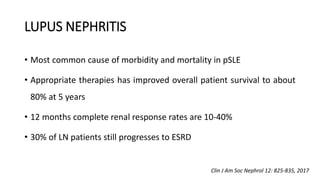
LUPUS NEPHRITIS
• Most common cause of morbidity and mortality in pSLE
• Appropriate therapies has improved overall patient survival to about
80% at 5 years
• 12 months complete renal response rates are 10-40%
• 30% of LN patients still progresses to ESRD
Clin J Am Soc Nephrol 12: 825-835, 2017
International Society of Nephrology/Renal
pathology Society (ISN/RPS) Classification
Histologic findings Immunofluorescence (IF)
findings
Minimal Mesangial lupus
nephritis (CLASS I)
Normal glomeruli by light
microscopy (LM)
Mesangial immune
deposits by IF
Mesangial proliferative
Lupus nephritis
(CLASS II)
Mesangial hyper
cellularity or mesangial
matrix expansion by LM
Mesangial immune
deposits
Focal Lupus nephritis
(CLASS III)
Segmental endocapillary
proliferation < 50% of
glomeruli
Mesangial & sub-
endothelial immune
complex deposition
International Society of Nephrology/Renal
pathology Society (ISN/RPS) Classification
Histologic findings Immunofluorescence (IF)
findings
Diffuse lupus nephritis
(CLASS IV)
Segmental or global
endocapillary proliferation
> 50% of glomeruli
Mesangial & sub-
endothelial immune
complex deposition
Membranous Lupus
nephritis (CLASS V)
Global or segmental
subepithelial deposits
Subepithelial immune
deposits
Advanced sclerotic Lupus
nephritis (CLASS VI)
≥ 90% glomeruli globally
sclerosed
No residual activity
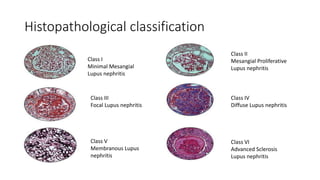
Histopathological classification
Class I
Minimal Mesangial
Lupus nephritis
Class III
Focal Lupus nephritis
Class V
Membranous Lupus
nephritis
Class II
Mesangial Proliferative
Lupus nephritis
Class IV
Diffuse Lupus nephritis
Class VI
Advanced Sclerosis
Lupus nephritis
LUPUS NEPHRITIS SUSPECTED
PERFORM DIAGNOSTIC BIOPSY
INDUCTION FOLLOWED BY MAINTENANCE THERAPY
POSSIBLE OUTCOMES
NO RESPONSE:
PERSISTENT NEPHROTIC
PROTEINURIA
NO RESPONSE:
WORSENING
KIDNEY FUNCTION
PARTIAL RENAL
CLINICAL RESPONSE
COMPLETE
CLINICAL RENAL
RESPONSE
RE-BIOPSY MAY NOT BE
NECESSARY; INTENSIFY
TREATMENT
RE-BIOPSY MAY
SHOW SCAR; NO
TREATMENT NEEDED
RE-BIOPSY MAY SHOW
RESOLUTION; NO
TREATMENT NEEDED
Clin J Am Soc Nephrol 12: 825-835, 2017
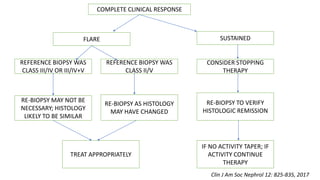
COMPLETE CLINICAL RESPONSE
FLARE SUSTAINED
REFERENCE BIOPSY WAS
CLASS III/IV OR III/IV+V
REFERENCE BIOPSY WAS
CLASS II/V
CONSIDER STOPPING
THERAPY
RE-BIOPSY TO VERIFY
HISTOLOGIC REMISSION
IF NO ACTIVITY TAPER; IF
ACTIVITY CONTINUE
THERAPY
RE-BIOPSY MAY NOT BE
NECESSARY; HISTOLOGY
LIKELY TO BE SIMILAR
RE-BIOPSY AS HISTOLOGY
MAY HAVE CHANGED
TREAT APPROPRIATELY
Clin J Am Soc Nephrol 12: 825-835, 2017
PROLIFERATIVE LUPUS NEPHRITIS : Severe?
YES NO
IV Methylprednisolone 0.25-1g/d for 1-3 days
followed by
Oral prednisolone 1 mg/kg/d ideal body
weight, Maximum 80mg/d, Taper over weeks
PLUS: Intravenous Cyclophosphamide 0.5-1
g/m2 Monthly for 6 months
Oral Prednisolone 1mg/kg/d ideal body
weight, Maximum 80mg/d, Taper over weeks
PLUS:
Low-Dose Intravenous
Cyclophosphamide
500 mg/m2 every 2
weeks for 3 months
Oral
Cyclophosphamide 1-
1.5 mg/kg/d,
maximum 150mg/d
for 2-4 months
Oral MMF 2-3 g/d for
6 months
Maintenance Phase
Prednisolone 5-10 mg/d
PLUS:
Or Or
Clin J Am Soc Nephrol 12: 825-835, 2017
Maintenance Phase
Prednisolone 5-10 mg/d
PLUS:
MMF 1-2 g/d
(first choice)
AZA 1-2.5 mg/kg/d
(individual indication)
CSA 2.5-4 mg/kg/d or TAC to
trough of 4-6 ng/ml
Or Or
Current induction and maintenance treatment choices for proliferative lupus nephritis. Patients are considered to
have severe lupus nephritis if they have :
• functional kidney injury with an elevated serum creatinine and/or heavy proteinuria,
• evidence that the loss of renal function occurred over a relatively short period of time, and
• active histologic injury with glomerular crescents and necroses affecting several glomeruli.
Major recommendations from guidelines/CTPs for
treatment of proliferative lupus nephritis
1. Treatment is best guided by renal biopsy classified by the current
ISN/RPS classification
2. All patients should receive a background of hydroxychloroquine to
reduce renal flare unless contraindicated
3. Induction therapy
A choice of MMF or CYC plus glucocorticoids for 6 months is
recommended for initial treatment
1. MMF
a. CARRA – 600 mg/m2 /dose twice daily
b. EULAR/ERA-EDTA – 3 gm/day
c. ACR – 2–3 gm/day
OR
2. Low-dose CYC
a. EULAR/ERA-EDTA, ACR – 500 mg/IV every 2 weeks x 6 followed by
maintenance with oral MMF or AZA
OR
3. High-dose CYC
a. CARRA – 500 mg/m2 initial dose increased not to exceed 1,500 mg
monthly x 6
b. ACR – 500–1,000 mg/m2 IV every month x 6
c. EULAR/ERA-EDTA – 750–1,000 mg/m2 IV monthly x 6 or 2–2.5
mg/kg/d orally x 3 months.
PLUS
4. Glucocorticoid Regimen
4. Glucocorticoid regimens
a. CARRA
i. Primarily oral prednisone 2 mg/kg/d max 80 mg tapered to 20
mg/d for patient >30 kg by 6 months
ii. Primarily IV – IVMP 30 mg/kg/dose to 1,000 mg max 1–3 x/week
for 5–7 weeks, then monthly until 6 months with 10–20 mg
prednisone daily by mouth tapered to 5–10 mg daily by 6 months
iii. Mixed oral/IV – monthly IVMP (as above) plus oral prednisone 1.5
mg/kg/d up to 60 mg tapered to 15 mg or 0.5 mg/kg by 6 months
OR
OR
OR
b. EULAR/ERA-EDTA-IVMP – 500–750 mg daily x 3 followed by oral
prednisone 0.5 mg/kg/d for 4 weeks reducing to ≤10 mg/d by 4–6
months
OR
c. ACR-IVMP – 500–1,000 mg daily x 3, then oral prednisone 0.5–1
mg/kg/d tapered after a few weeks to lowest effective dose (*with 1
mg/kg/d if crescents seen)
4. Maintenance therapy after successful induction
a. EULAR-ERA/EDTA-MMF (2 g/d) or AZA (2 mg/kg/d) plus low-dose
corticosteroids for at least 3 years *continuation of MMF in those
patients with a successful induction by MMF
b. ACR – 1–2 g/d MMF or AZA 2 mg/kg/d with or without low-dose
corticosteroids
Refractory disease
a. EULAR-ERA/EDTA – For patients who fail either MMF or CYC due to
lack of efficacy or adverse events, treatment should be changed
from MMF to CYC or CYC to MMF or rituximab be given
b. ACR – For patients who fail either MMF or CYC, a switch to the
other medication accompanied by IVMP pulses for 3 days.
Rituximab may be used in some cases
c. ACR – Those patients failing both CYC and MMF may be treated
with rituximab or calcineurin inhibitors plus glucocorticoids
Response to treatment
Criteria
Complete response
(CR)
uPCR < 0.5 mg/mg or urinary protein < 500 mg/d, or < 0.5 g/24 with normal
renal function
Partial response
(PR)
≥ 50% decrease in proteinuria, to at least sub-nephrotic levels
plus
Stabilization or improvement of serum creatinine
Flare or Relapse Increase or recurrence of active urinary sediment (hematuria from <5
RBC/HPF to > 15 RBC/HPF)
Or
Increase in serum creatinine
Or
An increase in proteinuria:
• If proteinuria <500 mg/d (complete response), an increase to ≥1000 mg/d
is required
• If proteinuria >500 mg/d (partial response), a doubling of uPCR to ≥2
mg/mg is required
• Management of relapse cases:
Consider original induction and maintenance regimen unless
repeat renal biopsy confers change of renal histology with
worsening of renal function
• Management of resistant cases:
Alternate treatment regimen
Rituximab, calcineurin inhibitor, newer medications, intravenous
immunoglobulins, plasmapheresis
• Worsening of renal function during first three months of
treatment
Warrants alternate treatment regimen
Repeat renal biopsy
• Indications for repeat biopsy
Worsening of disease or disease refractory to treatment
Relapse, to demonstrate change or progression in histological
class, change in activity and chronicity (index) or other
pathologies.
Management of ESRD cases:
• Renal replacement therapy
• If lupus is inactive  peritoneal dialysis
• If lupus is active  hemodialysis
• Renal transplantation
• If lupus activity absent or low for 3-6 (EULAR/ERA-EDTA)
or 6-12 (GEAS) months
(Determine aPL; associated with increased risk of
vascular events in the transplant)
Monitoring
• Determine at each visit:
i. Clinical evaluation: Body weight, Blood pressure
ii. Laboratory parameters: Serum creatinine, proteinuria, urinary
sediment, uPCR, serum albumin and complete blood count
iii. Serological markers: C3/C4 blood levels, anti-ds DNA titre
• Scheduled visits:
Active nephritis: monthly or more frequently
No active nephritis: every 3-6 months
Lupus nephritis management guidelines compared, Nephrology dialysis Transplantation, 2015;31:904-13
Prognosis
• With advances in the diagnosis and treatment of SLE,
survival rate has improved dramatically over past 50
years
5 year survival rate for pSLE is approx. 95%
10 year survival rate remains 80-90%
NELSON textbook of pediatrics, 21st Edition
Neuropsychiatric Involvement (NP-
SLE)
• Occurs in 20–70% of pSLE patients
• Second leading cause of morbidity and mortality
• Headache (refractory to standard analgesics) is the most common
neuropsychiatric manifestation.
• Decreased concentration and cognitive dysfunction, psychosis,
seizures, transverse myelitis, CNS vasculitis, or stroke, cranial nerve
palsies, peripheral neuropathy are the other common manifestations.
Treatment
• Symptomatic management and treatment based on
pathogenic mechanisms
• Symptomatic management includes
• Correction of hypertension and metabolic imbalances
• Antiepileptics for seizures
• Anxiolytic agents, mood stabilizers, or antipsychotic
agents for psychiatric manifestations
Autoimmune inflammatory process
• Use of regimen is similar to lupus nephritis
• A single RCT demonstrated that
i/v cyclophosphamide infusions are associated with
better outcome than is bimonthly intravenous
methylprednisolone in severe NPSLE
Oral cyclophosphamide for 6 months followed by
azathioprine maintenance therapy effective in lupus-
related psychosis
• Rituximab was effective for refractory NPSLE
Ischemic process
• As with aPL antibody- related thrombosis, with NPSLE
• Lifelong anticoagulation with warfarin is mainstay of therapy
• Low dose aspirin is recommended for patients with
cardiovascular risk factors
In patients with NPSLE and APS
• Pulse corticosteroids, intravenous immunoglobulin
infusions and/or plasmapheresis can be considered.
Pregnancy with SLE
Fertility with SLE
• Fertility is not thought to be reduced in women with SLE
unless:
• Ovarian failure with use of high dosages of cyclophosphamide
• End-stage renal failure associated with lupus nephritis, which can
cause amenorrhea
• NSAIDs by inhibition of cyclooxygenase, (luteinized unruptured
follicle syndrome)
Anti-Ro/La and APL Antibodies
• Anti Ro/La  congenital heart block and neonatal
cutaneous lupus syndrome
• Antiphospholipid antibodies (in 30% of women with SLE) 
arterial and venous thrombosis and utero-placental
insufficiency.
• Recurrent miscarriage
• Fetal growth restriction
• Fetal loss
• Preterm delivery
Drug therapy in SLE
• Glucocorticoids are considered 1st line treatment in pregnancy
• Glucocorticoids maternal adverse effects:
• Weight gain
• Immunosuppression
• Acne
• Git irritation
• Increased glucose tolerance (screen for GDM)
• Immunosuppressant agents that are considered safe : Azathioprine
and hydroxychloroquine
Reassurance
• Conception in a period of quiescence  reduce the likelihood of a
flare of the disease during pregnancy.
• In quiescent disease, without associated APS, hypertension or renal
involvement the risk of miscarriage/stillbirth and fetal growth
restriction are not significantly increased
Possible risks
Miscarriage Stillbirth
Congenital heart blocks Fetal growth restriction
Preterm delivery Pre-eclampsia
When not to conceive
• Associated pulmonary arterial hypertension
• During a period of active disease, particularly with lupus nephritis
Approach to Babies born to mother with SLE
Anti Ro – Anti La : Negative
No previous Neonatal
Lupus Syndrome delivery
Fetal monitoring
according to regular
pregnancy protocols
Previous Neonatal Lupus
Syndrome delivery
Pulsed Doppler Echo 4
weekly, 18-26th week
 No development of any degree
heart block: No treatment
 Development of 2nd & 3rd degree
of heart block : Treat with
Betamethasone /
dexamethasone
Apollo medicine 2012 September, volume 9, number 3; pp. 280-281
Anti Ro – Anti La : Positive
Pulsed Doppler Echo &/or Fetal ECG
First Degree Heart Block Second Degree Heart Block Third Degree Heart Block
No treatment Close Follow-up
Progression to 2nd or 3rd degree
heart block with cardiomyopathy
Treatment with Betamethasone /
Dexamethasone till end of
pregnancy
No response on 2nd degree heart
block advancing to 3rd degree heart
block without cardiomyopathy
Cardiomyopathy + Cardiomyopathy -
Consider for pacing post delivery (or)
after variable time in infancy / childhood
based on clinical judgement
Apollo medicine 2012 September, volume 9, number 3; pp. 280-281
Anti Ro – Anti La : Positive
Pulsed Doppler Echo &/or Fetal ECG
Third Degree Heart Block
with Hydrops
Consider Termination of
pregnancy
Apollo medicine 2012 September, volume 9, number 3; pp. 280-281
Management of Asymptomatic babies
• HR ≥ 80 bpm and clinically stable  Mother’s side
• ECG prior to discharge
• F/U – outpatient clinic 2-3 weeks
Management of Symptomatic babies
Congenital Heart Block
• HR <80 bpm : admit and 24 hr ECG recording
• If clinically stable  Transfer mother’s side and F/U – outpatient
clinic
• If HR < 55 bpm
• No treatment for asymptomatic
• If signs of low cardiac output  inotropes temporarily before a
pacemaker
THANK YOU

management of SLE.pptx

  • 1.
    Management of SLE Presenter: Dr Prakash Man Shah Moderators: Dr Shankar Yadav Dr Mukesh Bhatta Dr Lalan Rauniyar
  • 2.
    LUPUS NEPHRITIS • Mostcommon cause of morbidity and mortality in pSLE • Appropriate therapies has improved overall patient survival to about 80% at 5 years • 12 months complete renal response rates are 10-40% • 30% of LN patients still progresses to ESRD Clin J Am Soc Nephrol 12: 825-835, 2017
  • 3.
    International Society ofNephrology/Renal pathology Society (ISN/RPS) Classification Histologic findings Immunofluorescence (IF) findings Minimal Mesangial lupus nephritis (CLASS I) Normal glomeruli by light microscopy (LM) Mesangial immune deposits by IF Mesangial proliferative Lupus nephritis (CLASS II) Mesangial hyper cellularity or mesangial matrix expansion by LM Mesangial immune deposits Focal Lupus nephritis (CLASS III) Segmental endocapillary proliferation < 50% of glomeruli Mesangial & sub- endothelial immune complex deposition
  • 4.
    International Society ofNephrology/Renal pathology Society (ISN/RPS) Classification Histologic findings Immunofluorescence (IF) findings Diffuse lupus nephritis (CLASS IV) Segmental or global endocapillary proliferation > 50% of glomeruli Mesangial & sub- endothelial immune complex deposition Membranous Lupus nephritis (CLASS V) Global or segmental subepithelial deposits Subepithelial immune deposits Advanced sclerotic Lupus nephritis (CLASS VI) ≥ 90% glomeruli globally sclerosed No residual activity
  • 5.
    Histopathological classification Class I MinimalMesangial Lupus nephritis Class III Focal Lupus nephritis Class V Membranous Lupus nephritis Class II Mesangial Proliferative Lupus nephritis Class IV Diffuse Lupus nephritis Class VI Advanced Sclerosis Lupus nephritis
  • 6.
    LUPUS NEPHRITIS SUSPECTED PERFORMDIAGNOSTIC BIOPSY INDUCTION FOLLOWED BY MAINTENANCE THERAPY POSSIBLE OUTCOMES NO RESPONSE: PERSISTENT NEPHROTIC PROTEINURIA NO RESPONSE: WORSENING KIDNEY FUNCTION PARTIAL RENAL CLINICAL RESPONSE COMPLETE CLINICAL RENAL RESPONSE RE-BIOPSY MAY NOT BE NECESSARY; INTENSIFY TREATMENT RE-BIOPSY MAY SHOW SCAR; NO TREATMENT NEEDED RE-BIOPSY MAY SHOW RESOLUTION; NO TREATMENT NEEDED Clin J Am Soc Nephrol 12: 825-835, 2017
  • 7.
    COMPLETE CLINICAL RESPONSE FLARESUSTAINED REFERENCE BIOPSY WAS CLASS III/IV OR III/IV+V REFERENCE BIOPSY WAS CLASS II/V CONSIDER STOPPING THERAPY RE-BIOPSY TO VERIFY HISTOLOGIC REMISSION IF NO ACTIVITY TAPER; IF ACTIVITY CONTINUE THERAPY RE-BIOPSY MAY NOT BE NECESSARY; HISTOLOGY LIKELY TO BE SIMILAR RE-BIOPSY AS HISTOLOGY MAY HAVE CHANGED TREAT APPROPRIATELY Clin J Am Soc Nephrol 12: 825-835, 2017
  • 8.
    PROLIFERATIVE LUPUS NEPHRITIS: Severe? YES NO IV Methylprednisolone 0.25-1g/d for 1-3 days followed by Oral prednisolone 1 mg/kg/d ideal body weight, Maximum 80mg/d, Taper over weeks PLUS: Intravenous Cyclophosphamide 0.5-1 g/m2 Monthly for 6 months Oral Prednisolone 1mg/kg/d ideal body weight, Maximum 80mg/d, Taper over weeks PLUS: Low-Dose Intravenous Cyclophosphamide 500 mg/m2 every 2 weeks for 3 months Oral Cyclophosphamide 1- 1.5 mg/kg/d, maximum 150mg/d for 2-4 months Oral MMF 2-3 g/d for 6 months Maintenance Phase Prednisolone 5-10 mg/d PLUS: Or Or Clin J Am Soc Nephrol 12: 825-835, 2017
  • 9.
    Maintenance Phase Prednisolone 5-10mg/d PLUS: MMF 1-2 g/d (first choice) AZA 1-2.5 mg/kg/d (individual indication) CSA 2.5-4 mg/kg/d or TAC to trough of 4-6 ng/ml Or Or Current induction and maintenance treatment choices for proliferative lupus nephritis. Patients are considered to have severe lupus nephritis if they have : • functional kidney injury with an elevated serum creatinine and/or heavy proteinuria, • evidence that the loss of renal function occurred over a relatively short period of time, and • active histologic injury with glomerular crescents and necroses affecting several glomeruli.
  • 10.
    Major recommendations fromguidelines/CTPs for treatment of proliferative lupus nephritis 1. Treatment is best guided by renal biopsy classified by the current ISN/RPS classification 2. All patients should receive a background of hydroxychloroquine to reduce renal flare unless contraindicated 3. Induction therapy
  • 11.
    A choice ofMMF or CYC plus glucocorticoids for 6 months is recommended for initial treatment 1. MMF a. CARRA – 600 mg/m2 /dose twice daily b. EULAR/ERA-EDTA – 3 gm/day c. ACR – 2–3 gm/day OR 2. Low-dose CYC a. EULAR/ERA-EDTA, ACR – 500 mg/IV every 2 weeks x 6 followed by maintenance with oral MMF or AZA
  • 12.
    OR 3. High-dose CYC a.CARRA – 500 mg/m2 initial dose increased not to exceed 1,500 mg monthly x 6 b. ACR – 500–1,000 mg/m2 IV every month x 6 c. EULAR/ERA-EDTA – 750–1,000 mg/m2 IV monthly x 6 or 2–2.5 mg/kg/d orally x 3 months. PLUS 4. Glucocorticoid Regimen
  • 13.
    4. Glucocorticoid regimens a.CARRA i. Primarily oral prednisone 2 mg/kg/d max 80 mg tapered to 20 mg/d for patient >30 kg by 6 months ii. Primarily IV – IVMP 30 mg/kg/dose to 1,000 mg max 1–3 x/week for 5–7 weeks, then monthly until 6 months with 10–20 mg prednisone daily by mouth tapered to 5–10 mg daily by 6 months iii. Mixed oral/IV – monthly IVMP (as above) plus oral prednisone 1.5 mg/kg/d up to 60 mg tapered to 15 mg or 0.5 mg/kg by 6 months OR OR OR
  • 14.
    b. EULAR/ERA-EDTA-IVMP –500–750 mg daily x 3 followed by oral prednisone 0.5 mg/kg/d for 4 weeks reducing to ≤10 mg/d by 4–6 months OR c. ACR-IVMP – 500–1,000 mg daily x 3, then oral prednisone 0.5–1 mg/kg/d tapered after a few weeks to lowest effective dose (*with 1 mg/kg/d if crescents seen)
  • 15.
    4. Maintenance therapyafter successful induction a. EULAR-ERA/EDTA-MMF (2 g/d) or AZA (2 mg/kg/d) plus low-dose corticosteroids for at least 3 years *continuation of MMF in those patients with a successful induction by MMF b. ACR – 1–2 g/d MMF or AZA 2 mg/kg/d with or without low-dose corticosteroids
  • 16.
    Refractory disease a. EULAR-ERA/EDTA– For patients who fail either MMF or CYC due to lack of efficacy or adverse events, treatment should be changed from MMF to CYC or CYC to MMF or rituximab be given b. ACR – For patients who fail either MMF or CYC, a switch to the other medication accompanied by IVMP pulses for 3 days. Rituximab may be used in some cases c. ACR – Those patients failing both CYC and MMF may be treated with rituximab or calcineurin inhibitors plus glucocorticoids
  • 17.
    Response to treatment Criteria Completeresponse (CR) uPCR < 0.5 mg/mg or urinary protein < 500 mg/d, or < 0.5 g/24 with normal renal function Partial response (PR) ≥ 50% decrease in proteinuria, to at least sub-nephrotic levels plus Stabilization or improvement of serum creatinine Flare or Relapse Increase or recurrence of active urinary sediment (hematuria from <5 RBC/HPF to > 15 RBC/HPF) Or Increase in serum creatinine Or An increase in proteinuria: • If proteinuria <500 mg/d (complete response), an increase to ≥1000 mg/d is required • If proteinuria >500 mg/d (partial response), a doubling of uPCR to ≥2 mg/mg is required
  • 18.
    • Management ofrelapse cases: Consider original induction and maintenance regimen unless repeat renal biopsy confers change of renal histology with worsening of renal function • Management of resistant cases: Alternate treatment regimen Rituximab, calcineurin inhibitor, newer medications, intravenous immunoglobulins, plasmapheresis
  • 19.
    • Worsening ofrenal function during first three months of treatment Warrants alternate treatment regimen Repeat renal biopsy • Indications for repeat biopsy Worsening of disease or disease refractory to treatment Relapse, to demonstrate change or progression in histological class, change in activity and chronicity (index) or other pathologies.
  • 20.
    Management of ESRDcases: • Renal replacement therapy • If lupus is inactive  peritoneal dialysis • If lupus is active  hemodialysis • Renal transplantation • If lupus activity absent or low for 3-6 (EULAR/ERA-EDTA) or 6-12 (GEAS) months (Determine aPL; associated with increased risk of vascular events in the transplant)
  • 21.
    Monitoring • Determine ateach visit: i. Clinical evaluation: Body weight, Blood pressure ii. Laboratory parameters: Serum creatinine, proteinuria, urinary sediment, uPCR, serum albumin and complete blood count iii. Serological markers: C3/C4 blood levels, anti-ds DNA titre • Scheduled visits: Active nephritis: monthly or more frequently No active nephritis: every 3-6 months Lupus nephritis management guidelines compared, Nephrology dialysis Transplantation, 2015;31:904-13
  • 22.
    Prognosis • With advancesin the diagnosis and treatment of SLE, survival rate has improved dramatically over past 50 years 5 year survival rate for pSLE is approx. 95% 10 year survival rate remains 80-90% NELSON textbook of pediatrics, 21st Edition
  • 24.
    Neuropsychiatric Involvement (NP- SLE) •Occurs in 20–70% of pSLE patients • Second leading cause of morbidity and mortality • Headache (refractory to standard analgesics) is the most common neuropsychiatric manifestation. • Decreased concentration and cognitive dysfunction, psychosis, seizures, transverse myelitis, CNS vasculitis, or stroke, cranial nerve palsies, peripheral neuropathy are the other common manifestations.
  • 26.
    Treatment • Symptomatic managementand treatment based on pathogenic mechanisms • Symptomatic management includes • Correction of hypertension and metabolic imbalances • Antiepileptics for seizures • Anxiolytic agents, mood stabilizers, or antipsychotic agents for psychiatric manifestations
  • 27.
    Autoimmune inflammatory process •Use of regimen is similar to lupus nephritis • A single RCT demonstrated that i/v cyclophosphamide infusions are associated with better outcome than is bimonthly intravenous methylprednisolone in severe NPSLE Oral cyclophosphamide for 6 months followed by azathioprine maintenance therapy effective in lupus- related psychosis • Rituximab was effective for refractory NPSLE
  • 28.
    Ischemic process • Aswith aPL antibody- related thrombosis, with NPSLE • Lifelong anticoagulation with warfarin is mainstay of therapy • Low dose aspirin is recommended for patients with cardiovascular risk factors In patients with NPSLE and APS • Pulse corticosteroids, intravenous immunoglobulin infusions and/or plasmapheresis can be considered.
  • 29.
  • 30.
    Fertility with SLE •Fertility is not thought to be reduced in women with SLE unless: • Ovarian failure with use of high dosages of cyclophosphamide • End-stage renal failure associated with lupus nephritis, which can cause amenorrhea • NSAIDs by inhibition of cyclooxygenase, (luteinized unruptured follicle syndrome)
  • 31.
    Anti-Ro/La and APLAntibodies • Anti Ro/La  congenital heart block and neonatal cutaneous lupus syndrome • Antiphospholipid antibodies (in 30% of women with SLE)  arterial and venous thrombosis and utero-placental insufficiency. • Recurrent miscarriage • Fetal growth restriction • Fetal loss • Preterm delivery
  • 32.
    Drug therapy inSLE • Glucocorticoids are considered 1st line treatment in pregnancy • Glucocorticoids maternal adverse effects: • Weight gain • Immunosuppression • Acne • Git irritation • Increased glucose tolerance (screen for GDM) • Immunosuppressant agents that are considered safe : Azathioprine and hydroxychloroquine
  • 33.
    Reassurance • Conception ina period of quiescence  reduce the likelihood of a flare of the disease during pregnancy. • In quiescent disease, without associated APS, hypertension or renal involvement the risk of miscarriage/stillbirth and fetal growth restriction are not significantly increased Possible risks Miscarriage Stillbirth Congenital heart blocks Fetal growth restriction Preterm delivery Pre-eclampsia
  • 34.
    When not toconceive • Associated pulmonary arterial hypertension • During a period of active disease, particularly with lupus nephritis
  • 35.
    Approach to Babiesborn to mother with SLE
  • 36.
    Anti Ro –Anti La : Negative No previous Neonatal Lupus Syndrome delivery Fetal monitoring according to regular pregnancy protocols Previous Neonatal Lupus Syndrome delivery Pulsed Doppler Echo 4 weekly, 18-26th week  No development of any degree heart block: No treatment  Development of 2nd & 3rd degree of heart block : Treat with Betamethasone / dexamethasone Apollo medicine 2012 September, volume 9, number 3; pp. 280-281
  • 37.
    Anti Ro –Anti La : Positive Pulsed Doppler Echo &/or Fetal ECG First Degree Heart Block Second Degree Heart Block Third Degree Heart Block No treatment Close Follow-up Progression to 2nd or 3rd degree heart block with cardiomyopathy Treatment with Betamethasone / Dexamethasone till end of pregnancy No response on 2nd degree heart block advancing to 3rd degree heart block without cardiomyopathy Cardiomyopathy + Cardiomyopathy - Consider for pacing post delivery (or) after variable time in infancy / childhood based on clinical judgement Apollo medicine 2012 September, volume 9, number 3; pp. 280-281
  • 38.
    Anti Ro –Anti La : Positive Pulsed Doppler Echo &/or Fetal ECG Third Degree Heart Block with Hydrops Consider Termination of pregnancy Apollo medicine 2012 September, volume 9, number 3; pp. 280-281
  • 39.
    Management of Asymptomaticbabies • HR ≥ 80 bpm and clinically stable  Mother’s side • ECG prior to discharge • F/U – outpatient clinic 2-3 weeks
  • 40.
    Management of Symptomaticbabies Congenital Heart Block • HR <80 bpm : admit and 24 hr ECG recording • If clinically stable  Transfer mother’s side and F/U – outpatient clinic • If HR < 55 bpm • No treatment for asymptomatic • If signs of low cardiac output  inotropes temporarily before a pacemaker
  • 41.

Editor's Notes

  • #7 Proteinuria >500 mg/d, with or without other clinical abnormalities, or any level of proteinuria or hematuria with impaired kidney function
  • #9 All patients (unless contraindicated) should be treated with an antimalarial given the evidence that lack of antimalarial use may be associated with an increase in LN treatment failures