Proteinuria- H T Approach?
                 ow o
           Dr. Sachin Verma MD, FICM, FCCS, ICFC
              Fellowship in Intensive Care Medicine
                Infection Control Fellows Course
         Consultant Internal Medicine and Critical Care
       Web:- http://www.medicinedoctorinchandigarh.com
                     Mob:- +91-7508677495
References:
  1.   Brenner’s & Rector’s The Kidney 7th Ed.
  2.   Harrison’s Internal Medicine 17th Ed.
  3.   Oxford Textbook Of Clinical Nephrology
  4.   Internet
Problem Statement
   Proteinuria is a common finding in at least
    17% adults in general practice, in routine
    dip stick screening
   Fewer than 2% of patients whose urine
    dipstick is positive for protein have serious
    and treatable urinary tract disorders
Definition
   240 years ago, Hippocrates noted the
    association between “Bubbles on surface
    of urine” and kidney disease
   Proteinuria is defined as protein excretion
    >150mg/day.
   Most of the positive dip stick test results
    are due to benign proteinuria, which has
    no associated morbidity and mortality
Causes of Benign Proteinuria
   Dehydration
   Emotional stress
   Fever
   Heat injury
   Intense physical activity
   Most acute illnesses
   Orthostatic (postural )disorder
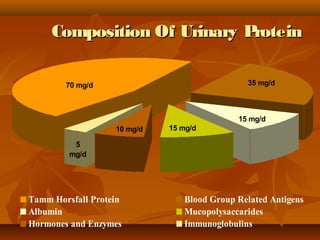
Composition Of Urinary Protein

        70 mg/d                               35 mg/d


                                            15 mg/d
                   10 mg/d   15 mg/d

          5
         mg/d


Tamm Horsfall Protein           Blood Group Related Antigens
Albumin                         Mucopolysaccarides
Hormones and Enzymes            Immunoglobulins
Mechanism of Proteinuria
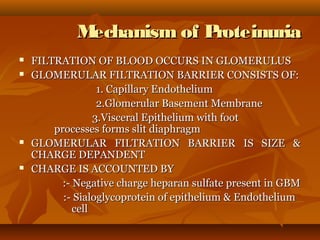
   FILTRATION OF BLOOD OCCURS IN GLOMERULUS
   GLOMERULAR FILTRATION BARRIER CONSISTS OF:
                   1. Capillary Endothelium
                   2.Glomerular Basement Membrane
                  3.Visceral Epithelium with foot
        processes forms slit diaphragm
   GLOMERULAR FILTRATION BARRIER IS SIZE &
    CHARGE DEPANDENT
   CHARGE IS ACCOUNTED BY
          :- Negative charge heparan sulfate present in GBM
          :- Sialoglycoprotein of epithelium & Endothelium
             cell
Mechanism of Proteinuria
   SIZE BARRIER IS ACCOUNTED BY:
    Slit diphragm made up of podocytes of
    visceral epithelium.
    Hence structure which is negatively charged
    and large size is restricted by GFB
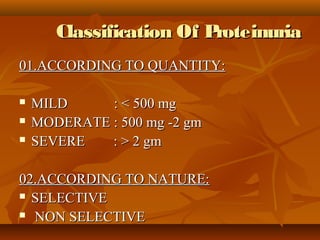
Classification Of Proteinuria
01.ACCORDING TO QUANTITY:

   MILD     : < 500 mg
   MODERATE : 500 mg -2 gm
   SEVERE   : > 2 gm

02.ACCORDING TO NATURE:
 SELECTIVE

 NON SELECTIVE
03.ACCORDING T SIT :
                O   E
            PATHOPHYSIOLOGIC
  TYPE                                 CAUSES
                  FEATURES
           Increased glomerular   Primary or
Glomerular capillary permeability secondary
           to proteins            glomerulopathy
           Decreased tubular         Tubular or
           resorbtion of proteins    interstitial disease
Tubular    in glomerular filterate   caused by drugs,
                                     hypertensive
                                     glomerulosclerosis
           Increased production      Monoclonal
Overflow   of low molecular          gammopahy,
           weight proteins           leukemia
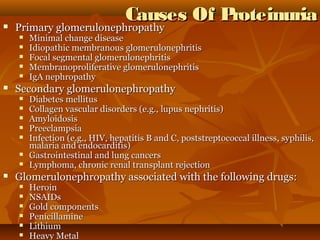
Causes Of Proteinuria
   Primary glomerulonephropathy
    Primary glomerulonephropathy
       Minimal change disease
       Idiopathic membranous glomerulonephritis
       Focal segmental glomerulonephritis
       Membranoproliferative glomerulonephritis
       IgA nephropathy
   Secondary glomerulonephropathy
       Diabetes mellitus
       Collagen vascular disorders (e.g., lupus nephritis)
       Amyloidosis
       Preeclampsia
       Infection (e.g., HIV, hepatitis B and C, poststreptococcal illness, syphilis,
        malaria and endocarditis)
       Gastrointestinal and lung cancers
       Lymphoma, chronic renal transplant rejection
   Glomerulonephropathy associated with the following drugs:
       Heroin
       NSAIDs
       Gold components
       Penicillamine
       Lithium
       Heavy Metal
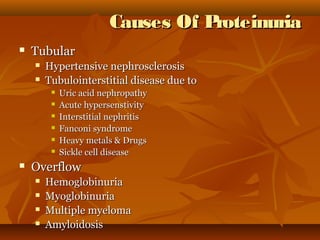
Causes Of Proteinuria
   Tubular
       Hypertensive nephrosclerosis
       Tubulointerstitial disease due to
            Uric acid nephropathy
            Acute hypersenstivity
            Interstitial nephritis
            Fanconi syndrome
            Heavy metals & Drugs
            Sickle cell disease
   Overflow
       Hemoglobinuria
       Myoglobinuria
       Multiple myeloma
       Amyloidosis
Selectivity of Proteinuria
   It is a relative glomerular selectivity for proteins,
    although it is of little significance
   It is the ratio of clearance of larger molecule with
    that of smaller i.e., IgG, IgM against that of
    albumin
       >20% to that of albumin, represents nonselective
        proteinuria
       <10%is highly selective
       10 %to 20% is of little discriminatory value
   This is of little importance ,except to distinguish
    between minimal change disease from other
    forms of nephritis or glomerular disease
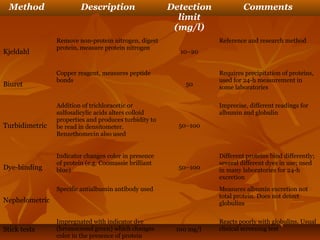
Method                 Description                    Detection            Comments
                                                         limit
                                                        (mg/l)
                Remove non-protein nitrogen, digest                Reference and research method
                protein, measure protein nitrogen
Kjeldahl                                                 10–20


                Copper reagent, measures peptide                   Requires precipitation of proteins,
                bonds                                              used for 24-h measurement in
Biuret                                                     50
                                                                   some laboratories

                Addition of trichloracetic or                      Imprecise, different readings for
                sulfosalicylic acids alters colloid                albumin and globulin
                properties and produces turbidity to
Turbidimetric   be read in densitometer.                 50–100
                Benzethomecin also used


                Indicator changes color in presence                Different proteins bind differently;
                of protein (e.g. Coomassie brilliant               several different dyes in use; used
Dye-binding     blue)                                    50–100    in many laboratories for 24-h
                                                                   excretion
                Specific antialbumin antibody used                 Measures albumin excretion not
                                                                   total protein. Does not detect
Nephelometric                                                      globulins

                Impregnated with indicator dye                     Reacts poorly with globulins. Usual
Stick tests     (bromocresol green) which changes       100 mg/l   clinical screening test
                color in the presence of protein
Detecting And Quantifying Proteinuria
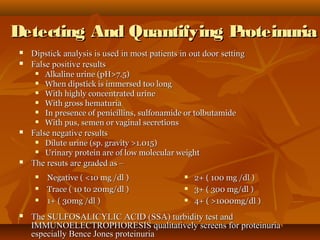
    Dipstick analysis is used in most patients in out door setting
    False positive results
         Alkaline urine (pH>7.5)
         When dipstick is immersed too long
         With highly concentrated urine
         With gross hematuria
         In presence of penicillins, sulfonamide or tolbutamide
         With pus, semen or vaginal secretions
    False negative results
         Dilute urine (sp. gravity >1.015)
         Urinary protein are of low molecular weight
    The resuts are graded as –
         Negative ( <10 mg /dl )                   2+ ( 100 mg /dl )
         Trace ( 10 to 20mg/dl )                   3+ ( 300 mg/dl )
         1+ ( 30mg /dl )                           4+ ( >1000mg/dl )
    The SULFOSALICYLIC ACID (SSA) turbidity test and
     IMMUNOELECTROPHORESIS qualitatively screens for proteinuria
     especially Bence Jones proteinuria
Detecting And Quantifying Proteinuria
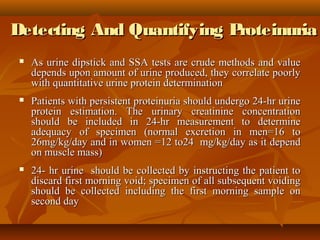
    As urine dipstick and SSA tests are crude methods and value
     depends upon amount of urine produced, they correlate poorly
     with quantitative urine protein determination
    Patients with persistent proteinuria should undergo 24-hr urine
     protein estimation. The urinary creatinine concentration
     should be included in 24-hr measurement to determine
     adequacy of specimen (normal excretion in men=16 to
     26mg/kg/day and in women =12 to24 mg/kg/day as it depend
     on muscle mass)
    24- hr urine should be collected by instructing the patient to
     discard first morning void; specimen of all subsequent voiding
     should be collected including the first morning sample on
     second day
Detecting And Quantifying Proteinuria
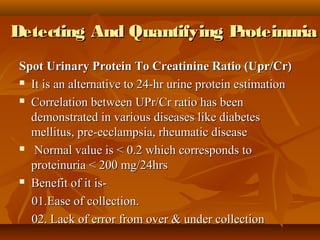
 Spot Urinary Protein To Creatinine Ratio (Upr/Cr)
  It is an alternative to 24-hr urine protein estimation

  Correlation between UPr/Cr ratio has been

   demonstrated in various diseases like diabetes
   mellitus, pre-ecclampsia, rheumatic disease
  Normal value is < 0.2 which corresponds to

   proteinuria < 200 mg/24hrs
  Benefit of it is-

   01.Ease of collection.
   02. Lack of error from over & under collection
Diagnostic Evaluation
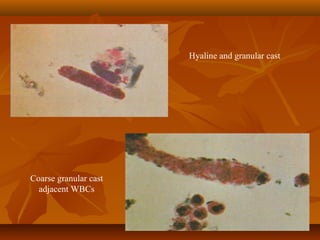
   When proteinuria is found on a dipstick analysis, the urinary sediment
    should be examined microscopically for-
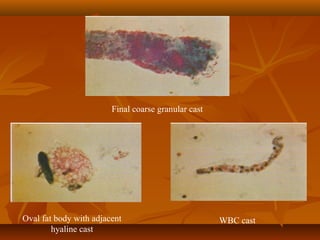
    Fatty casts, free fat or oval fat bodies      Nephrotic range proteinuria (>3.5 g /24
                                                  hours)
    Leukocytes, leukocyte casts with bacteria     Urinary tract infection
    Leukocytes, leukocyte casts without bacteria Renal interstitial disease
    Normal-shaped erythrocytes                    Suggestive of lower urinary tract lesion
    Dysmorphic erythrocytes                       Suggestive of upper urinary tract lesion
    Erythrocyte casts                             Glomerular disease
    Waxy, granular or cellular casts              Advanced chronic renal disease
    Eosinophiluria                                Drug-induced acute interstitial nephritis
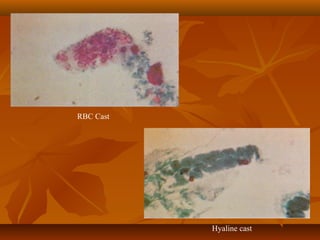
    Hyaline casts                                 No renal disease; present with dehydration
RBC Cast


           Hyaline cast
Hyaline and granular cast


Coarse granular cast
  adjacent WBCs
Final coarse granular cast


Oval fat body with adjacent                          WBC cast
        hyaline cast
Transient Proteinuria
   If results of microscopic analysis are
    inconclusive and the dipstick analysis shows
    trace to 2+protein, the dipstick test should be
    repeated on morning specimen at least twice
    during next month
   If subsequent dipstick test are negative the
    patient has transient proteinuria
   It is not associated with increased mortality or
    morbidity,and specific follow-up is not required
Persistent Proteinuria
   When diagnosis of persistent proteinuria is established, a
    detailed history and physical examination should be
    performed, looking for systemic disease with renal
    involvement
   A medication history is important
   A 24-hr urine protein or a UPr/Cr ratio on random urine
    sample should be obtained
   An adult with proteinuria >2gm /24 hr requires
    aggressive work up
   If creatinine clearance is normal and if diagnosis is clear
    as diabetes or uncompensated CHF, treat underlying
    medical condition with regular follow up
   If there is decreased creatinine clearance or an unclear
    cause, further investigations should be done in
    consultation with nephrologist
Orthostatic Proteinuria
   Persons younger than 30 yrs who excrete
    <2gm of protein /day with normal
    creatinine clearance should be tested for
    orthostatic or postural proteinuria
   This benign condition occur in 3 to 5 %of
    adolescent and young adults, it is
    characterized by increased protein excretion
    in upright position but normal excretion in
    supine
   Diagnosis is made by split urine specimen
    collection
Orthostatic Proteinuria
   The first morning void is discarded , a 16 hr daytime
    specimen is obtained with patient performing
    normal activities and finishing the collection by
    voiding before bed time, an overnight 8 hr.
    specimen is then collected
   The day time specimen typically has an increased
    concentration of protein, while night time specimen
    has having normal concentration
   It is a benign condition associated with normal renal
    function after as long as 20 to 50 yrs of follow up
   Annual       blood    pressure     measurement      is
    recommended in these patients
Isolated Proteinuria
   A proteinuric patient with normal renal function,
    no evidence of systemic disease, normal urinary
    sediments and normal blood pressure is considered
    to have isolated proteinuria
   Protein excretion is usually <2 gm/day
   20%of these patients have risk for renal
    insufficiency after 10years and should be followed
    with blood pressure measurement, urinalysis and
    creatinine clearance every 6 month
   Isolated proteinuria with excretion >2 gm /day
    usually signifies glomerular disease and needs
    further evaluation.
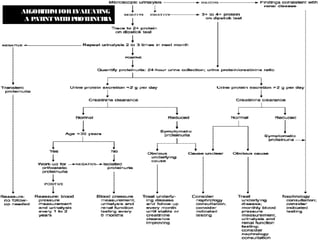
ALGORIT M FOR E
       H       VALUATING
 A P INT W H P
    AT    IT ROT INURIA
                  E
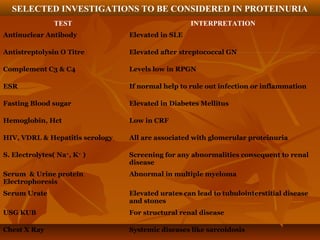
SELECTED INVESTIGATIONS TO BE CONSIDERED IN PROTEINURIA
                TEST                               INTERPRETATION
Antinuclear Antibody             Elevated in SLE

Antistreptolysin O Titre         Elevated after streptococcal GN

Complement C3 & C4               Levels low in RPGN

ESR                              If normal help to rule out infection or inflammation

Fasting Blood sugar              Elevated in Diabetes Mellitus

Hemoglobin, Hct                  Low in CRF

HIV, VDRL & Hepatitis serology   All are associated with glomerular proteinuria

S. Electrolytes( Na+, K+ )       Screening for any abnormalities consequent to renal
                                 disease
Serum & Urine protein            Abnormal in multiple myeloma
Electrophoresis
Serum Urate                      Elevated urates can lead to tubulointerstitial disease
                                 and stones
USG KUB                          For structural renal disease

Chest X Ray                      Systemic diseases like sarcoidosis
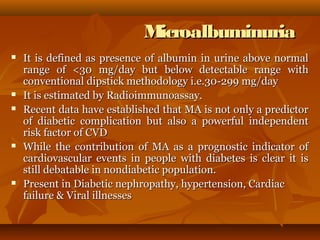
Microalbuminuria
   It is defined as presence of albumin in urine above normal
    range of <30 mg/day but below detectable range with
    conventional dipstick methodology i.e.30-299 mg/day
   It is estimated by Radioimmunoassay.
   Recent data have established that MA is not only a predictor
    of diabetic complication but also a powerful independent
    risk factor of CVD
   While the contribution of MA as a prognostic indicator of
    cardiovascular events in people with diabetes is clear it is
    still debatable in nondiabetic population.
   Present in Diabetic nephropathy, hypertension, Cardiac
    failure & Viral illnesses
FINAL COM E
                        M NT
A systematic approach to the patient
with proteinuria will allow the
clinician to efficiently distinguish
between benign and pathological
causes.
T ANK YOU
 H

Proteinuria how to approach final

  • 1.
    Proteinuria- H TApproach? ow o Dr. Sachin Verma MD, FICM, FCCS, ICFC Fellowship in Intensive Care Medicine Infection Control Fellows Course Consultant Internal Medicine and Critical Care Web:- http://www.medicinedoctorinchandigarh.com Mob:- +91-7508677495 References: 1. Brenner’s & Rector’s The Kidney 7th Ed. 2. Harrison’s Internal Medicine 17th Ed. 3. Oxford Textbook Of Clinical Nephrology 4. Internet
  • 2.
    Problem Statement  Proteinuria is a common finding in at least 17% adults in general practice, in routine dip stick screening  Fewer than 2% of patients whose urine dipstick is positive for protein have serious and treatable urinary tract disorders
  • 3.
    Definition  240 years ago, Hippocrates noted the association between “Bubbles on surface of urine” and kidney disease  Proteinuria is defined as protein excretion >150mg/day.  Most of the positive dip stick test results are due to benign proteinuria, which has no associated morbidity and mortality
  • 4.
    Causes of BenignProteinuria  Dehydration  Emotional stress  Fever  Heat injury  Intense physical activity  Most acute illnesses  Orthostatic (postural )disorder
  • 5.
    Composition Of UrinaryProtein 70 mg/d 35 mg/d 15 mg/d 10 mg/d 15 mg/d 5 mg/d Tamm Horsfall Protein Blood Group Related Antigens Albumin Mucopolysaccarides Hormones and Enzymes Immunoglobulins
  • 6.
    Mechanism of Proteinuria  FILTRATION OF BLOOD OCCURS IN GLOMERULUS  GLOMERULAR FILTRATION BARRIER CONSISTS OF: 1. Capillary Endothelium 2.Glomerular Basement Membrane 3.Visceral Epithelium with foot processes forms slit diaphragm  GLOMERULAR FILTRATION BARRIER IS SIZE & CHARGE DEPANDENT  CHARGE IS ACCOUNTED BY :- Negative charge heparan sulfate present in GBM :- Sialoglycoprotein of epithelium & Endothelium cell
  • 7.
    Mechanism of Proteinuria  SIZE BARRIER IS ACCOUNTED BY: Slit diphragm made up of podocytes of visceral epithelium. Hence structure which is negatively charged and large size is restricted by GFB
  • 8.
    Classification Of Proteinuria 01.ACCORDINGTO QUANTITY:  MILD : < 500 mg  MODERATE : 500 mg -2 gm  SEVERE : > 2 gm 02.ACCORDING TO NATURE:  SELECTIVE  NON SELECTIVE
  • 9.
    03.ACCORDING T SIT: O E PATHOPHYSIOLOGIC TYPE CAUSES FEATURES Increased glomerular Primary or Glomerular capillary permeability secondary to proteins glomerulopathy Decreased tubular Tubular or resorbtion of proteins interstitial disease Tubular in glomerular filterate caused by drugs, hypertensive glomerulosclerosis Increased production Monoclonal Overflow of low molecular gammopahy, weight proteins leukemia
  • 10.
    Causes Of Proteinuria  Primary glomerulonephropathy Primary glomerulonephropathy  Minimal change disease  Idiopathic membranous glomerulonephritis  Focal segmental glomerulonephritis  Membranoproliferative glomerulonephritis  IgA nephropathy  Secondary glomerulonephropathy  Diabetes mellitus  Collagen vascular disorders (e.g., lupus nephritis)  Amyloidosis  Preeclampsia  Infection (e.g., HIV, hepatitis B and C, poststreptococcal illness, syphilis, malaria and endocarditis)  Gastrointestinal and lung cancers  Lymphoma, chronic renal transplant rejection  Glomerulonephropathy associated with the following drugs:  Heroin  NSAIDs  Gold components  Penicillamine  Lithium  Heavy Metal
  • 11.
    Causes Of Proteinuria  Tubular  Hypertensive nephrosclerosis  Tubulointerstitial disease due to  Uric acid nephropathy  Acute hypersenstivity  Interstitial nephritis  Fanconi syndrome  Heavy metals & Drugs  Sickle cell disease  Overflow  Hemoglobinuria  Myoglobinuria  Multiple myeloma  Amyloidosis
  • 12.
    Selectivity of Proteinuria  It is a relative glomerular selectivity for proteins, although it is of little significance  It is the ratio of clearance of larger molecule with that of smaller i.e., IgG, IgM against that of albumin  >20% to that of albumin, represents nonselective proteinuria  <10%is highly selective  10 %to 20% is of little discriminatory value  This is of little importance ,except to distinguish between minimal change disease from other forms of nephritis or glomerular disease
  • 13.
    Method Description Detection Comments limit (mg/l) Remove non-protein nitrogen, digest Reference and research method protein, measure protein nitrogen Kjeldahl 10–20 Copper reagent, measures peptide Requires precipitation of proteins, bonds used for 24-h measurement in Biuret 50 some laboratories Addition of trichloracetic or Imprecise, different readings for sulfosalicylic acids alters colloid albumin and globulin properties and produces turbidity to Turbidimetric be read in densitometer. 50–100 Benzethomecin also used Indicator changes color in presence Different proteins bind differently; of protein (e.g. Coomassie brilliant several different dyes in use; used Dye-binding blue) 50–100 in many laboratories for 24-h excretion Specific antialbumin antibody used Measures albumin excretion not total protein. Does not detect Nephelometric globulins Impregnated with indicator dye Reacts poorly with globulins. Usual Stick tests (bromocresol green) which changes 100 mg/l clinical screening test color in the presence of protein
  • 14.
    Detecting And QuantifyingProteinuria  Dipstick analysis is used in most patients in out door setting  False positive results  Alkaline urine (pH>7.5)  When dipstick is immersed too long  With highly concentrated urine  With gross hematuria  In presence of penicillins, sulfonamide or tolbutamide  With pus, semen or vaginal secretions  False negative results  Dilute urine (sp. gravity >1.015)  Urinary protein are of low molecular weight  The resuts are graded as –  Negative ( <10 mg /dl )  2+ ( 100 mg /dl )  Trace ( 10 to 20mg/dl )  3+ ( 300 mg/dl )  1+ ( 30mg /dl )  4+ ( >1000mg/dl )  The SULFOSALICYLIC ACID (SSA) turbidity test and IMMUNOELECTROPHORESIS qualitatively screens for proteinuria especially Bence Jones proteinuria
  • 15.
    Detecting And QuantifyingProteinuria  As urine dipstick and SSA tests are crude methods and value depends upon amount of urine produced, they correlate poorly with quantitative urine protein determination  Patients with persistent proteinuria should undergo 24-hr urine protein estimation. The urinary creatinine concentration should be included in 24-hr measurement to determine adequacy of specimen (normal excretion in men=16 to 26mg/kg/day and in women =12 to24 mg/kg/day as it depend on muscle mass)  24- hr urine should be collected by instructing the patient to discard first morning void; specimen of all subsequent voiding should be collected including the first morning sample on second day
  • 16.
    Detecting And QuantifyingProteinuria Spot Urinary Protein To Creatinine Ratio (Upr/Cr)  It is an alternative to 24-hr urine protein estimation  Correlation between UPr/Cr ratio has been demonstrated in various diseases like diabetes mellitus, pre-ecclampsia, rheumatic disease  Normal value is < 0.2 which corresponds to proteinuria < 200 mg/24hrs  Benefit of it is- 01.Ease of collection. 02. Lack of error from over & under collection
  • 17.
    Diagnostic Evaluation  When proteinuria is found on a dipstick analysis, the urinary sediment should be examined microscopically for- Fatty casts, free fat or oval fat bodies Nephrotic range proteinuria (>3.5 g /24 hours) Leukocytes, leukocyte casts with bacteria Urinary tract infection Leukocytes, leukocyte casts without bacteria Renal interstitial disease Normal-shaped erythrocytes Suggestive of lower urinary tract lesion Dysmorphic erythrocytes Suggestive of upper urinary tract lesion Erythrocyte casts Glomerular disease Waxy, granular or cellular casts Advanced chronic renal disease Eosinophiluria Drug-induced acute interstitial nephritis Hyaline casts No renal disease; present with dehydration
  • 18.
    RBC Cast Hyaline cast
  • 19.
    Hyaline and granularcast Coarse granular cast adjacent WBCs
  • 20.
    Final coarse granularcast Oval fat body with adjacent WBC cast hyaline cast
  • 21.
    Transient Proteinuria  If results of microscopic analysis are inconclusive and the dipstick analysis shows trace to 2+protein, the dipstick test should be repeated on morning specimen at least twice during next month  If subsequent dipstick test are negative the patient has transient proteinuria  It is not associated with increased mortality or morbidity,and specific follow-up is not required
  • 22.
    Persistent Proteinuria  When diagnosis of persistent proteinuria is established, a detailed history and physical examination should be performed, looking for systemic disease with renal involvement  A medication history is important  A 24-hr urine protein or a UPr/Cr ratio on random urine sample should be obtained  An adult with proteinuria >2gm /24 hr requires aggressive work up  If creatinine clearance is normal and if diagnosis is clear as diabetes or uncompensated CHF, treat underlying medical condition with regular follow up  If there is decreased creatinine clearance or an unclear cause, further investigations should be done in consultation with nephrologist
  • 23.
    Orthostatic Proteinuria  Persons younger than 30 yrs who excrete <2gm of protein /day with normal creatinine clearance should be tested for orthostatic or postural proteinuria  This benign condition occur in 3 to 5 %of adolescent and young adults, it is characterized by increased protein excretion in upright position but normal excretion in supine  Diagnosis is made by split urine specimen collection
  • 24.
    Orthostatic Proteinuria  The first morning void is discarded , a 16 hr daytime specimen is obtained with patient performing normal activities and finishing the collection by voiding before bed time, an overnight 8 hr. specimen is then collected  The day time specimen typically has an increased concentration of protein, while night time specimen has having normal concentration  It is a benign condition associated with normal renal function after as long as 20 to 50 yrs of follow up  Annual blood pressure measurement is recommended in these patients
  • 25.
    Isolated Proteinuria  A proteinuric patient with normal renal function, no evidence of systemic disease, normal urinary sediments and normal blood pressure is considered to have isolated proteinuria  Protein excretion is usually <2 gm/day  20%of these patients have risk for renal insufficiency after 10years and should be followed with blood pressure measurement, urinalysis and creatinine clearance every 6 month  Isolated proteinuria with excretion >2 gm /day usually signifies glomerular disease and needs further evaluation.
  • 26.
    ALGORIT M FORE H VALUATING A P INT W H P AT IT ROT INURIA E
  • 27.
    SELECTED INVESTIGATIONS TOBE CONSIDERED IN PROTEINURIA TEST INTERPRETATION Antinuclear Antibody Elevated in SLE Antistreptolysin O Titre Elevated after streptococcal GN Complement C3 & C4 Levels low in RPGN ESR If normal help to rule out infection or inflammation Fasting Blood sugar Elevated in Diabetes Mellitus Hemoglobin, Hct Low in CRF HIV, VDRL & Hepatitis serology All are associated with glomerular proteinuria S. Electrolytes( Na+, K+ ) Screening for any abnormalities consequent to renal disease Serum & Urine protein Abnormal in multiple myeloma Electrophoresis Serum Urate Elevated urates can lead to tubulointerstitial disease and stones USG KUB For structural renal disease Chest X Ray Systemic diseases like sarcoidosis
  • 28.
    Microalbuminuria  It is defined as presence of albumin in urine above normal range of <30 mg/day but below detectable range with conventional dipstick methodology i.e.30-299 mg/day  It is estimated by Radioimmunoassay.  Recent data have established that MA is not only a predictor of diabetic complication but also a powerful independent risk factor of CVD  While the contribution of MA as a prognostic indicator of cardiovascular events in people with diabetes is clear it is still debatable in nondiabetic population.  Present in Diabetic nephropathy, hypertension, Cardiac failure & Viral illnesses
  • 29.
    FINAL COM E M NT A systematic approach to the patient with proteinuria will allow the clinician to efficiently distinguish between benign and pathological causes.
  • 30.