

SLE Update 2022
SLE Update 2022
Dr. M.Salah Eldin Abdel Baky
Prof. of Internal Medicine & Rheumatology
Ain Shams University
Disclosures
Speaker or advisory board member or clinical trials PI for:
• Abbvie
• Amgen
• Janssen
• Novartis
• Lilly
• Pfizer
• Organon
• Roche
 Antonis Fanouriakis et al. Ann Rheum Dis 2021;80:14-25
 SIPPL N et al. Clin Exp Immunol 2021; 205: 44-52
 van Vollenhoven RF, et al. Lupus Science & Medicine 2021;8:e000538. doi:10.1136/lupus-
2021-000538
 DIETZ B et al. Arthritis Care Res (Hoboken) 2021; 73: 48- 54.
 TSELIOS K, GLADMAN DD, SU J, UROWITZ MB: ACR Open Rheumatol 2021; 3: 550-7
 C. Arriens et al.Ann Rheum Dis, volume 79, supplement 1, year 2020, page 172. OP0277
 Furie R, Rovin BH, Houssiau F, et al. N Engl J Med 2020; 383:1117
 TAKEUCHI T, WAKASUGI N, UNO S, MAKINO H: J Rheumatol 2021; 48: 74-81.
 SHIPA M, EMBLETON-THIRSK A, PARVAZ M et al. Ann Intern Med 2021; 174: 1647-57.
 Eric F. Morand, M.B.,et al.N Engl J Med 2020; 382:211-221
 SAKTHISWARY R et al: COVID-19 in systemic lupus erythematosus: Lupus 2021; 30: 1946
Evidence-based medicine key references
4
Objective
Our objective is to describe the
most relevant data on SLE that
emerged during the past year
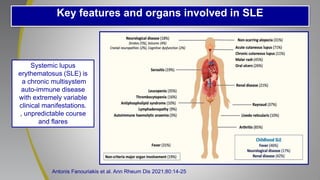
Key features and organs involved in SLE
Antonis Fanouriakis et al. Ann Rheum Dis 2021;80:14-25
Systemic lupus
erythematosus (SLE) is
a chronic multisystem
auto-immune disease
with extremely variable
clinical manifestations.
, unpredictable course
and flares
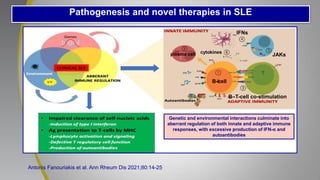
Pathogenesis and novel therapies in SLE
Antonis Fanouriakis et al. Ann Rheum Dis 2021;80:14-25
Genetic and environmental interactions culminate into
aberrant regulation of both innate and adaptive immune
responses, with excessive production of IFN-α and
autoantibodies
B-cell
plasma cell
B–T-cell co-stimulation
IFNs
JAKs
cytokines
Pathogenesis
 Female predominance is poorly understood, suggesting the presence of
hormonal or X-linked genetic factors.
 New evidences suggest that sex-bias in SLE is likely related to epigenetically-
induced modifications in X linked immunity genes expression, especially in
B cells-driven autoimmunity
YU B, QI Y. et al Cell 2021; 184: 1790-803 e17
 The T helper 17 (Th17) pathway has been implicated in several aspects of
SLE disease pathogenesis including lupus arthritis, related cytokines, such as
IL-8 and IL-21 may become a potential therapeutic target in SLE
SIPPL N et al. Clin Exp Immunol 2021; 205: 44-52.
 IL-18 is confirmed to have a recognised role in SLE disease progression
and activity. XIANG M et al. Sci Rep 2021; 11: 4707
Treat-to-target and remission
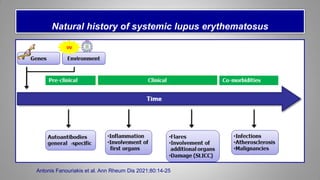
Natural history of systemic lupus erythematosus
Antonis Fanouriakis et al. Ann Rheum Dis 2021;80:14-25
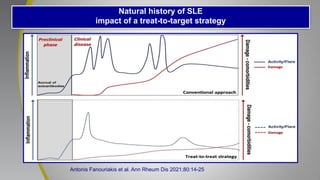
Natural history of SLE
impact of a treat-to-target strategy
Antonis Fanouriakis et al. Ann Rheum Dis 2021;80:14-25
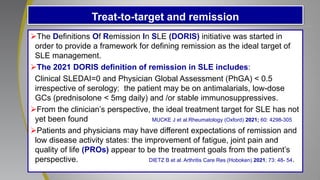
Treat-to-target and remission
The Definitions Of Remission In SLE (DORIS) initiative was started in
order to provide a framework for defining remission as the ideal target of
SLE management.
The 2021 DORIS definition of remission in SLE includes:
Clinical SLEDAI=0 and Physician Global Assessment (PhGA) < 0.5
irrespective of serology; the patient may be on antimalarials, low-dose
GCs (prednisolone < 5mg daily) and /or stable immunosuppressives.
From the clinician’s perspective, the ideal treatment target for SLE has not
yet been found MUCKE J et al.Rheumatology (Oxford) 2021; 60: 4298-305
Patients and physicians may have different expectations of remission and
low disease activity states: the improvement of fatigue, joint pain and
quality of life (PROs) appear to be the treatment goals from the patient’s
perspective. DIETZ B et al. Arthritis Care Res (Hoboken) 2021; 73: 48- 54.
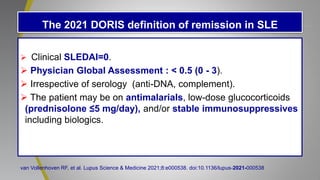
The 2021 DORIS definition of remission in SLE
 Clinical SLEDAI=0.
 Physician Global Assessment : < 0.5 (0 - 3).
 Irrespective of serology (anti-DNA, complement).
 The patient may be on antimalarials, low-dose glucocorticoids
(prednisolone ≤5 mg/day), and/or stable immunosuppressives
including biologics.
van Vollenhoven RF, et al. Lupus Science & Medicine 2021;8:e000538. doi:10.1136/lupus-2021-000538
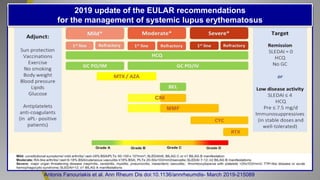
Antonis Fanouriakis et al. Ann Rheum Dis doi:10.1136/annrheumdis- March 2019-215089
2019 update of the EULAR recommendations
for the management of systemic lupus erythematosus
New therapies and therapeutic
strategies
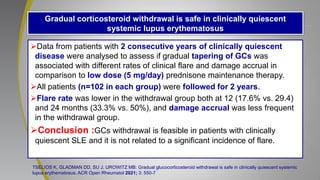
Gradual corticosteroid withdrawal is safe in clinically quiescent
systemic lupus erythematosus
Data from patients with 2 consecutive years of clinically quiescent
disease were analysed to assess if gradual tapering of GCs was
associated with different rates of clinical flare and damage accrual in
comparison to low dose (5 mg/day) prednisone maintenance therapy.
All patients (n=102 in each group) were followed for 2 years.
Flare rate was lower in the withdrawal group both at 12 (17.6% vs. 29.4)
and 24 months (33.3% vs. 50%), and damage accrual was less frequent
in the withdrawal group.
Conclusion :GCs withdrawal is feasible in patients with clinically
quiescent SLE and it is not related to a significant incidence of flare.
TSELIOS K, GLADMAN DD, SU J, UROWITZ MB: Gradual glucocorticosteroid withdrawal is safe in clinically quiescent systemic
lupus erythematosus. ACR Open Rheumatol 2021; 3: 550-7
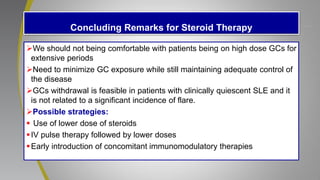
Concluding Remarks for Steroid Therapy
We should not being comfortable with patients being on high dose GCs for
extensive periods
Need to minimize GC exposure while still maintaining adequate control of
the disease
GCs withdrawal is feasible in patients with clinically quiescent SLE and it
is not related to a significant incidence of flare.
Possible strategies:
 Use of lower dose of steroids
IV pulse therapy followed by lower doses
Early introduction of concomitant immunomodulatory therapies
Lupkynis (voclosporin)
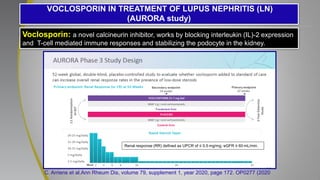
C. Arriens et al.Ann Rheum Dis, volume 79, supplement 1, year 2020, page 172. OP0277 (2020
VOCLOSPORIN IN TREATMENT OF LUPUS NEPHRITIS (LN)
(AURORA study)
Voclosporin: a novel calcineurin inhibitor, works by blocking interleukin (IL)-2 expression
and T-cell mediated immune responses and stabilizing the podocyte in the kidney.
Renal response (RR) defined as UPCR of ≤ 0.5 mg/mg, eGFR ≥ 60 mL/min.
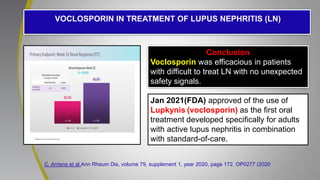
C. Arriens et al.Ann Rheum Dis, volume 79, supplement 1, year 2020, page 172. OP0277 (2020
.
VOCLOSPORIN IN TREATMENT OF LUPUS NEPHRITIS (LN)
Conclusion
Voclosporin was efficacious in patients
with difficult to treat LN with no unexpected
safety signals.
Jan 2021(FDA) approved of the use of
Lupkynis (voclosporin) as the first oral
treatment developed specifically for adults
with active lupus nephritis in combination
with standard-of-care.
BENLYSTA (belimumab)
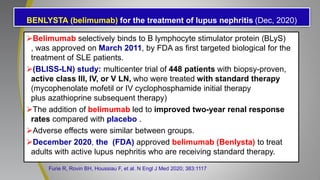
BENLYSTA (belimumab) for the treatment of lupus nephritis (Dec, 2020)
Belimumab selectively binds to B lymphocyte stimulator protein (BLyS)
, was approved on March 2011, by FDA as first targeted biological for the
treatment of SLE patients.
(BLISS-LN) study: multicenter trial of 448 patients with biopsy-proven,
active class III, IV, or V LN, who were treated with standard therapy
(mycophenolate mofetil or IV cyclophosphamide initial therapy
plus azathioprine subsequent therapy)
The addition of belimumab led to improved two-year renal response
rates compared with placebo .
Adverse effects were similar between groups.
December 2020, the (FDA) approved belimumab (Benlysta) to treat
adults with active lupus nephritis who are receiving standard therapy.
Furie R, Rovin BH, Houssiau F, et al. N Engl J Med 2020; 383:1117
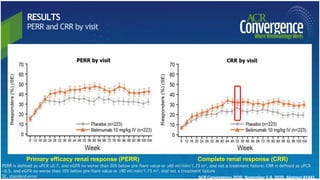
ACR Convergence 2020, November 5-9, 2020. Abstract #1441.
Primary efficacy renal response (PERR) Complete renal response (CRR)
Great Debate
Belimumab vs Voclosporin
Michelle Petri MD MPH
Johns Hopkins University School of Medicine
Brad H. Rovin MD
The Ohio State University Division of Nephrology
Belimumab
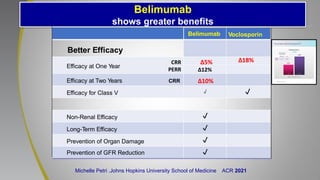
shows greater benefits
Belimumab Voclosporin
Better Efficacy
Efficacy at One Year
Δ5%
Δ12%
Δ18%
Efficacy at Two Years CRR Δ10%
Efficacy for Class V
Non-Renal Efficacy
Long-Term Efficacy
Prevention of Organ Damage
Prevention of GFR Reduction
CRR
PERR
Michelle Petri .Johns Hopkins University School of Medicine ACR 2021
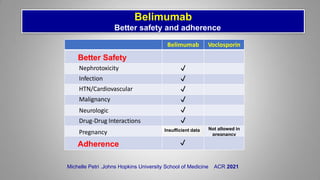
Not allowed in
pregnancy
Belimumab Voclosporin
Better Safety
Nephrotoxicity
Infection
HTN/Cardiovascular
Malignancy
Neurologic
Drug-Drug Interactions
Pregnancy
Adherence
Belimumab
Better safety and adherence
Michelle Petri .Johns Hopkins University School of Medicine ACR 2021
Insufficient data
Voclosporin
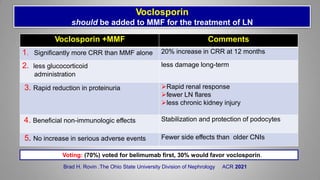
should be added to MMF for the treatment of LN
Voclosporin +MMF Comments
1. Significantly more CRR than MMF alone 20% increase in CRR at 12 months
2. less glucocorticoid
administration
less damage long-term
3. Rapid reduction in proteinuria Rapid renal response
fewer LN flares
less chronic kidney injury
4. Beneficial non-immunologic effects Stabilization and protection of podocytes
5. No increase in serious adverse events Fewer side effects than older CNIs
Brad H. Rovin .The Ohio State University Division of Nephrology ACR 2021
Voting: (70%) voted for belimumab first, 30% would favor voclosporin.
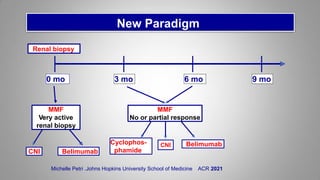
New Paradigm
0 mo 3 mo 6 mo 9 mo
MMF
Very active
renal biopsy
Renal biopsy
MMF
No or partial response
CNI
Cyclophos-
phamide
Belimumab
Belimumab
CNI
Michelle Petri .Johns Hopkins University School of Medicine ACR 2021
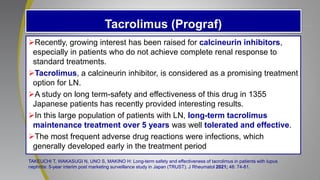
Tacrolimus (Prograf)
Recently, growing interest has been raised for calcineurin inhibitors,
especially in patients who do not achieve complete renal response to
standard treatments.
Tacrolimus, a calcineurin inhibitor, is considered as a promising treatment
option for LN.
A study on long term-safety and effectiveness of this drug in 1355
Japanese patients has recently provided interesting results.
In this large population of patients with LN, long-term tacrolimus
maintenance treatment over 5 years was well tolerated and effective.
The most frequent adverse drug reactions were infections, which
generally developed early in the treatment period
TAKEUCHI T, WAKASUGI N, UNO S, MAKINO H: Long-term safety and effectiveness of tacrolimus in patients with lupus
nephritis: 5-year interim post marketing surveillance study in Japan (TRUST). J Rheumatol 2021; 48: 74-81.
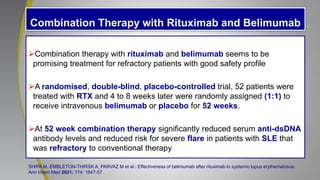
Combination Therapy with Rituximab and Belimumab
Combination therapy with rituximab and belimumab seems to be
promising treatment for refractory patients with good safety profile
A randomised, double-blind, placebo-controlled trial, 52 patients were
treated with RTX and 4 to 8 weeks later were randomly assigned (1:1) to
receive intravenous belimumab or placebo for 52 weeks.
At 52 week combination therapy significantly reduced serum anti-dsDNA
antibody levels and reduced risk for severe flare in patients with SLE that
was refractory to conventional therapy
SHIPA M, EMBLETON-THIRSK A, PARVAZ M et al.: Effectiveness of belimumab after rituximab in systemic lupus erythematosus.
Ann Intern Med 2021; 174: 1647-57.
Saphnelo (anifrolumab)
Saphnelo (anifrolumab) for SLE
The FDA Aug, 2021 has approved Saphnelo (anifrolumab) for adults with
moderate to severe (SLE) who are receiving standard therapy.
Anifrolumab, a human monoclonal antibody, binds to the type I IFN
receptor and blocks the biologic activity of type I IFN
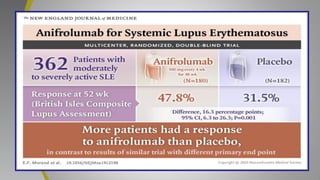
The approval was based on data from three 52-week, multicenter,
randomized, double-blind, placebo controlled studies TULIP-1 and TULIP-2,
which evaluated the efficacy and safety of anifrolumab in adults with
moderate to severe SLE.
The frequency of herpes zoster was higher with anifrolumab than with
placebo
Saphnelo is supplied as a 2mL single-dose vial containing 300 mg via IV
infusion every 4 weeks
Eric F. Morand, M.B.,et al.N Engl J Med 2020; 382:211-221
SLE and COVID-19
 In SLE patients with COVID-19 only lupus nephritis resulted as a predictor
of severe to critical COVID19.
 None of the medications used to treat SLE was significantly associated
with the severity of the COVID-19 infection.
 Most patients with SLE and confirmed COVID-19 were able to produce and
maintain a serological response despite the use immunosuppressants.
COVID-19 vaccination seems to be well tolerated in SLE patients.
SAKTHISWARY R et al: COVID-19 in systemic lupus erythematosus: Lupus 2021; 30: 1946
FELTEN R et al.: Tolerance of COVID-19 vaccination in patients with systemic lupus erythematosus. Lancet
Rheumatol 2021; 3: e613-
SLE Updates M Salah 2022.pdf

SLE Updates M Salah 2022.pdf

  • 1.
    SLE Update 2022 SLEUpdate 2022 Dr. M.Salah Eldin Abdel Baky Prof. of Internal Medicine & Rheumatology Ain Shams University
  • 2.
    Disclosures Speaker or advisoryboard member or clinical trials PI for: • Abbvie • Amgen • Janssen • Novartis • Lilly • Pfizer • Organon • Roche
  • 3.
     Antonis Fanouriakiset al. Ann Rheum Dis 2021;80:14-25  SIPPL N et al. Clin Exp Immunol 2021; 205: 44-52  van Vollenhoven RF, et al. Lupus Science & Medicine 2021;8:e000538. doi:10.1136/lupus- 2021-000538  DIETZ B et al. Arthritis Care Res (Hoboken) 2021; 73: 48- 54.  TSELIOS K, GLADMAN DD, SU J, UROWITZ MB: ACR Open Rheumatol 2021; 3: 550-7  C. Arriens et al.Ann Rheum Dis, volume 79, supplement 1, year 2020, page 172. OP0277  Furie R, Rovin BH, Houssiau F, et al. N Engl J Med 2020; 383:1117  TAKEUCHI T, WAKASUGI N, UNO S, MAKINO H: J Rheumatol 2021; 48: 74-81.  SHIPA M, EMBLETON-THIRSK A, PARVAZ M et al. Ann Intern Med 2021; 174: 1647-57.  Eric F. Morand, M.B.,et al.N Engl J Med 2020; 382:211-221  SAKTHISWARY R et al: COVID-19 in systemic lupus erythematosus: Lupus 2021; 30: 1946 Evidence-based medicine key references
  • 4.
    4 Objective Our objective isto describe the most relevant data on SLE that emerged during the past year
  • 5.
    Key features andorgans involved in SLE Antonis Fanouriakis et al. Ann Rheum Dis 2021;80:14-25 Systemic lupus erythematosus (SLE) is a chronic multisystem auto-immune disease with extremely variable clinical manifestations. , unpredictable course and flares
  • 6.
    Pathogenesis and noveltherapies in SLE Antonis Fanouriakis et al. Ann Rheum Dis 2021;80:14-25 Genetic and environmental interactions culminate into aberrant regulation of both innate and adaptive immune responses, with excessive production of IFN-α and autoantibodies B-cell plasma cell B–T-cell co-stimulation IFNs JAKs cytokines
  • 7.
    Pathogenesis  Female predominanceis poorly understood, suggesting the presence of hormonal or X-linked genetic factors.  New evidences suggest that sex-bias in SLE is likely related to epigenetically- induced modifications in X linked immunity genes expression, especially in B cells-driven autoimmunity YU B, QI Y. et al Cell 2021; 184: 1790-803 e17  The T helper 17 (Th17) pathway has been implicated in several aspects of SLE disease pathogenesis including lupus arthritis, related cytokines, such as IL-8 and IL-21 may become a potential therapeutic target in SLE SIPPL N et al. Clin Exp Immunol 2021; 205: 44-52.  IL-18 is confirmed to have a recognised role in SLE disease progression and activity. XIANG M et al. Sci Rep 2021; 11: 4707
  • 8.
  • 9.
    Natural history ofsystemic lupus erythematosus Antonis Fanouriakis et al. Ann Rheum Dis 2021;80:14-25
  • 10.
    Natural history ofSLE impact of a treat-to-target strategy Antonis Fanouriakis et al. Ann Rheum Dis 2021;80:14-25
  • 11.
    Treat-to-target and remission TheDefinitions Of Remission In SLE (DORIS) initiative was started in order to provide a framework for defining remission as the ideal target of SLE management. The 2021 DORIS definition of remission in SLE includes: Clinical SLEDAI=0 and Physician Global Assessment (PhGA) < 0.5 irrespective of serology; the patient may be on antimalarials, low-dose GCs (prednisolone < 5mg daily) and /or stable immunosuppressives. From the clinician’s perspective, the ideal treatment target for SLE has not yet been found MUCKE J et al.Rheumatology (Oxford) 2021; 60: 4298-305 Patients and physicians may have different expectations of remission and low disease activity states: the improvement of fatigue, joint pain and quality of life (PROs) appear to be the treatment goals from the patient’s perspective. DIETZ B et al. Arthritis Care Res (Hoboken) 2021; 73: 48- 54.
  • 12.
    The 2021 DORISdefinition of remission in SLE  Clinical SLEDAI=0.  Physician Global Assessment : < 0.5 (0 - 3).  Irrespective of serology (anti-DNA, complement).  The patient may be on antimalarials, low-dose glucocorticoids (prednisolone ≤5 mg/day), and/or stable immunosuppressives including biologics. van Vollenhoven RF, et al. Lupus Science & Medicine 2021;8:e000538. doi:10.1136/lupus-2021-000538
  • 13.
    Antonis Fanouriakis etal. Ann Rheum Dis doi:10.1136/annrheumdis- March 2019-215089 2019 update of the EULAR recommendations for the management of systemic lupus erythematosus
  • 14.
    New therapies andtherapeutic strategies
  • 15.
    Gradual corticosteroid withdrawalis safe in clinically quiescent systemic lupus erythematosus Data from patients with 2 consecutive years of clinically quiescent disease were analysed to assess if gradual tapering of GCs was associated with different rates of clinical flare and damage accrual in comparison to low dose (5 mg/day) prednisone maintenance therapy. All patients (n=102 in each group) were followed for 2 years. Flare rate was lower in the withdrawal group both at 12 (17.6% vs. 29.4) and 24 months (33.3% vs. 50%), and damage accrual was less frequent in the withdrawal group. Conclusion :GCs withdrawal is feasible in patients with clinically quiescent SLE and it is not related to a significant incidence of flare. TSELIOS K, GLADMAN DD, SU J, UROWITZ MB: Gradual glucocorticosteroid withdrawal is safe in clinically quiescent systemic lupus erythematosus. ACR Open Rheumatol 2021; 3: 550-7
  • 16.
    Concluding Remarks forSteroid Therapy We should not being comfortable with patients being on high dose GCs for extensive periods Need to minimize GC exposure while still maintaining adequate control of the disease GCs withdrawal is feasible in patients with clinically quiescent SLE and it is not related to a significant incidence of flare. Possible strategies:  Use of lower dose of steroids IV pulse therapy followed by lower doses Early introduction of concomitant immunomodulatory therapies
  • 17.
  • 18.
    C. Arriens etal.Ann Rheum Dis, volume 79, supplement 1, year 2020, page 172. OP0277 (2020 VOCLOSPORIN IN TREATMENT OF LUPUS NEPHRITIS (LN) (AURORA study) Voclosporin: a novel calcineurin inhibitor, works by blocking interleukin (IL)-2 expression and T-cell mediated immune responses and stabilizing the podocyte in the kidney. Renal response (RR) defined as UPCR of ≤ 0.5 mg/mg, eGFR ≥ 60 mL/min.
  • 19.
    C. Arriens etal.Ann Rheum Dis, volume 79, supplement 1, year 2020, page 172. OP0277 (2020 . VOCLOSPORIN IN TREATMENT OF LUPUS NEPHRITIS (LN) Conclusion Voclosporin was efficacious in patients with difficult to treat LN with no unexpected safety signals. Jan 2021(FDA) approved of the use of Lupkynis (voclosporin) as the first oral treatment developed specifically for adults with active lupus nephritis in combination with standard-of-care.
  • 20.
  • 21.
    BENLYSTA (belimumab) forthe treatment of lupus nephritis (Dec, 2020) Belimumab selectively binds to B lymphocyte stimulator protein (BLyS) , was approved on March 2011, by FDA as first targeted biological for the treatment of SLE patients. (BLISS-LN) study: multicenter trial of 448 patients with biopsy-proven, active class III, IV, or V LN, who were treated with standard therapy (mycophenolate mofetil or IV cyclophosphamide initial therapy plus azathioprine subsequent therapy) The addition of belimumab led to improved two-year renal response rates compared with placebo . Adverse effects were similar between groups. December 2020, the (FDA) approved belimumab (Benlysta) to treat adults with active lupus nephritis who are receiving standard therapy. Furie R, Rovin BH, Houssiau F, et al. N Engl J Med 2020; 383:1117
  • 22.
    ACR Convergence 2020,November 5-9, 2020. Abstract #1441. Primary efficacy renal response (PERR) Complete renal response (CRR)
  • 23.
    Great Debate Belimumab vsVoclosporin Michelle Petri MD MPH Johns Hopkins University School of Medicine Brad H. Rovin MD The Ohio State University Division of Nephrology
  • 24.
    Belimumab shows greater benefits BelimumabVoclosporin Better Efficacy Efficacy at One Year Δ5% Δ12% Δ18% Efficacy at Two Years CRR Δ10% Efficacy for Class V Non-Renal Efficacy Long-Term Efficacy Prevention of Organ Damage Prevention of GFR Reduction CRR PERR Michelle Petri .Johns Hopkins University School of Medicine ACR 2021
  • 25.
    Not allowed in pregnancy BelimumabVoclosporin Better Safety Nephrotoxicity Infection HTN/Cardiovascular Malignancy Neurologic Drug-Drug Interactions Pregnancy Adherence Belimumab Better safety and adherence Michelle Petri .Johns Hopkins University School of Medicine ACR 2021 Insufficient data
  • 26.
    Voclosporin should be addedto MMF for the treatment of LN Voclosporin +MMF Comments 1. Significantly more CRR than MMF alone 20% increase in CRR at 12 months 2. less glucocorticoid administration less damage long-term 3. Rapid reduction in proteinuria Rapid renal response fewer LN flares less chronic kidney injury 4. Beneficial non-immunologic effects Stabilization and protection of podocytes 5. No increase in serious adverse events Fewer side effects than older CNIs Brad H. Rovin .The Ohio State University Division of Nephrology ACR 2021 Voting: (70%) voted for belimumab first, 30% would favor voclosporin.
  • 27.
    New Paradigm 0 mo3 mo 6 mo 9 mo MMF Very active renal biopsy Renal biopsy MMF No or partial response CNI Cyclophos- phamide Belimumab Belimumab CNI Michelle Petri .Johns Hopkins University School of Medicine ACR 2021
  • 28.
    Tacrolimus (Prograf) Recently, growinginterest has been raised for calcineurin inhibitors, especially in patients who do not achieve complete renal response to standard treatments. Tacrolimus, a calcineurin inhibitor, is considered as a promising treatment option for LN. A study on long term-safety and effectiveness of this drug in 1355 Japanese patients has recently provided interesting results. In this large population of patients with LN, long-term tacrolimus maintenance treatment over 5 years was well tolerated and effective. The most frequent adverse drug reactions were infections, which generally developed early in the treatment period TAKEUCHI T, WAKASUGI N, UNO S, MAKINO H: Long-term safety and effectiveness of tacrolimus in patients with lupus nephritis: 5-year interim post marketing surveillance study in Japan (TRUST). J Rheumatol 2021; 48: 74-81.
  • 29.
    Combination Therapy withRituximab and Belimumab Combination therapy with rituximab and belimumab seems to be promising treatment for refractory patients with good safety profile A randomised, double-blind, placebo-controlled trial, 52 patients were treated with RTX and 4 to 8 weeks later were randomly assigned (1:1) to receive intravenous belimumab or placebo for 52 weeks. At 52 week combination therapy significantly reduced serum anti-dsDNA antibody levels and reduced risk for severe flare in patients with SLE that was refractory to conventional therapy SHIPA M, EMBLETON-THIRSK A, PARVAZ M et al.: Effectiveness of belimumab after rituximab in systemic lupus erythematosus. Ann Intern Med 2021; 174: 1647-57.
  • 30.
  • 31.
    Saphnelo (anifrolumab) forSLE The FDA Aug, 2021 has approved Saphnelo (anifrolumab) for adults with moderate to severe (SLE) who are receiving standard therapy. Anifrolumab, a human monoclonal antibody, binds to the type I IFN receptor and blocks the biologic activity of type I IFN The approval was based on data from three 52-week, multicenter, randomized, double-blind, placebo controlled studies TULIP-1 and TULIP-2, which evaluated the efficacy and safety of anifrolumab in adults with moderate to severe SLE. The frequency of herpes zoster was higher with anifrolumab than with placebo Saphnelo is supplied as a 2mL single-dose vial containing 300 mg via IV infusion every 4 weeks Eric F. Morand, M.B.,et al.N Engl J Med 2020; 382:211-221
  • 33.
    SLE and COVID-19 In SLE patients with COVID-19 only lupus nephritis resulted as a predictor of severe to critical COVID19.  None of the medications used to treat SLE was significantly associated with the severity of the COVID-19 infection.  Most patients with SLE and confirmed COVID-19 were able to produce and maintain a serological response despite the use immunosuppressants. COVID-19 vaccination seems to be well tolerated in SLE patients. SAKTHISWARY R et al: COVID-19 in systemic lupus erythematosus: Lupus 2021; 30: 1946 FELTEN R et al.: Tolerance of COVID-19 vaccination in patients with systemic lupus erythematosus. Lancet Rheumatol 2021; 3: e613-