INTRODUCTION
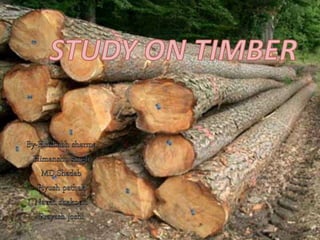
Timber is another name for wood, whether still standing in the
form of trees or felled and turned into boards for construction.
Some people may also refer to it as lumber, or differentiate
between unprocessed wood and lumber as cut wood packaged
for commercial sale. The timber industry around the world is
huge, providing wood for a variety of products from paper to
particleboard.
CLASSIFICATION
Timber is divided into 3 classes:-
Class- A(Elasticity-12.5Gpa)
+ High Durability
+Class- B(Elasticity-9.8 to 12.5Gpa)
+ Moderate Durability
+Class- C(Elasticity-5.6 to 9.8Gpa)
+ Low Durability
IDENTIFICATION OF TIMBER
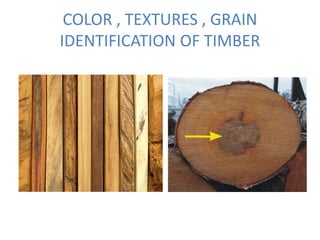
Color , Order(smell) , Hardness , Density , Grain
(depending on actual alignment the grain may be
straight, spiral, interlocked, wavy or irregular) , textures
, Luster , Workability , Warping , Moisture content ,
Specific Gravity
COLOR , TEXTURES , GRAIN
IDENTIFICATION OF TIMBER
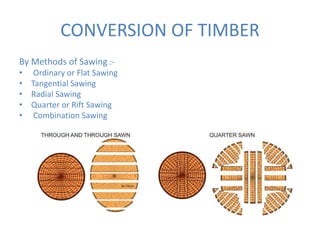
CONVERSION OF TIMBER
By Methods of Sawing :-
• Ordinary or Flat Sawing
• Tangential Sawing
• Radial Sawing
• Quarter or Rift Sawing
• Combination Sawing
DEFECTS OF TIMBER
Defects in Timber Defects caused in timber may
be basically classified into two categories:
Internal Defects – due to factors affecting the
growing tissue or the tree.
External Defects – due to external agents or
subsequent treatment of timber.
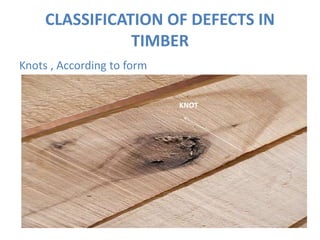
CLASSIFICATION OF DEFECTS IN
TIMBER
Knots , According to form
KNOT
CLASSIFICATION OF DEFECTS IN TIMBER
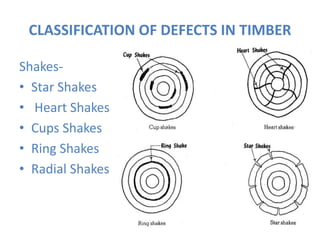
Shakes-
• Star Shakes
• Heart Shakes
• Cups Shakes
• Ring Shakes
• Radial Shakes
CLASSIFICATION OF DEFECTS IN TIMBER
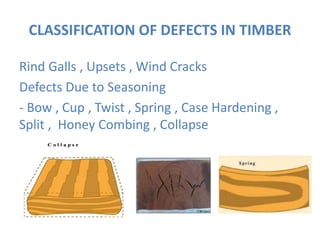
Rind Galls , Upsets , Wind Cracks
Defects Due to Seasoning
- Bow , Cup , Twist , Spring , Case Hardening ,
Split , Honey Combing , Collapse
DEFECTS DURING MANUFACTURING-
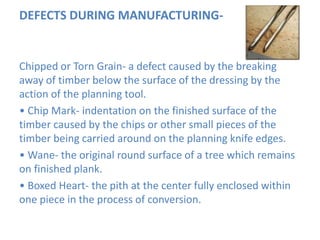
Chipped or Torn Grain- a defect caused by the breaking
away of timber below the surface of the dressing by the
action of the planning tool.
• Chip Mark- indentation on the finished surface of the
timber caused by the chips or other small pieces of the
timber being carried around on the planning knife edges.
• Wane- the original round surface of a tree which remains
on finished plank.
• Boxed Heart- the pith at the center fully enclosed within
one piece in the process of conversion.
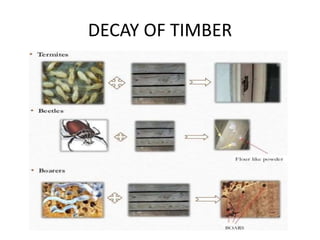
DECAY OF TIMBER
AVAILABILITY OF TIMBER
• Availability of Timber - Teak , Deodar , Chir , Kail , Sisso
, Sal , Mango.
• Uses of Timber- Timber can be used for both load
bearing structures and non-load bearing instruments. It
can be easily converted to any shape and size. The
wastage in timber construction is less because all
wastes can be put one use or the other. Durability of
timber can be very high, if properly seasoned and
preserved. Timber constructions are light in weight and
can be made economical. For aesthetic and decorative
appearance.
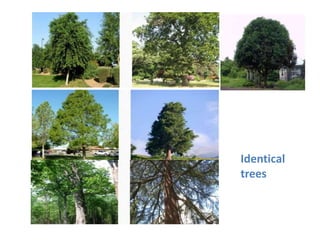
Identical
trees
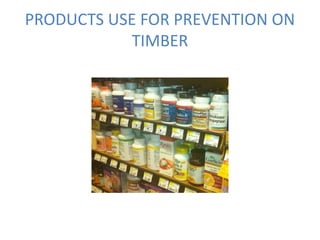
PRODUCTS USE FOR PREVENTION ON
TIMBER
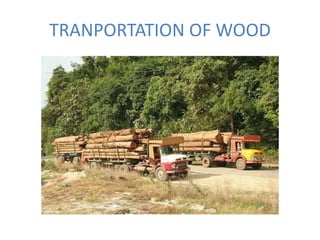
TRANPORTATION OF WOOD
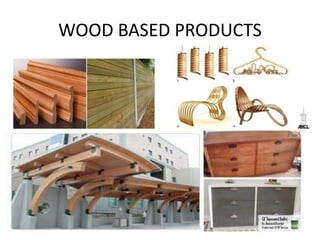
WOOD BASED PRODUCTS
With the reference of slide share, Wikipedia…

A Study on timber | TIMBER IN DETAIL

  • 2.
    INTRODUCTION Timber is anothername for wood, whether still standing in the form of trees or felled and turned into boards for construction. Some people may also refer to it as lumber, or differentiate between unprocessed wood and lumber as cut wood packaged for commercial sale. The timber industry around the world is huge, providing wood for a variety of products from paper to particleboard.
  • 3.
    CLASSIFICATION Timber is dividedinto 3 classes:- Class- A(Elasticity-12.5Gpa) + High Durability +Class- B(Elasticity-9.8 to 12.5Gpa) + Moderate Durability +Class- C(Elasticity-5.6 to 9.8Gpa) + Low Durability
  • 4.
    IDENTIFICATION OF TIMBER Color, Order(smell) , Hardness , Density , Grain (depending on actual alignment the grain may be straight, spiral, interlocked, wavy or irregular) , textures , Luster , Workability , Warping , Moisture content , Specific Gravity
  • 5.
    COLOR , TEXTURES, GRAIN IDENTIFICATION OF TIMBER
  • 6.
    CONVERSION OF TIMBER ByMethods of Sawing :- • Ordinary or Flat Sawing • Tangential Sawing • Radial Sawing • Quarter or Rift Sawing • Combination Sawing
  • 7.
    DEFECTS OF TIMBER Defectsin Timber Defects caused in timber may be basically classified into two categories: Internal Defects – due to factors affecting the growing tissue or the tree. External Defects – due to external agents or subsequent treatment of timber.
  • 8.
    CLASSIFICATION OF DEFECTSIN TIMBER Knots , According to form KNOT
  • 9.
    CLASSIFICATION OF DEFECTSIN TIMBER Shakes- • Star Shakes • Heart Shakes • Cups Shakes • Ring Shakes • Radial Shakes
  • 10.
    CLASSIFICATION OF DEFECTSIN TIMBER Rind Galls , Upsets , Wind Cracks Defects Due to Seasoning - Bow , Cup , Twist , Spring , Case Hardening , Split , Honey Combing , Collapse
  • 11.
    DEFECTS DURING MANUFACTURING- Chippedor Torn Grain- a defect caused by the breaking away of timber below the surface of the dressing by the action of the planning tool. • Chip Mark- indentation on the finished surface of the timber caused by the chips or other small pieces of the timber being carried around on the planning knife edges. • Wane- the original round surface of a tree which remains on finished plank. • Boxed Heart- the pith at the center fully enclosed within one piece in the process of conversion.
  • 12.
  • 13.
    AVAILABILITY OF TIMBER •Availability of Timber - Teak , Deodar , Chir , Kail , Sisso , Sal , Mango. • Uses of Timber- Timber can be used for both load bearing structures and non-load bearing instruments. It can be easily converted to any shape and size. The wastage in timber construction is less because all wastes can be put one use or the other. Durability of timber can be very high, if properly seasoned and preserved. Timber constructions are light in weight and can be made economical. For aesthetic and decorative appearance.
  • 14.
  • 15.
    PRODUCTS USE FORPREVENTION ON TIMBER
  • 16.
  • 17.
  • 18.
    With the referenceof slide share, Wikipedia…