

SOLAR DRYER
Name : SURAJ KUMAR
Roll No: 18AG63R16
Department of Agricultural and Food Engineering,
Indian Institute of Technology, Kharagpur,
West Bengal, India.
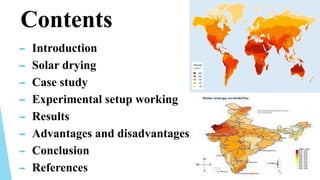
Contents
 Introduction
 Solar drying
 Case study
 Experimental setup working
 Results
 Advantages and disadvantages
 Conclusion
 References 2
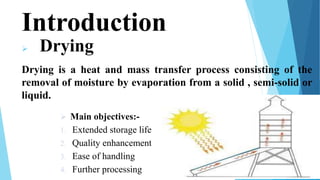
Introduction
 Drying
Drying is a heat and mass transfer process consisting of the
removal of moisture by evaporation from a solid , semi-solid or
liquid.
3
 Main objectives:-
1. Extended storage life
2. Quality enhancement
3. Ease of handling
4. Further processing
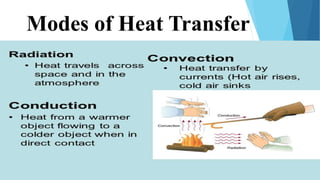
Modes of Heat Transfer
4
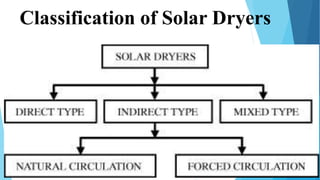
Classification of Solar Dryers
5
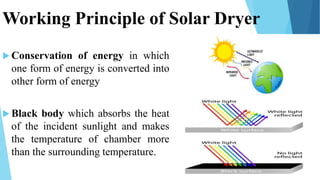
 Conservation of energy in which
one form of energy is converted into
other form of energy
 Black body which absorbs the heat
of the incident sunlight and makes
the temperature of chamber more
than the surrounding temperature.
Working Principle of Solar Dryer
Solar Dryers the most important
characteristics to be considered are:
 Low capital and operation cost.
 High load ratio.
 Use of commercially available technology.
 Achievement of uniform material drying.
 Have a high throughput of fruit or other crops.
 Have simple mechanical material handling system.7
Can be used for drying of:-
Fruits
Vegetables
Fish
Meat
Mushrooms
Medical plant
Spices
Tea
Compared with open-air drying
The product is hygienic.
Protection of rain.
Protection of pollution by dust etc.
Protection of wind which can blow away the food.
Reduction of drying time.
No loss of colours.
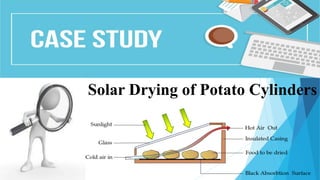
“Case Study”
Solar Drying of Potato Cylinders
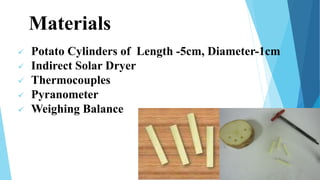
Materials
 Potato Cylinders of Length -5cm, Diameter-1cm
 Indirect Solar Dryer
 Thermocouples
 Pyranometer
 Weighing Balance
11
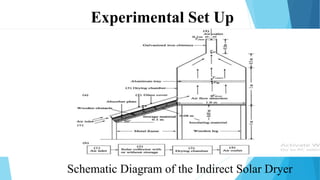
Experimental Set Up
Schematic Diagram of the Indirect Solar Dryer
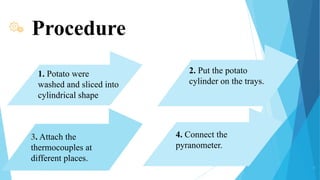
Procedure
13
1. Potato were
washed and sliced into
cylindrical shape
3. Attach the
thermocouples at
different places.
4. Connect the
pyranometer.
2. Put the potato
cylinder on the trays.
RESULTS & DISCUSSIONS
0.00
100.00
200.00
300.00
400.00
500.00
600.00
700.00
800.00
900.00
0.00
10.00
20.00
30.00
40.00
50.00
60.00
Insolation(Wm-2)
Temperature(°C)
Time of the day
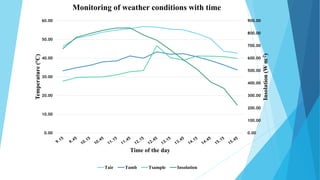
Monitoring of weather conditions with time
Tair Tamb Tsample Insolation
0.00
1.00
2.00
3.00
4.00
5.00
6.00
7.00
0.00 1.00 2.00 3.00 4.00 5.00 6.00 7.00 8.00
MoistureContent(drybasis)
Time (h)
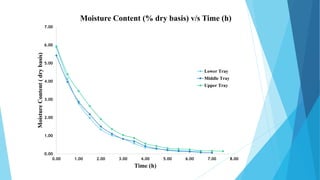
Moisture Content (% dry basis) v/s Time (h)
Lower Tray
Middle Tray
Upper Tray
0.00
0.20
0.40
0.60
0.80
1.00
1.20
1.40
0.00 1.00 2.00 3.00 4.00 5.00
Dryingrate(kgH2Om-2h-1)
Moisture Content (dry basis)
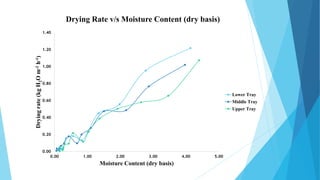
Drying Rate v/s Moisture Content (dry basis)
Lower Tray
Middle Tray
Upper Tray
Advantages
 Efficient Heating Device: These dryers work in any sunny area which include decks, patios,
gardens and so forth.
 Portable: Most of these devices are compact in size and extremely portable. It is also light
in weight which is one of the greatest advantages of using these devices.
 Operational Costs: It also involves zero operational costs and it can function on passive
solar energy too.
 Temperature Control: It is also quite easy to control the temperature as it includes
adjustable venting features.
 Weatherproof Designs: These devices also include sturdy and weather proof designs which
ensure long time usage and durability.
 Direct And Indirect Heating: These devices utilize both direct and indirect solar energy for
quick drying purposes. It also offers optimum performance and so the food items last for a
longer period of time.
Disadvantages
 Not workable at night.
 Efficiency decreases to a large extent on cloudy days.
 Over heating may occur if regular attention is not paid.
 Change in taste and flavour of food may occur if regular
monitoring is not done.
 We can not get the accurate amount of sun rays and heat.
Conclusion
 In a country like India where 300 days out of 365 days are sunny have a
huge asset of solar energy . Government is also promoting the use of
solar energy.
 Sunlight is free of cost and sun is a renewable source of energy .
 Faster drying rates can be achieved through indirect drying.
 The deleterious effects on colour was also reduced than that of direct sun
drying.
References
 Mustayen, A.G.M.B., Mekhilef, S., and Saidur, R. 2014. Performance study of
different solar dryers: A review. Renewable and Sustainable Energy Reviews
34 (2014) 463-470.
 Tripathy, P.P., Kumar Subodh.2008. Determination of temperature dependent
drying parameters for potato cylinders and slices during solar drying, Energy
Conversion and Management 49 (2008) 2941–2948.
 Tripathy, P.P., Kumar Subodh.2008. A methodology for determination of
temperature dependent mass transfer coefficients from drying kinetics:
Application to solar drying. Journal of Food Engineering 90 (2009) 212–218.
Solar Dryer

Solar Dryer

  • 1.
    SOLAR DRYER Name :SURAJ KUMAR Roll No: 18AG63R16 Department of Agricultural and Food Engineering, Indian Institute of Technology, Kharagpur, West Bengal, India.
  • 2.
    Contents  Introduction  Solardrying  Case study  Experimental setup working  Results  Advantages and disadvantages  Conclusion  References 2
  • 3.
    Introduction  Drying Drying isa heat and mass transfer process consisting of the removal of moisture by evaporation from a solid , semi-solid or liquid. 3  Main objectives:- 1. Extended storage life 2. Quality enhancement 3. Ease of handling 4. Further processing
  • 4.
    Modes of HeatTransfer 4
  • 5.
  • 6.
     Conservation ofenergy in which one form of energy is converted into other form of energy  Black body which absorbs the heat of the incident sunlight and makes the temperature of chamber more than the surrounding temperature. Working Principle of Solar Dryer
  • 7.
    Solar Dryers themost important characteristics to be considered are:  Low capital and operation cost.  High load ratio.  Use of commercially available technology.  Achievement of uniform material drying.  Have a high throughput of fruit or other crops.  Have simple mechanical material handling system.7
  • 8.
    Can be usedfor drying of:- Fruits Vegetables Fish Meat Mushrooms Medical plant Spices Tea
  • 9.
    Compared with open-airdrying The product is hygienic. Protection of rain. Protection of pollution by dust etc. Protection of wind which can blow away the food. Reduction of drying time. No loss of colours.
  • 10.
    “Case Study” Solar Dryingof Potato Cylinders
  • 11.
    Materials  Potato Cylindersof Length -5cm, Diameter-1cm  Indirect Solar Dryer  Thermocouples  Pyranometer  Weighing Balance 11
  • 12.
    Experimental Set Up SchematicDiagram of the Indirect Solar Dryer
  • 13.
    Procedure 13 1. Potato were washedand sliced into cylindrical shape 3. Attach the thermocouples at different places. 4. Connect the pyranometer. 2. Put the potato cylinder on the trays.
  • 14.
  • 15.
  • 16.
    0.00 1.00 2.00 3.00 4.00 5.00 6.00 7.00 0.00 1.00 2.003.00 4.00 5.00 6.00 7.00 8.00 MoistureContent(drybasis) Time (h) Moisture Content (% dry basis) v/s Time (h) Lower Tray Middle Tray Upper Tray
  • 17.
    0.00 0.20 0.40 0.60 0.80 1.00 1.20 1.40 0.00 1.00 2.003.00 4.00 5.00 Dryingrate(kgH2Om-2h-1) Moisture Content (dry basis) Drying Rate v/s Moisture Content (dry basis) Lower Tray Middle Tray Upper Tray
  • 18.
    Advantages  Efficient HeatingDevice: These dryers work in any sunny area which include decks, patios, gardens and so forth.  Portable: Most of these devices are compact in size and extremely portable. It is also light in weight which is one of the greatest advantages of using these devices.  Operational Costs: It also involves zero operational costs and it can function on passive solar energy too.  Temperature Control: It is also quite easy to control the temperature as it includes adjustable venting features.  Weatherproof Designs: These devices also include sturdy and weather proof designs which ensure long time usage and durability.  Direct And Indirect Heating: These devices utilize both direct and indirect solar energy for quick drying purposes. It also offers optimum performance and so the food items last for a longer period of time.
  • 19.
    Disadvantages  Not workableat night.  Efficiency decreases to a large extent on cloudy days.  Over heating may occur if regular attention is not paid.  Change in taste and flavour of food may occur if regular monitoring is not done.  We can not get the accurate amount of sun rays and heat.
  • 20.
    Conclusion  In acountry like India where 300 days out of 365 days are sunny have a huge asset of solar energy . Government is also promoting the use of solar energy.  Sunlight is free of cost and sun is a renewable source of energy .  Faster drying rates can be achieved through indirect drying.  The deleterious effects on colour was also reduced than that of direct sun drying.
  • 21.
    References  Mustayen, A.G.M.B.,Mekhilef, S., and Saidur, R. 2014. Performance study of different solar dryers: A review. Renewable and Sustainable Energy Reviews 34 (2014) 463-470.  Tripathy, P.P., Kumar Subodh.2008. Determination of temperature dependent drying parameters for potato cylinders and slices during solar drying, Energy Conversion and Management 49 (2008) 2941–2948.  Tripathy, P.P., Kumar Subodh.2008. A methodology for determination of temperature dependent mass transfer coefficients from drying kinetics: Application to solar drying. Journal of Food Engineering 90 (2009) 212–218.