Theme: 
«Lumbar triangle(Petit’s 
triangle) and it’s anatomical 
characteristics» 
Done By: Myrzakhanov Yerik 
4course GMF 451 group 
Check By: Aldyngurov Daulet 
Kadirovich 
Semey 2014
Plan: 
 Introduction. Jean Louis Petit 
 Petit triangle, boundaries 
 Lumbar hernia, Treatment 
 Surgical significance 
 List of references
Introduction 
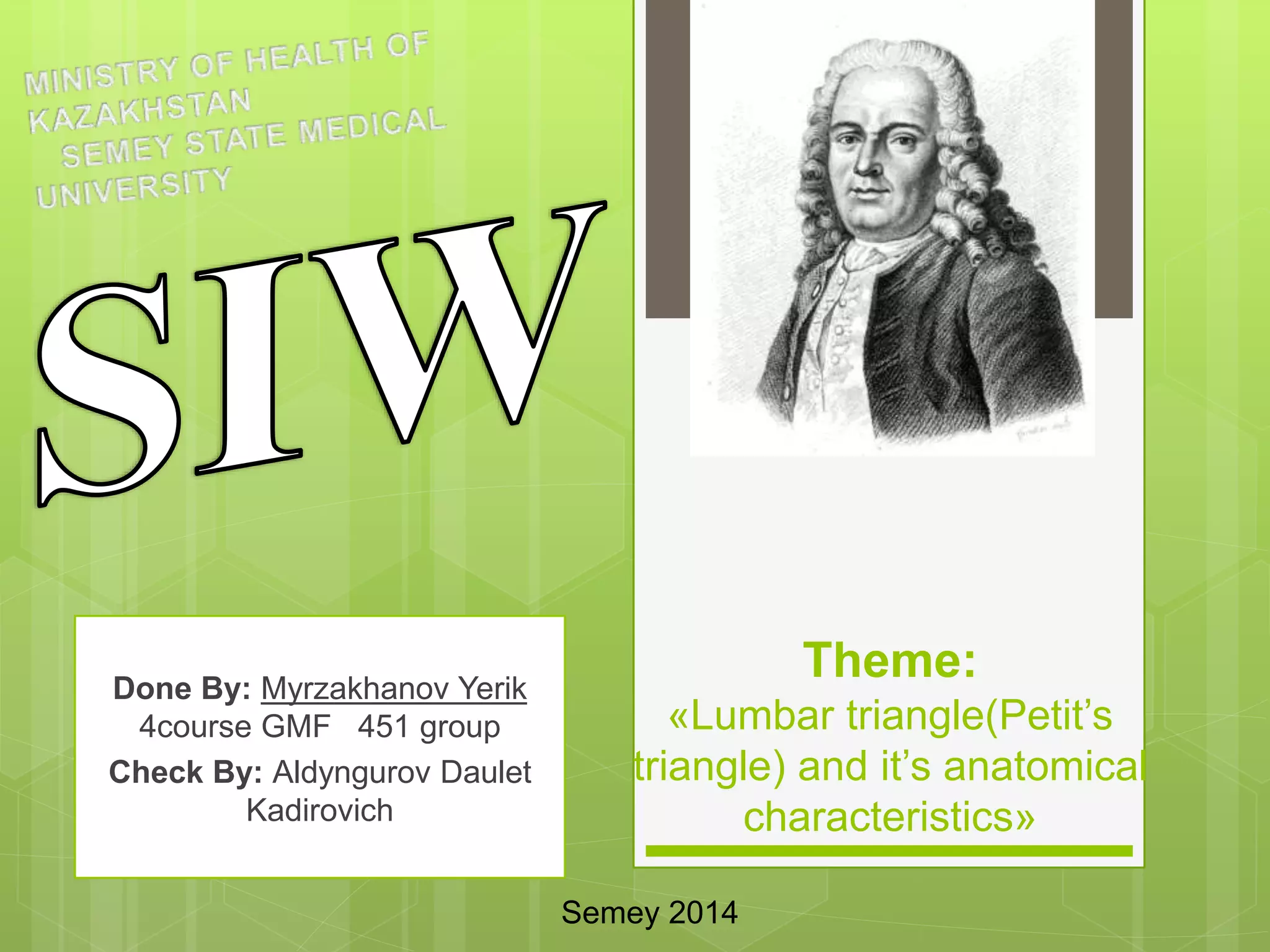
 Jean-Louis Petit (13 March 1674 – 20 April 1750) 
was a French surgeon. He was first enthusiastic 
about anatomy, received a master's certificate in 
surgery in Paris in 1700. He became a member of the 
French Royal Academy of Sciences, and was named 
director of the French Royal Academy of Surgery by 
the king when it was created. Offered ways of hernia 
repair, enterography, amputations; invented a variety 
of tools and devices (such as a tourniquet, the unit for 
the treatment of foot deformities).
Introduction 
 His name is associated the name of the lumbar 
triangle (trigonum lumbale Petiti). Also wrote about 
the injuries of the skull, the treatment of cleft lip, 
gallstones, and many other issues in surgery. 
 Known for his work on the Achilles tendon rupture, 
dislocation of the jaw, he first described about 
osteomalation. Just the first to describe the relaxation 
of the diaphragm , implying that the notion of 
complete relaxation domes and its high standing.
Boundaries (borders) of 
lumbar triangle 
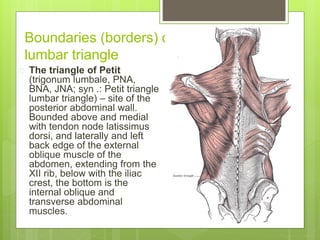
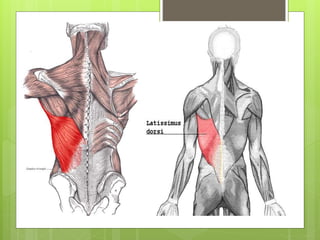
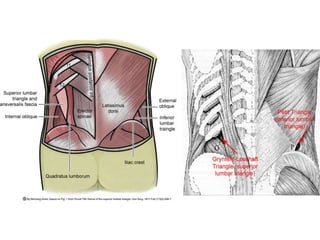
 The triangle of Petit 
(trigonum lumbale, PNA, 
BNA, JNA; syn .: Petit triangle 
lumbar triangle) – site of the 
posterior abdominal wall. 
Bounded above and medial 
with tendon node latissimus 
dorsi, and laterally and left 
back edge of the external 
oblique muscle of the 
abdomen, extending from the 
XII rib, below with the iliac 
crest, the bottom is the 
internal oblique and 
transverse abdominal 
muscles.
 The initial division of the latissimus dorsi muscle 
(as well as the site of attachment of the external 
oblique abdominal muscles to iliac crest) is divide 
to individual differences, so the shape of the 
lumbar triangle changeable. It resembles a narrow 
hole between the edges of forming his latissimus 
dorsi and external oblique abdominal muscles. 
According by P. F. Lesgaft, lumbar triangle is 
found only in 75% of people.
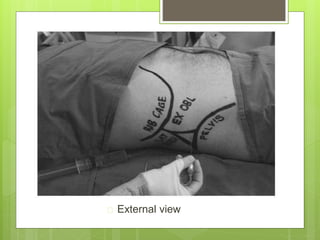
 External view
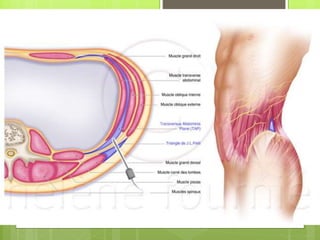
 The bottom of the triangle is the internal 
oblique muscle, covered by fascia, weakness 
which may cause the appearance of lumbar 
hernia.
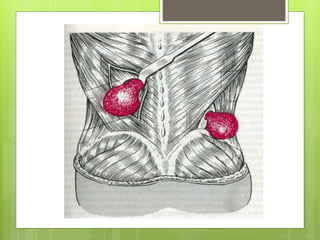
Lumbar hernia 
 Lumbar hernia(h. Lumbalis) - hernial protrusion on 
the back and side walls of the abdomen in the 
lumbar region. They are congenital and acquired 
(traumatic, muscle atrophy and etc.). 
 Place their output is lower and upper lumbar 
triangles between the XII rib and the iliac crest to 
the lateral edge of the latissimus dorsi muscle (m. 
Latissimus dorsi), as well as defects in the 
aponeurosis without specific localization due to 
rupture or inflammation.
 Hernial ring at the lower lumbar hernia are 
within the lower lumbar triangle (Petit). 
 Hernial ring at the upper lumbar hernia are 
within the upper lumbar triangle (Grynfeltt- 
Lesshaft)*. The base of the triangle, the apex 
facing down is the transversus abdominis, the 
outside is covered with a broad back muscles.
* 
 The superior lumbar (Grynfeltt-Lesshaft) 
triangle is formed medially by the quadratus 
lumborum muscle, laterally by the internal 
abdominal oblique muscle, and superiorly by 
the 12th rib. The floor of the superior lumbar 
triangle is the transversalis fascia and its roof 
is the external abdominal oblique muscle.
 The mostly, the contents of a typical lumbar 
hernia is small intestine, while sliding hernia - 
ascending or descending colon. Often lumbar 
hernia have no hernia sac, and through the 
hernial ring out retroperitoneal fat, sometimes 
kidney. In this case, the hernia will be false.
Treatment 
 Surgical - resection of the hernial sac, closure 
of hernial ring, the reconstruction of the 
transversal abdominal muscles. When lumbar 
hernia with large hernial ring used to close the 
defect synthetic materials or muscle flaps.
Surgical significances of triangle 
of Petit 
 At peritonitis abdominal establish drainage 
through lumbar triangles of Petit by a cross-section 
of the skin, subcutaneous tissue, 
superficial fascia and private over the iliac crest at 
the intersection, with its posterior axillary line, with 
a further dislocation of internal oblique abdominal 
muscles in the course of its fibers and introduce of 
all drainages on the parietal peritoneum posterior 
wall of the abdominal cavity in the mesenteric 
sinuses under the root of the mesentery of the 
transverse colon.
Surgical significances of triangle 
of Petit 
 Symptom Joure-Rozanov - pain when finger 
pressure in the triangle of Petit. Used in the 
diagnosis of acute appendicitis. In that case 
peritoneum in this department is relatively 
superficial.
Surgical significances of triangle 
of Petit 
 At retrocecal appendicitis in this area can be 
detected positive symptom Gabai – the sharp 
increases of pain when palpated quickly 
remove your hands after pressing, as the 
symptoms of Shchetkina - Blumberg.
Surgical significances of triangle 
of Petit 
 Extraperitoneal laparoscopic approach to 
the adrenal glands. 
 In the angle between the rib XII and 
sacrospinous muscle (m. Sacrospinalis) (the 
so-called triangle of Petit) performed a cut 
length of 15 mm. In this incision the surgeon 
can accurately enter your finger to create 
access to the retroperitoneal paranephral 
space.
List of references: 
 Анатомия человека: В 2 томах / Под ред. 
М.Р.Сапина. – М.: Медицина, 1997.- Т.1.- 544 с. 
 http://en.wikipedia.org/wiki/Jean_Louis_Petit 
 http://en.wikipedia.org/wiki/Lumbar_triangle 
 Aguirre DA, Santosa AC, Casola G et-al. Abdominal 
wall hernias: imaging features, complications, and 
diagnostic pitfalls at multi-detector row CT. 
Radiographics. 2005;25 (6): 1501-20. 
 MILLARD DG. A Richter's hernia through the inferior 
lumbar triangle of petit. A radiographic demonstration. 
Br J Radiol. 1959;32 (382): 693-5 
 Большаков О.П., Семенов Г.М. Лекции по 
оперативной хирургии и клинической анатомии. – 
СПб.: Питер, 2000. – 480 с.

Lumbar triangle(Petit’s triangle) and it’s anatomical characteristics

  • 1.
    Theme: «Lumbar triangle(Petit’s triangle) and it’s anatomical characteristics» Done By: Myrzakhanov Yerik 4course GMF 451 group Check By: Aldyngurov Daulet Kadirovich Semey 2014
  • 2.
    Plan:  Introduction.Jean Louis Petit  Petit triangle, boundaries  Lumbar hernia, Treatment  Surgical significance  List of references
  • 3.
    Introduction  Jean-LouisPetit (13 March 1674 – 20 April 1750) was a French surgeon. He was first enthusiastic about anatomy, received a master's certificate in surgery in Paris in 1700. He became a member of the French Royal Academy of Sciences, and was named director of the French Royal Academy of Surgery by the king when it was created. Offered ways of hernia repair, enterography, amputations; invented a variety of tools and devices (such as a tourniquet, the unit for the treatment of foot deformities).
  • 4.
    Introduction  Hisname is associated the name of the lumbar triangle (trigonum lumbale Petiti). Also wrote about the injuries of the skull, the treatment of cleft lip, gallstones, and many other issues in surgery.  Known for his work on the Achilles tendon rupture, dislocation of the jaw, he first described about osteomalation. Just the first to describe the relaxation of the diaphragm , implying that the notion of complete relaxation domes and its high standing.
  • 5.
    Boundaries (borders) of lumbar triangle  The triangle of Petit (trigonum lumbale, PNA, BNA, JNA; syn .: Petit triangle lumbar triangle) – site of the posterior abdominal wall. Bounded above and medial with tendon node latissimus dorsi, and laterally and left back edge of the external oblique muscle of the abdomen, extending from the XII rib, below with the iliac crest, the bottom is the internal oblique and transverse abdominal muscles.
  • 7.
     The initialdivision of the latissimus dorsi muscle (as well as the site of attachment of the external oblique abdominal muscles to iliac crest) is divide to individual differences, so the shape of the lumbar triangle changeable. It resembles a narrow hole between the edges of forming his latissimus dorsi and external oblique abdominal muscles. According by P. F. Lesgaft, lumbar triangle is found only in 75% of people.
  • 8.
  • 10.
     The bottomof the triangle is the internal oblique muscle, covered by fascia, weakness which may cause the appearance of lumbar hernia.
  • 11.
    Lumbar hernia Lumbar hernia(h. Lumbalis) - hernial protrusion on the back and side walls of the abdomen in the lumbar region. They are congenital and acquired (traumatic, muscle atrophy and etc.).  Place their output is lower and upper lumbar triangles between the XII rib and the iliac crest to the lateral edge of the latissimus dorsi muscle (m. Latissimus dorsi), as well as defects in the aponeurosis without specific localization due to rupture or inflammation.
  • 12.
     Hernial ringat the lower lumbar hernia are within the lower lumbar triangle (Petit).  Hernial ring at the upper lumbar hernia are within the upper lumbar triangle (Grynfeltt- Lesshaft)*. The base of the triangle, the apex facing down is the transversus abdominis, the outside is covered with a broad back muscles.
  • 13.
    *  Thesuperior lumbar (Grynfeltt-Lesshaft) triangle is formed medially by the quadratus lumborum muscle, laterally by the internal abdominal oblique muscle, and superiorly by the 12th rib. The floor of the superior lumbar triangle is the transversalis fascia and its roof is the external abdominal oblique muscle.
  • 15.
     The mostly,the contents of a typical lumbar hernia is small intestine, while sliding hernia - ascending or descending colon. Often lumbar hernia have no hernia sac, and through the hernial ring out retroperitoneal fat, sometimes kidney. In this case, the hernia will be false.
  • 17.
    Treatment  Surgical- resection of the hernial sac, closure of hernial ring, the reconstruction of the transversal abdominal muscles. When lumbar hernia with large hernial ring used to close the defect synthetic materials or muscle flaps.
  • 18.
    Surgical significances oftriangle of Petit  At peritonitis abdominal establish drainage through lumbar triangles of Petit by a cross-section of the skin, subcutaneous tissue, superficial fascia and private over the iliac crest at the intersection, with its posterior axillary line, with a further dislocation of internal oblique abdominal muscles in the course of its fibers and introduce of all drainages on the parietal peritoneum posterior wall of the abdominal cavity in the mesenteric sinuses under the root of the mesentery of the transverse colon.
  • 19.
    Surgical significances oftriangle of Petit  Symptom Joure-Rozanov - pain when finger pressure in the triangle of Petit. Used in the diagnosis of acute appendicitis. In that case peritoneum in this department is relatively superficial.
  • 20.
    Surgical significances oftriangle of Petit  At retrocecal appendicitis in this area can be detected positive symptom Gabai – the sharp increases of pain when palpated quickly remove your hands after pressing, as the symptoms of Shchetkina - Blumberg.
  • 21.
    Surgical significances oftriangle of Petit  Extraperitoneal laparoscopic approach to the adrenal glands.  In the angle between the rib XII and sacrospinous muscle (m. Sacrospinalis) (the so-called triangle of Petit) performed a cut length of 15 mm. In this incision the surgeon can accurately enter your finger to create access to the retroperitoneal paranephral space.
  • 22.
    List of references:  Анатомия человека: В 2 томах / Под ред. М.Р.Сапина. – М.: Медицина, 1997.- Т.1.- 544 с.  http://en.wikipedia.org/wiki/Jean_Louis_Petit  http://en.wikipedia.org/wiki/Lumbar_triangle  Aguirre DA, Santosa AC, Casola G et-al. Abdominal wall hernias: imaging features, complications, and diagnostic pitfalls at multi-detector row CT. Radiographics. 2005;25 (6): 1501-20.  MILLARD DG. A Richter's hernia through the inferior lumbar triangle of petit. A radiographic demonstration. Br J Radiol. 1959;32 (382): 693-5  Большаков О.П., Семенов Г.М. Лекции по оперативной хирургии и клинической анатомии. – СПб.: Питер, 2000. – 480 с.