Systems of LinearAlgebraic Equations
b) LU Decomposition
There are many methods developed in Matrix computation. The LU decomposition of the
Gaussian elimination technique, however, is the most practical of these techniques. One
reason for initiating LU decomposition is that it provides an effective means of calculating
the inverse of The Matrix. It is possible to show that any square matrix A can be expressed as
a product of a lower triangular matrix L and an upper triangular matrix U:
A = LU
The process of computing L and U for a given A is known as LU decomposition or LU
factorization. LU decomposition methods separate the time-consuming elimination of the
matrix [A] from the manipulations of the right-hand side {B}. Thus, once [A] has been
“decomposed,” multiple right-hand-side vectors can be evaluated in an efficient manner.
Unless certain constraints are placed on L or U, these constraints distinguish one type of
decomposition from another.
4.
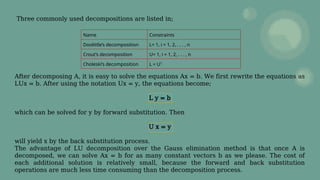
Three commonly useddecompositions are listed in;
After decomposing A, it is easy to solve the equations Ax = b. We first rewrite the equations as
LUx = b. After using the notation Ux = y, the equations become;
L y = b
which can be solved for y by forward substitution. Then
U x = y
will yield x by the back substitution process.
The advantage of LU decomposition over the Gauss elimination method is that once A is
decomposed, we can solve Ax = b for as many constant vectors b as we please. The cost of
each additional solution is relatively small, because the forward and back substitution
operations are much less time consuming than the decomposition process.
Name Constraints
Doolittle’s decomposition L= 1, i = 1, 2, . . . , n
Crout’s decomposition U= 1, i = 1, 2, . . . , n
Choleski’s decomposition L = UT
5.
Doolittle’s Decomposition Method
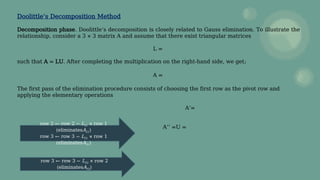
Decompositionphase. Doolittle’s decomposition is closely related to Gauss elimination. To illustrate the
relationship, consider a 3 × 3 matrix A and assume that there exist triangular matrices
L =
such that A = LU. After completing the multiplication on the right-hand side, we get;
A =
The first pass of the elimination procedure consists of choosing the first row as the pivot row and
applying the elementary operations
A’=
A’’ =U =
row 2 ← row 2 − L21 × row 1
(eliminatesA21)
row 3 ← row 3 − L31 × row 1
(eliminatesA31)
row 3 ← row 3 − L32 × row 2
(eliminatesA32)
6.
Doolittle's decomposition hastwo important properties:
1. The matrix U is identical to the upper triangular matrix that results from Gauss elimination.
2. The off - diagonal elements of L are the pivot equation multipliers used during Gauss elimination; that
is, Lij is the multiplier that eliminated A ij .
It is usual practice to store the multipliers in the lower triangular portion of the coefficient matrix,
replacing the coefficients as they are eliminated (L ij replacing A ij ). The diagonal elements of L do not
have to be stored, because it is understood that each of them is unity. The final form of the coefficient
matrix would thus be the following mixture of L and U:
Solution phase. Consider now the procedure for the solution of Ly = b by forward substitution. The scalar
form of the equations is (recall that L ii = 1)
y1 = b1
L21y1 + y2 = b2
. .
Lk1y1 + Lk2y2 +· · ·+ Lk,k−1yk−1 + y k = b k
. . .
Solving the kth equation for y k yields
yk = bk − Lkj yj for k = 2, 3, . . . , n
7.
Example: Solve thesystem of equations with Doolittle’s Decomposition Method
1. Create matrices A, X and B , where A is the augmented matrix, X constitutes the variable vectors and B are the
constants
2. Let A = LU, where L is the lower triangular matrix and U is the upper triangular matrix assume that the diagonal
entries L is equal to 1
3. Let Ly = B, solve for y’s
4. Let Ux = y, solve for the variable vectors x
x1 + x2 + x3 =5
x1 + 2x2 + 2x3 =6
x1 + 2x2 + 3x3 =8
Solution:
A= X= B=
A=LU =.
d=1 e=1 f=1
ad=1 ag+g=2 af+h=2
a=1 g=1 h=1
bd=1 be+cg=2 bf+ch+i= 3
b=1 c=1 i=1
Choleski’s Decomposition Method
Choleski’sdecomposition A = LLT
has two limitations:
1. Since LLT
is always a symmetric matrix, Choleski’s decomposition requires A to be symmetric.
2. The decomposition process involves taking square roots of certain combinations of the elements of A.
It can be shown that to avoid square roots of negative numbers A must be positive definite.
Choleski’s decomposition contains approximately n3
/6 long operations plus n square root computations.
This is about half the number of operations required in LU decomposition. The relative efficiency of
Choleski’s decomposition is due to its exploitation of symmetry.
Choleski’s decomposition;
A = L LT
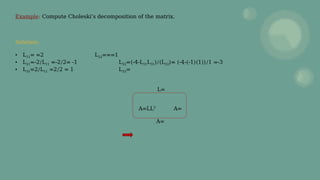
of a 3 ×3matrix:
10.
After completing thematrix multiplication on the right-hand side, we get
By equating the elements in the first column, starting with the first row and proceeding
downward, we can compute L11, L21 and L31 in that order:
A11 = L2
11 L11 =
A21 = L11L21 L21 = A21/L11
A31 = L11L31 L31 = A31/L11
The second column, starting with second row, yields L22 and L32:
A22 = L2
21+ L2
22 L22 =
A32 = L21L31 + L22L32 L32 = (A32 − L21L31)/L22
11.
Finally the thirdcolumn, third row gives us L33:
A33 = L2
31+ L2
32+ L2
33 L33 =
We can now extrapolate the results for an n ×n matrix. We observe that a typical element in
the lower triangular portion of LLT
is of the form
(LLT
)ij = Li1L j 1 + Li2L j 2 +· · ·+ Lij L j j = Lik L jk , i ≥ j
Equating this term to the corresponding element of A yields
Aij= Lik L jk , i=j,j+1,.....,n j=1,2,....,n
(1)
The range of indices shown limits the elements to the lower triangular part. For the first
column ( j = 1), we obtain from Eq.(1)
L11 = Li1 = Ai1/L11, i = 2, 3, . . . , n
12.
Proceeding to othercolumns, we observe that the unknown in Eq. (1) is L ij (the other
elements of L appearing in the equation have already been computed). Taking the term
containing L ij outside the summation in Eq. (1), we obtain
Aij=
If i = j (a diagonal term), the solution is
Lij= , j=2,3......n
For a non diagonal term we get
Lij = / L j j , j= 2, 3, . . . , n − 1, i = j + 1, j + 2, . . . , n
Other Methods
Crout’s decomposition.Various A = LU decompositions are characterized by restrictions placed on L or U
elements. In matrix solutions, it offers a solution proposal very similar to the LU decomposition method.
Crout's method decomposes a nonsingular n × n matrix A into the product of an n×n lower triangular
matrix L and an n×n unit upper triangular matrix U. A unit triangular matrix is a triangular matrix with
1's along the diagonal.
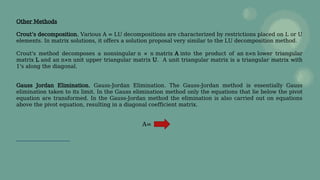
Gauss Jordan Elimination. Gauss-Jordan Elimination. The Gauss-Jordan method is essentially Gauss
elimination taken to its limit. In the Gauss elimination method only the equations that lie below the pivot
equation are transformed. In the Gauss-Jordan method the elimination is also carried out on equations
above the pivot equation, resulting in a diagonal coefficient matrix.
A=
15.
REFERENCES
• Jaan Kiusalaas,“Numerical Methods in Engineering with Python 3”,3rd Edition,
Cambridge, NY, 2013
• S.C. Chapra and R.P. Canale, “Numerical Methods for Engineers”, 6th ed., McGraw-Hill,, NY,
2010
• www.python.org


![Systems of Linear Algebraic Equations
b) LU Decomposition
There are many methods developed in Matrix computation. The LU decomposition of the
Gaussian elimination technique, however, is the most practical of these techniques. One
reason for initiating LU decomposition is that it provides an effective means of calculating
the inverse of The Matrix. It is possible to show that any square matrix A can be expressed as
a product of a lower triangular matrix L and an upper triangular matrix U:
A = LU
The process of computing L and U for a given A is known as LU decomposition or LU
factorization. LU decomposition methods separate the time-consuming elimination of the
matrix [A] from the manipulations of the right-hand side {B}. Thus, once [A] has been
“decomposed,” multiple right-hand-side vectors can be evaluated in an efficient manner.
Unless certain constraints are placed on L or U, these constraints distinguish one type of
decomposition from another.](https://image.slidesharecdn.com/3-unit-ludecomposition-250503210953-a4d1db4f/85/Math-501-linear-3-UNIT-LU-Decomposition-pptx-3-320.jpg)