SOME METHODS FOR SMALL SYSTEMS OF EQUATIONS SOLUTIONS
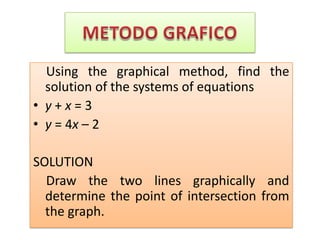
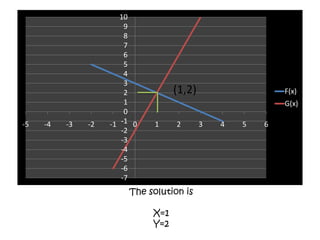
METODO GRAFICO    Using the graphical method, find the solution of the systems of equations y + x = 3 y = 4x – 2SOLUTION    Draw the two lines graphically and determine the point of intersection from the graph.
The solutionisX=1Y=2
CRAMER'S RULEits a theorem, which gives an expression for the solution of a system of linear equations with as many equations as unknowns, valid in those cases where there is a unique solution.
The solution is expressed in terms of the determinants of the (square) coefficient matrix and of matrices obtained from it by replacing one column by the vector of right hand sides of the equations.I´m recommended http://www.youtube.com/watch?v=PO4hpSyxH9g
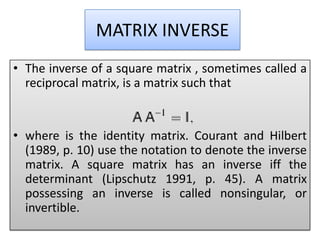
MATRIX INVERSEThe inverse of a square matrix, sometimes called a reciprocal matrix, is a matrix such that where is the identity matrix. Courant and Hilbert (1989, p. 10) use the notation to denote the inverse matrix. A square matrixhas an inverse iff the determinant(Lipschutz 1991, p. 45). A matrix possessing an inverse is called nonsingular, or invertible.
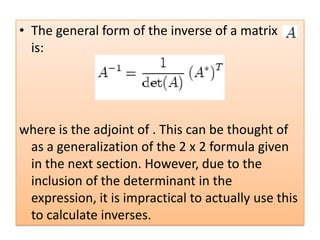
The general form of the inverse of a matrix     is:where is the adjoint of . This can be thought of as a generalization of the 2 x 2 formula given in the next section. However, due to the inclusion of the determinant in the expression, it is impractical to actually use this to calculate inverses.
GAUSS SIMPLEThe Gauss, also known as single-elimination method of Gauss, is one of the first techniques used by actuaries, mathematicians and engineers to solve systems of equations. The method includes two phases:    • Elimination of the unknowns ahead• Replacement back
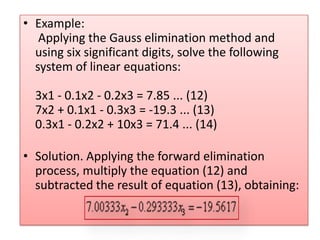
Example:  Applying the Gauss elimination method and using six significant digits, solve the following system of linear equations: 3x1 - 0.1x2 - 0.2x3 = 7.85 ... (12) 7x2 + 0.1x1 - 0.3x3 = -19.3 ... (13) 0.3x1 - 0.2x2 + 10x3 = 71.4 ... (14) Solution. Applying the forward elimination process, multiply the equation (12) and subtracted the result of equation (13), obtaining:
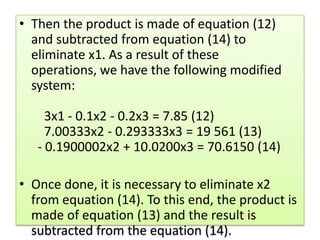
Then the product is made of equation (12) and subtracted from equation (14) to eliminate x1. As a result of these operations, we have the following modified system:     3x1 - 0.1x2 - 0.2x3 = 7.85 (12)     7.00333x2 - 0.293333x3 = 19 561 (13)   - 0.1900002x2 + 10.0200x3 = 70.6150 (14) Once done, it is necessary to eliminate x2 from equation (14). To this end, the product is made of equation (13) and the result is subtracted from the equation (14).
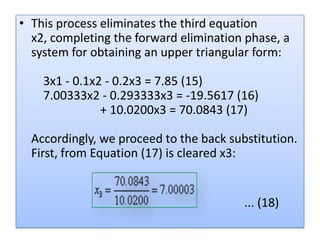
This process eliminates the third equation x2, completing the forward elimination phase, a system for obtaining an upper triangular form:     3x1 - 0.1x2 - 0.2x3 = 7.85 (15)     7.00333x2 - 0.293333x3 = -19.5617 (16)                        + 10.0200x3 = 70.0843 (17) Accordingly, we proceed to the back substitution. First, from Equation (17) is cleared x3:                                                                        ... (18)
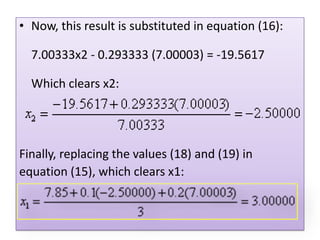
Now, this result is substituted in equation (16): 7.00333x2 - 0.293333 (7.00003) = -19.5617 Which clears x2: Finally, replacing the values (18) and (19) in equation (15), which clears x1:
LU DESCOMPOSITIONthe LU decomposition is a matrix decomposition which writes a matrix as the product of a lower triangular matrix and an upper triangular matrix. The product sometimes includes a permutation matrix as well. This decomposition is used in numerical analysis to solve systems of linear equations or calculate the determinant.
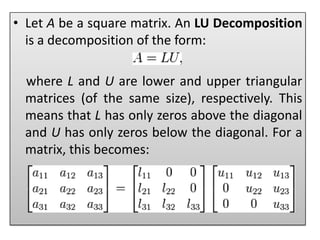
Let A be a square matrix. An LU Decomposition is a decomposition of the form:    where L and U are lower and upper triangular matrices (of the same size), respectively. This means that L has only zeros above the diagonal and U has only zeros below the diagonal. For a matrix, this becomes:
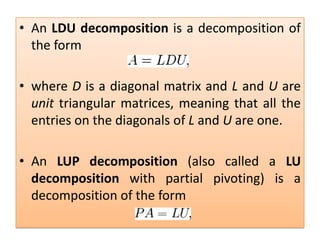
An LDU decomposition is a decomposition of the formwhere D is a diagonal matrix and L and U are unit triangular matrices, meaning that all the entries on the diagonals of L and U are one.An LUP decomposition (also called a LU decomposition with partial pivoting) is a decomposition of the form
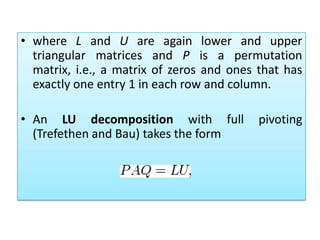
where L and U are again lower and upper triangular matrices and P is a permutation matrix, i.e., a matrix of zeros and ones that has exactly one entry 1 in each row and column.An LU decomposition with full pivoting (Trefethen and Bau) takes the form
 Above we required that A be a square matrix, but these decompositions can all be generalized to rectangular matrices as well. In that case, L and P are square matrices which each have the same number of rows as A, while U is exactly the same shape as A. Upper triangular should be interpreted as having only zero entries below the main diagonal, which starts at the upper left corner.
BIBLIOGRAPHYSteven c. Chapra, Métodos Numéricos Para Ingenieros. Quinta Edición Parte 3 Análisis numérico Escrito por Richard L. Burden,J. Douglas FairesInvestigación de operaciones: aplicaciones y algoritmos Escrito por Wayne L. Winston

Some methods for small systems of equations solutions

  • 1.
    SOME METHODS FORSMALL SYSTEMS OF EQUATIONS SOLUTIONS
  • 2.
    METODO GRAFICO Using the graphical method, find the solution of the systems of equations y + x = 3 y = 4x – 2SOLUTION Draw the two lines graphically and determine the point of intersection from the graph.
  • 3.
  • 4.
    CRAMER'S RULEits atheorem, which gives an expression for the solution of a system of linear equations with as many equations as unknowns, valid in those cases where there is a unique solution.
  • 5.
    The solution isexpressed in terms of the determinants of the (square) coefficient matrix and of matrices obtained from it by replacing one column by the vector of right hand sides of the equations.I´m recommended http://www.youtube.com/watch?v=PO4hpSyxH9g
  • 6.
    MATRIX INVERSEThe inverseof a square matrix, sometimes called a reciprocal matrix, is a matrix such that where is the identity matrix. Courant and Hilbert (1989, p. 10) use the notation to denote the inverse matrix. A square matrixhas an inverse iff the determinant(Lipschutz 1991, p. 45). A matrix possessing an inverse is called nonsingular, or invertible.
  • 7.
    The general formof the inverse of a matrix is:where is the adjoint of . This can be thought of as a generalization of the 2 x 2 formula given in the next section. However, due to the inclusion of the determinant in the expression, it is impractical to actually use this to calculate inverses.
  • 8.
    GAUSS SIMPLEThe Gauss,also known as single-elimination method of Gauss, is one of the first techniques used by actuaries, mathematicians and engineers to solve systems of equations. The method includes two phases: • Elimination of the unknowns ahead• Replacement back
  • 9.
    Example:  Applying theGauss elimination method and using six significant digits, solve the following system of linear equations: 3x1 - 0.1x2 - 0.2x3 = 7.85 ... (12) 7x2 + 0.1x1 - 0.3x3 = -19.3 ... (13) 0.3x1 - 0.2x2 + 10x3 = 71.4 ... (14) Solution. Applying the forward elimination process, multiply the equation (12) and subtracted the result of equation (13), obtaining:
  • 10.
    Then the productis made of equation (12) and subtracted from equation (14) to eliminate x1. As a result of these operations, we have the following modified system:     3x1 - 0.1x2 - 0.2x3 = 7.85 (12)     7.00333x2 - 0.293333x3 = 19 561 (13)   - 0.1900002x2 + 10.0200x3 = 70.6150 (14) Once done, it is necessary to eliminate x2 from equation (14). To this end, the product is made of equation (13) and the result is subtracted from the equation (14).
  • 11.
    This process eliminatesthe third equation x2, completing the forward elimination phase, a system for obtaining an upper triangular form:     3x1 - 0.1x2 - 0.2x3 = 7.85 (15)     7.00333x2 - 0.293333x3 = -19.5617 (16)           + 10.0200x3 = 70.0843 (17) Accordingly, we proceed to the back substitution. First, from Equation (17) is cleared x3: ... (18)
  • 12.
    Now, this resultis substituted in equation (16): 7.00333x2 - 0.293333 (7.00003) = -19.5617 Which clears x2: Finally, replacing the values (18) and (19) in equation (15), which clears x1:
  • 13.
    LU DESCOMPOSITIONthe LUdecomposition is a matrix decomposition which writes a matrix as the product of a lower triangular matrix and an upper triangular matrix. The product sometimes includes a permutation matrix as well. This decomposition is used in numerical analysis to solve systems of linear equations or calculate the determinant.
  • 14.
    Let A bea square matrix. An LU Decomposition is a decomposition of the form: where L and U are lower and upper triangular matrices (of the same size), respectively. This means that L has only zeros above the diagonal and U has only zeros below the diagonal. For a matrix, this becomes:
  • 15.
    An LDU decompositionis a decomposition of the formwhere D is a diagonal matrix and L and U are unit triangular matrices, meaning that all the entries on the diagonals of L and U are one.An LUP decomposition (also called a LU decomposition with partial pivoting) is a decomposition of the form
  • 16.
    where L andU are again lower and upper triangular matrices and P is a permutation matrix, i.e., a matrix of zeros and ones that has exactly one entry 1 in each row and column.An LU decomposition with full pivoting (Trefethen and Bau) takes the form
  • 17.
    Above werequired that A be a square matrix, but these decompositions can all be generalized to rectangular matrices as well. In that case, L and P are square matrices which each have the same number of rows as A, while U is exactly the same shape as A. Upper triangular should be interpreted as having only zero entries below the main diagonal, which starts at the upper left corner.
  • 18.
    BIBLIOGRAPHYSteven c. Chapra,Métodos Numéricos Para Ingenieros. Quinta Edición Parte 3 Análisis numérico Escrito por Richard L. Burden,J. Douglas FairesInvestigación de operaciones: aplicaciones y algoritmos Escrito por Wayne L. Winston