LTE Medium Access Layer
LTE-MAC Layer Presentation
LTE-MAC Scheduling

Dynamic Scheduling

Suitable for bursty traffic.

eNB allocates downlink radio
resources to the UE using
resource allocation information
called downlink assignment

eNB allocates uplink radio
resources to the UE using
resource allocation information
called uplink assignment

The down-link assignment and the
uplink grant are signaled
separately to the UE through the
Physical Downlink Control
CHannel (PDCCH), masked with
the UE’s C-RNTI

Semi-Persistent Scheduling (SPS)

a VoIP service periodically
generates many small-sized
packets at short intervals.

To avoid lot of the downlink
assignment and the uplink grant,
leading to a heavy load on the
PDCCH

reducing the number of the
downlink assignment and the
uplink grant is required to increase
the number of supportable
simultaneous VoIP calls in a cell

SPS is used to allocate radio
resources for a long time period
with a minimized load on the
PDCCH
LTE MAC – SPS (detailed)

Questions

Why we need SPS-RNTI, when we can distinguish UE based on CRNTI ?

What will happen when UE uses Web Browser (dynamic scheduling) and Voip
call (semi persistence scheduling) simultaneously and scheduled both in single
PDSCH frame?

What will happened when eNB is scheduling a RRC message with SPS-data in a
single PDSCH frame ?

Concept of overriding the SPS Resource - When the resource allocation
information masked by the C-RNTI is received at the subframe when the radio
resources for SPS are configured, the UE uses the radio resource indicated by
dynamic scheduling at that subframe and does not use the radio resource
configured by SPS. The radio resource for SPS is replaced temporarily by the radio
resources allocated by dynamic scheduling and after that Ue continues to use SPS
configuration.

In essence, the resource allocation information over the PDCCH masked by SPS-C-
RNTI indicates:

the activation of radio resources for SPS;

the reactivation of radio resources for SPS;

HARQ retransmission of transport blocks which were originally transmitted over
LTE MAC – SPS (detailed)

RRC IEs for configuring SPS.
− semiPersistSchedC-RNTI
− DLConfig
− semiPersistSchedIntervalDL(sf10 to sf640)
− NumberOfConfSPS-Processes (1..8)
− N1PUCCH-AN-PersistentList (1..4 PUCCH resource index)
− ULConfig
− semiPersistSchedIntervalUL
− implicitReleaseAfter
− p0-NominalPUSCH-Persistent
− p0-UE-PUSCH-Persistent
− TwoIntervalsConfig

When the UE receives resource allocation information masked with the SPS-C-RNTI
with the NDI field set to 0, the UE stores the received resource allocation information
and periodically uses the radio resources indicated by the stored information for the
reception or transmission of MAC PDUs

When the UE receives resource allocation information masked withthe SPS-C-RNTI
with the NDI field set to 1, it does not use the stored radio resource
LTE MAC – SPS (detailed)

the time duration when people do not talk, called the silent period, is relatively long.
when there is not so much gain from using SPS, it may be better to release the
configured radio resources for SPS. To do so, the resource allocation information
masked by the SPS-C-RNTI can include an indication to release radio resource for
SPS and this is called explicit SPS release

In the uplink, as a solution to the problem of loss of the explicit SPS release
command, another mechanism is adopted. In fact, the eNB cannot immediately be
aware of the need to release the uplink radio resources for SPS. Thus, an implicit
SPS release mechanism to release the uplink radio resources for SPS is also
adopted in LTE. In this implicit SPS release, when a certain number of MAC PDUs is
transmitted consecutively without includeing any MAC SDU using the radio resource
for SPS, the UE releases the uplink radio resources for SPS without informing the
eNB of this event
LTE MAC – BSR (Buffer Status
Reporting)

The BSR indicates how much data are buffered in the UE’s memory. for uplink radio
resource allocation, a UE needs to send the BSR to the eNB to indicate the amount
of data in the UE that need to be transmitted.

Two formats are defined for the BSR: Long BSR and Short BSR

The Long BSR is longer than the Short BSR and is used to deliver buffer status
information for the four Logical Channel Groups (LCGs)

The Short BSR is used to deliver buffer status information for only one LCG. Which
BSR format is used depends on what triggers the BSR, how many LCGs have data to
send, and how much space is available in the MAC PDU.

The above states that the amount of data is indicated not per logical channel but per
LCG. by grouping logical channels with similar attributes into at most four LCGs and
by making the UE report the buffer status per LCG, LTE strikes a good balance
between reporting efficiency and reporting accuracy

One special type of BSR is the Truncated BSR. The Truncated BSR has the same
format as the Short BSR but with a different LCID field. The Truncated BSR is used
when a Padding BSR is triggered and the space in the MAC PDU is not enough to
include a Long BSR but when more than one LCG has data in the buffer
LTE MAC – BSR (detailed)

A BSR can be triggered in any of the following situations:

When data arrive for a logical channel which has higher priority than the
logical channels whose buffers are not empty. In this case, the triggered
BSR is called a Regular BSR

When data become available for the UE’s buffer, which is empty. This is
also called a Regular BSR

When the retxBSR-Timer expires and there is still data in the UE’s
buffer. This is also called a Regular BSR
− Purpose of retransmission BSR Timer :- HARQ NACK transmitted by
the eNB is wrongly interpreted as a HARQ ACK by the UE (HARQ
NACK-to-ACK error). To avoid this deadlock situation, the retxBSR-
Timer is used.The timer is started when the MAC PDU including the
BSR is transmitted, and restarted whenever the UE receives the
uplink grant for a new transmission. When the retxBSR-Timer
expires, it means that the UE has not received any uplink grant for
some time.

When a periodicBSR-Timer expires. This BSR is called a Periodic BSR.
This is used for the UE periodically to deliver updated buffer status
LTE MAC – BSR (detailed)

Why periodic buffer status report is needed ?

let’s assume that the data belonging to only one logical channel arrive
continuously at the UE’s buffer and the UE is in the middle of transmission of the
data. In this case, the first BSR is triggered when the first data for the logical
channel are available. However, provided that the data belonging to other logical
channels do not arrive at the UE’s buffer, no BSR listed above will be triggered.
As time goes by, more data may arrive for the logical channel and some data for
the logical channel may be discarded. Thus, to prevent the discarding of data in a
logical channel, a BSR is transmitted periodically using the periodicBSR-Timer

When SR transmission over PUCCH or RA procedure is used for transmitting BSR

if a UE does not have the uplink radio resource for a new transmission when a
Regular BSR is triggered, a Scheduling Request (SR) procedure is triggered if
the PUCCH for SR transmission is configured for the UE. However, if the UE is
neither configured with the SR resource on the PUCCH nor allocated with the
uplink grant, the UE starts the Random Access (RA) procedure when a Regular
BSR is triggered

when a BSR other than a Regular BSR is triggered, SR transmission over the
PUCCH or the RA procedure is not triggered
LTE MAC – BSR (detailed)

The Truncated BSR has the same format as the Short BSR but with a different LCID
field. when the UE cannot include a Long BSR in the MAC PDU and when more than
one LCG have data to send, the UE uses the Truncated BSR instead of the Short
BSR. When the eNB receives a Truncated BSR, it knows implicitly that other LCGs
not indicated in the Truncated BSR also have data to send

If the eNB receives a Short BSR from the UE, this means that only the LCG included
in the Short BSR has data to send and other LCGs do not have any data. If a
Padding BSR is triggered and the UE sends a Short BSR, the eNB will conclude that
other LCGs not included in the BSR do not have any data

RRC Ies (MAC-MainConfig)

ul-SCH-Config
− PeriodicBSR-Timer (sf5 to sf 2560)
− retxBSR-Timer (sf320 to sf10240)
LTE MAC – Scheduling Request
(SR)

The SR procedure starts when a Regular BSR is triggered but uplink radio resource
to transmit the BSR is not available in the UE. During the SR procedure, the UE
performs either transmission of the SR over the PUCCH or initiates the Random
Access (RA) procedure, depending on whether the UE is configured with the PUCCH
resource for SR or not. The RA procedure is initiated only when the PUCCH resource
for SR is not configured

However, it may not always be possible for the eNB to configure the UE with the
PUCCH resource for SR because the PUCCH resource in a cell is limited. Thus,
there is a trade-off between resource allocation delay (due to RACH procedure) and
the PUCCH load

The PUCCH resource for SR is allocated by the eNB in a periodic manner. The
periodicity of the PUCCH resource allocated for SR is called SR periodicity. The SR
periodicity impacts upon the delay for the UE to obtain uplink resource; that is, short
periodicity leads to fast resource allocation. Thus, the eNB should strike a good
balance between SR periodicity and PUCCH load
LTE MAC – SR (detailed)

When the UE transmits the SR over the PUCCH, the UE keeps track of the number
of SR transmissions. If the UE has not been allocated any uplink radio resource after
reaching the maximum number of SR transmissions, it releases the PUCCH
resources for SR and then initiates the RA procedure instead. This unsuccessful
transmission of the SR over the PUCCH may have been caused by the wrong
configuration, such as inaccurate transmission power. The eNB may identify the
wrong SR configuration by detecting the RA procedure initiated by a UE configured
with the PUCCH resource for SR

In Release 9, a timer, sr-ProhibitTimer, is introduced to prevent transmission of
another SR within a short time period. Since there is a delay between SR
transmission and uplink resource allocation (more than 4 ms), it is useless to transmit
another SR during that period. Thus, the UE is not allowed to transmit an SR while
the sr-ProhibitTimer is running. The value of the sr-ProhibitTimer is defined in
multiples of SR periodicity.

RRC Ies MAC-MainConfig

Sr-ProhibitTimer-r9 (0 to 7) Value 0 means no timer for SR transmission on
PUCCH is configured. Value 1 corresponds to one SR period, Value 2
corresponds to 2*SR periods and so on
LTE MAC – Power Headroom
Reporting (PHR)

With a given maximum power, if the UE is allocated more resources than it can
support, the decoding error rate at the eNB will increase. Thus, it is important that the
eNB has an accurate power status for the UE and allocates a suitable amount of
radio resource. The Power Headroom Report (PHR) is used to provide the eNB with
information about the difference between the nominal maximum transmit power and
the estimated required power for uplink transmission

RRC IEs MAC-MainConfig

PeriodicPHR-Timer - The periodicPHR-Timer is used to make the UE periodically
transmit a PHR

ProhibitPHR-Timer - The prohibitPHR-Timer is used to prevent frequent
transmission of PHRs

dl-PathlossChange - When the pathloss fluctuates dramatically, the short-term
changes in pathloss are filtered out by the prohibitPHR-Timer. The dl-
PathlossChange parameter is used as a criterion to trigger a PHR. When the
measured downlink pathloss is larger than this parameter, a PHR is triggered by
the UE
LTE MAC – Logical Channel
Prioritization (LCP)

The LCP procedure is used for MAC PDU construction by deciding the amount of
data from each logical channel and the type of MAC Control Element that should be
included in the MAC PDU. By using the LCP procedure, the UE can satisfy the QoS
of each radio bearer in the best and most predictable way

In LTE, a Prioritized Bit Rate (PBR) is defined for each logical channel, in order to
transmit data in order of importance but also to avoid starvation of data with lower
priority. The PBR is the minimum data rate guaranteed for the logical channel. Even if
the logical channel has low priority, at least a small amount of MAC PDU space is
allocated to guarantee the PBR. Thus, the starvation problem can be avoided by
using the PBR

Constructing a MAC PDU with PBR consists of two rounds. In the first round, each
logical channel is served in decreasing order of logical channel priority, but the
amount of data from each logical channel included in the MAC PDU is initially limited
to the amount corresponding to the configured PBR value of the logical channel.

After all logical channels have been served up to their PBR values, if there is room
left in the MAC PDU, the second round is performed. In the second round, each
logical channel is served again in decreasing order of priority. The major difference
for the second round compared to the first round is that each logical channel of lower
priority can be allocated with MAC PDU space only if all logical channels of higher
priority have no more data to transmit
LTE MAC – LCP/PBR (detailed)

Priority of MAC CEs and data from logical channels (Highest to Lowest)
− MAC CE for C-RNTI or data from UL-CCCH
− MAC CE for BSR, with the exception of BSR included for padding
− MAC CE for PHR
− Data from any logical channel, except data from UL-CCCH
− MAC CE for padding BSR

Token Bucket Model for Logical Channel

Rather than applying the above PBR requirements for every subframe, it is better
to meet the PBR requirements for a long time period. To reduce the overhead
and to prevent too much segmentation, the token bucket model with PBR is
applied

In the token-bucket model, each logical channel is associated with two
parameters: bucketSizeDuration and prioritizedBitRate
LTE MAC – LCP/PBR (detailed)

In this model, it is assumed that each logical channel is given a right to transmit a
prioritizedBitRate amount of data in every subframe. If a certain logical channel
has not fully used the right to transmit its prioritizedBitRate amount of data in a
certain subframe, the remaining right can be used in another subframe. The right
to transmit can be accumulated up to a ( prioritizedBitRate X bucketSizeDuration)
amount of data.

When some data for the logical channel are included in a MAC PDU, the right to
transmit is decreased by the amount of data included in the MAC PDU. To
prevent a certain logical channel from accumulating too much right to transmit,
the parameter bucketSizeDuration sets the limit up to which a logical channel can
accumulate the right to transmit. Through this token-bucket model, the UE can
meet the PBR principle on average for a longer time period, not per subframe.

RRC IEs LogicalChannelConfig
− LogicalChannelConfig

Priority (1 to 16)

PrioritisedBitRate (0kbps to 2048kbps)

BucketSizeDuration (ms50 to ms1000)

LogicalChannelGroup (0 to 3)
LTE MAC – Discontinuous
Reception (DRX)

To reduce the battery consumption in the UE, a mechanism to minimize the time that
the UE spends monitoring the PDCCH is used; this is called the Discontinuous
Reception (DRX) functionality. The DRX mechanism should meet two conflicting
requirements. As a result, the parameterization of DRX involves a trade-off between
battery saving and latency reduction

In LTE, up to two different lengths of DRX cycle – that is, long DRX cycle and short
DRX cycle – can be used for a UE in RRC_CONNECTED. Note that the use of short
DRX cycle is optionally configured by the eNB.

A long DRX cycle is beneficial for lengthening the UE’s battery life.On the other hand,
a shorter DRX cycle is better when data transfer is resumed quickly

State Transition for DRX
− Continuous Reception To Short DRX
− Short DRX to Continuous Reception
− Short DRX to Long DRX
− Long DRX to Continuous Reception
− Continuous Reception to Long DRX
LTE MAC – DRX (detailed)

In Continuous Reception State
− On expiry of drx-InactivityTimer it is transit to Short DRX.

In short DRX State
− When the UE moves into a short DRX cycle, it starts drxShortCycleTimer
− The UE stays in the short DRX cycle until the expiry of the
drxShortCycleTimer, and moves to a long DRX cycle at the expiry of the
drxShortCycleTimer.
− If the UE receives any resource allocation information while the
drxShortCycleTimer is running, it moves back to continuous reception mode
− whenever the UE receives resource allocation information indicating a new
transmission during any of the DRX cycle, it immediately moves back to
continuous reception mode

In addition to timer-based transition, explicit-command-based transition is also used.
If the eNB is sure that there is no more data for the UE or if it does not want to
schedule any down link data for the UE for some time, the eNB can send a DRX
command MAC CE to the UE. When the UE receives this DRX command MAC CE, it
immediately moves either to a short DRX cycle (if configured) or to a long DRX cycle.
LTE MAC – DRX (detailed)

In the short DRX cycle and the long DRX cycle, the UE monitors the PDCCH for
some of the subframes out of all available subframes. Because the UE monitors only
a small portion of all possible subframes, the UE’s power consumption can be
reduced

The mandatory PDCCH monitoring time in each DRX cycle is called the “On
Duration” and it is located in the first part of each DRX cycle. More specifically, a
DRX cycle consists of an “On Duration” during which the UE should monitor the
PDCCH and the “DRX period” during which the UE is allowed not to monitor the
PDCCH

The number of subframes or the length of time that a UE should monitor the PDCCH
in one DRX cycle is controlled by the onDurationTimer. At the beginning of each
DRX cycle, the UE starts the onDurationTimer and monitors the PDCCH while the
timer is running. The length of the timer controls the scheduling flexibility of the eNB.

If the length of the onDurationTimer is one subframe, the eNB can send a resource
allocation message only during that one subframe. However, if the length of the
onDurationTimer is more than one subframe, the eNB can select one of the available
subframes to send the resource allocation information. This is beneficial to the eNB
especially when the PDCCH is heavily loaded. Thus, depending on the length of the
onDurationTimer, the eNB can have flexibility regarding when to send resource
allocation information
LTE MAC – DRX (detailed)

The Active Time is the time when a UE should monitor the PDCCH for possible
resource allocation information. This Active Time includes the time period when
timers such as drx-InactivityTimer, drx-RetransmissionTimer, and onDurationTimer
are running.

When resource allocation information is received during the Active Time, the UE
starts or restarts the drx-InactivityTimer and monitors the PDCCH in every subframe
while the drx-InactivityTimer is running. Thus, resource allocation information
received during the Active Time effectively extends the Active Time

At the expiry of the drx-InactivityTimer or on receipt of a DRX Command MAC CE,
the UE stops the Active Time and moves into a short DRX cycle or a long DRX cycle

HARQ related DRX operation

When the decoding of a downlink transport block for one HARQ process fails, the
UE starts the HARQ RTT timer for the HARQ process, assuming that the next
HARQ retransmission of the process will occur at least after the expiry of the
HARQ RTT timer.
LTE MAC – DRX (detailed)

HARQ related DRX operation

For the HARQ process for which the HARQ RTT timer is running, the UE does
not need to monitor the PDCCH.

at the expiry of the HARQ RTT timer, the UE should resume monitoring the
PDCCH for a possible HARQ retransmission. However, the UE cannot wait
endlessly for a HARQ retransmission because a HARQ NACK-to-ACK error
might occur or the eNB might just decide not to transmit anything for the
concerned HARQ process.

To limit the PDCCH monitoring time for potential retransmission, a drx-
RetransmissionTimer is used for the DL HARQ process. This timer starts at the
expiry of the HARQ RTT timer, and the UE monitors the PDCCH only when the
drx-RetransmissionTimer is running.

The length of the drx-RetransmissionTimer is related to how much eNB
scheduling flexibility is required. For optimal UE battery consumption, it is
desirable for the eNB to schedule HARQ retransmission as soon as the HARQ
RTT timer expires. However, this requires the eNB always to reserve the capacity
to transmit resource allocation information for the subframe where the HARQ
RTT timer expires.
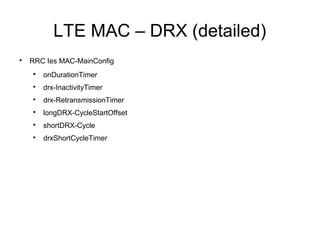
LTE MAC – DRX (detailed)

RRC Ies MAC-MainConfig

onDurationTimer

drx-InactivityTimer

drx-RetransmissionTimer

longDRX-CycleStartOffset

shortDRX-Cycle

drxShortCycleTimer
LTE MAC – HARQ (detailed)

the HARQ operation can be categorized according to whether the retransmission for
a given HARQ process occurs at a predefined time or at an arbitrary time, and also
according to whether the HARQ retransmission is adaptive or non-adaptive. In LTE,
asynchronous adaptive HARQ is used for the downlink and synchronous adaptive or
synchronous non-adaptive HARQ is used for the uplink

The New Data Indicator (NDI) field delivered through the PDCCH indicates whether
the transmitted data unit is a new one or a retransmitted one. If the value of the NDI
fieldin the downlink assignment changes compared to the value used in the previous
downlink assignment, this means that a new data unit is transmitted for the given
HARQ process. Likewise, if the value of the NDI field changes in the uplink grant, the
UE should transmit a new data unit

HARQ in Uplink
− n the synchronous HARQ scheme used in the uplink of LTE,
retransmission(s) for each HARQ process occurs at a predefined time
relative to the initial transmission. Using the time interval of successive
transmissions of the HARQ process and the time duration of each
transmission, the maximum number of usable HARQ processes can be
calculated. Because HARQ processes are used in a round-robin fashion, the
HARQ process being used at a given time can be identified easily based on
the transmission timing
LTE MAC – HARQ (detailed)

HARQ in Uplink
− In the uplink, HARQ retransmissions can be either adaptive or non-adaptive.
Adaptive HARQ retransmission means that new signaling of the transmission
attributes, such as the modulation and coding scheme, and transmission
resource allocation in the frequency domain are provided at the time of the
HARQ retransmission. Non-adaptive HARQ retransmission means that the
previously used transmission attributes are used again without any further
signaling of the transmission attributes
− non-adaptive retransmission scheme used as the default in the uplink

HARQ in Downlink
− HARQ retransmissions for a given HARQ process can occur at any time
relative to the initial transmission. Because several HARQ processes are
active at the same time, when the eNB assigns radio resources to the UE,
explicit signaling to indicate which HARQ process is intended is required in
the resource allocation information over the PDCCH. In that explicit
signaling, the process identifier of the target HARQ process should be
included so that the receiver can correctly associate each HARQ
retransmission with the corresponding initial transmission of the same HARQ
process.
LTE MAC - HARQ (detailed)

In the adaptive retransmission scheme used in the downlink, the transmission
attributes can be changed at each HARQ retransmission in response to variations in
the radio channel conditions. Though the adaptive scheme brings more scheduling
gain and flexibility, it also brings increased signaling overhead over the PDCCH. This
is because whenever there is HARQ retransmission, the eNB has to send resource
allocation information.
LTE MAC – TTI BUNDLING

when the UE is located near to the cell edge, even a small packet such as VoIP may
not be transmittable in a single subframe. In other words, compared to transmission
by a UE located in the center of a cell, the UE at the cell edge needs more energy per
subframe to achieve the same bit error rate. If the UE cannot increase its
transmission power, the UE should alternatively lengthen the transmission time to
increase the effective energy per bit. In the end, this can be regarded as decreasing
the effective amount of data per subframe

Decreasing the effective amount of data is also possible in the RLC layer by
generating smaller PDUs per subframe. However, this will result in more overhead
due to RLC and MAC PDU headers, and thus a MAC-based solution is preferable to
an RLC-based solution. TTI bundling is one of the MAC-based solutions

TTI bundling is effective in extending the uplink coverage and minimizing latency

If TTI bundling is not used, it takes 24 subframes for one HARQ process to make one
initial transmission with three retransmissions. However, if TTI bundling is used, it
takes only four subframes to make four HARQ (re-)transmissions
LTE MAC – TTI BUNDLING
(detailed)

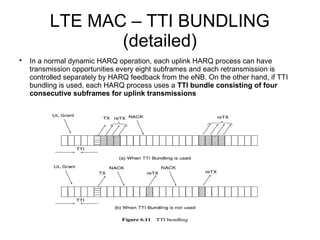
In a normal dynamic HARQ operation, each uplink HARQ process can have
transmission opportunities every eight subframes and each retransmission is
controlled separately by HARQ feedback from the eNB. On the other hand, if TTI
bundling is used, each HARQ process uses a TTI bundle consisting of four
consecutive subframes for uplink transmissions
LTE MAC – TTI BUNDLING
(detailed)

The use of TTI bundling also brings with it a trade-off. Because each TTI bundle
consists of four subframes, this requires a lot of scheduling consideration at the eNB.
Because four subframes are a big chunk of the radio resource, the eNB should be
careful that each subframe of the TTI bundle does not collide with the allocated radio
resource for other Ues. HARQ retransmissions in a TTI bundle are non-adaptive, and
this will further limit the eNB’s scheduling flexibility. In addition, if the eNB decodes
the user data successfully using the first few subframes of the TTI bundle, the other
subframes of the TTI bundle are just a waste of radio resource. However, as stated
previously, TTI bundling reduces the latency of data transmission by a UE at the cell
edge and this is beneficial for time-critical services such as a VoIP service. In
addition, with TTI bundling, because the last three subframes in a TTI bundle do not
require any signaling such as HARQ feedback or the uplink grant, this effectively
reduces the overhead of the resource allocation information

RRC IEs- MAC-MainConfig
− ul-SCH-Config

ttiBundling
LTE MAC - Measurement Gap

to make the UE perform the required measurement, the eNB configures the UE with
a measurement gap during which the UE does not need to transmit in the uplink nor
listen to downlink channels. Thus, during the measurement gap, the UE can stay
away from the serving frequency and ignore HARQ operations.

When the HARQ feedback for a transmitted transport block cannot be received due
to measurement gaps, the UE considers that a HARQ ACK has been received for the
transport block. In this case, the UE does not autonomously start HARQ
retransmissions at the next transmission opportunity. To resume the HARQ operation
on the HARQ process, the UE has to receive new resource allocation information.
The UE then performs either initial HARQ transmission or HARQ retransmission
depending on the content of the resource allocation information. When an uplink
transport block cannot be transmitted due to measurement gaps, the UE considers
that a HARQ NACK has been received for the transport block. This is a natural
consequence because the eNB cannot even try to decode a transport block which
has not been transmitted due to the measurement gap. Accordingly, the UE performs
HARQ retransmissions of the transport block at the next transmission opportunities
after it comes back from the measurement gap.
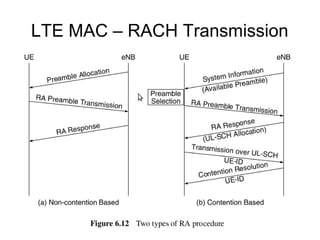
LTE MAC – RACH Transmission
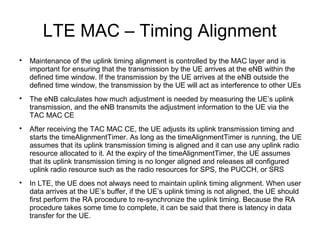
LTE MAC – Timing Alignment

Maintenance of the uplink timing alignment is controlled by the MAC layer and is
important for ensuring that the transmission by the UE arrives at the eNB within the
defined time window. If the transmission by the UE arrives at the eNB outside the
defined time window, the transmission by the UE will act as interference to other UEs

The eNB calculates how much adjustment is needed by measuring the UE’s uplink
transmission, and the eNB transmits the adjustment information to the UE via the
TAC MAC CE

After receiving the TAC MAC CE, the UE adjusts its uplink transmission timing and
starts the timeAlignmentTimer. As long as the timeAlignmentTimer is running, the UE
assumes that its uplink transmission timing is aligned and it can use any uplink radio
resource allocated to it. At the expiry of the timeAlignmentTimer, the UE assumes
that its uplink transmission timing is no longer aligned and releases all configured
uplink radio resource such as the radio resources for SPS, the PUCCH, or SRS

In LTE, the UE does not always need to maintain uplink timing alignment. When user
data arrives at the UE’s buffer, if the UE’s uplink timing is not aligned, the UE should
first perform the RA procedure to re-synchronize the uplink timing. Because the RA
procedure takes some time to complete, it can be said that there is latency in data
transfer for the UE.
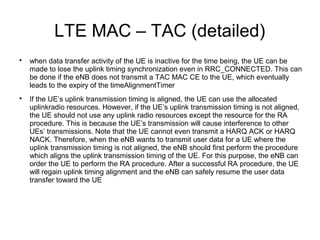
LTE MAC – TAC (detailed)

when data transfer activity of the UE is inactive for the time being, the UE can be
made to lose the uplink timing synchronization even in RRC_CONNECTED. This can
be done if the eNB does not transmit a TAC MAC CE to the UE, which eventually
leads to the expiry of the timeAlignmentTimer

If the UE’s uplink transmission timing is aligned, the UE can use the allocated
uplinkradio resources. However, if the UE’s uplink transmission timing is not aligned,
the UE should not use any uplink radio resources except the resource for the RA
procedure. This is because the UE’s transmission will cause interference to other
UEs’ transmissions. Note that the UE cannot even transmit a HARQ ACK or HARQ
NACK. Therefore, when the eNB wants to transmit user data for a UE where the
uplink transmission timing is not aligned, the eNB should first perform the procedure
which aligns the uplink transmission timing of the UE. For this purpose, the eNB can
order the UE to perform the RA procedure. After a successful RA procedure, the UE
will regain uplink timing alignment and the eNB can safely resume the user data
transfer toward the UE
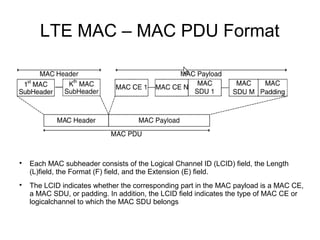
LTE MAC – MAC PDU Format

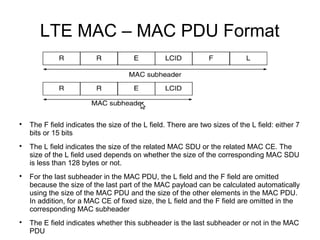
Each MAC subheader consists of the Logical Channel ID (LCID) field, the Length
(L)field, the Format (F) field, and the Extension (E) field.

The LCID indicates whether the corresponding part in the MAC payload is a MAC CE,
a MAC SDU, or padding. In addition, the LCID field indicates the type of MAC CE or
logicalchannel to which the MAC SDU belongs
LTE MAC – MAC PDU Format

The F field indicates the size of the L field. There are two sizes of the L field: either 7
bits or 15 bits

The L field indicates the size of the related MAC SDU or the related MAC CE. The
size of the L field used depends on whether the size of the corresponding MAC SDU
is less than 128 bytes or not.

For the last subheader in the MAC PDU, the L field and the F field are omitted
because the size of the last part of the MAC payload can be calculated automatically
using the size of the MAC PDU and the size of the other elements in the MAC PDU.
In addition, for a MAC CE of fixed size, the L field and the F field are omitted in the
corresponding MAC subheader

The E field indicates whether this subheader is the last subheader or not in the MAC
PDU
LTE MAC – MAC PDU Format

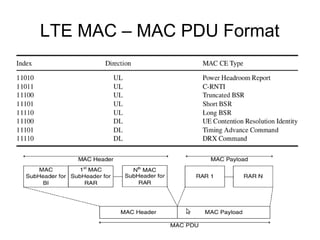
MAC Control Elements (CEs)

Buffer Status Report MAC CE

Power Headroom MAC CE

DRX Command MAC CE:- This MAC CE includes only a MAC subheader, and
the size of this MAC CE is fixed

Timing Advance Command MAC CE :- The size of this MAC CE is fixed

C-RNTI MAC CE:- The size of this MAC CE is fixed

UE Contention Resolution Identity MAC CE:- his MAC CE is sent from the eNB to
the UE and is used for the purpose of contention resolution during the RA
procedure. It is used only when the UE does not have a valid C-RNTI. When the
UE sends a CCCH SDU during the RA procedure, the eNB includes exactly the
same CCCH SDU in this MAC Control. Element to indicate which UE has won
the contention resolution. By comparing what it has sent in the CCCH SDU with
the received UE Contention Resolution Identity MAC CE, the UE can decide
whether it has finished the RA procedure successfully or not. The size of this
MAC CE is fixed
LTE MAC – MAC PDU Format

Lte mac presentation

  • 1.
    LTE Medium AccessLayer LTE-MAC Layer Presentation
  • 2.
    LTE-MAC Scheduling  Dynamic Scheduling  Suitablefor bursty traffic.  eNB allocates downlink radio resources to the UE using resource allocation information called downlink assignment  eNB allocates uplink radio resources to the UE using resource allocation information called uplink assignment  The down-link assignment and the uplink grant are signaled separately to the UE through the Physical Downlink Control CHannel (PDCCH), masked with the UE’s C-RNTI  Semi-Persistent Scheduling (SPS)  a VoIP service periodically generates many small-sized packets at short intervals.  To avoid lot of the downlink assignment and the uplink grant, leading to a heavy load on the PDCCH  reducing the number of the downlink assignment and the uplink grant is required to increase the number of supportable simultaneous VoIP calls in a cell  SPS is used to allocate radio resources for a long time period with a minimized load on the PDCCH
  • 3.
    LTE MAC –SPS (detailed)  Questions  Why we need SPS-RNTI, when we can distinguish UE based on CRNTI ?  What will happen when UE uses Web Browser (dynamic scheduling) and Voip call (semi persistence scheduling) simultaneously and scheduled both in single PDSCH frame?  What will happened when eNB is scheduling a RRC message with SPS-data in a single PDSCH frame ?  Concept of overriding the SPS Resource - When the resource allocation information masked by the C-RNTI is received at the subframe when the radio resources for SPS are configured, the UE uses the radio resource indicated by dynamic scheduling at that subframe and does not use the radio resource configured by SPS. The radio resource for SPS is replaced temporarily by the radio resources allocated by dynamic scheduling and after that Ue continues to use SPS configuration.  In essence, the resource allocation information over the PDCCH masked by SPS-C- RNTI indicates:  the activation of radio resources for SPS;  the reactivation of radio resources for SPS;  HARQ retransmission of transport blocks which were originally transmitted over
  • 4.
    LTE MAC –SPS (detailed)  RRC IEs for configuring SPS. − semiPersistSchedC-RNTI − DLConfig − semiPersistSchedIntervalDL(sf10 to sf640) − NumberOfConfSPS-Processes (1..8) − N1PUCCH-AN-PersistentList (1..4 PUCCH resource index) − ULConfig − semiPersistSchedIntervalUL − implicitReleaseAfter − p0-NominalPUSCH-Persistent − p0-UE-PUSCH-Persistent − TwoIntervalsConfig  When the UE receives resource allocation information masked with the SPS-C-RNTI with the NDI field set to 0, the UE stores the received resource allocation information and periodically uses the radio resources indicated by the stored information for the reception or transmission of MAC PDUs  When the UE receives resource allocation information masked withthe SPS-C-RNTI with the NDI field set to 1, it does not use the stored radio resource
  • 5.
    LTE MAC –SPS (detailed)  the time duration when people do not talk, called the silent period, is relatively long. when there is not so much gain from using SPS, it may be better to release the configured radio resources for SPS. To do so, the resource allocation information masked by the SPS-C-RNTI can include an indication to release radio resource for SPS and this is called explicit SPS release  In the uplink, as a solution to the problem of loss of the explicit SPS release command, another mechanism is adopted. In fact, the eNB cannot immediately be aware of the need to release the uplink radio resources for SPS. Thus, an implicit SPS release mechanism to release the uplink radio resources for SPS is also adopted in LTE. In this implicit SPS release, when a certain number of MAC PDUs is transmitted consecutively without includeing any MAC SDU using the radio resource for SPS, the UE releases the uplink radio resources for SPS without informing the eNB of this event
  • 6.
    LTE MAC –BSR (Buffer Status Reporting)  The BSR indicates how much data are buffered in the UE’s memory. for uplink radio resource allocation, a UE needs to send the BSR to the eNB to indicate the amount of data in the UE that need to be transmitted.  Two formats are defined for the BSR: Long BSR and Short BSR  The Long BSR is longer than the Short BSR and is used to deliver buffer status information for the four Logical Channel Groups (LCGs)  The Short BSR is used to deliver buffer status information for only one LCG. Which BSR format is used depends on what triggers the BSR, how many LCGs have data to send, and how much space is available in the MAC PDU.  The above states that the amount of data is indicated not per logical channel but per LCG. by grouping logical channels with similar attributes into at most four LCGs and by making the UE report the buffer status per LCG, LTE strikes a good balance between reporting efficiency and reporting accuracy  One special type of BSR is the Truncated BSR. The Truncated BSR has the same format as the Short BSR but with a different LCID field. The Truncated BSR is used when a Padding BSR is triggered and the space in the MAC PDU is not enough to include a Long BSR but when more than one LCG has data in the buffer
  • 7.
    LTE MAC –BSR (detailed)  A BSR can be triggered in any of the following situations:  When data arrive for a logical channel which has higher priority than the logical channels whose buffers are not empty. In this case, the triggered BSR is called a Regular BSR  When data become available for the UE’s buffer, which is empty. This is also called a Regular BSR  When the retxBSR-Timer expires and there is still data in the UE’s buffer. This is also called a Regular BSR − Purpose of retransmission BSR Timer :- HARQ NACK transmitted by the eNB is wrongly interpreted as a HARQ ACK by the UE (HARQ NACK-to-ACK error). To avoid this deadlock situation, the retxBSR- Timer is used.The timer is started when the MAC PDU including the BSR is transmitted, and restarted whenever the UE receives the uplink grant for a new transmission. When the retxBSR-Timer expires, it means that the UE has not received any uplink grant for some time.  When a periodicBSR-Timer expires. This BSR is called a Periodic BSR. This is used for the UE periodically to deliver updated buffer status
  • 8.
    LTE MAC –BSR (detailed)  Why periodic buffer status report is needed ?  let’s assume that the data belonging to only one logical channel arrive continuously at the UE’s buffer and the UE is in the middle of transmission of the data. In this case, the first BSR is triggered when the first data for the logical channel are available. However, provided that the data belonging to other logical channels do not arrive at the UE’s buffer, no BSR listed above will be triggered. As time goes by, more data may arrive for the logical channel and some data for the logical channel may be discarded. Thus, to prevent the discarding of data in a logical channel, a BSR is transmitted periodically using the periodicBSR-Timer  When SR transmission over PUCCH or RA procedure is used for transmitting BSR  if a UE does not have the uplink radio resource for a new transmission when a Regular BSR is triggered, a Scheduling Request (SR) procedure is triggered if the PUCCH for SR transmission is configured for the UE. However, if the UE is neither configured with the SR resource on the PUCCH nor allocated with the uplink grant, the UE starts the Random Access (RA) procedure when a Regular BSR is triggered  when a BSR other than a Regular BSR is triggered, SR transmission over the PUCCH or the RA procedure is not triggered
  • 9.
    LTE MAC –BSR (detailed)  The Truncated BSR has the same format as the Short BSR but with a different LCID field. when the UE cannot include a Long BSR in the MAC PDU and when more than one LCG have data to send, the UE uses the Truncated BSR instead of the Short BSR. When the eNB receives a Truncated BSR, it knows implicitly that other LCGs not indicated in the Truncated BSR also have data to send  If the eNB receives a Short BSR from the UE, this means that only the LCG included in the Short BSR has data to send and other LCGs do not have any data. If a Padding BSR is triggered and the UE sends a Short BSR, the eNB will conclude that other LCGs not included in the BSR do not have any data  RRC Ies (MAC-MainConfig)  ul-SCH-Config − PeriodicBSR-Timer (sf5 to sf 2560) − retxBSR-Timer (sf320 to sf10240)
  • 10.
    LTE MAC –Scheduling Request (SR)  The SR procedure starts when a Regular BSR is triggered but uplink radio resource to transmit the BSR is not available in the UE. During the SR procedure, the UE performs either transmission of the SR over the PUCCH or initiates the Random Access (RA) procedure, depending on whether the UE is configured with the PUCCH resource for SR or not. The RA procedure is initiated only when the PUCCH resource for SR is not configured  However, it may not always be possible for the eNB to configure the UE with the PUCCH resource for SR because the PUCCH resource in a cell is limited. Thus, there is a trade-off between resource allocation delay (due to RACH procedure) and the PUCCH load  The PUCCH resource for SR is allocated by the eNB in a periodic manner. The periodicity of the PUCCH resource allocated for SR is called SR periodicity. The SR periodicity impacts upon the delay for the UE to obtain uplink resource; that is, short periodicity leads to fast resource allocation. Thus, the eNB should strike a good balance between SR periodicity and PUCCH load
  • 11.
    LTE MAC –SR (detailed)  When the UE transmits the SR over the PUCCH, the UE keeps track of the number of SR transmissions. If the UE has not been allocated any uplink radio resource after reaching the maximum number of SR transmissions, it releases the PUCCH resources for SR and then initiates the RA procedure instead. This unsuccessful transmission of the SR over the PUCCH may have been caused by the wrong configuration, such as inaccurate transmission power. The eNB may identify the wrong SR configuration by detecting the RA procedure initiated by a UE configured with the PUCCH resource for SR  In Release 9, a timer, sr-ProhibitTimer, is introduced to prevent transmission of another SR within a short time period. Since there is a delay between SR transmission and uplink resource allocation (more than 4 ms), it is useless to transmit another SR during that period. Thus, the UE is not allowed to transmit an SR while the sr-ProhibitTimer is running. The value of the sr-ProhibitTimer is defined in multiples of SR periodicity.  RRC Ies MAC-MainConfig  Sr-ProhibitTimer-r9 (0 to 7) Value 0 means no timer for SR transmission on PUCCH is configured. Value 1 corresponds to one SR period, Value 2 corresponds to 2*SR periods and so on
  • 12.
    LTE MAC –Power Headroom Reporting (PHR)  With a given maximum power, if the UE is allocated more resources than it can support, the decoding error rate at the eNB will increase. Thus, it is important that the eNB has an accurate power status for the UE and allocates a suitable amount of radio resource. The Power Headroom Report (PHR) is used to provide the eNB with information about the difference between the nominal maximum transmit power and the estimated required power for uplink transmission  RRC IEs MAC-MainConfig  PeriodicPHR-Timer - The periodicPHR-Timer is used to make the UE periodically transmit a PHR  ProhibitPHR-Timer - The prohibitPHR-Timer is used to prevent frequent transmission of PHRs  dl-PathlossChange - When the pathloss fluctuates dramatically, the short-term changes in pathloss are filtered out by the prohibitPHR-Timer. The dl- PathlossChange parameter is used as a criterion to trigger a PHR. When the measured downlink pathloss is larger than this parameter, a PHR is triggered by the UE
  • 13.
    LTE MAC –Logical Channel Prioritization (LCP)  The LCP procedure is used for MAC PDU construction by deciding the amount of data from each logical channel and the type of MAC Control Element that should be included in the MAC PDU. By using the LCP procedure, the UE can satisfy the QoS of each radio bearer in the best and most predictable way  In LTE, a Prioritized Bit Rate (PBR) is defined for each logical channel, in order to transmit data in order of importance but also to avoid starvation of data with lower priority. The PBR is the minimum data rate guaranteed for the logical channel. Even if the logical channel has low priority, at least a small amount of MAC PDU space is allocated to guarantee the PBR. Thus, the starvation problem can be avoided by using the PBR  Constructing a MAC PDU with PBR consists of two rounds. In the first round, each logical channel is served in decreasing order of logical channel priority, but the amount of data from each logical channel included in the MAC PDU is initially limited to the amount corresponding to the configured PBR value of the logical channel.  After all logical channels have been served up to their PBR values, if there is room left in the MAC PDU, the second round is performed. In the second round, each logical channel is served again in decreasing order of priority. The major difference for the second round compared to the first round is that each logical channel of lower priority can be allocated with MAC PDU space only if all logical channels of higher priority have no more data to transmit
  • 14.
    LTE MAC –LCP/PBR (detailed)  Priority of MAC CEs and data from logical channels (Highest to Lowest) − MAC CE for C-RNTI or data from UL-CCCH − MAC CE for BSR, with the exception of BSR included for padding − MAC CE for PHR − Data from any logical channel, except data from UL-CCCH − MAC CE for padding BSR  Token Bucket Model for Logical Channel  Rather than applying the above PBR requirements for every subframe, it is better to meet the PBR requirements for a long time period. To reduce the overhead and to prevent too much segmentation, the token bucket model with PBR is applied  In the token-bucket model, each logical channel is associated with two parameters: bucketSizeDuration and prioritizedBitRate
  • 15.
    LTE MAC –LCP/PBR (detailed)  In this model, it is assumed that each logical channel is given a right to transmit a prioritizedBitRate amount of data in every subframe. If a certain logical channel has not fully used the right to transmit its prioritizedBitRate amount of data in a certain subframe, the remaining right can be used in another subframe. The right to transmit can be accumulated up to a ( prioritizedBitRate X bucketSizeDuration) amount of data.  When some data for the logical channel are included in a MAC PDU, the right to transmit is decreased by the amount of data included in the MAC PDU. To prevent a certain logical channel from accumulating too much right to transmit, the parameter bucketSizeDuration sets the limit up to which a logical channel can accumulate the right to transmit. Through this token-bucket model, the UE can meet the PBR principle on average for a longer time period, not per subframe.  RRC IEs LogicalChannelConfig − LogicalChannelConfig  Priority (1 to 16)  PrioritisedBitRate (0kbps to 2048kbps)  BucketSizeDuration (ms50 to ms1000)  LogicalChannelGroup (0 to 3)
  • 16.
    LTE MAC –Discontinuous Reception (DRX)  To reduce the battery consumption in the UE, a mechanism to minimize the time that the UE spends monitoring the PDCCH is used; this is called the Discontinuous Reception (DRX) functionality. The DRX mechanism should meet two conflicting requirements. As a result, the parameterization of DRX involves a trade-off between battery saving and latency reduction  In LTE, up to two different lengths of DRX cycle – that is, long DRX cycle and short DRX cycle – can be used for a UE in RRC_CONNECTED. Note that the use of short DRX cycle is optionally configured by the eNB.  A long DRX cycle is beneficial for lengthening the UE’s battery life.On the other hand, a shorter DRX cycle is better when data transfer is resumed quickly  State Transition for DRX − Continuous Reception To Short DRX − Short DRX to Continuous Reception − Short DRX to Long DRX − Long DRX to Continuous Reception − Continuous Reception to Long DRX
  • 17.
    LTE MAC –DRX (detailed)  In Continuous Reception State − On expiry of drx-InactivityTimer it is transit to Short DRX.  In short DRX State − When the UE moves into a short DRX cycle, it starts drxShortCycleTimer − The UE stays in the short DRX cycle until the expiry of the drxShortCycleTimer, and moves to a long DRX cycle at the expiry of the drxShortCycleTimer. − If the UE receives any resource allocation information while the drxShortCycleTimer is running, it moves back to continuous reception mode − whenever the UE receives resource allocation information indicating a new transmission during any of the DRX cycle, it immediately moves back to continuous reception mode  In addition to timer-based transition, explicit-command-based transition is also used. If the eNB is sure that there is no more data for the UE or if it does not want to schedule any down link data for the UE for some time, the eNB can send a DRX command MAC CE to the UE. When the UE receives this DRX command MAC CE, it immediately moves either to a short DRX cycle (if configured) or to a long DRX cycle.
  • 18.
    LTE MAC –DRX (detailed)  In the short DRX cycle and the long DRX cycle, the UE monitors the PDCCH for some of the subframes out of all available subframes. Because the UE monitors only a small portion of all possible subframes, the UE’s power consumption can be reduced  The mandatory PDCCH monitoring time in each DRX cycle is called the “On Duration” and it is located in the first part of each DRX cycle. More specifically, a DRX cycle consists of an “On Duration” during which the UE should monitor the PDCCH and the “DRX period” during which the UE is allowed not to monitor the PDCCH  The number of subframes or the length of time that a UE should monitor the PDCCH in one DRX cycle is controlled by the onDurationTimer. At the beginning of each DRX cycle, the UE starts the onDurationTimer and monitors the PDCCH while the timer is running. The length of the timer controls the scheduling flexibility of the eNB.  If the length of the onDurationTimer is one subframe, the eNB can send a resource allocation message only during that one subframe. However, if the length of the onDurationTimer is more than one subframe, the eNB can select one of the available subframes to send the resource allocation information. This is beneficial to the eNB especially when the PDCCH is heavily loaded. Thus, depending on the length of the onDurationTimer, the eNB can have flexibility regarding when to send resource allocation information
  • 19.
    LTE MAC –DRX (detailed)  The Active Time is the time when a UE should monitor the PDCCH for possible resource allocation information. This Active Time includes the time period when timers such as drx-InactivityTimer, drx-RetransmissionTimer, and onDurationTimer are running.  When resource allocation information is received during the Active Time, the UE starts or restarts the drx-InactivityTimer and monitors the PDCCH in every subframe while the drx-InactivityTimer is running. Thus, resource allocation information received during the Active Time effectively extends the Active Time  At the expiry of the drx-InactivityTimer or on receipt of a DRX Command MAC CE, the UE stops the Active Time and moves into a short DRX cycle or a long DRX cycle  HARQ related DRX operation  When the decoding of a downlink transport block for one HARQ process fails, the UE starts the HARQ RTT timer for the HARQ process, assuming that the next HARQ retransmission of the process will occur at least after the expiry of the HARQ RTT timer.
  • 20.
    LTE MAC –DRX (detailed)  HARQ related DRX operation  For the HARQ process for which the HARQ RTT timer is running, the UE does not need to monitor the PDCCH.  at the expiry of the HARQ RTT timer, the UE should resume monitoring the PDCCH for a possible HARQ retransmission. However, the UE cannot wait endlessly for a HARQ retransmission because a HARQ NACK-to-ACK error might occur or the eNB might just decide not to transmit anything for the concerned HARQ process.  To limit the PDCCH monitoring time for potential retransmission, a drx- RetransmissionTimer is used for the DL HARQ process. This timer starts at the expiry of the HARQ RTT timer, and the UE monitors the PDCCH only when the drx-RetransmissionTimer is running.  The length of the drx-RetransmissionTimer is related to how much eNB scheduling flexibility is required. For optimal UE battery consumption, it is desirable for the eNB to schedule HARQ retransmission as soon as the HARQ RTT timer expires. However, this requires the eNB always to reserve the capacity to transmit resource allocation information for the subframe where the HARQ RTT timer expires.
  • 21.
    LTE MAC –DRX (detailed)  RRC Ies MAC-MainConfig  onDurationTimer  drx-InactivityTimer  drx-RetransmissionTimer  longDRX-CycleStartOffset  shortDRX-Cycle  drxShortCycleTimer
  • 22.
    LTE MAC –HARQ (detailed)  the HARQ operation can be categorized according to whether the retransmission for a given HARQ process occurs at a predefined time or at an arbitrary time, and also according to whether the HARQ retransmission is adaptive or non-adaptive. In LTE, asynchronous adaptive HARQ is used for the downlink and synchronous adaptive or synchronous non-adaptive HARQ is used for the uplink  The New Data Indicator (NDI) field delivered through the PDCCH indicates whether the transmitted data unit is a new one or a retransmitted one. If the value of the NDI fieldin the downlink assignment changes compared to the value used in the previous downlink assignment, this means that a new data unit is transmitted for the given HARQ process. Likewise, if the value of the NDI field changes in the uplink grant, the UE should transmit a new data unit  HARQ in Uplink − n the synchronous HARQ scheme used in the uplink of LTE, retransmission(s) for each HARQ process occurs at a predefined time relative to the initial transmission. Using the time interval of successive transmissions of the HARQ process and the time duration of each transmission, the maximum number of usable HARQ processes can be calculated. Because HARQ processes are used in a round-robin fashion, the HARQ process being used at a given time can be identified easily based on the transmission timing
  • 23.
    LTE MAC –HARQ (detailed)  HARQ in Uplink − In the uplink, HARQ retransmissions can be either adaptive or non-adaptive. Adaptive HARQ retransmission means that new signaling of the transmission attributes, such as the modulation and coding scheme, and transmission resource allocation in the frequency domain are provided at the time of the HARQ retransmission. Non-adaptive HARQ retransmission means that the previously used transmission attributes are used again without any further signaling of the transmission attributes − non-adaptive retransmission scheme used as the default in the uplink  HARQ in Downlink − HARQ retransmissions for a given HARQ process can occur at any time relative to the initial transmission. Because several HARQ processes are active at the same time, when the eNB assigns radio resources to the UE, explicit signaling to indicate which HARQ process is intended is required in the resource allocation information over the PDCCH. In that explicit signaling, the process identifier of the target HARQ process should be included so that the receiver can correctly associate each HARQ retransmission with the corresponding initial transmission of the same HARQ process.
  • 24.
    LTE MAC -HARQ (detailed)  In the adaptive retransmission scheme used in the downlink, the transmission attributes can be changed at each HARQ retransmission in response to variations in the radio channel conditions. Though the adaptive scheme brings more scheduling gain and flexibility, it also brings increased signaling overhead over the PDCCH. This is because whenever there is HARQ retransmission, the eNB has to send resource allocation information.
  • 25.
    LTE MAC –TTI BUNDLING  when the UE is located near to the cell edge, even a small packet such as VoIP may not be transmittable in a single subframe. In other words, compared to transmission by a UE located in the center of a cell, the UE at the cell edge needs more energy per subframe to achieve the same bit error rate. If the UE cannot increase its transmission power, the UE should alternatively lengthen the transmission time to increase the effective energy per bit. In the end, this can be regarded as decreasing the effective amount of data per subframe  Decreasing the effective amount of data is also possible in the RLC layer by generating smaller PDUs per subframe. However, this will result in more overhead due to RLC and MAC PDU headers, and thus a MAC-based solution is preferable to an RLC-based solution. TTI bundling is one of the MAC-based solutions  TTI bundling is effective in extending the uplink coverage and minimizing latency  If TTI bundling is not used, it takes 24 subframes for one HARQ process to make one initial transmission with three retransmissions. However, if TTI bundling is used, it takes only four subframes to make four HARQ (re-)transmissions
  • 26.
    LTE MAC –TTI BUNDLING (detailed)  In a normal dynamic HARQ operation, each uplink HARQ process can have transmission opportunities every eight subframes and each retransmission is controlled separately by HARQ feedback from the eNB. On the other hand, if TTI bundling is used, each HARQ process uses a TTI bundle consisting of four consecutive subframes for uplink transmissions
  • 27.
    LTE MAC –TTI BUNDLING (detailed)  The use of TTI bundling also brings with it a trade-off. Because each TTI bundle consists of four subframes, this requires a lot of scheduling consideration at the eNB. Because four subframes are a big chunk of the radio resource, the eNB should be careful that each subframe of the TTI bundle does not collide with the allocated radio resource for other Ues. HARQ retransmissions in a TTI bundle are non-adaptive, and this will further limit the eNB’s scheduling flexibility. In addition, if the eNB decodes the user data successfully using the first few subframes of the TTI bundle, the other subframes of the TTI bundle are just a waste of radio resource. However, as stated previously, TTI bundling reduces the latency of data transmission by a UE at the cell edge and this is beneficial for time-critical services such as a VoIP service. In addition, with TTI bundling, because the last three subframes in a TTI bundle do not require any signaling such as HARQ feedback or the uplink grant, this effectively reduces the overhead of the resource allocation information  RRC IEs- MAC-MainConfig − ul-SCH-Config  ttiBundling
  • 28.
    LTE MAC -Measurement Gap  to make the UE perform the required measurement, the eNB configures the UE with a measurement gap during which the UE does not need to transmit in the uplink nor listen to downlink channels. Thus, during the measurement gap, the UE can stay away from the serving frequency and ignore HARQ operations.  When the HARQ feedback for a transmitted transport block cannot be received due to measurement gaps, the UE considers that a HARQ ACK has been received for the transport block. In this case, the UE does not autonomously start HARQ retransmissions at the next transmission opportunity. To resume the HARQ operation on the HARQ process, the UE has to receive new resource allocation information. The UE then performs either initial HARQ transmission or HARQ retransmission depending on the content of the resource allocation information. When an uplink transport block cannot be transmitted due to measurement gaps, the UE considers that a HARQ NACK has been received for the transport block. This is a natural consequence because the eNB cannot even try to decode a transport block which has not been transmitted due to the measurement gap. Accordingly, the UE performs HARQ retransmissions of the transport block at the next transmission opportunities after it comes back from the measurement gap.
  • 29.
    LTE MAC –RACH Transmission
  • 30.
    LTE MAC –Timing Alignment  Maintenance of the uplink timing alignment is controlled by the MAC layer and is important for ensuring that the transmission by the UE arrives at the eNB within the defined time window. If the transmission by the UE arrives at the eNB outside the defined time window, the transmission by the UE will act as interference to other UEs  The eNB calculates how much adjustment is needed by measuring the UE’s uplink transmission, and the eNB transmits the adjustment information to the UE via the TAC MAC CE  After receiving the TAC MAC CE, the UE adjusts its uplink transmission timing and starts the timeAlignmentTimer. As long as the timeAlignmentTimer is running, the UE assumes that its uplink transmission timing is aligned and it can use any uplink radio resource allocated to it. At the expiry of the timeAlignmentTimer, the UE assumes that its uplink transmission timing is no longer aligned and releases all configured uplink radio resource such as the radio resources for SPS, the PUCCH, or SRS  In LTE, the UE does not always need to maintain uplink timing alignment. When user data arrives at the UE’s buffer, if the UE’s uplink timing is not aligned, the UE should first perform the RA procedure to re-synchronize the uplink timing. Because the RA procedure takes some time to complete, it can be said that there is latency in data transfer for the UE.
  • 31.
    LTE MAC –TAC (detailed)  when data transfer activity of the UE is inactive for the time being, the UE can be made to lose the uplink timing synchronization even in RRC_CONNECTED. This can be done if the eNB does not transmit a TAC MAC CE to the UE, which eventually leads to the expiry of the timeAlignmentTimer  If the UE’s uplink transmission timing is aligned, the UE can use the allocated uplinkradio resources. However, if the UE’s uplink transmission timing is not aligned, the UE should not use any uplink radio resources except the resource for the RA procedure. This is because the UE’s transmission will cause interference to other UEs’ transmissions. Note that the UE cannot even transmit a HARQ ACK or HARQ NACK. Therefore, when the eNB wants to transmit user data for a UE where the uplink transmission timing is not aligned, the eNB should first perform the procedure which aligns the uplink transmission timing of the UE. For this purpose, the eNB can order the UE to perform the RA procedure. After a successful RA procedure, the UE will regain uplink timing alignment and the eNB can safely resume the user data transfer toward the UE
  • 32.
    LTE MAC –MAC PDU Format  Each MAC subheader consists of the Logical Channel ID (LCID) field, the Length (L)field, the Format (F) field, and the Extension (E) field.  The LCID indicates whether the corresponding part in the MAC payload is a MAC CE, a MAC SDU, or padding. In addition, the LCID field indicates the type of MAC CE or logicalchannel to which the MAC SDU belongs
  • 33.
    LTE MAC –MAC PDU Format  The F field indicates the size of the L field. There are two sizes of the L field: either 7 bits or 15 bits  The L field indicates the size of the related MAC SDU or the related MAC CE. The size of the L field used depends on whether the size of the corresponding MAC SDU is less than 128 bytes or not.  For the last subheader in the MAC PDU, the L field and the F field are omitted because the size of the last part of the MAC payload can be calculated automatically using the size of the MAC PDU and the size of the other elements in the MAC PDU. In addition, for a MAC CE of fixed size, the L field and the F field are omitted in the corresponding MAC subheader  The E field indicates whether this subheader is the last subheader or not in the MAC PDU
  • 34.
    LTE MAC –MAC PDU Format  MAC Control Elements (CEs)  Buffer Status Report MAC CE  Power Headroom MAC CE  DRX Command MAC CE:- This MAC CE includes only a MAC subheader, and the size of this MAC CE is fixed  Timing Advance Command MAC CE :- The size of this MAC CE is fixed  C-RNTI MAC CE:- The size of this MAC CE is fixed  UE Contention Resolution Identity MAC CE:- his MAC CE is sent from the eNB to the UE and is used for the purpose of contention resolution during the RA procedure. It is used only when the UE does not have a valid C-RNTI. When the UE sends a CCCH SDU during the RA procedure, the eNB includes exactly the same CCCH SDU in this MAC Control. Element to indicate which UE has won the contention resolution. By comparing what it has sent in the CCCH SDU with the received UE Contention Resolution Identity MAC CE, the UE can decide whether it has finished the RA procedure successfully or not. The size of this MAC CE is fixed
  • 35.
    LTE MAC –MAC PDU Format