C2 – Vodafone Idea Internal
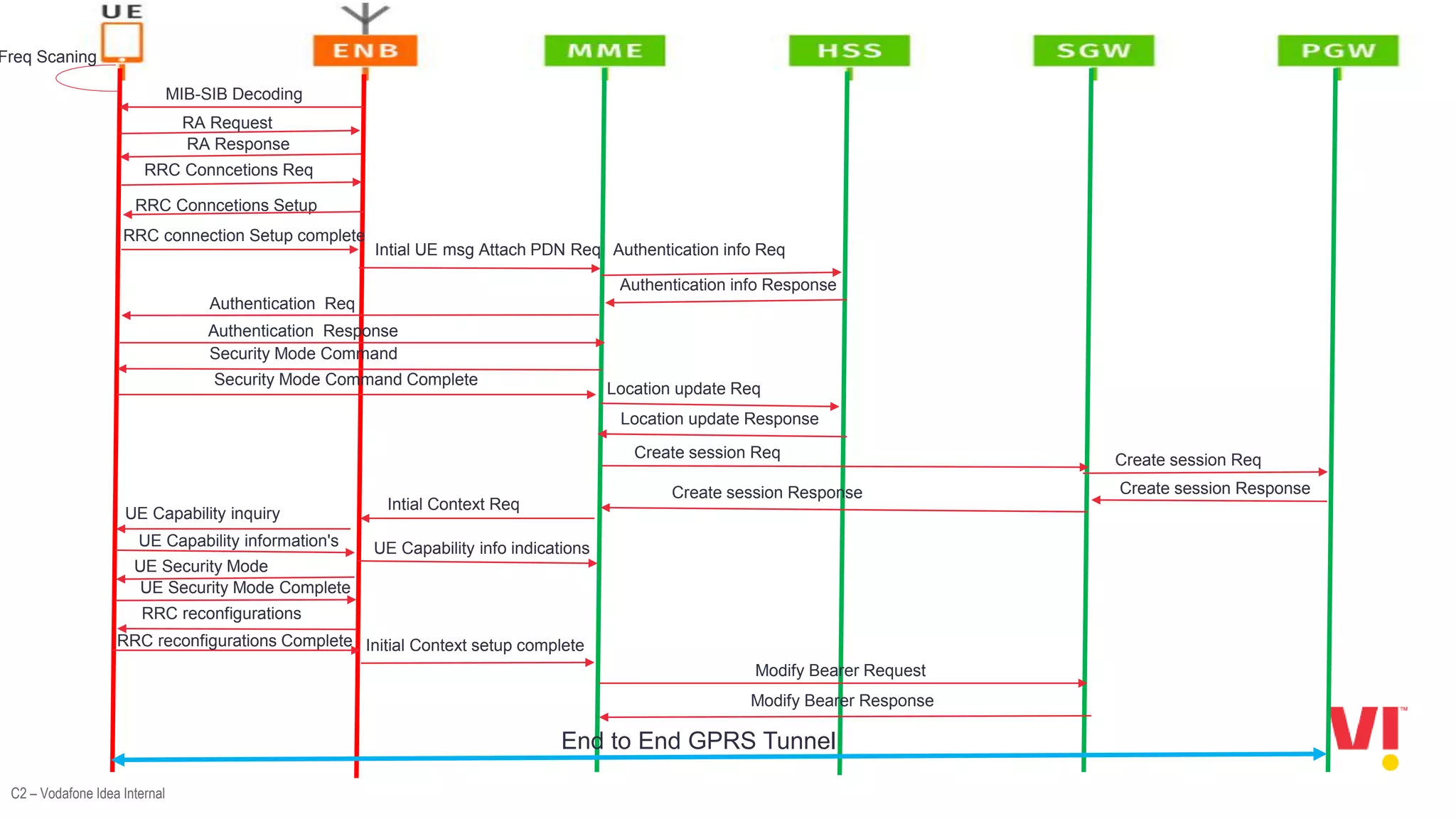
LTE Attach Call
Flow Discussion
Surinder Salyan
RF Quality_Haryana
C2 – Vodafone Idea Internal
Content of Discussion
1. Evolution of Cellular system
2. Coverage Pattern of Different Bands
3. 5G introductions for Coverage point of view
4. Sites Connectivity diagram
5. LTE/EPS Network Elements & architecture
6. Massage flow overview to attach in LTE network
7. Frequency scanning
8. PSS & SSS Decoding
9. MIB decoding
10. PDCCH decoding
11. SIB Decoding
12. RACH process
13. RRC connections request
14. RRC connections Setup
15. RRC connections Setup complete
C2 – Vodafone Idea Internal
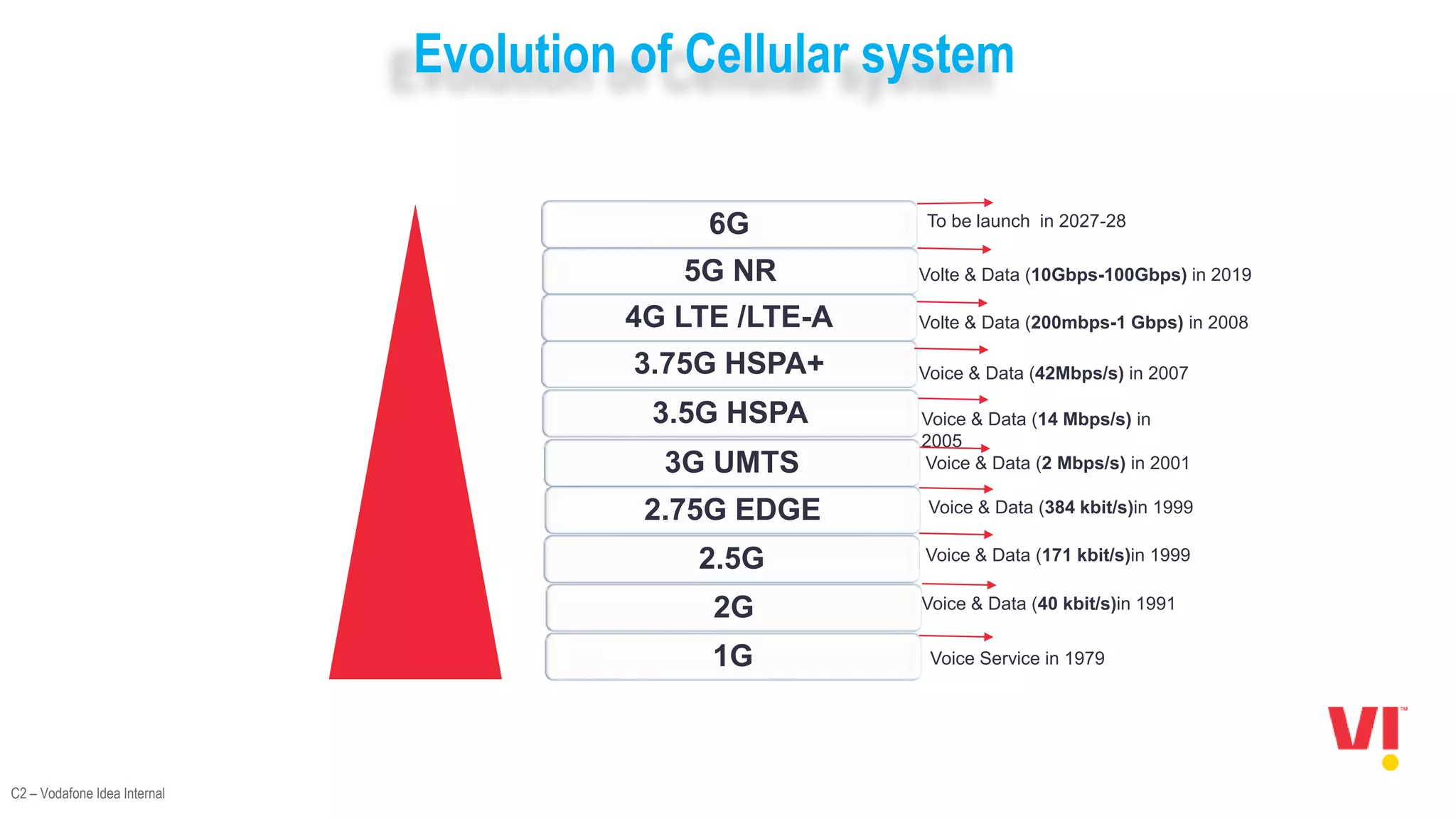
Evolution of Cellular system
Voice Service in 1979
Voice & Data (40 kbit/s)in 1991
Voice & Data (171 kbit/s)in 1999
Voice & Data (384 kbit/s)in 1999
Voice & Data (2 Mbps/s) in 2001
Voice & Data (14 Mbps/s) in
2005
Voice & Data (42Mbps/s) in 2007
Volte & Data (200mbps-1 Gbps) in 2008
Volte & Data (10Gbps-100Gbps) in 2019
3.75G HSPA+
To be launch in 2027-28
6G
2G
2.5G
2.75G EDGE
3G UMTS
3.5G HSPA
5G NR
4G LTE /LTE-A
1G
C2 – Vodafone Idea Internal
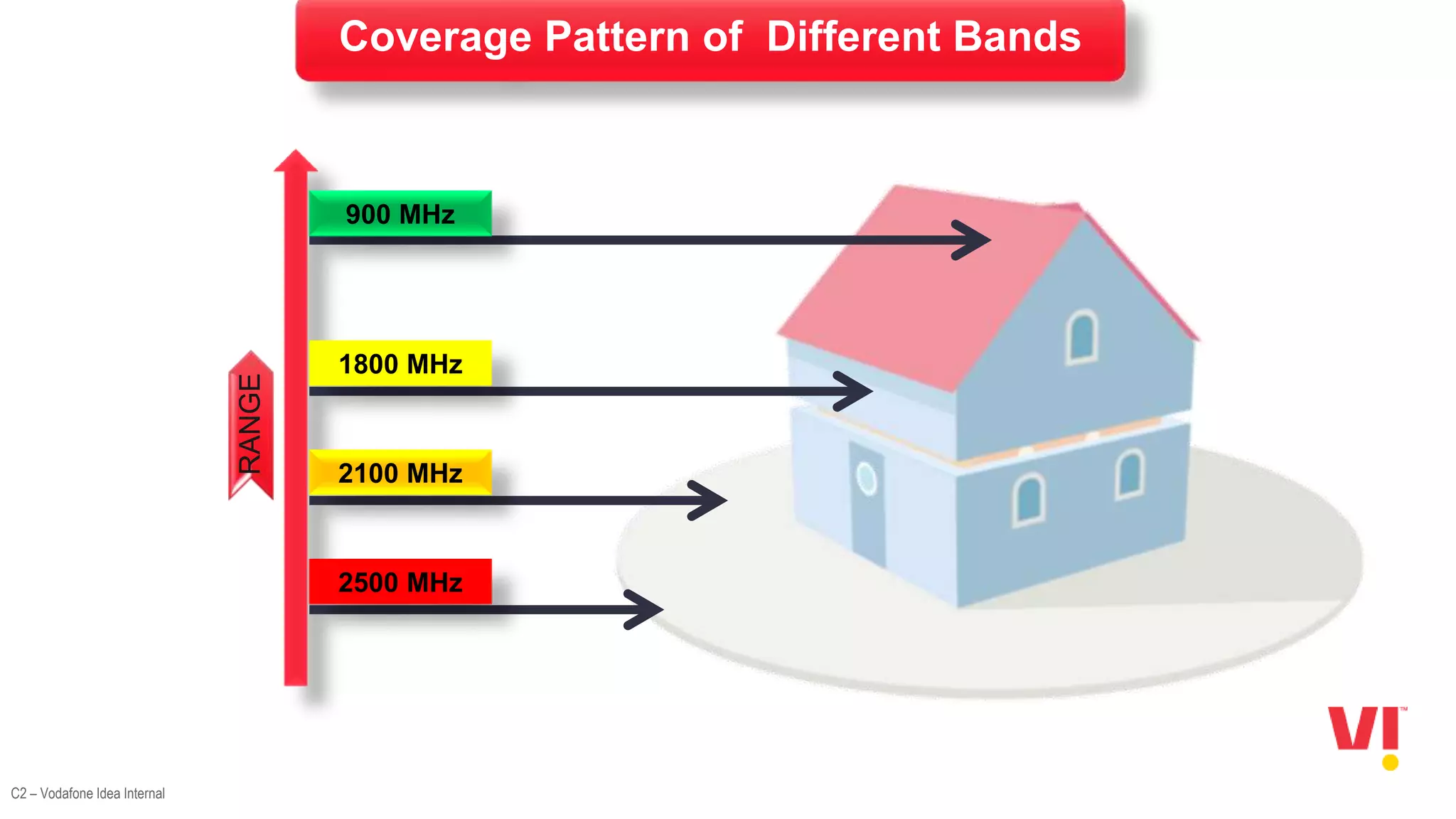
Coverage Pattern of Different Bands
900 MHz
2500 MHz
2100 MHz
1800 MHz
RANGE
C2 – Vodafone Idea Internal
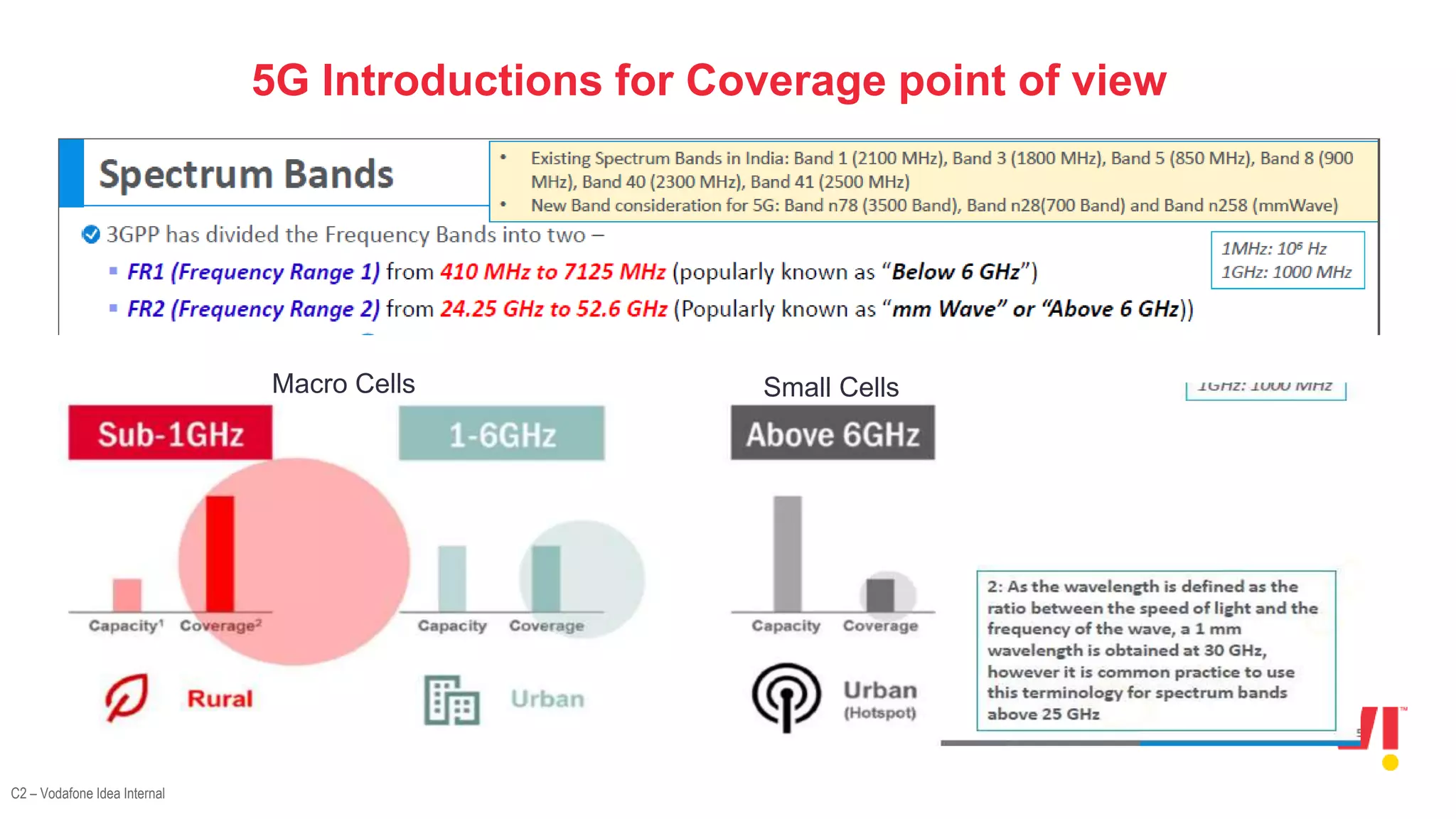
5G Introductions for Coverage point of view
Macro Cells Small Cells
C2 – Vodafone Idea Internal
PoP
A
D
C
B
E
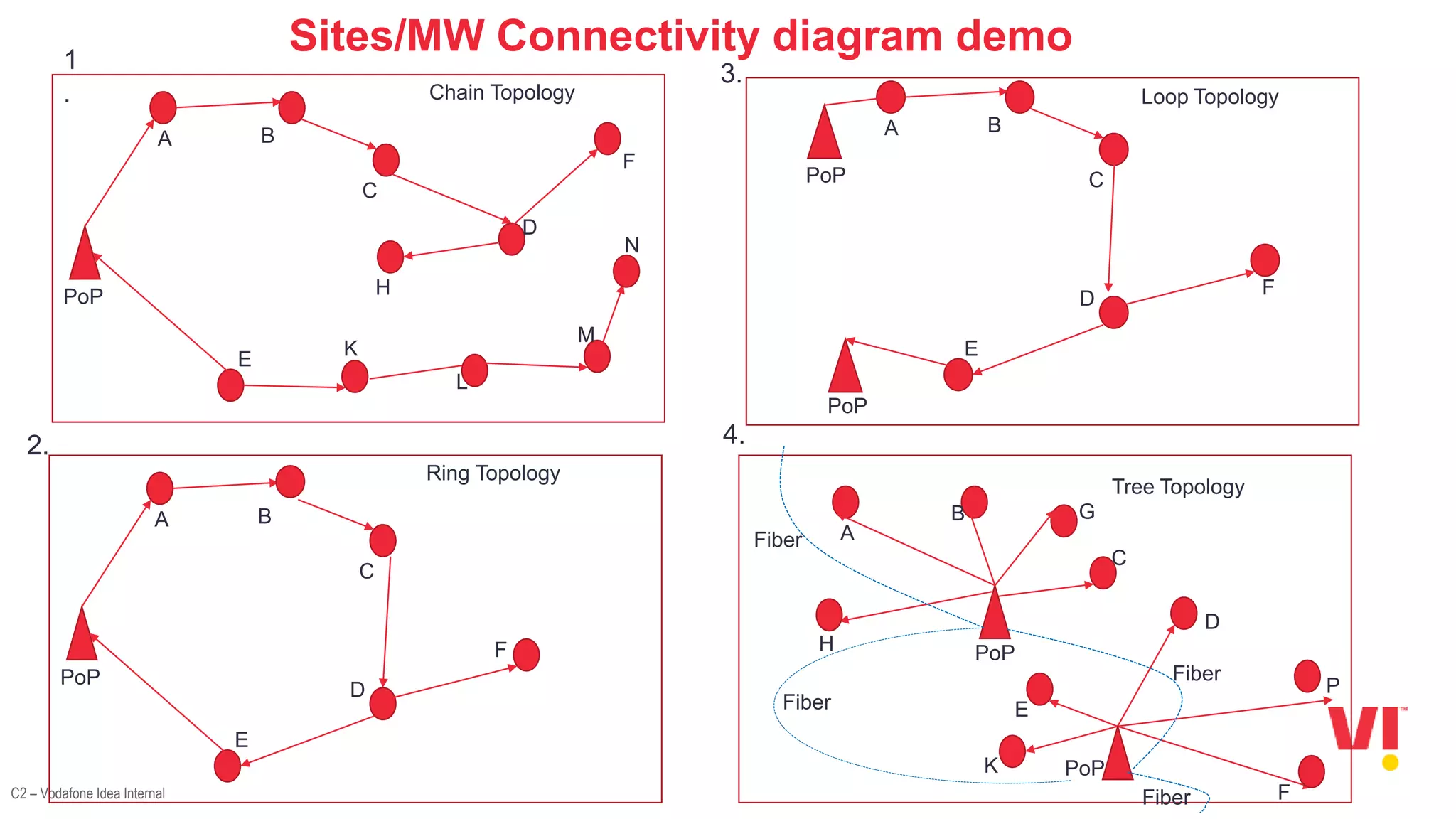
Ring Topology
F
PoP
A
D
C
B
E
Chain Topology
F
PoP
A
D
C
B
E
Tree Topology
F
PoP
H
G
P
K
K
L
M
N
H
Sites/MW Connectivity diagram demo
1
.
2. 4.
A
D
C
B
E
Loop Topology
PoP
F
3.
Fiber
Fiber
Fiber
Fiber
PoP
C2 – Vodafone Idea Internal
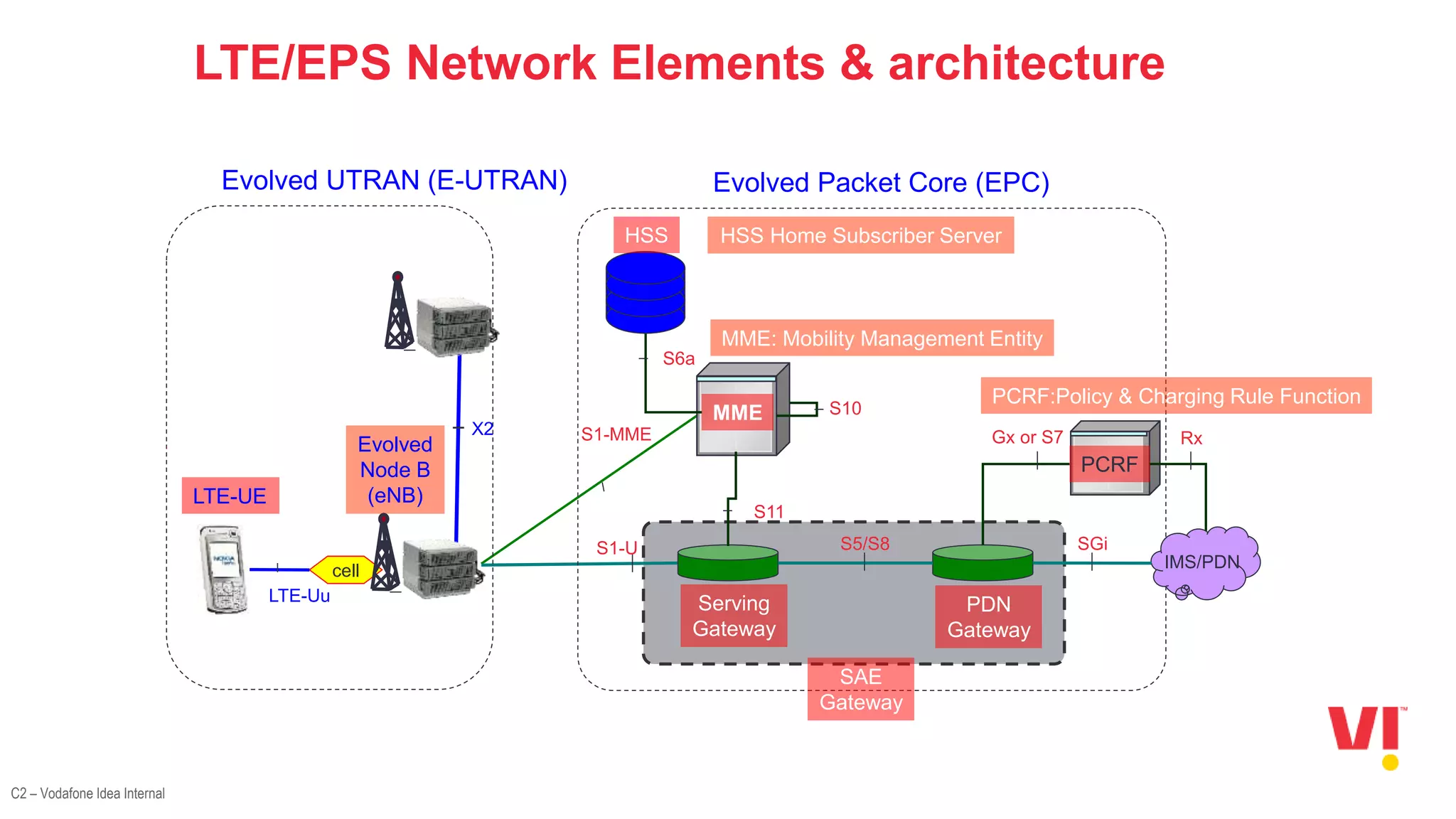
LTE/EPS Network Elements & architecture
LTE-UE
Evolved UTRAN (E-UTRAN)
MME S10
S6a
Serving
Gateway
S1-U
S11
PDN
Gateway
IMS/PDN
Evolved Packet Core (EPC)
S1-MME
PCRF
Gx or S7 Rx
SGi
S5/S8
Evolved
Node B
(eNB)
cell
X2
LTE-Uu
HSS
MME: Mobility Management Entity
PCRF:Policy & Charging Rule Function
SAE
Gateway
HSS Home Subscriber Server
C2 – Vodafone Idea Internal
MIB-SIB Decoding
Freq Scaning
RA Request
RA Response
RRC Conncetions Req
RRC Conncetions Setup
RRC connection Setup complete
Intial UE msg Attach PDN Req Authentication info Req
Authentication info Response
Authentication Req
Authentication Response
Security Mode Command
Security Mode Command Complete
Location update Req
Location update Response
Create session Req Create session Req
Create session Response
Intial Context Req
UE Capability inquiry
UE Capability information's UE Capability info indications
UE Security Mode
UE Security Mode Complete
RRC reconfigurations
RRC reconfigurations Complete Initial Context setup complete
Modify Bearer Request
Modify Bearer Response
End to End GPRS Tunnel
C2 – Vodafone Idea Internal
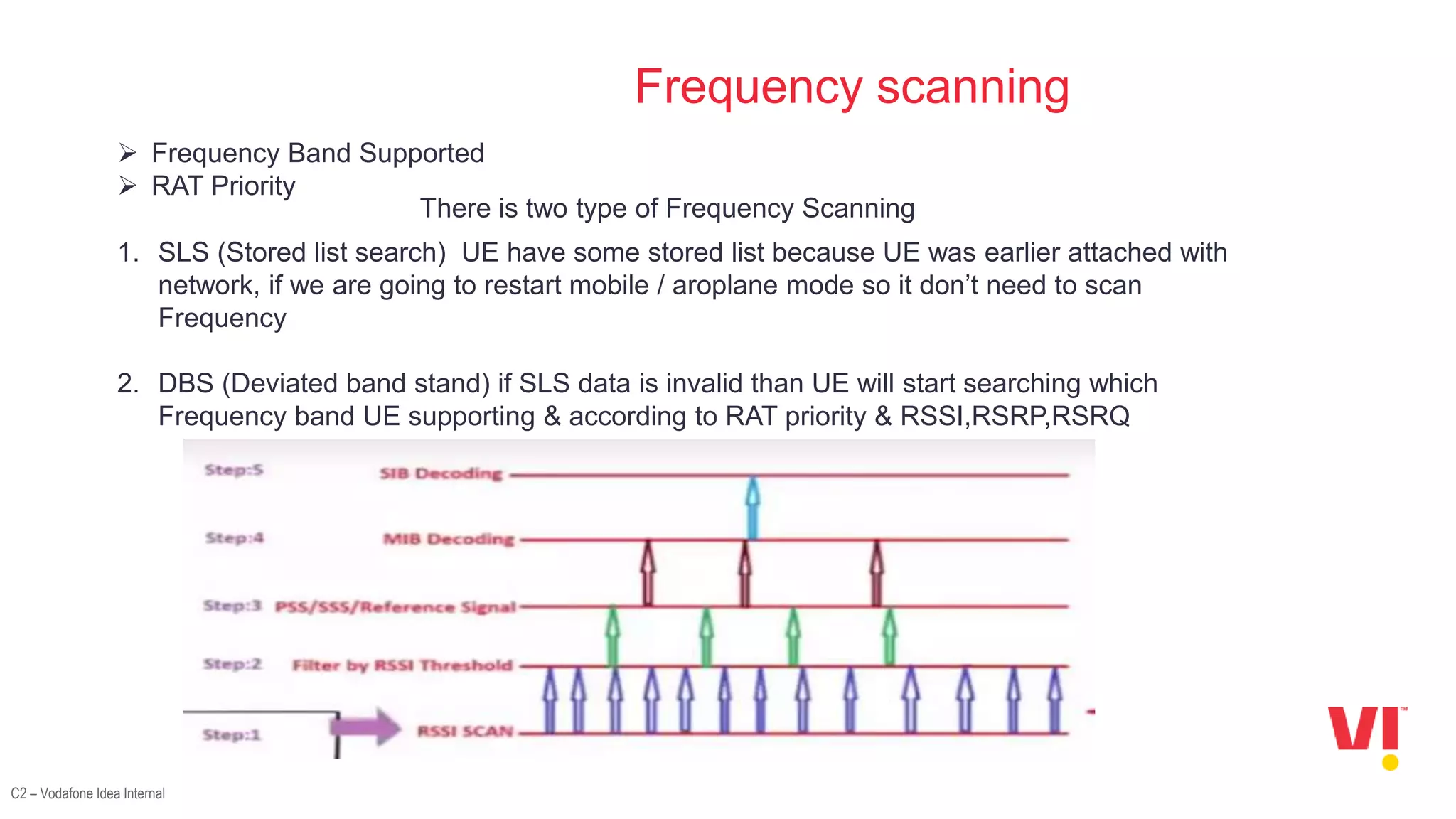
Frequency scanning
1. SLS (Stored list search) UE have some stored list because UE was earlier attached with
network, if we are going to restart mobile / aroplane mode so it don’t need to scan
Frequency
2. DBS (Deviated band stand) if SLS data is invalid than UE will start searching which
Frequency band UE supporting & according to RAT priority & RSSI,RSRP,RSRQ
 Frequency Band Supported
 RAT Priority
There is two type of Frequency Scanning
C2 – Vodafone Idea Internal
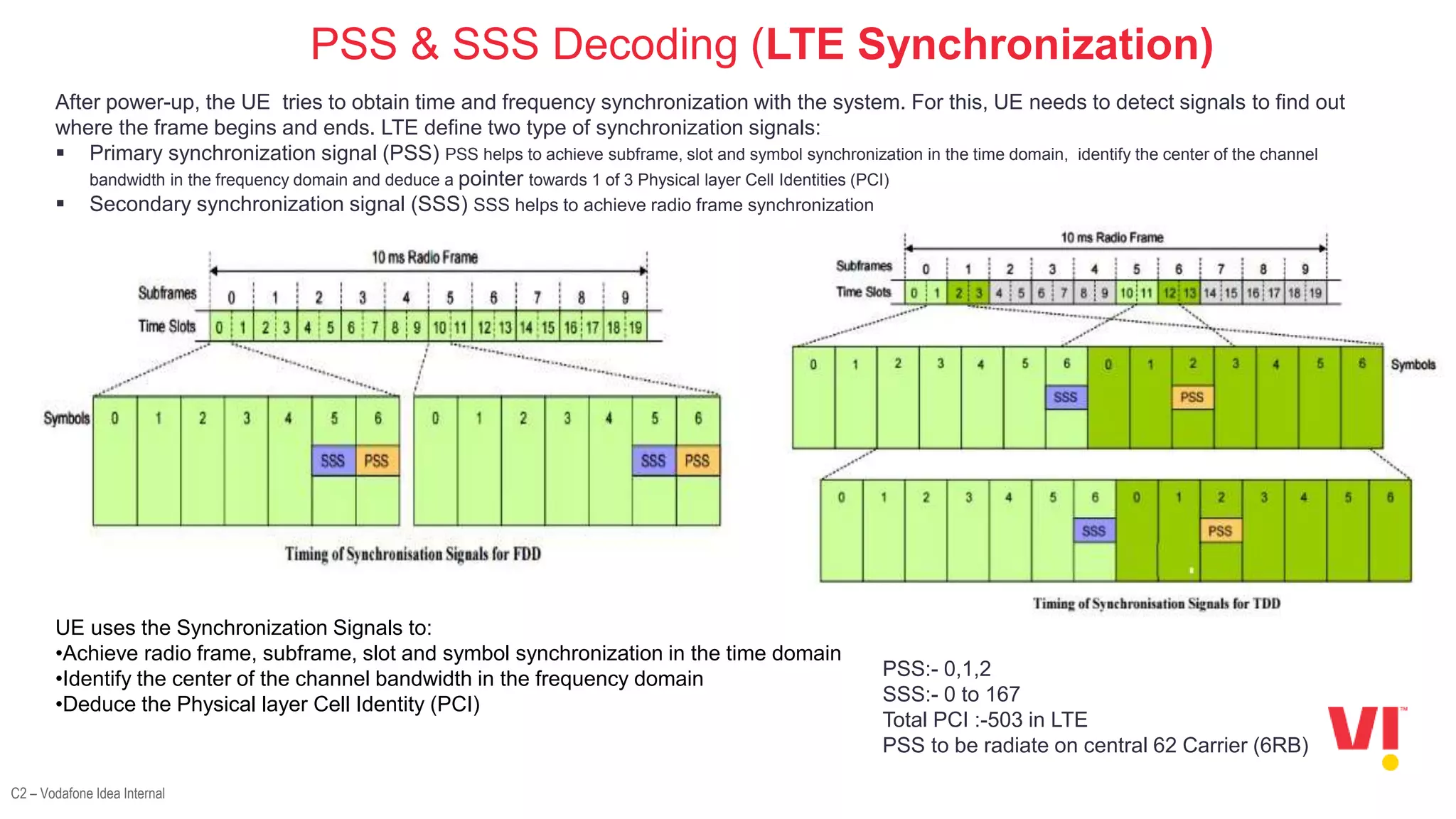
PSS & SSS Decoding (LTE Synchronization)
After power-up, the UE tries to obtain time and frequency synchronization with the system. For this, UE needs to detect signals to find out
where the frame begins and ends. LTE define two type of synchronization signals:
 Primary synchronization signal (PSS) PSS helps to achieve subframe, slot and symbol synchronization in the time domain, identify the center of the channel
bandwidth in the frequency domain and deduce a pointer towards 1 of 3 Physical layer Cell Identities (PCI)
 Secondary synchronization signal (SSS) SSS helps to achieve radio frame synchronization
UE uses the Synchronization Signals to:
•Achieve radio frame, subframe, slot and symbol synchronization in the time domain
•Identify the center of the channel bandwidth in the frequency domain
•Deduce the Physical layer Cell Identity (PCI)
PSS:- 0,1,2
SSS:- 0 to 167
Total PCI :-503 in LTE
PSS to be radiate on central 62 Carrier (6RB)
C2 – Vodafone Idea Internal
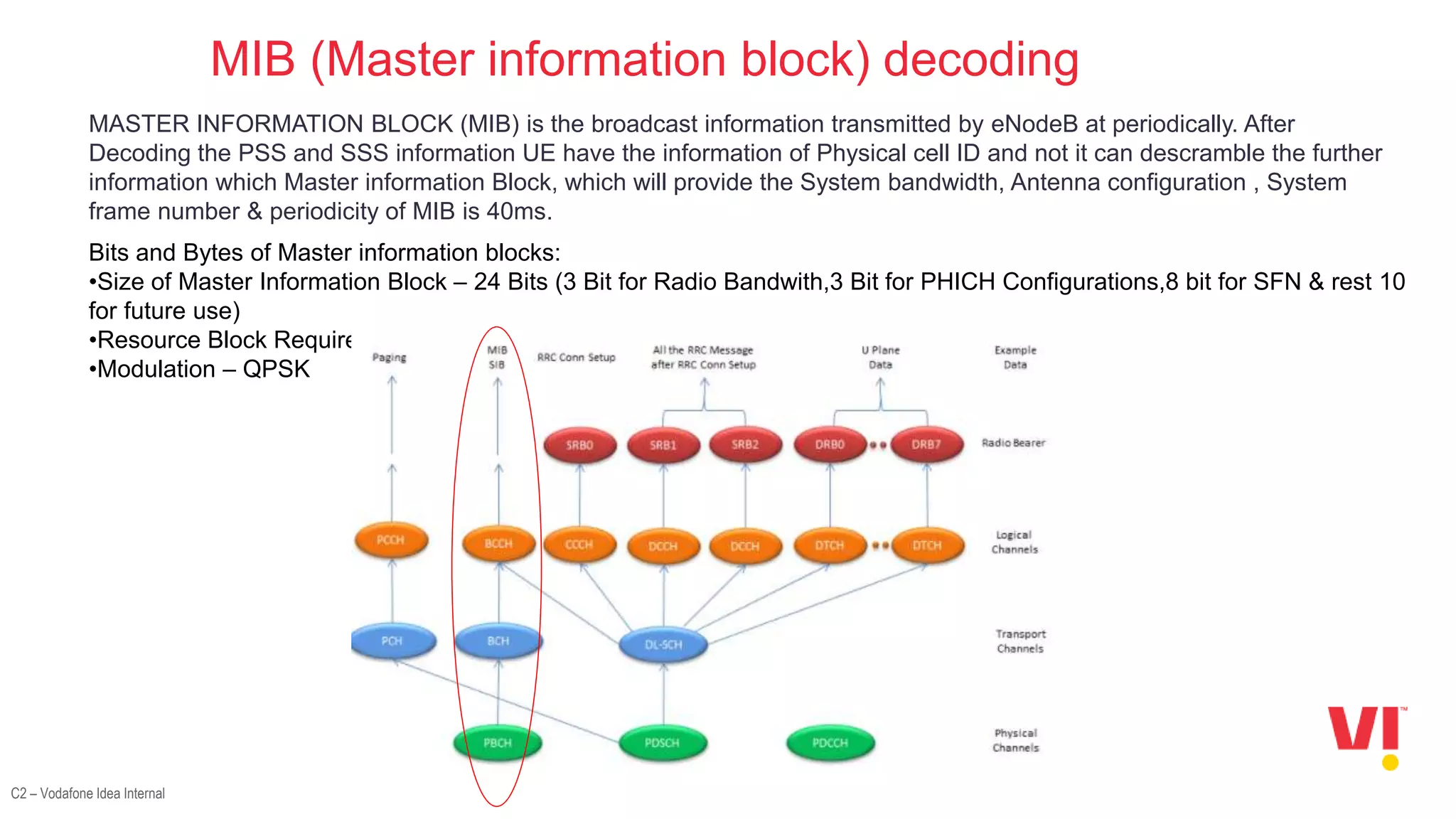
MIB (Master information block) decoding
MASTER INFORMATION BLOCK (MIB) is the broadcast information transmitted by eNodeB at periodically. After
Decoding the PSS and SSS information UE have the information of Physical cell ID and not it can descramble the further
information which Master information Block, which will provide the System bandwidth, Antenna configuration , System
frame number & periodicity of MIB is 40ms.
Bits and Bytes of Master information blocks:
•Size of Master Information Block – 24 Bits (3 Bit for Radio Bandwith,3 Bit for PHICH Configurations,8 bit for SFN & rest 10
for future use)
•Resource Block Requirement – MIB require 6 RBs (72 subcarriers) in Frequency domain
•Modulation – QPSK
C2 – Vodafone Idea Internal
PDCCH (Physical downlink control channel) decoding
PDCCH is a physical channel that carries downlink control information (DCI), PDSCH channel to be use
to send this information's, we also have UCI format which is to be use through PUSCH ,
PDCCH has following formats..
 Resource block assignment information ( number of RBG allocated to UE)
 New data indicator value ( indications its new data of old data means part of retransmission)
 TPC command for PUCCH (transmit power control).
 Redundancy version (LTE utilizes incremental-redundancy HARQ with a 1/3 turbo encoder used for FEC)
 Modulation and coding scheme.
C2 – Vodafone Idea Internal
SIB ( System information Block) Decoding
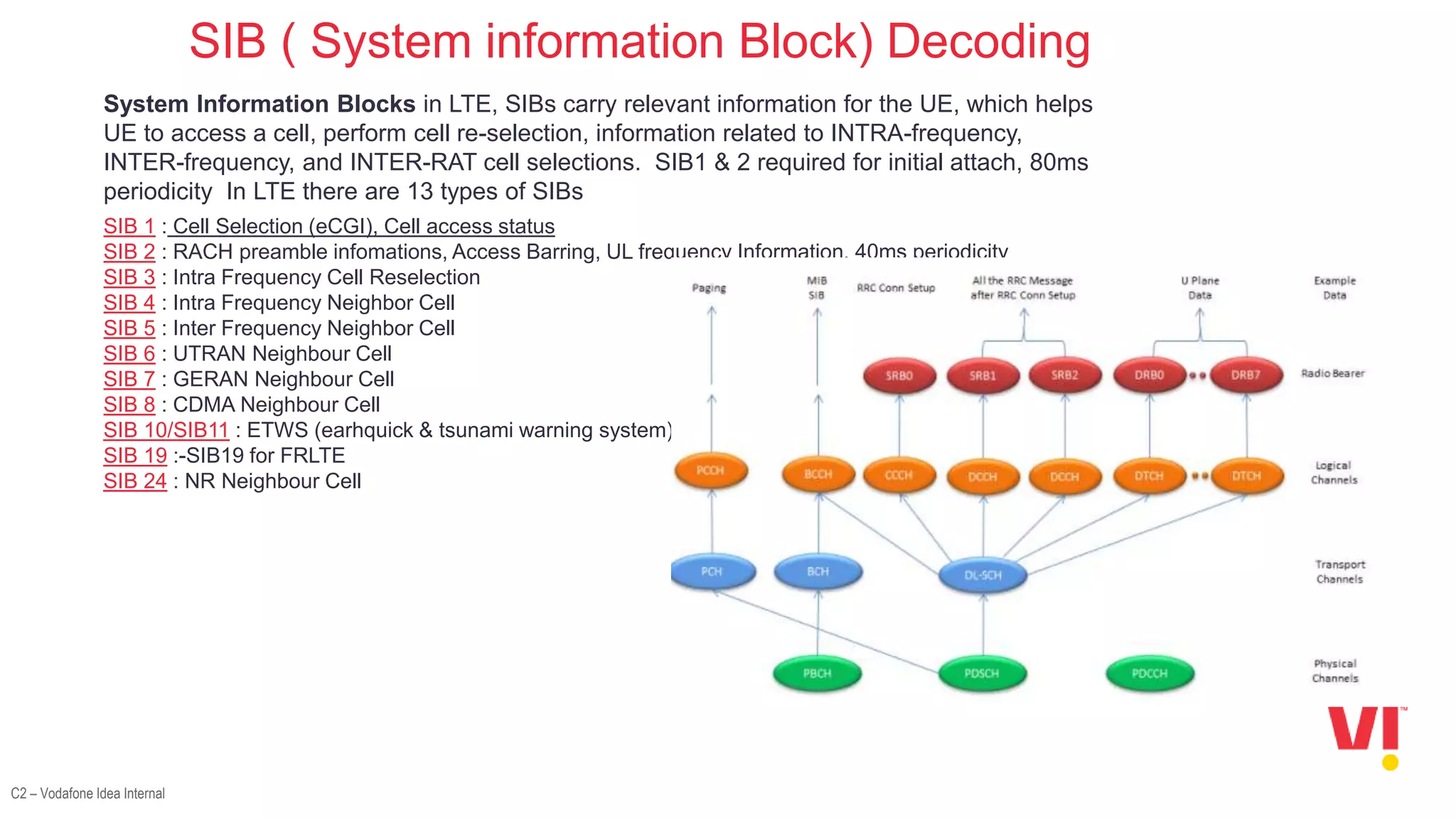
System Information Blocks in LTE, SIBs carry relevant information for the UE, which helps
UE to access a cell, perform cell re-selection, information related to INTRA-frequency,
INTER-frequency, and INTER-RAT cell selections. SIB1 & 2 required for initial attach, 80ms
periodicity In LTE there are 13 types of SIBs
SIB 1 : Cell Selection (eCGI), Cell access status
SIB 2 : RACH preamble infomations, Access Barring, UL frequency Information, 40ms periodicity
SIB 3 : Intra Frequency Cell Reselection
SIB 4 : Intra Frequency Neighbor Cell
SIB 5 : Inter Frequency Neighbor Cell
SIB 6 : UTRAN Neighbour Cell
SIB 7 : GERAN Neighbour Cell
SIB 8 : CDMA Neighbour Cell
SIB 10/SIB11 : ETWS (earhquick & tsunami warning system)
SIB 19 :-SIB19 for FRLTE
SIB 24 : NR Neighbour Cell
C2 – Vodafone Idea Internal
RACH process (random access channels)
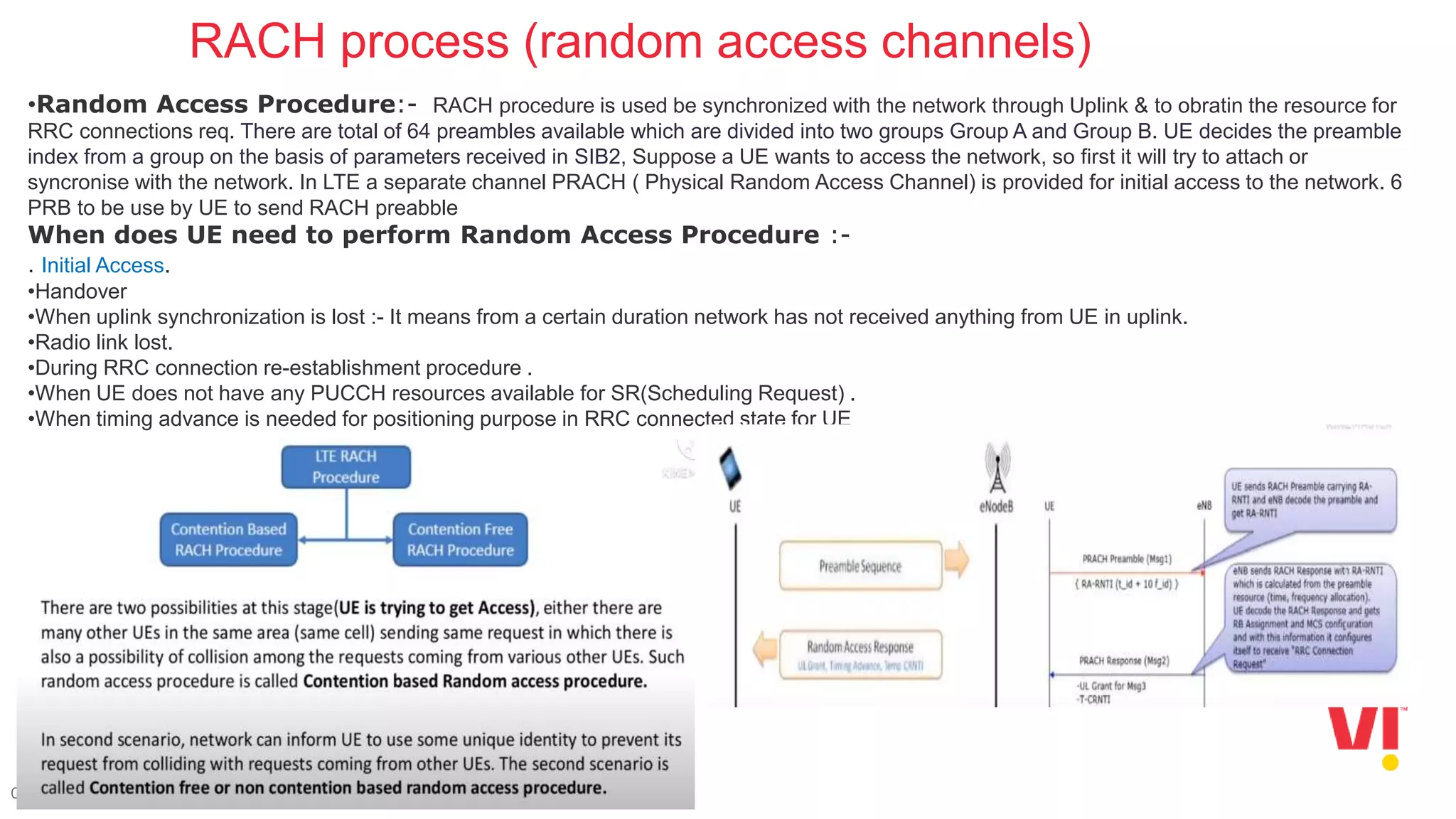
•Random Access Procedure:- RACH procedure is used be synchronized with the network through Uplink & to obratin the resource for
RRC connections req. There are total of 64 preambles available which are divided into two groups Group A and Group B. UE decides the preamble
index from a group on the basis of parameters received in SIB2, Suppose a UE wants to access the network, so first it will try to attach or
syncronise with the network. In LTE a separate channel PRACH ( Physical Random Access Channel) is provided for initial access to the network. 6
PRB to be use by UE to send RACH preabble
When does UE need to perform Random Access Procedure :-
. Initial Access.
•Handover
•When uplink synchronization is lost :- It means from a certain duration network has not received anything from UE in uplink.
•Radio link lost.
•During RRC connection re-establishment procedure .
•When UE does not have any PUCCH resources available for SR(Scheduling Request) .
•When timing advance is needed for positioning purpose in RRC connected state for UE
C2 – Vodafone Idea Internal
RRC connections request
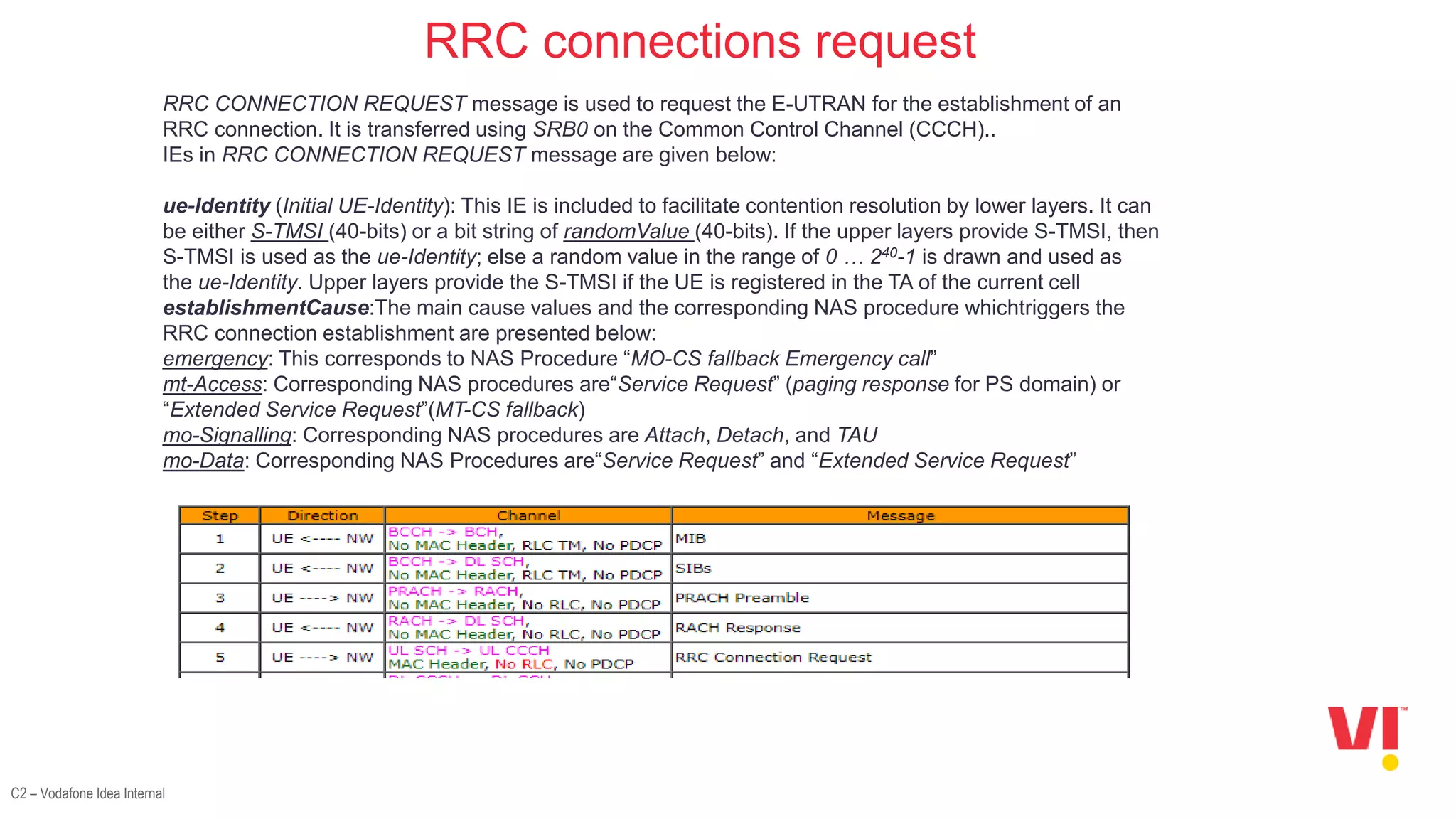
RRC CONNECTION REQUEST message is used to request the E-UTRAN for the establishment of an
RRC connection. It is transferred using SRB0 on the Common Control Channel (CCCH)..
IEs in RRC CONNECTION REQUEST message are given below:
ue-Identity (Initial UE-Identity): This IE is included to facilitate contention resolution by lower layers. It can
be either S-TMSI (40-bits) or a bit string of randomValue (40-bits). If the upper layers provide S-TMSI, then
S-TMSI is used as the ue-Identity; else a random value in the range of 0 … 240-1 is drawn and used as
the ue-Identity. Upper layers provide the S-TMSI if the UE is registered in the TA of the current cell
establishmentCause:The main cause values and the corresponding NAS procedure whichtriggers the
RRC connection establishment are presented below:
emergency: This corresponds to NAS Procedure “MO-CS fallback Emergency call”
mt-Access: Corresponding NAS procedures are“Service Request” (paging response for PS domain) or
“Extended Service Request”(MT-CS fallback)
mo-Signalling: Corresponding NAS procedures are Attach, Detach, and TAU
mo-Data: Corresponding NAS Procedures are“Service Request” and “Extended Service Request”
C2 – Vodafone Idea Internal
RRC connections Setup
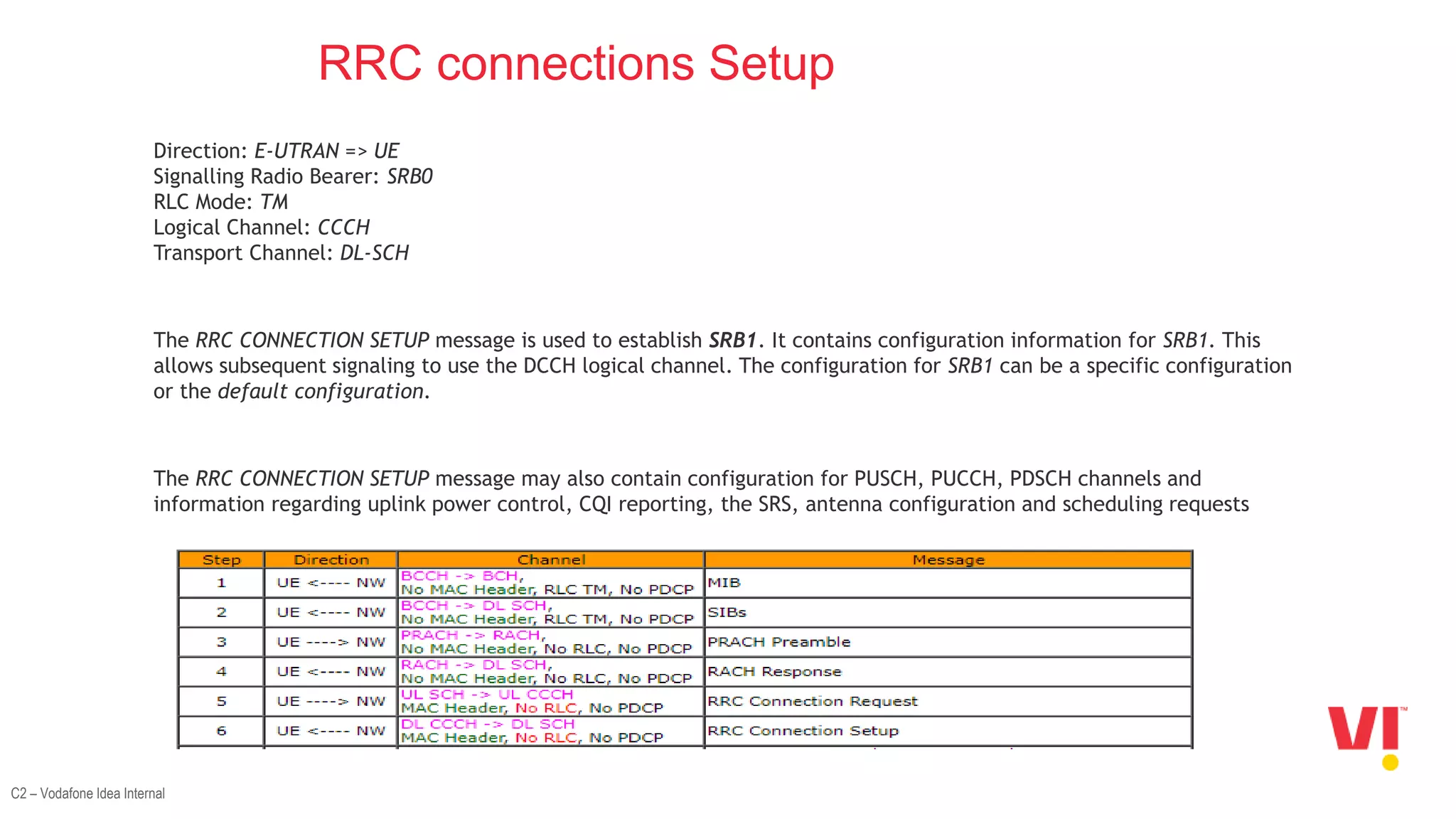
Direction: E-UTRAN => UE
Signalling Radio Bearer: SRB0
RLC Mode: TM
Logical Channel: CCCH
Transport Channel: DL-SCH
The RRC CONNECTION SETUP message is used to establish SRB1. It contains configuration information for SRB1. This
allows subsequent signaling to use the DCCH logical channel. The configuration for SRB1 can be a specific configuration
or the default configuration.
The RRC CONNECTION SETUP message may also contain configuration for PUSCH, PUCCH, PDSCH channels and
information regarding uplink power control, CQI reporting, the SRS, antenna configuration and scheduling requests
C2 – Vodafone Idea Internal
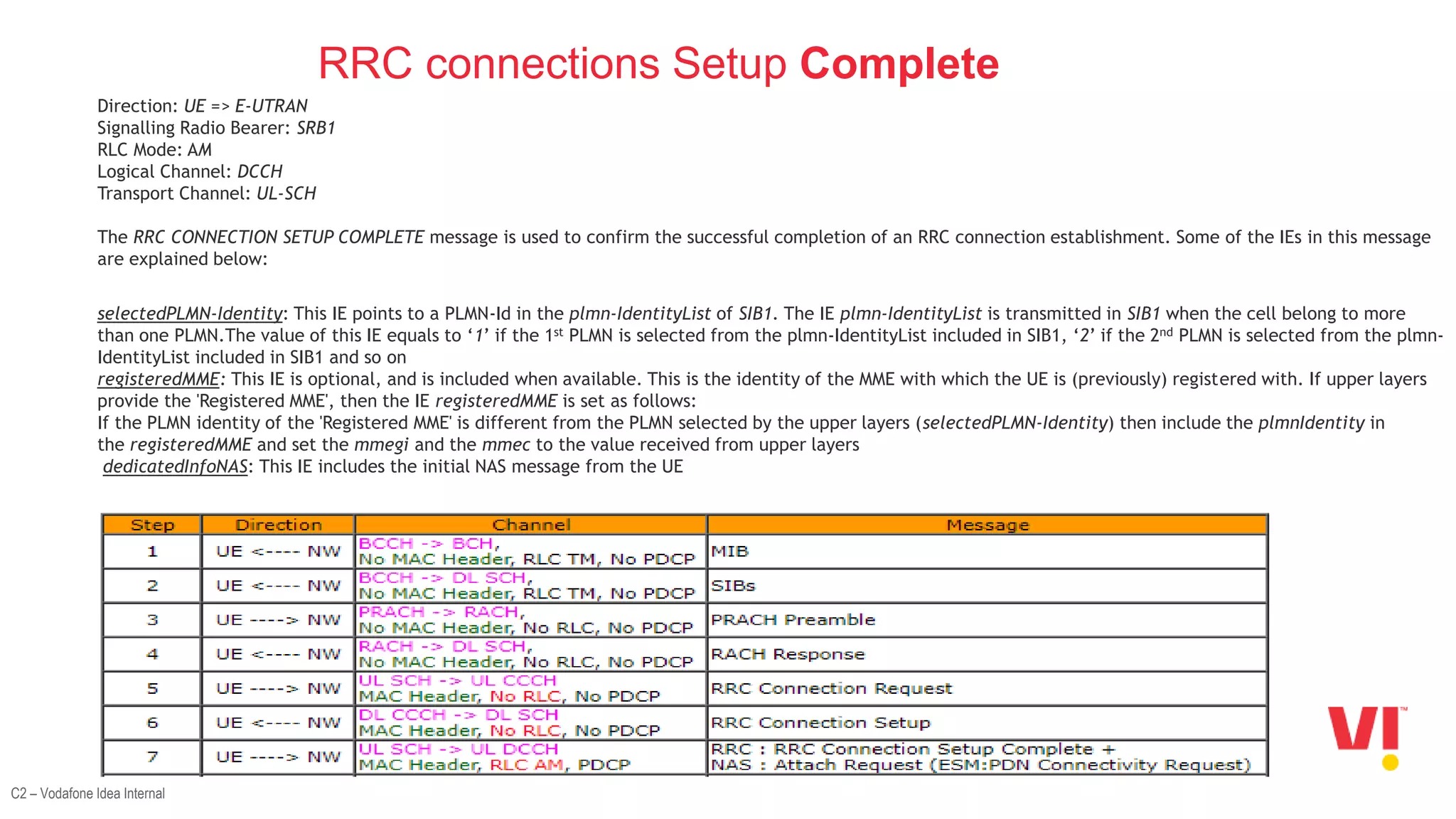
RRC connections Setup Complete
Direction: UE => E-UTRAN
Signalling Radio Bearer: SRB1
RLC Mode: AM
Logical Channel: DCCH
Transport Channel: UL-SCH
The RRC CONNECTION SETUP COMPLETE message is used to confirm the successful completion of an RRC connection establishment. Some of the IEs in this message
are explained below:
selectedPLMN-Identity: This IE points to a PLMN-Id in the plmn-IdentityList of SIB1. The IE plmn-IdentityList is transmitted in SIB1 when the cell belong to more
than one PLMN.The value of this IE equals to ‘1’ if the 1st PLMN is selected from the plmn-IdentityList included in SIB1, ‘2’ if the 2nd PLMN is selected from the plmn-
IdentityList included in SIB1 and so on
registeredMME: This IE is optional, and is included when available. This is the identity of the MME with which the UE is (previously) registered with. If upper layers
provide the 'Registered MME', then the IE registeredMME is set as follows:
If the PLMN identity of the 'Registered MME' is different from the PLMN selected by the upper layers (selectedPLMN-Identity) then include the plmnIdentity in
the registeredMME and set the mmegi and the mmec to the value received from upper layers
dedicatedInfoNAS: This IE includes the initial NAS message from the UE
C2 – Vodafone Idea Internal
Thank you…

LTE Attach Call Flow_Vi.pptx

  • 1.
    C2 – VodafoneIdea Internal LTE Attach Call Flow Discussion Surinder Salyan RF Quality_Haryana
  • 2.
    C2 – VodafoneIdea Internal Content of Discussion 1. Evolution of Cellular system 2. Coverage Pattern of Different Bands 3. 5G introductions for Coverage point of view 4. Sites Connectivity diagram 5. LTE/EPS Network Elements & architecture 6. Massage flow overview to attach in LTE network 7. Frequency scanning 8. PSS & SSS Decoding 9. MIB decoding 10. PDCCH decoding 11. SIB Decoding 12. RACH process 13. RRC connections request 14. RRC connections Setup 15. RRC connections Setup complete
  • 3.
    C2 – VodafoneIdea Internal Evolution of Cellular system Voice Service in 1979 Voice & Data (40 kbit/s)in 1991 Voice & Data (171 kbit/s)in 1999 Voice & Data (384 kbit/s)in 1999 Voice & Data (2 Mbps/s) in 2001 Voice & Data (14 Mbps/s) in 2005 Voice & Data (42Mbps/s) in 2007 Volte & Data (200mbps-1 Gbps) in 2008 Volte & Data (10Gbps-100Gbps) in 2019 3.75G HSPA+ To be launch in 2027-28 6G 2G 2.5G 2.75G EDGE 3G UMTS 3.5G HSPA 5G NR 4G LTE /LTE-A 1G
  • 4.
    C2 – VodafoneIdea Internal Coverage Pattern of Different Bands 900 MHz 2500 MHz 2100 MHz 1800 MHz RANGE
  • 5.
    C2 – VodafoneIdea Internal 5G Introductions for Coverage point of view Macro Cells Small Cells
  • 6.
    C2 – VodafoneIdea Internal PoP A D C B E Ring Topology F PoP A D C B E Chain Topology F PoP A D C B E Tree Topology F PoP H G P K K L M N H Sites/MW Connectivity diagram demo 1 . 2. 4. A D C B E Loop Topology PoP F 3. Fiber Fiber Fiber Fiber PoP
  • 7.
    C2 – VodafoneIdea Internal LTE/EPS Network Elements & architecture LTE-UE Evolved UTRAN (E-UTRAN) MME S10 S6a Serving Gateway S1-U S11 PDN Gateway IMS/PDN Evolved Packet Core (EPC) S1-MME PCRF Gx or S7 Rx SGi S5/S8 Evolved Node B (eNB) cell X2 LTE-Uu HSS MME: Mobility Management Entity PCRF:Policy & Charging Rule Function SAE Gateway HSS Home Subscriber Server
  • 8.
    C2 – VodafoneIdea Internal MIB-SIB Decoding Freq Scaning RA Request RA Response RRC Conncetions Req RRC Conncetions Setup RRC connection Setup complete Intial UE msg Attach PDN Req Authentication info Req Authentication info Response Authentication Req Authentication Response Security Mode Command Security Mode Command Complete Location update Req Location update Response Create session Req Create session Req Create session Response Create session Response Intial Context Req UE Capability inquiry UE Capability information's UE Capability info indications UE Security Mode UE Security Mode Complete RRC reconfigurations RRC reconfigurations Complete Initial Context setup complete Modify Bearer Request Modify Bearer Response End to End GPRS Tunnel
  • 9.
    C2 – VodafoneIdea Internal Frequency scanning 1. SLS (Stored list search) UE have some stored list because UE was earlier attached with network, if we are going to restart mobile / aroplane mode so it don’t need to scan Frequency 2. DBS (Deviated band stand) if SLS data is invalid than UE will start searching which Frequency band UE supporting & according to RAT priority & RSSI,RSRP,RSRQ  Frequency Band Supported  RAT Priority There is two type of Frequency Scanning
  • 10.
    C2 – VodafoneIdea Internal PSS & SSS Decoding (LTE Synchronization) After power-up, the UE tries to obtain time and frequency synchronization with the system. For this, UE needs to detect signals to find out where the frame begins and ends. LTE define two type of synchronization signals:  Primary synchronization signal (PSS) PSS helps to achieve subframe, slot and symbol synchronization in the time domain, identify the center of the channel bandwidth in the frequency domain and deduce a pointer towards 1 of 3 Physical layer Cell Identities (PCI)  Secondary synchronization signal (SSS) SSS helps to achieve radio frame synchronization UE uses the Synchronization Signals to: •Achieve radio frame, subframe, slot and symbol synchronization in the time domain •Identify the center of the channel bandwidth in the frequency domain •Deduce the Physical layer Cell Identity (PCI) PSS:- 0,1,2 SSS:- 0 to 167 Total PCI :-503 in LTE PSS to be radiate on central 62 Carrier (6RB)
  • 11.
    C2 – VodafoneIdea Internal MIB (Master information block) decoding MASTER INFORMATION BLOCK (MIB) is the broadcast information transmitted by eNodeB at periodically. After Decoding the PSS and SSS information UE have the information of Physical cell ID and not it can descramble the further information which Master information Block, which will provide the System bandwidth, Antenna configuration , System frame number & periodicity of MIB is 40ms. Bits and Bytes of Master information blocks: •Size of Master Information Block – 24 Bits (3 Bit for Radio Bandwith,3 Bit for PHICH Configurations,8 bit for SFN & rest 10 for future use) •Resource Block Requirement – MIB require 6 RBs (72 subcarriers) in Frequency domain •Modulation – QPSK
  • 12.
    C2 – VodafoneIdea Internal PDCCH (Physical downlink control channel) decoding PDCCH is a physical channel that carries downlink control information (DCI), PDSCH channel to be use to send this information's, we also have UCI format which is to be use through PUSCH , PDCCH has following formats..  Resource block assignment information ( number of RBG allocated to UE)  New data indicator value ( indications its new data of old data means part of retransmission)  TPC command for PUCCH (transmit power control).  Redundancy version (LTE utilizes incremental-redundancy HARQ with a 1/3 turbo encoder used for FEC)  Modulation and coding scheme.
  • 13.
    C2 – VodafoneIdea Internal SIB ( System information Block) Decoding System Information Blocks in LTE, SIBs carry relevant information for the UE, which helps UE to access a cell, perform cell re-selection, information related to INTRA-frequency, INTER-frequency, and INTER-RAT cell selections. SIB1 & 2 required for initial attach, 80ms periodicity In LTE there are 13 types of SIBs SIB 1 : Cell Selection (eCGI), Cell access status SIB 2 : RACH preamble infomations, Access Barring, UL frequency Information, 40ms periodicity SIB 3 : Intra Frequency Cell Reselection SIB 4 : Intra Frequency Neighbor Cell SIB 5 : Inter Frequency Neighbor Cell SIB 6 : UTRAN Neighbour Cell SIB 7 : GERAN Neighbour Cell SIB 8 : CDMA Neighbour Cell SIB 10/SIB11 : ETWS (earhquick & tsunami warning system) SIB 19 :-SIB19 for FRLTE SIB 24 : NR Neighbour Cell
  • 14.
    C2 – VodafoneIdea Internal RACH process (random access channels) •Random Access Procedure:- RACH procedure is used be synchronized with the network through Uplink & to obratin the resource for RRC connections req. There are total of 64 preambles available which are divided into two groups Group A and Group B. UE decides the preamble index from a group on the basis of parameters received in SIB2, Suppose a UE wants to access the network, so first it will try to attach or syncronise with the network. In LTE a separate channel PRACH ( Physical Random Access Channel) is provided for initial access to the network. 6 PRB to be use by UE to send RACH preabble When does UE need to perform Random Access Procedure :- . Initial Access. •Handover •When uplink synchronization is lost :- It means from a certain duration network has not received anything from UE in uplink. •Radio link lost. •During RRC connection re-establishment procedure . •When UE does not have any PUCCH resources available for SR(Scheduling Request) . •When timing advance is needed for positioning purpose in RRC connected state for UE
  • 15.
    C2 – VodafoneIdea Internal RRC connections request RRC CONNECTION REQUEST message is used to request the E-UTRAN for the establishment of an RRC connection. It is transferred using SRB0 on the Common Control Channel (CCCH).. IEs in RRC CONNECTION REQUEST message are given below: ue-Identity (Initial UE-Identity): This IE is included to facilitate contention resolution by lower layers. It can be either S-TMSI (40-bits) or a bit string of randomValue (40-bits). If the upper layers provide S-TMSI, then S-TMSI is used as the ue-Identity; else a random value in the range of 0 … 240-1 is drawn and used as the ue-Identity. Upper layers provide the S-TMSI if the UE is registered in the TA of the current cell establishmentCause:The main cause values and the corresponding NAS procedure whichtriggers the RRC connection establishment are presented below: emergency: This corresponds to NAS Procedure “MO-CS fallback Emergency call” mt-Access: Corresponding NAS procedures are“Service Request” (paging response for PS domain) or “Extended Service Request”(MT-CS fallback) mo-Signalling: Corresponding NAS procedures are Attach, Detach, and TAU mo-Data: Corresponding NAS Procedures are“Service Request” and “Extended Service Request”
  • 16.
    C2 – VodafoneIdea Internal RRC connections Setup Direction: E-UTRAN => UE Signalling Radio Bearer: SRB0 RLC Mode: TM Logical Channel: CCCH Transport Channel: DL-SCH The RRC CONNECTION SETUP message is used to establish SRB1. It contains configuration information for SRB1. This allows subsequent signaling to use the DCCH logical channel. The configuration for SRB1 can be a specific configuration or the default configuration. The RRC CONNECTION SETUP message may also contain configuration for PUSCH, PUCCH, PDSCH channels and information regarding uplink power control, CQI reporting, the SRS, antenna configuration and scheduling requests
  • 17.
    C2 – VodafoneIdea Internal RRC connections Setup Complete Direction: UE => E-UTRAN Signalling Radio Bearer: SRB1 RLC Mode: AM Logical Channel: DCCH Transport Channel: UL-SCH The RRC CONNECTION SETUP COMPLETE message is used to confirm the successful completion of an RRC connection establishment. Some of the IEs in this message are explained below: selectedPLMN-Identity: This IE points to a PLMN-Id in the plmn-IdentityList of SIB1. The IE plmn-IdentityList is transmitted in SIB1 when the cell belong to more than one PLMN.The value of this IE equals to ‘1’ if the 1st PLMN is selected from the plmn-IdentityList included in SIB1, ‘2’ if the 2nd PLMN is selected from the plmn- IdentityList included in SIB1 and so on registeredMME: This IE is optional, and is included when available. This is the identity of the MME with which the UE is (previously) registered with. If upper layers provide the 'Registered MME', then the IE registeredMME is set as follows: If the PLMN identity of the 'Registered MME' is different from the PLMN selected by the upper layers (selectedPLMN-Identity) then include the plmnIdentity in the registeredMME and set the mmegi and the mmec to the value received from upper layers dedicatedInfoNAS: This IE includes the initial NAS message from the UE
  • 18.
    C2 – VodafoneIdea Internal Thank you…

Editor's Notes

  • #4 3G Partnership Project- 3GPP is a defining world body in Telecom comprising of USA, Japan, Korea, China & Europe, which decides upon the various technology parameters for different equipment, bandwidth etc. 3GPP also decides upon the releases. Call Environment in 2G & 3G are quite similar in terms of the network architecture. The TRX (the transmitter / receiver unit for the BTS) cards play an important role in providing sufficient time slots for voice and data calls. The uncongested network availability is dependent on the three factors; Number of User Equipment (handsets), Radio condition of the UE and the Backhaul availability
  • #5 The penetration of network coverage is better in 1800 band when compared to 2300 band.