3GPP SON Series:
Mobility Load Balancing
(MLB)
@3g4gUK
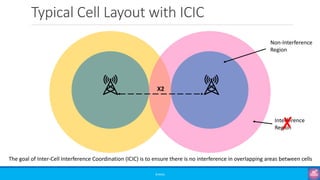
Typical Cell Layout with ICIC
©3G4G
Non-Interference
Region
Interference
Region
X2
✘
The goal of Inter-Cell Interference Coordination (ICIC) is to ensure there is no interference in overlapping areas between cells
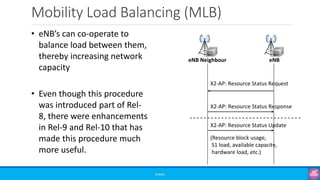
Mobility Load Balancing (MLB)
©3G4G
• eNB’s can co-operate to
balance load between them,
thereby increasing network
capacity
• Even though this procedure
was introduced part of Rel-
8, there were enhancements
in Rel-9 and Rel-10 that has
made this procedure much
more useful.
X2-AP: Resource Status Request
X2-AP: Resource Status Response
X2-AP: Resource Status Update
(Resource block usage,
S1 load, available capacity,
hardware load, etc.)
eNB
eNB Neighbour
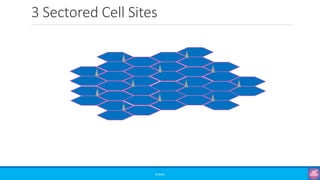
3 Sectored Cell Sites
©3G4G
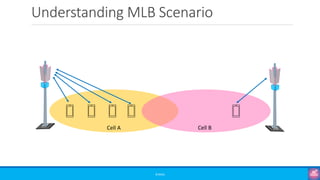
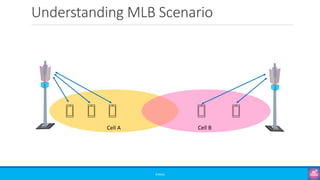
Understanding MLB Scenario
©3G4G
Cell A Cell B
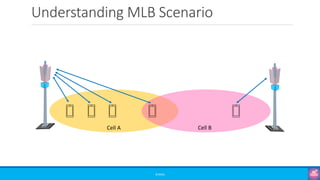
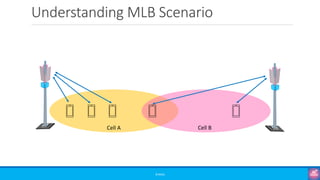
Understanding MLB Scenario
©3G4G
Cell A Cell B
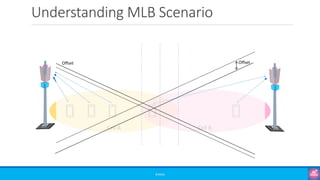
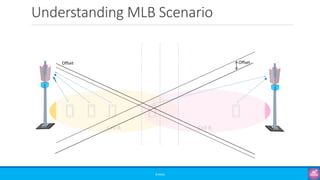
Understanding MLB Scenario
©3G4G
Cell A Cell B
Offset
Offset
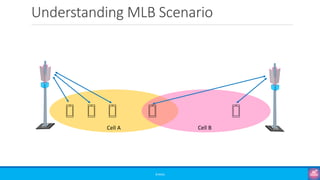
Understanding MLB Scenario
©3G4G
Cell A Cell B
Understanding MLB Scenario
©3G4G
Cell A Cell B
Understanding MLB Scenario
©3G4G
Cell A Cell B
Understanding MLB Scenario
©3G4G
Cell A Cell B
Offset
Offset
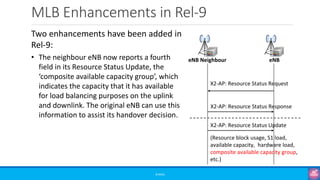
MLB Enhancements in Rel-9
©3G4G
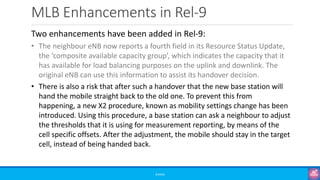
Two enhancements have been added in
Rel-9:
• The neighbour eNB now reports a fourth
field in its Resource Status Update, the
‘composite available capacity group’, which
indicates the capacity that it has available
for load balancing purposes on the uplink
and downlink. The original eNB can use this
information to assist its handover decision.
X2-AP: Resource Status Request
X2-AP: Resource Status Response
X2-AP: Resource Status Update
(Resource block usage, S1 load,
available capacity, hardware load,
composite available capacity group,
etc.)
eNB
eNB Neighbour
MLB Enhancements in Rel-9
©3G4G
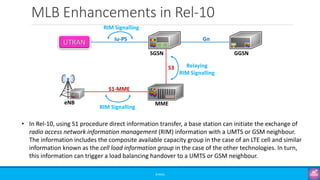
Two enhancements have been added in Rel-9:
• The neighbour eNB now reports a fourth field in its Resource Status Update,
the ‘composite available capacity group’, which indicates the capacity that it
has available for load balancing purposes on the uplink and downlink. The
original eNB can use this information to assist its handover decision.
• There is also a risk that after such a handover that the new base station will
hand the mobile straight back to the old one. To prevent this from
happening, a new X2 procedure, known as mobility settings change has been
introduced. Using this procedure, a base station can ask a neighbour to adjust
the thresholds that it is using for measurement reporting, by means of the
cell specific offsets. After the adjustment, the mobile should stay in the target
cell, instead of being handed back.
MLB Enhancements in Rel-10
©3G4G
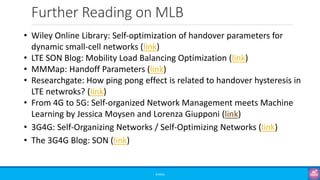
• In Rel-10, using S1 procedure direct information transfer, a base station can initiate the exchange of
radio access network information management (RIM) information with a UMTS or GSM neighbour.
The information includes the composite available capacity group in the case of an LTE cell and similar
information known as the cell load information group in the case of the other technologies. In turn,
this information can trigger a load balancing handover to a UMTS or GSM neighbour.
UTRAN
MME
SGSN GGSN
eNB
Iu-PS Gn
S1-MME
S3
RIM Signalling
RIM Signalling
Relaying
RIM Signalling
Further Reading on MLB
©3G4G
• Wiley Online Library: Self‐optimization of handover parameters for
dynamic small‐cell networks (link)
• LTE SON Blog: Mobility Load Balancing Optimization (link)
• MMMap: Handoff Parameters (link)
• Researchgate: How ping pong effect is related to handover hysteresis in
LTE netwroks? (link)
• From 4G to 5G: Self-organized Network Management meets Machine
Learning by Jessica Moysen and Lorenza Giupponi (link)
• 3G4G: Self-Organizing Networks / Self-Optimizing Networks (link)
• The 3G4G Blog: SON (link)
Thank You
To learn more, visit:
3G4G Website – https://www.3g4g.co.uk/
3G4G Blog – https://blog.3g4g.co.uk/
Telecoms Infrastructure Blog – https://www.telecomsinfrastructure.com/
Operator Watch Blog – https://www.operatorwatch.com/
Connectivity Technology Blog – https://www.connectivity.technology/
Free 5G Training – https://www.free5gtraining.com/
Free 6G Training – https://www.free6gtraining.com/
Follow us on Twitter: https://twitter.com/3g4gUK
Follow us on Facebook: https://www.facebook.com/3g4gUK/
Follow us on LinkedIn: https://www.linkedin.com/company/3g4g
Follow us on SlideShare: https://www.slideshare.net/3G4GLtd
Follow us on YouTube: https://www.youtube.com/3G4G5G
©3G4G

3GPP SON Series: Mobility Load Balancing (MLB)

  • 1.
    3GPP SON Series: MobilityLoad Balancing (MLB) @3g4gUK
  • 2.
    Typical Cell Layoutwith ICIC ©3G4G Non-Interference Region Interference Region X2 ✘ The goal of Inter-Cell Interference Coordination (ICIC) is to ensure there is no interference in overlapping areas between cells
  • 3.
    Mobility Load Balancing(MLB) ©3G4G • eNB’s can co-operate to balance load between them, thereby increasing network capacity • Even though this procedure was introduced part of Rel- 8, there were enhancements in Rel-9 and Rel-10 that has made this procedure much more useful. X2-AP: Resource Status Request X2-AP: Resource Status Response X2-AP: Resource Status Update (Resource block usage, S1 load, available capacity, hardware load, etc.) eNB eNB Neighbour
  • 4.
    3 Sectored CellSites ©3G4G
  • 5.
  • 6.
  • 7.
  • 8.
  • 9.
  • 10.
  • 11.
  • 12.
    MLB Enhancements inRel-9 ©3G4G Two enhancements have been added in Rel-9: • The neighbour eNB now reports a fourth field in its Resource Status Update, the ‘composite available capacity group’, which indicates the capacity that it has available for load balancing purposes on the uplink and downlink. The original eNB can use this information to assist its handover decision. X2-AP: Resource Status Request X2-AP: Resource Status Response X2-AP: Resource Status Update (Resource block usage, S1 load, available capacity, hardware load, composite available capacity group, etc.) eNB eNB Neighbour
  • 13.
    MLB Enhancements inRel-9 ©3G4G Two enhancements have been added in Rel-9: • The neighbour eNB now reports a fourth field in its Resource Status Update, the ‘composite available capacity group’, which indicates the capacity that it has available for load balancing purposes on the uplink and downlink. The original eNB can use this information to assist its handover decision. • There is also a risk that after such a handover that the new base station will hand the mobile straight back to the old one. To prevent this from happening, a new X2 procedure, known as mobility settings change has been introduced. Using this procedure, a base station can ask a neighbour to adjust the thresholds that it is using for measurement reporting, by means of the cell specific offsets. After the adjustment, the mobile should stay in the target cell, instead of being handed back.
  • 14.
    MLB Enhancements inRel-10 ©3G4G • In Rel-10, using S1 procedure direct information transfer, a base station can initiate the exchange of radio access network information management (RIM) information with a UMTS or GSM neighbour. The information includes the composite available capacity group in the case of an LTE cell and similar information known as the cell load information group in the case of the other technologies. In turn, this information can trigger a load balancing handover to a UMTS or GSM neighbour. UTRAN MME SGSN GGSN eNB Iu-PS Gn S1-MME S3 RIM Signalling RIM Signalling Relaying RIM Signalling
  • 15.
    Further Reading onMLB ©3G4G • Wiley Online Library: Self‐optimization of handover parameters for dynamic small‐cell networks (link) • LTE SON Blog: Mobility Load Balancing Optimization (link) • MMMap: Handoff Parameters (link) • Researchgate: How ping pong effect is related to handover hysteresis in LTE netwroks? (link) • From 4G to 5G: Self-organized Network Management meets Machine Learning by Jessica Moysen and Lorenza Giupponi (link) • 3G4G: Self-Organizing Networks / Self-Optimizing Networks (link) • The 3G4G Blog: SON (link)
  • 16.
    Thank You To learnmore, visit: 3G4G Website – https://www.3g4g.co.uk/ 3G4G Blog – https://blog.3g4g.co.uk/ Telecoms Infrastructure Blog – https://www.telecomsinfrastructure.com/ Operator Watch Blog – https://www.operatorwatch.com/ Connectivity Technology Blog – https://www.connectivity.technology/ Free 5G Training – https://www.free5gtraining.com/ Free 6G Training – https://www.free6gtraining.com/ Follow us on Twitter: https://twitter.com/3g4gUK Follow us on Facebook: https://www.facebook.com/3g4gUK/ Follow us on LinkedIn: https://www.linkedin.com/company/3g4g Follow us on SlideShare: https://www.slideshare.net/3G4GLtd Follow us on YouTube: https://www.youtube.com/3G4G5G ©3G4G