•   Location management
•   UE procedures from “power on” to IDLE
•   UE procedures in IDLE and Active
•   Handover
•   Protocol stack
•   RRC state
•   3GPP terminology
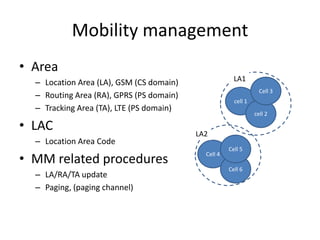
Mobility management
• Area
  – Location Area (LA), GSM (CS domain)                LA1
                                                                  Cell 3
  – Routing Area (RA), GPRS (PS domain)
                                                       cell 1
  – Tracking Area (TA), LTE (PS domain)
                                                                cell 2

• LAC                                     LA2
  – Location Area Code
                                                     Cell 5
• MM related procedures                     Cell 4

                                                     Cell 6
  – LA/RA/TA update
  – Paging, (paging channel)
UE procedures from Power on
• Generic Procedures
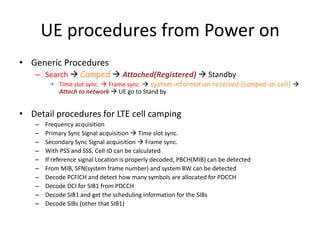
   – Search  Camped  Attached(Registered)  Standby
         • Time slot sync.  Frame sync.  system information received (camped on cell) 
           Attach to network  UE go to Stand by


• Detail procedures for LTE cell camping
   –   Frequency acquisition
   –   Primary Sync Signal acquisition  Time slot sync.
   –   Secondary Sync Signal acquisition  Frame sync.
   –   With PSS and SSS, Cell ID can be calculated
   –   If reference signal Location is properly decoded, PBCH(MIB) can be detected
   –   From MIB, SFN(system frame number) and system BW can be detected
   –   Decode PCFICH and detect how many symbols are allocated for PDCCH
   –   Decode DCI for SIB1 from PDCCH
   –   Decode SIB1 and get the scheduling information for the SIBs
   –   Decode SIBs (other that SIB1)
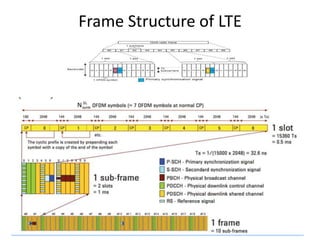
Frame Structure of LTE
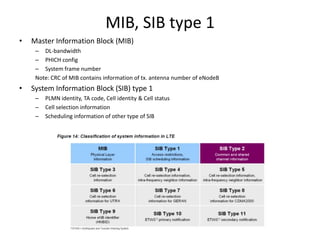
MIB, SIB type 1
•   Master Information Block (MIB)
     – DL-bandwidth
     – PHICH config
     – System frame number
     Note: CRC of MIB contains information of tx. antenna number of eNodeB
•   System Information Block (SIB) type 1
     –   PLMN identity, TA code, Cell identity & Cell status
     –   Cell selection information
     –   Scheduling information of other type of SIB
UE procedures in Idle and Active
• Idle
   – Cell reselection / location update
   – Listen to paging channel
   – Receive system information


• Active
   – Measurement
   – Handover
Cell type
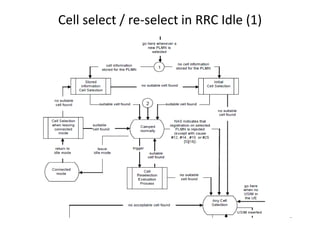
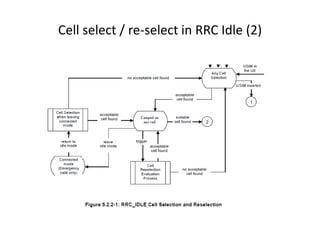
• acceptable cell:
    – An "acceptable cell" is a cell on which the UE may camp to obtain limited service
      (originate emergency calls and receive ETWS and CMAS notifications).
• suitable cell:
    – A "suitable cell" is a cell on which the UE may camp on to obtain normal service
• Barred cell:
    – A cell is barred if it is so indicated in the system information
• reserved cell:
    – A cell is reserved if it is so indicated in system information
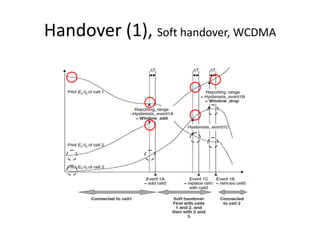
Type of handover
• Frequency
   – Intra / Inter frequency handover
• RAT (Radio Access Technology)
   – Intra / Inter system (RAT) handover
• Hard/Soft/Softer
   – Hard handover (2G/3G/4G)
   – Soft handover (3G)
   – Softer handover (3G)
• Backward / Forward
   – Backward handover (source cell  target cell )
   – Forward handover (target cell  source cell ), Rel. 9
Handover (1), Soft handover, WCDMA
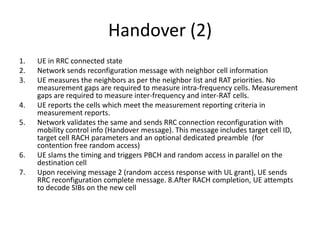
Handover (2)
1.   UE in RRC connected state
2.   Network sends reconfiguration message with neighbor cell information
3.   UE measures the neighbors as per the neighbor list and RAT priorities. No
     measurement gaps are required to measure intra-frequency cells. Measurement
     gaps are required to measure inter-frequency and inter-RAT cells.
4.   UE reports the cells which meet the measurement reporting criteria in
     measurement reports.
5.   Network validates the same and sends RRC connection reconfiguration with
     mobility control info (Handover message). This message includes target cell ID,
     target cell RACH parameters and an optional dedicated preamble (for
     contention free random access)
6.   UE slams the timing and triggers PBCH and random access in parallel on the
     destination cell
7.   Upon receiving message 2 (random access response with UL grant), UE sends
     RRC reconfiguration complete message. 8.After RACH completion, UE attempts
     to decode SIBs on the new cell
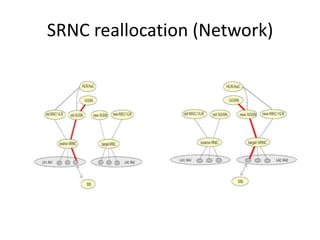
SRNC reallocation (Network)
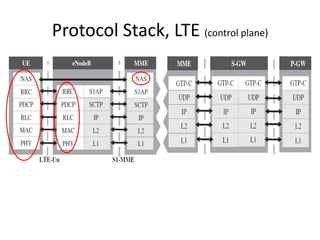
Protocol Stack, LTE (control plane)
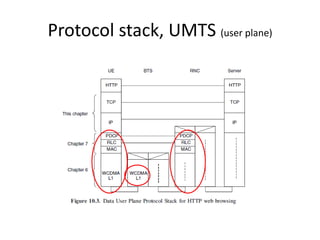
Protocol stack, UMTS (user plane)
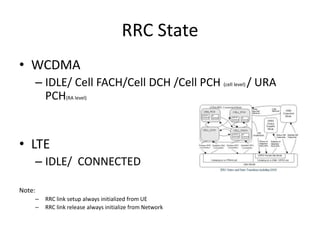
RRC State
• WCDMA
    – IDLE/ Cell FACH/Cell DCH /Cell PCH (cell level) / URA
      PCH(RA level)


• LTE
    – IDLE/ CONNECTED

Note:
    –   RRC link setup always initialized from UE
    –   RRC link release always initialize from Network
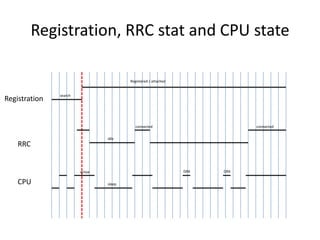
Registration, RRC stat and CPU state

                                         Registered / attached


               search
Registration


                                            connected                        connected


                                 idle
    RRC


                        active                                   DRX   DRX

    CPU                          sleep
3GPP Terminology
• PLMN = MCC + MNC
    – HPLMN, EPLMN, RPLMN, …

•   IMSI = MCC + MNC + sequence no.
•   IMEI
•   CAMP on cell, ATTACH to network ( or Registration )
•   ICC / SIM, UICC/USIM
•   Roaming
•   R99(WCDMA) /R5(HSDPA) /R6(HSUPA) /R7(HSPA+) / R8(DC-
    HSPA), LTE
END …
Cell select / re-select in RRC Idle (1)
Cell select / re-select in RRC Idle (2)
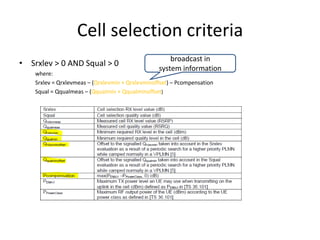
Cell selection criteria
                                                      broadcast in
• Srxlev > 0 AND Squal > 0
                                                  system information
    where:
    Srxlev = Qrxlevmeas – (Qrxlevmin + Qrxlevminoffset) – Pcompensation
    Squal = Qqualmeas – (Qqualmin + Qqualminoffset)
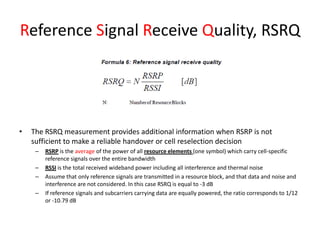
Reference Signal Receive Quality, RSRQ


•   The RSRQ measurement provides additional information when RSRP is not
    sufficient to make a reliable handover or cell reselection decision
     –   RSRP is the average of the power of all resource elements (one symbol) which carry cell-specific
         reference signals over the entire bandwidth
     –   RSSI is the total received wideband power including all interference and thermal noise
     –   Assume that only reference signals are transmitted in a resource block, and that data and noise and
         interference are not considered. In this case RSRQ is equal to -3 dB
     –   If reference signals and subcarriers carrying data are equally powered, the ratio corresponds to 1/12
         or -10.79 dB
Cell Ranking criteria
• The cell-ranking criterion Rs for serving cell and Rn for
  neighbouring cells is defined by:
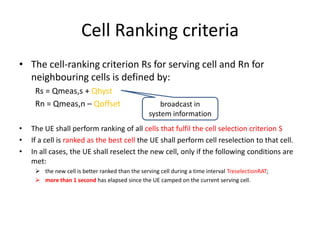
     Rs = Qmeas,s + Qhyst
     Rn = Qmeas,n – Qoffset                           broadcast in
                                                  system information
•   The UE shall perform ranking of all cells that fulfil the cell selection criterion S
•   If a cell is ranked as the best cell the UE shall perform cell reselection to that cell.
•   In all cases, the UE shall reselect the new cell, only if the following conditions are
    met:
      the new cell is better ranked than the serving cell during a time interval TreselectionRAT;
      more than 1 second has elapsed since the UE camped on the current serving cell.
Cell Re-selection example
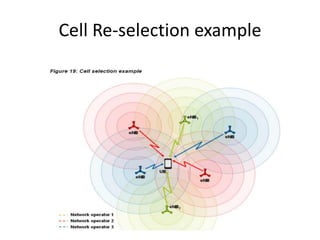
•   Figure 19 shows one possible scenario in a real network.
•   Assume that
     –    the UE belongs to network operator 1 (green).
     –    There are two other carriers also operating an LTE network but of course at different frequencies.

•   The terminal receives all base stations but at different power levels.
•   Based on the above definition the UE will select the strong cell for each carrier .
      – Using this the UE will start with network operator 3 (blue) and figure out after decoding the SIB Type 1 that the PLMN
           saved on the USIM does not match to the transmitted one.
      – From this information it will stop with its attempt and proceed to the next strongest signal, which is operator 2 (red).
           Now the PLMN does not correspond
•   so the UE will continue with signal 3 (green) – and the PLMN will match.
      – The UE continues to use the information in SIB Type 1 and Type 2 to compute the cell selection criteria. In this
           example,
      – the parameters transferred and belonging to eNB1 do not fulfill S > 0 where the UE will move along with
           demodulating and decoding the information provided by eNB2. S > 0 is fulfilled and the UE starts camping on this cell.
END …

Ue introduction

  • 1.
    Location management • UE procedures from “power on” to IDLE • UE procedures in IDLE and Active • Handover • Protocol stack • RRC state • 3GPP terminology
  • 2.
    Mobility management • Area – Location Area (LA), GSM (CS domain) LA1 Cell 3 – Routing Area (RA), GPRS (PS domain) cell 1 – Tracking Area (TA), LTE (PS domain) cell 2 • LAC LA2 – Location Area Code Cell 5 • MM related procedures Cell 4 Cell 6 – LA/RA/TA update – Paging, (paging channel)
  • 3.
    UE procedures fromPower on • Generic Procedures – Search  Camped  Attached(Registered)  Standby • Time slot sync.  Frame sync.  system information received (camped on cell)  Attach to network  UE go to Stand by • Detail procedures for LTE cell camping – Frequency acquisition – Primary Sync Signal acquisition  Time slot sync. – Secondary Sync Signal acquisition  Frame sync. – With PSS and SSS, Cell ID can be calculated – If reference signal Location is properly decoded, PBCH(MIB) can be detected – From MIB, SFN(system frame number) and system BW can be detected – Decode PCFICH and detect how many symbols are allocated for PDCCH – Decode DCI for SIB1 from PDCCH – Decode SIB1 and get the scheduling information for the SIBs – Decode SIBs (other that SIB1)
  • 4.
  • 5.
    MIB, SIB type1 • Master Information Block (MIB) – DL-bandwidth – PHICH config – System frame number Note: CRC of MIB contains information of tx. antenna number of eNodeB • System Information Block (SIB) type 1 – PLMN identity, TA code, Cell identity & Cell status – Cell selection information – Scheduling information of other type of SIB
  • 6.
    UE procedures inIdle and Active • Idle – Cell reselection / location update – Listen to paging channel – Receive system information • Active – Measurement – Handover
  • 7.
    Cell type • acceptablecell: – An "acceptable cell" is a cell on which the UE may camp to obtain limited service (originate emergency calls and receive ETWS and CMAS notifications). • suitable cell: – A "suitable cell" is a cell on which the UE may camp on to obtain normal service • Barred cell: – A cell is barred if it is so indicated in the system information • reserved cell: – A cell is reserved if it is so indicated in system information
  • 8.
    Type of handover •Frequency – Intra / Inter frequency handover • RAT (Radio Access Technology) – Intra / Inter system (RAT) handover • Hard/Soft/Softer – Hard handover (2G/3G/4G) – Soft handover (3G) – Softer handover (3G) • Backward / Forward – Backward handover (source cell  target cell ) – Forward handover (target cell  source cell ), Rel. 9
  • 9.
    Handover (1), Softhandover, WCDMA
  • 10.
    Handover (2) 1. UE in RRC connected state 2. Network sends reconfiguration message with neighbor cell information 3. UE measures the neighbors as per the neighbor list and RAT priorities. No measurement gaps are required to measure intra-frequency cells. Measurement gaps are required to measure inter-frequency and inter-RAT cells. 4. UE reports the cells which meet the measurement reporting criteria in measurement reports. 5. Network validates the same and sends RRC connection reconfiguration with mobility control info (Handover message). This message includes target cell ID, target cell RACH parameters and an optional dedicated preamble (for contention free random access) 6. UE slams the timing and triggers PBCH and random access in parallel on the destination cell 7. Upon receiving message 2 (random access response with UL grant), UE sends RRC reconfiguration complete message. 8.After RACH completion, UE attempts to decode SIBs on the new cell
  • 11.
  • 12.
    Protocol Stack, LTE(control plane)
  • 13.
  • 14.
    RRC State • WCDMA – IDLE/ Cell FACH/Cell DCH /Cell PCH (cell level) / URA PCH(RA level) • LTE – IDLE/ CONNECTED Note: – RRC link setup always initialized from UE – RRC link release always initialize from Network
  • 15.
    Registration, RRC statand CPU state Registered / attached search Registration connected connected idle RRC active DRX DRX CPU sleep
  • 16.
    3GPP Terminology • PLMN= MCC + MNC – HPLMN, EPLMN, RPLMN, … • IMSI = MCC + MNC + sequence no. • IMEI • CAMP on cell, ATTACH to network ( or Registration ) • ICC / SIM, UICC/USIM • Roaming • R99(WCDMA) /R5(HSDPA) /R6(HSUPA) /R7(HSPA+) / R8(DC- HSPA), LTE
  • 17.
  • 18.
    Cell select /re-select in RRC Idle (1)
  • 19.
    Cell select /re-select in RRC Idle (2)
  • 20.
    Cell selection criteria broadcast in • Srxlev > 0 AND Squal > 0 system information where: Srxlev = Qrxlevmeas – (Qrxlevmin + Qrxlevminoffset) – Pcompensation Squal = Qqualmeas – (Qqualmin + Qqualminoffset)
  • 21.
    Reference Signal ReceiveQuality, RSRQ • The RSRQ measurement provides additional information when RSRP is not sufficient to make a reliable handover or cell reselection decision – RSRP is the average of the power of all resource elements (one symbol) which carry cell-specific reference signals over the entire bandwidth – RSSI is the total received wideband power including all interference and thermal noise – Assume that only reference signals are transmitted in a resource block, and that data and noise and interference are not considered. In this case RSRQ is equal to -3 dB – If reference signals and subcarriers carrying data are equally powered, the ratio corresponds to 1/12 or -10.79 dB
  • 22.
    Cell Ranking criteria •The cell-ranking criterion Rs for serving cell and Rn for neighbouring cells is defined by: Rs = Qmeas,s + Qhyst Rn = Qmeas,n – Qoffset broadcast in system information • The UE shall perform ranking of all cells that fulfil the cell selection criterion S • If a cell is ranked as the best cell the UE shall perform cell reselection to that cell. • In all cases, the UE shall reselect the new cell, only if the following conditions are met:  the new cell is better ranked than the serving cell during a time interval TreselectionRAT;  more than 1 second has elapsed since the UE camped on the current serving cell.
  • 23.
  • 24.
    Cell Re-selection example • Figure 19 shows one possible scenario in a real network. • Assume that – the UE belongs to network operator 1 (green). – There are two other carriers also operating an LTE network but of course at different frequencies. • The terminal receives all base stations but at different power levels. • Based on the above definition the UE will select the strong cell for each carrier . – Using this the UE will start with network operator 3 (blue) and figure out after decoding the SIB Type 1 that the PLMN saved on the USIM does not match to the transmitted one. – From this information it will stop with its attempt and proceed to the next strongest signal, which is operator 2 (red). Now the PLMN does not correspond • so the UE will continue with signal 3 (green) – and the PLMN will match. – The UE continues to use the information in SIB Type 1 and Type 2 to compute the cell selection criteria. In this example, – the parameters transferred and belonging to eNB1 do not fulfill S > 0 where the UE will move along with demodulating and decoding the information provided by eNB2. S > 0 is fulfilled and the UE starts camping on this cell.
  • 25.