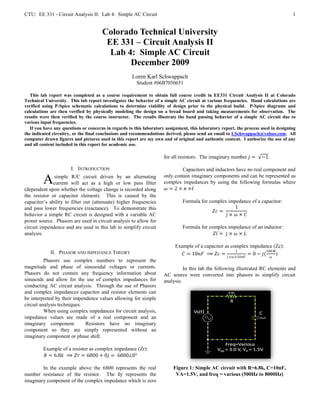
CTU: EE 331 - Circuit Analysis II: Lab 4: Simple AC Circuit                                                                           1


                                       Colorado Technical University
                                        EE 331 – Circuit Analysis II
                                         Lab 4: Simple AC Circuit
                                              December 2009
                                                     Loren Karl Schwappach
                                                        Student #06B7050651

   This lab report was completed as a course requirement to obtain full course credit in EE331 Circuit Analysis II at Colorado
Technical University. This lab report investigates the behavior of a simple AC circuit at various frequencies. Hand calculations are
verified using P-Spice schematic calculations to determine viability of design prior to the physical build. P-Spice diagrams and
calculations are then verified by physically modeling the design on a bread board and taking measurements for observation. The
results were then verified by the course instructor. The results illustrate the band passing behavior of a simple AC circuit due to
various input frequencies.
   If you have any questions or concerns in regards to this laboratory assignment, this laboratory report, the process used in designing
the indicated circuitry, or the final conclusions and recommendations derived, please send an email to LSchwappach@yahoo.com. All
computer drawn figures and pictures used in this report are my own and of original and authentic content. I authorize the use of any
and all content included in this report for academic use.

                                                                     for all resistors. The imaginary number  =     −1.

                       I. INTRODUCTION                                       Capacitors and inductors have no real component and
                                                                     only contain imaginary components and can be represented as
         A    simple R/C circuit driven by an alternating
              current will act as a high or low pass filter          complex impedances by using the following formulas where
                                                                      = 2 ×  ×f.
(dependent upon whether the voltage change is recorded along
the resistor or capacitor element). This is caused by the
capacitor’s ability to filter out (attenuate) higher frequencies               Formula for complex impedance of a capacitor:
and pass lower frequencies (reactance). To demonstrate this                                              1
                                                                                             =
behavior a simple RC circuit is designed with a variable AC                                         ×  × 
power source. Phasors are used in circuit analysis to allow for
circuit impendence and are used in this lab to simplify circuit                Formula for complex impedance of an inductor:
analysis.                                                                                     =  ×  × 

                                                                           Example of a capacitor as complex impedance (Zc):
             II. PHASOR AND IMPEDANCE THEORY                                                           1             100 
                                                                              = 10 ⟹  =           = 0 − (       )
                                                                                                      × ×10       
          Phasors use complex numbers to represent the
magnitude and phase of sinusoidal voltages or currents.                        In this lab the following illustrated RC elements and
Phasors do not contain any frequency information about               AC source were converted into phasors to simplify circuit
sinusoids and allow for the use of complex impedances for            analysis.
conducting AC circuit analysis. Through the use of Phasors
and complex impedances capacitor and resistor elements can
be interpreted by their impendence values allowing for simple
circuit analysis techniques.
          When using complex impedances for circuit analysis,
impedance values are made of a real component and an
imaginary component.         Resistors have no imaginary
component so they are simply represented without an
imaginary component or phase shift.

         Example of a resistor as complex impedance (Zr):
          = 6.8 ⟹  = 6800 + 0 = 6800∠0°

        In the example above the 6800 represents the real                 Figure 1: Simple AC circuit with R=6.8k, C=10nF,
number resistance of the resistor. The 0 represents the                  VA=1.5V, and freq = various (500Hz to 8000Hz)
imaginary component of the complex impedance which is zero
CTU: EE 331 - Circuit Analysis II: Lab 4: Simple AC Circuit                                                                                      2

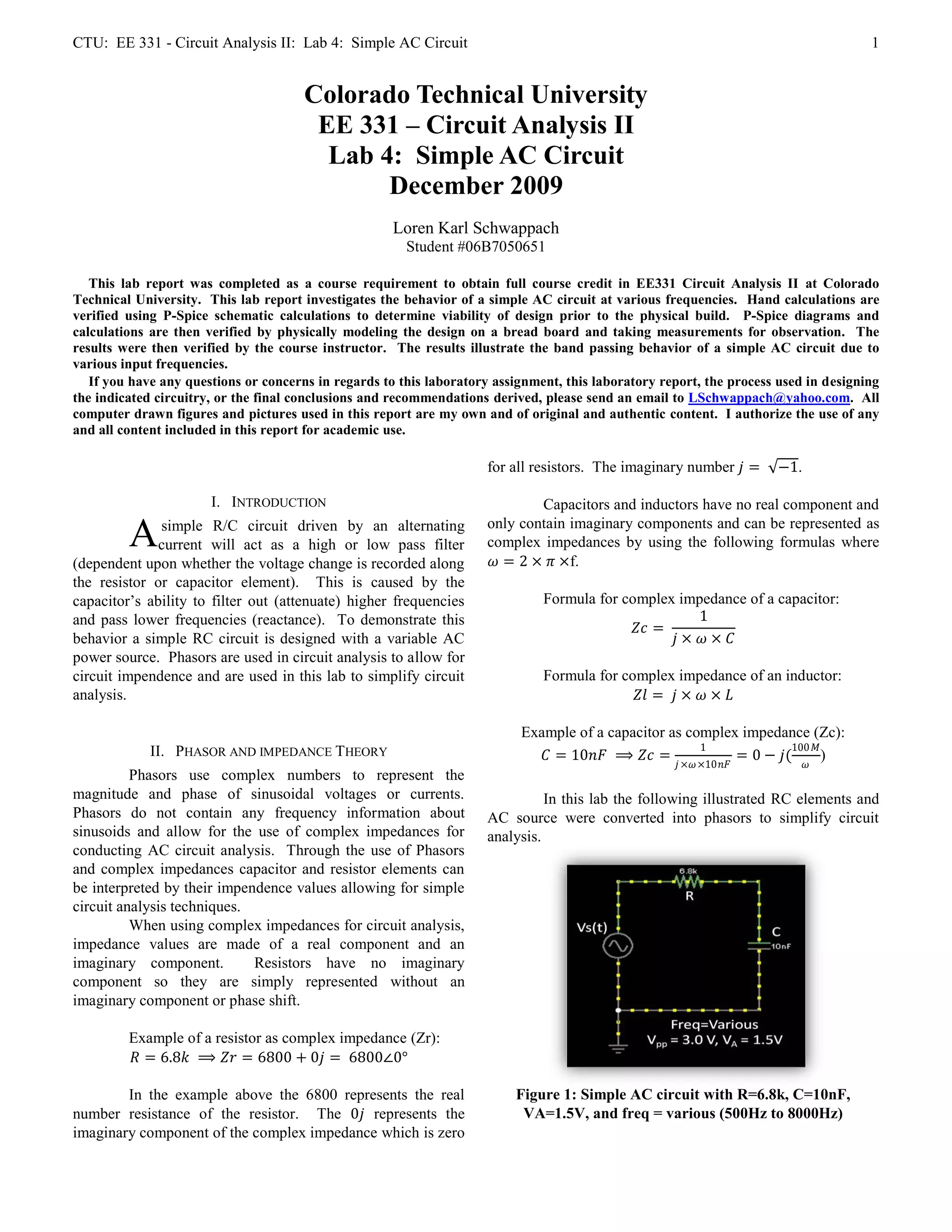
         Because we know this circuit is in series the current
is the same throughout the circuit and by using a Phasor to                                               Circuit Current (Phasor Form) A
represent the sinusoidal input by the relationship  =                               Frequency (Hz)
                                                                                                           Rectangular         Polar Form
1.5 cos  + 0° →  = 1.5∠0° = 1.5 + 0        and      by
converting the resistor and capacitor into complex impedances                               500        9.63 + j45.1 uA       46.1 ∟ 77.9º uA
we can discover the voltage at various frequencies along the                               1000        34.1 + j79.7 uA       86.7 ∟ 66.8º uA
resistor and capacitor. This is illustrated by the hand
calculated formula using Ohms law below.                                                   1500        64.2 + j100 uA        119 ∟ 57.3º uA
                                                                                           2000        93.1 + j109 uA        143 ∟ 49.5º uA
                                                                                           4000        164 + j96.2 uA        190 ∟ 30.4º uA
                                                                                            8000         203 + j59.4 uA       208 ∟ 12.8º uA
                                                                                          Table 2: Series current in Phasor form at various
                                                                                                             frequencies.
                                                                                             With these results obtained Ohms law  =  ×  is
                                                                                    utilized to find the respective voltage Phasors along each
                                                                                    element as identified below.


  Figure 2: Simple AC circuit using a Phasor for Vs and
   complex impedances for the resistor and capacitor.


                 III.      HAND CALCULATIONS FOR VC AND VR
         By finding the complex impedance values and
corresponding current Phasor  for each frequency (500Hz,
1kHz, 1.5kHz, 2kHz, 4kHz, and 8kHz) we can then use this
knowledge to find the complex voltage Phasor across each
element using Ohms law:  =  ×  where         is the                           Figure 3: Hand calculations for voltage levels along the
impedance. Thus the following values were found using hand                                       capacitor at various frequencies.
calculations.

 Frequency (Hz)                    Impedance of Capacitor: Zc (Ohms)
            500                                    0 - 31830j Ω
           1000                                    0 - 12915j Ω
           1500                                    0 - 10610j Ω
           2000                                    0 - 7958j Ω
           4000                                    0 - 3979j Ω
                                                                                      Figure 4: Hand calculations for voltage levels along the
           8000                                    0 - 1989j Ω                                   resistors at various frequencies.
  Table 1: Impedance values of 10nF capacitor at various
                      frequencies.

                 Now using the series current can be found by:
                          1.5+ 0
 =                =              100000000   so for the various frequencies the
        +       6800 −
                                       
following Phasor currents were found.
CTU: EE 331 - Circuit Analysis II: Lab 4: Simple AC Circuit                                                                    3


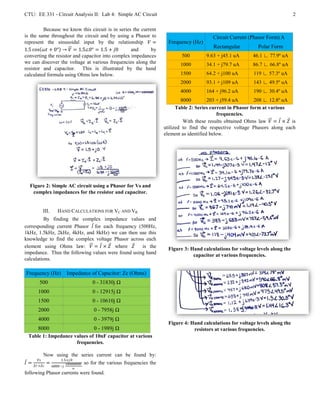
                         Voltage across capacitor (Phasor                        V. PHYSICAL MEASUREMENTS
  Frequency (Hz)                  form) in Volts                           The circuit in Figure 1 was then constructed on a
                                                                 breadboard using a sine wave generator for Vsource with VA =
                         Rectangular         Polar Form
                                                                 1.5V at various frequencies. Oscilloscope probes were
        500           1.44V – j307mV        1.47 ∟ -12º V        connected across the second circuit element (first the capacitor
       1000           1.27V – j543mV       1.38 ∟ -23.1º V       and then the resistor, switching there places each time) and
                                                                 from +Vs to ground. This had to be done due to Oscilloscope
       1500           1.06V – j681mV       1.26 ∟ -32.7º V       grounding concerns and was discovered after two hours of
       2000           867mV – j741mV       1.14 ∟ -40.5º V       troubleshooting the circuit with the aid of instructors. The
                                                                 oscilloscope was thus able to display the Voltage due to the
       4000           383mV – j653mV      757 ∟ -59.6º mV
                                                                 source in comparison to the voltage of the second element
      8000        118mV – j404mV 421 ∟ -73.7º mV                 (either resistor or capacitor). This allowed measurements of
   Table 3: Voltage in Phasor form across capacitor at           the phase angle and voltage across the elements in comparison
                  various frequencies.                           to the source.
                       Voltage across resistor (Phasor form)
                                     in Volts                                 VI. COMPONENTS USED / REQUIRED
  Frequency (Hz)
                                                                   The following is a list of components that were used.
                         Rectangular         Polar Form
                                                                        A digital multimeter for measuring circuit voltage,
        500           65.5mV – j307mV       314 ∟ 78º mV                    circuit current, resistance, and capacitance.
       1000           232mV – j542mV       590 ∟ 66.8º mV               A oscilloscope for viewing the input and output
                                                                            waveforms of a simple RC circuit with a 1kHz
       1500           437mV – j680mV       808 ∟ 57.3º mV                   square wave input.
       2000           633mV – j741mV       975 ∟ 49.5º mV               A signal generator capable of delivering 1.5V
                                                                            amplitude sine waves at various frequencies.
       4000           1.12V – j654mV        1.3 ∟ 30.3º V
                                                                        6.8kΩ resistors
      8000         1.38V – j404mV      1.44 ∟ 16.3º V                   10nF capacitors.
Table 4: Voltage in Phasor form across resistor at various              Bread board with wires.
                       frequencies.
                                                                                         VII. RESULTS
          These results were then confirmed by noting that the
                                                                         The circuit in Figure 1 was then constructed on a
total Voltage across the resistor and capacitor equals the
                                                                 breadboard using a sine wave generator for Vsource with VA =
voltage provided by the source (1.5V) per KVL. Also of note
                                                                 1.5V at various frequencies. Oscilloscope probes were
is the resistor and capacitor are 90 degrees out of phase with
                                                                 connected across the second circuit element
each other at each respective frequency.
                                                                          The following table illustrates the measurements.
                IV.       P-SPICE SIMULATION
   The hand calculated results were then compared against a
                                                                    Hz     Measured Capacitor         Measured Resistor
circuit with the same RC values built using P-Spice. Several
P-Spice simulations had to be run using a AC voltage source         500      1.45 ∟ -12º V              300 ∟ 80º mV
set at specific frequencies. Circuit probes were attached          1000       1.35 ∟-23º V               600 ∟ 65º mV
across the source, resistor and capacitor and a simulation was
ran to find the voltage and phase offsets at each frequency.       1500     1.2 ∟ -30º mV               800 ∟60º mV
The following table summarizes the P-Spice simulation              2000      1.1 ∟-41º mV               950 ∟ 50º mV
results.
                                                                   4000      0.7∟ -60º mV                1.3 ∟ 30º V
  Frequency      Capacitor voltage      Resistor voltage
     Hz              Phasor                 Phasor                 8000     0.35 ∟ -74º mV               1.4 ∟ 17º V
      500             1.47 ∟ -12º V      313 ∟ 78º mV            Table 6: Measured voltages in Phasor form across resistor
                                                                           and capacitor at various frequencies.
     1000             1.38 ∟-23º V       589 ∟ 67º mV
     1500         1.22 ∟ -31º mV         809 ∟57º mV
     2000          1.07 ∟-41º mV         974 ∟ 49º mV
     4000         0.742 ∟ -60º mV        1.26 ∟ 30º V
    8000        0.411 ∟ -74º mV       1.43 ∟ 17º V
   Table 5: P-Spice element voltage results as Phasors.
CTU: EE 331 - Circuit Analysis II: Lab 4: Simple AC Circuit                                                                      4

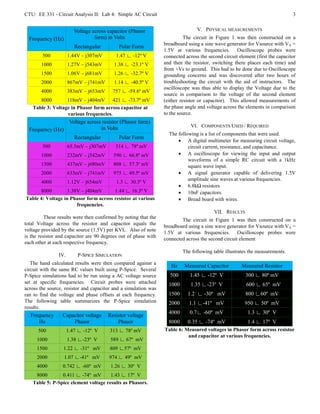
        The next figure is a graph of the actual magnitudes
measured of the source, resistor, and capacitor as a function of
frequency.


                                                                   Figure 7: Source, resistor, and capacitor on complex plane
                                                                                            at 1000 Hz
   Figure 5: Graph of source and element voltages as a
                 function of frequency.

           As illustrated in Figure 5 when measuring the output
voltage across the capacitor the RC circuit acts as a low pass
filter attenuating higher frequencies but when measuring the
voltage across the resistor the RC circuit acts as a band pass
filter attenuating lower frequencies.

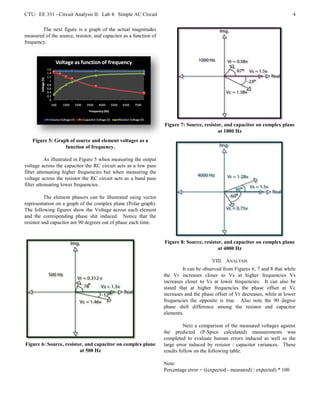
          The element phasors can be illustrated using vector
representation on a graph of the complex plane (Polar graph).
The following figures show the Voltage across each element
and the corresponding phase shit induced. Notice that the
resistor and capacitor are 90 degrees out of phase each time.


                                                                   Figure 8: Source, resistor, and capacitor on complex plane
                                                                                            at 4000 Hz

                                                                                         VIII. ANALYSIS
                                                                            It can be observed from Figures 6, 7 and 8 that while
                                                                   the Vr increases closer to Vs at higher frequencies Vs
                                                                   increases closer to Vs at lower frequencies. It can also be
                                                                   stated that at higher frequencies the phase offset at Vc
                                                                   increases and the phase offset of Vr decreases, while at lower
                                                                   frequencies the opposite is true. Also note the 90 degree
                                                                   phase shift difference among the resistor and capacitor
                                                                   elements.

                                                                             Next a comparison of the measured voltages against
                                                                   the predicted (P-Spice calculated) measurements was
                                                                   completed to evaluate human errors induced as well as the
Figure 6: Source, resistor, and capacitor on complex plane         large error induced by resistor / capacitor variances. These
                         at 500 Hz                                 results follow on the following table.

                                                                   Note:
                                                                   Percentage error = ((expected - measured) / expected) * 100
CTU: EE 331 - Circuit Analysis II: Lab 4: Simple AC Circuit                     5


       Voltage Amplitudes                       Phase Angles
      Resistor         Capacitor          Resistor         Capacitor
       -4.4%              -1.36             2.5%             16.66%
       1.69%             2.17%              -1.6%            0.45%
      -0.99%             -4.7%             4.71%               8.25
        2.5%             -3.5%             1.01%             2.25%
         0%              -7.5%             0.99%             0.671%
         0%             -4.98%              -8.15            0.407%
                 Table 7: Percentage error results


                           IX. CONCLUSION
          This lab was a success and was effective in
demonstrating the behavior of simple AC circuits at various
frequencies. It also was beneficial in demonstrating the power
and beauty of using Phasors and complex numbers to simplify
circuit analysis. The ability for RC circuits to act as band pass
filters is a powerful feature for engineers and will be
invaluable in work to come. Selective band pass filters are
critical in communication and digital systems and provides
most of the technology we have today. Using Phasor analysis
techniques instead of dealing with differential equations is a
tremendous relief.
          Finally, the unexpected finding that only the second
circuit element could be measured at the same time as Vs due
to grounding issues with the oscilloscope was frustrating but
will be invaluable in future laboratory work.

                              REFERENCES
[1]   R. E. Thomas, A. J. Rosa, and G. J. Toussaint, “The Analysis & Design
      of Linear Circuits, sixth edition” John Wiley & Sons, Inc. Hoboken, NJ,
      pp. 309, 2009.

Loren k. schwappach ee331 - lab 4

  • 1.
    CTU: EE 331- Circuit Analysis II: Lab 4: Simple AC Circuit 1 Colorado Technical University EE 331 – Circuit Analysis II Lab 4: Simple AC Circuit December 2009 Loren Karl Schwappach Student #06B7050651 This lab report was completed as a course requirement to obtain full course credit in EE331 Circuit Analysis II at Colorado Technical University. This lab report investigates the behavior of a simple AC circuit at various frequencies. Hand calculations are verified using P-Spice schematic calculations to determine viability of design prior to the physical build. P-Spice diagrams and calculations are then verified by physically modeling the design on a bread board and taking measurements for observation. The results were then verified by the course instructor. The results illustrate the band passing behavior of a simple AC circuit due to various input frequencies. If you have any questions or concerns in regards to this laboratory assignment, this laboratory report, the process used in designing the indicated circuitry, or the final conclusions and recommendations derived, please send an email to LSchwappach@yahoo.com. All computer drawn figures and pictures used in this report are my own and of original and authentic content. I authorize the use of any and all content included in this report for academic use. for all resistors. The imaginary number = −1. I. INTRODUCTION Capacitors and inductors have no real component and only contain imaginary components and can be represented as A simple R/C circuit driven by an alternating current will act as a high or low pass filter complex impedances by using the following formulas where = 2 × ×f. (dependent upon whether the voltage change is recorded along the resistor or capacitor element). This is caused by the capacitor’s ability to filter out (attenuate) higher frequencies Formula for complex impedance of a capacitor: and pass lower frequencies (reactance). To demonstrate this 1 = behavior a simple RC circuit is designed with a variable AC × × power source. Phasors are used in circuit analysis to allow for circuit impendence and are used in this lab to simplify circuit Formula for complex impedance of an inductor: analysis. = × × Example of a capacitor as complex impedance (Zc): II. PHASOR AND IMPEDANCE THEORY 1 100 = 10 ⟹ = = 0 − ( ) × ×10 Phasors use complex numbers to represent the magnitude and phase of sinusoidal voltages or currents. In this lab the following illustrated RC elements and Phasors do not contain any frequency information about AC source were converted into phasors to simplify circuit sinusoids and allow for the use of complex impedances for analysis. conducting AC circuit analysis. Through the use of Phasors and complex impedances capacitor and resistor elements can be interpreted by their impendence values allowing for simple circuit analysis techniques. When using complex impedances for circuit analysis, impedance values are made of a real component and an imaginary component. Resistors have no imaginary component so they are simply represented without an imaginary component or phase shift. Example of a resistor as complex impedance (Zr): = 6.8 ⟹ = 6800 + 0 = 6800∠0° In the example above the 6800 represents the real Figure 1: Simple AC circuit with R=6.8k, C=10nF, number resistance of the resistor. The 0 represents the VA=1.5V, and freq = various (500Hz to 8000Hz) imaginary component of the complex impedance which is zero
  • 2.
    CTU: EE 331- Circuit Analysis II: Lab 4: Simple AC Circuit 2 Because we know this circuit is in series the current is the same throughout the circuit and by using a Phasor to Circuit Current (Phasor Form) A represent the sinusoidal input by the relationship = Frequency (Hz) Rectangular Polar Form 1.5 cos + 0° → = 1.5∠0° = 1.5 + 0 and by converting the resistor and capacitor into complex impedances 500 9.63 + j45.1 uA 46.1 ∟ 77.9º uA we can discover the voltage at various frequencies along the 1000 34.1 + j79.7 uA 86.7 ∟ 66.8º uA resistor and capacitor. This is illustrated by the hand calculated formula using Ohms law below. 1500 64.2 + j100 uA 119 ∟ 57.3º uA 2000 93.1 + j109 uA 143 ∟ 49.5º uA 4000 164 + j96.2 uA 190 ∟ 30.4º uA 8000 203 + j59.4 uA 208 ∟ 12.8º uA Table 2: Series current in Phasor form at various frequencies. With these results obtained Ohms law = × is utilized to find the respective voltage Phasors along each element as identified below. Figure 2: Simple AC circuit using a Phasor for Vs and complex impedances for the resistor and capacitor. III. HAND CALCULATIONS FOR VC AND VR By finding the complex impedance values and corresponding current Phasor for each frequency (500Hz, 1kHz, 1.5kHz, 2kHz, 4kHz, and 8kHz) we can then use this knowledge to find the complex voltage Phasor across each element using Ohms law: = × where is the Figure 3: Hand calculations for voltage levels along the impedance. Thus the following values were found using hand capacitor at various frequencies. calculations. Frequency (Hz) Impedance of Capacitor: Zc (Ohms) 500 0 - 31830j Ω 1000 0 - 12915j Ω 1500 0 - 10610j Ω 2000 0 - 7958j Ω 4000 0 - 3979j Ω Figure 4: Hand calculations for voltage levels along the 8000 0 - 1989j Ω resistors at various frequencies. Table 1: Impedance values of 10nF capacitor at various frequencies. Now using the series current can be found by: 1.5+ 0 = = 100000000 so for the various frequencies the + 6800 − following Phasor currents were found.
  • 3.
    CTU: EE 331- Circuit Analysis II: Lab 4: Simple AC Circuit 3 Voltage across capacitor (Phasor V. PHYSICAL MEASUREMENTS Frequency (Hz) form) in Volts The circuit in Figure 1 was then constructed on a breadboard using a sine wave generator for Vsource with VA = Rectangular Polar Form 1.5V at various frequencies. Oscilloscope probes were 500 1.44V – j307mV 1.47 ∟ -12º V connected across the second circuit element (first the capacitor 1000 1.27V – j543mV 1.38 ∟ -23.1º V and then the resistor, switching there places each time) and from +Vs to ground. This had to be done due to Oscilloscope 1500 1.06V – j681mV 1.26 ∟ -32.7º V grounding concerns and was discovered after two hours of 2000 867mV – j741mV 1.14 ∟ -40.5º V troubleshooting the circuit with the aid of instructors. The oscilloscope was thus able to display the Voltage due to the 4000 383mV – j653mV 757 ∟ -59.6º mV source in comparison to the voltage of the second element 8000 118mV – j404mV 421 ∟ -73.7º mV (either resistor or capacitor). This allowed measurements of Table 3: Voltage in Phasor form across capacitor at the phase angle and voltage across the elements in comparison various frequencies. to the source. Voltage across resistor (Phasor form) in Volts VI. COMPONENTS USED / REQUIRED Frequency (Hz) The following is a list of components that were used. Rectangular Polar Form  A digital multimeter for measuring circuit voltage, 500 65.5mV – j307mV 314 ∟ 78º mV circuit current, resistance, and capacitance. 1000 232mV – j542mV 590 ∟ 66.8º mV  A oscilloscope for viewing the input and output waveforms of a simple RC circuit with a 1kHz 1500 437mV – j680mV 808 ∟ 57.3º mV square wave input. 2000 633mV – j741mV 975 ∟ 49.5º mV  A signal generator capable of delivering 1.5V amplitude sine waves at various frequencies. 4000 1.12V – j654mV 1.3 ∟ 30.3º V  6.8kΩ resistors 8000 1.38V – j404mV 1.44 ∟ 16.3º V  10nF capacitors. Table 4: Voltage in Phasor form across resistor at various  Bread board with wires. frequencies. VII. RESULTS These results were then confirmed by noting that the The circuit in Figure 1 was then constructed on a total Voltage across the resistor and capacitor equals the breadboard using a sine wave generator for Vsource with VA = voltage provided by the source (1.5V) per KVL. Also of note 1.5V at various frequencies. Oscilloscope probes were is the resistor and capacitor are 90 degrees out of phase with connected across the second circuit element each other at each respective frequency. The following table illustrates the measurements. IV. P-SPICE SIMULATION The hand calculated results were then compared against a Hz Measured Capacitor Measured Resistor circuit with the same RC values built using P-Spice. Several P-Spice simulations had to be run using a AC voltage source 500 1.45 ∟ -12º V 300 ∟ 80º mV set at specific frequencies. Circuit probes were attached 1000 1.35 ∟-23º V 600 ∟ 65º mV across the source, resistor and capacitor and a simulation was ran to find the voltage and phase offsets at each frequency. 1500 1.2 ∟ -30º mV 800 ∟60º mV The following table summarizes the P-Spice simulation 2000 1.1 ∟-41º mV 950 ∟ 50º mV results. 4000 0.7∟ -60º mV 1.3 ∟ 30º V Frequency Capacitor voltage Resistor voltage Hz Phasor Phasor 8000 0.35 ∟ -74º mV 1.4 ∟ 17º V 500 1.47 ∟ -12º V 313 ∟ 78º mV Table 6: Measured voltages in Phasor form across resistor and capacitor at various frequencies. 1000 1.38 ∟-23º V 589 ∟ 67º mV 1500 1.22 ∟ -31º mV 809 ∟57º mV 2000 1.07 ∟-41º mV 974 ∟ 49º mV 4000 0.742 ∟ -60º mV 1.26 ∟ 30º V 8000 0.411 ∟ -74º mV 1.43 ∟ 17º V Table 5: P-Spice element voltage results as Phasors.
  • 4.
    CTU: EE 331- Circuit Analysis II: Lab 4: Simple AC Circuit 4 The next figure is a graph of the actual magnitudes measured of the source, resistor, and capacitor as a function of frequency. Figure 7: Source, resistor, and capacitor on complex plane at 1000 Hz Figure 5: Graph of source and element voltages as a function of frequency. As illustrated in Figure 5 when measuring the output voltage across the capacitor the RC circuit acts as a low pass filter attenuating higher frequencies but when measuring the voltage across the resistor the RC circuit acts as a band pass filter attenuating lower frequencies. The element phasors can be illustrated using vector representation on a graph of the complex plane (Polar graph). The following figures show the Voltage across each element and the corresponding phase shit induced. Notice that the resistor and capacitor are 90 degrees out of phase each time. Figure 8: Source, resistor, and capacitor on complex plane at 4000 Hz VIII. ANALYSIS It can be observed from Figures 6, 7 and 8 that while the Vr increases closer to Vs at higher frequencies Vs increases closer to Vs at lower frequencies. It can also be stated that at higher frequencies the phase offset at Vc increases and the phase offset of Vr decreases, while at lower frequencies the opposite is true. Also note the 90 degree phase shift difference among the resistor and capacitor elements. Next a comparison of the measured voltages against the predicted (P-Spice calculated) measurements was completed to evaluate human errors induced as well as the Figure 6: Source, resistor, and capacitor on complex plane large error induced by resistor / capacitor variances. These at 500 Hz results follow on the following table. Note: Percentage error = ((expected - measured) / expected) * 100
  • 5.
    CTU: EE 331- Circuit Analysis II: Lab 4: Simple AC Circuit 5 Voltage Amplitudes Phase Angles Resistor Capacitor Resistor Capacitor -4.4% -1.36 2.5% 16.66% 1.69% 2.17% -1.6% 0.45% -0.99% -4.7% 4.71% 8.25 2.5% -3.5% 1.01% 2.25% 0% -7.5% 0.99% 0.671% 0% -4.98% -8.15 0.407% Table 7: Percentage error results IX. CONCLUSION This lab was a success and was effective in demonstrating the behavior of simple AC circuits at various frequencies. It also was beneficial in demonstrating the power and beauty of using Phasors and complex numbers to simplify circuit analysis. The ability for RC circuits to act as band pass filters is a powerful feature for engineers and will be invaluable in work to come. Selective band pass filters are critical in communication and digital systems and provides most of the technology we have today. Using Phasor analysis techniques instead of dealing with differential equations is a tremendous relief. Finally, the unexpected finding that only the second circuit element could be measured at the same time as Vs due to grounding issues with the oscilloscope was frustrating but will be invaluable in future laboratory work. REFERENCES [1] R. E. Thomas, A. J. Rosa, and G. J. Toussaint, “The Analysis & Design of Linear Circuits, sixth edition” John Wiley & Sons, Inc. Hoboken, NJ, pp. 309, 2009.