- Electrochemical impedance spectroscopy (EIS) measures the impedance of electrical circuits and chemical systems as a function of frequency. It provides more detailed information than DC techniques alone.
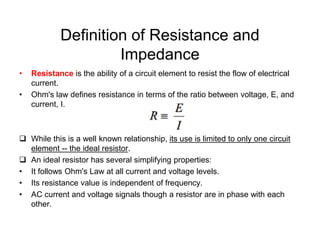
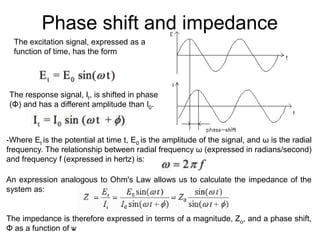
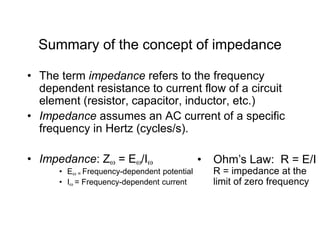
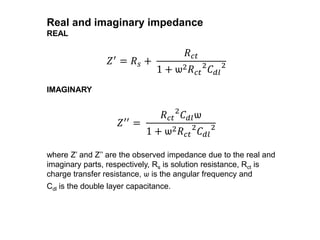
- Impedance replaces resistance as a more general parameter that accounts for frequency-dependent behavior of circuit elements like capacitors and inductors. It is defined as the ratio of voltage to current.
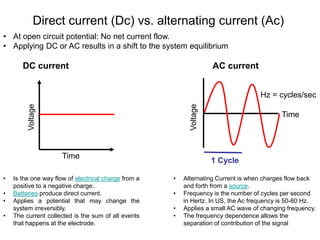
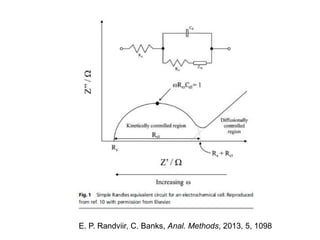
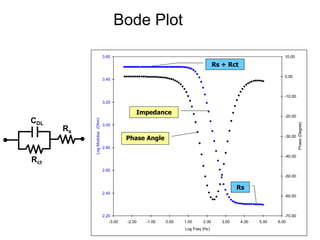
- EIS experiments involve applying a small AC potential over a range of frequencies and measuring the current response. The impedance is calculated from these measurements and plotted on Nyquist and Bode plots for analysis.
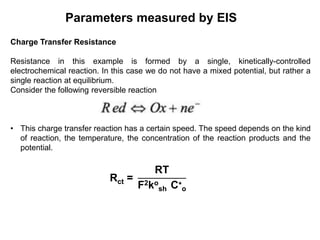
- Equivalent circuit models consisting of electrical components like resistors and capacitors are used to model electrochemical systems and interpret EIS data













![Parameters from fitting
oxidation of ethanol
Table 2. The electrochemical active surface area (ECASA) and the fitted equivalent circuit parameters of ethanol oxidation
for the different materials in the films.[a]
Catalysts surf. area (cm2) C (μF) (Rct,), KΩ Rate constant (ko, cm s-1)
AuNCs 2nm 20.1 ± 1.5 0.335 ± 0.03 1.42 ± 0.1 0.0158
AuNCs-MPA 19.1 ± 1.9 0.318 ± 0.03 34.7 ± 3.5 0.0006
AuNCs-DT 18.5 ± 1.9 0.308 ± 0.03 35.1 ± 3.5 0.0006
Au-6nm 14.9 ± 1.2 0.248 ± 0.02 6.0 ± 0.5 0.0037
Au-10nm 12.4 ± 0.9 0.207 ± 0.01 16.2 ± 1.1 0.0014
[a] The capacitance was calculated from the fitted equivalent circuit (assuming a specific capacitance of 60 mF/cm2).
Yao, H.; Liu, B.; Mosa, I. M.; Bist, I.; He, J.; Rusling, J. F., Electrocatalytic Oxidation of Alcohols, Tripropylamine, and DNA
with Ligand-Free Gold Nanoclusters on Nitrided Carbon. ChemElectroChem 2016, 3 (12), 2100-2109.
0 5 10 15 20 25 30 35
0
-5
-10
-15
-20
-25
A
0.0 0.5 1.0 1.5 2.0
0.2
0.0
-0.2
-0.4
-0.6
-0.8
Z''(KW)
Z''(K
W
)
a
e
d
c
b
Z''(k
W
)
Z'(kW)
a](https://image.slidesharecdn.com/basics-and-applications-of-impedance-230109101048-1c6bf496/85/Basics-and-Applications-of-impedance-pptx-30-320.jpg)


![Echem Basics for Corrosion analisis [Compatibility Mode].pdf](https://cdn.slidesharecdn.com/ss_thumbnails/echembasicscompatibilitymode-251110024506-8363342d-thumbnail.jpg?width=640&height=640&fit=bounds)
![Fundamentals of EIS [Compatibility Mode].pdf](https://cdn.slidesharecdn.com/ss_thumbnails/fundamentalsofeiscompatibilitymode-251110024359-9c64b02c-thumbnail.jpg?width=640&height=640&fit=bounds)


