LOQUAT (Eriobotrya japonica тАУ Lindl) PROCESSING AND
VALUE ADDITION
Dr jai Singh (ARS)
M. Tech. Ph. D
Former Director ICAR тАУ CIPHET
Mob: 8958463808 E-Mail: jsingh.sre@gmail.com
INTRODUCTION
Loquat (Eriobotrya japonica тАУ Lindl - Family тАУ Rosaceae) is a
large evergreen shrub or small tree, with a rounded crown, short trunk
and woolly new twigs. The loquat fruit is delicious, juicy, sweet, and
bursting with juice and flavor. The flavor is a pleasant blend of apricot,
plum and cherry with floral overtones, and is quite sweet when ripe. The
tree can grow to 5тАУ10 metres tall, but is often smaller, about 3тАУ4
metres. Loquat start bearing fruits from 3rd
year of plantation and gives
maximum yield at 15 years age. Fruits take 2 тАУ 3 months to mature after
set. It grows up to 1525 m in elevation all over India (Uttar Pradesh,
Delhi, Punjab, Himachal Pradesh, Assam, Maharashtra, and a few of the
hill stations in the south). In North India loquat fruit ripens during end
March to May. Loquat fruits, grow in clusters, are oval, rounded or
pear-shaped. yellow or orange . Each fruit contains three to five large
brown seeds. It contains 60 to 70 percent pulp depending upon the
cultivar and 15-20 percent seed. The pulp is composed of 88% water,
0.6% proteins, 9.6% carbohydrates, 0.5% minerals, 1.0% fibre and 55%
lU vitamin A. Waste loquat kernels can be used to produce valuable
industrial compounds providing cheap substrates to industrial
fermentation
Loquat Health Benefits :
Beneficial in Cancer Therapies due to its cytokine. Excellent Vitamin A .
Controls heart hate & blood pressure. Reduces blood cholesterol level.
Good source of essential minerals. Fights memory impairment,
neurological & oxidative stress. Anti-Inflammatory & analgesic
properties. Mild sedative quality: Loquat fruit moistens lungs, reduces
coughing, quenches thirst and eases stomach problems such as
nausea.
Planting Loquat :
It can be planted in February-March and August- September. The
planting distance varies from 6 meters to 7 meters or 196 to 256 plants
per hectare. Pits of 1m x 1m x 1m (length x width x depth) are prepared
one month prior to plantation. White ant treatment is given but no
compost or fertilizer is applied to the soil when planting loquat trees.
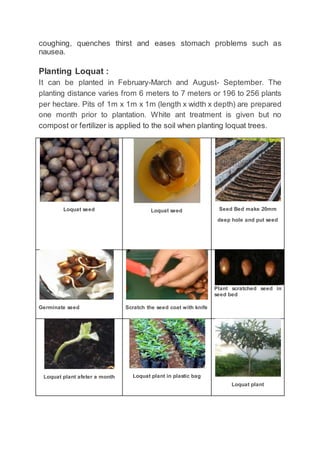
Loquat seed Loquat seed Seed Bed make 20mm
deep hole and put seed
Germinate seed Scratch the seed coat with knife
Plant scratched seed in
seed bed
Loquat plant afeter a month Loquat plant in plastic bag
Loquat plant
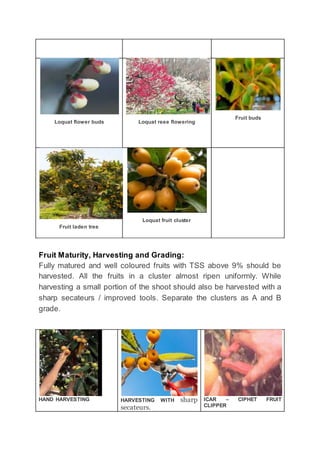
Loquat flower buds Loquat reee flowering
Fruit buds
Fruit laden tree
Loquat fruit cluster
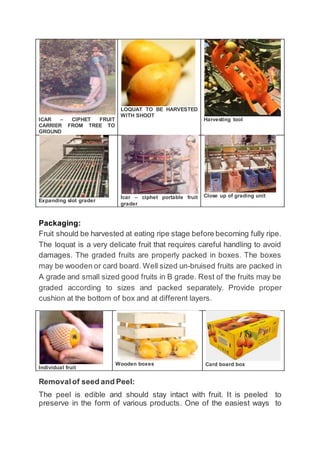
Fruit Maturity, Harvesting and Grading:
Fully matured and well coloured fruits with TSS above 9% should be
harvested. All the fruits in a cluster almost ripen uniformly. While
harvesting a small portion of the shoot should also be harvested with a
sharp secateurs / improved tools. Separate the clusters as A and B
grade.
HAND HARVESTING HARVESTING WITH sharp
secateurs.
ICAR тАУ CIPHET FRUIT
CLIPPER
ICAR тАУ CIPHET FRUIT
CARRIER FROM TREE TO
GROUND
LOQUAT TO BE HARVESTED
WITH SHOOT
Harvesting tool
Expanding slot grader
Icar тАУ ciphet portable fruit
grader
Close up of grading unit
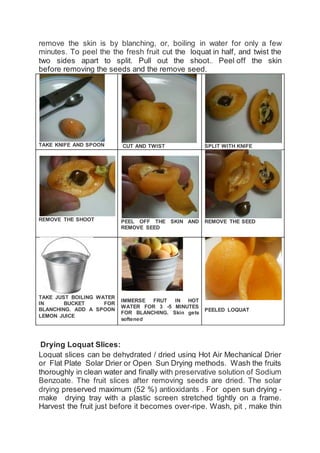
Packaging:
Fruit should be harvested at eating ripe stage before becoming fully ripe.
The loquat is a very delicate fruit that requires careful handling to avoid
damages. The graded fruits are properly packed in boxes. The boxes
may be wooden or card board. Well sized un-bruised fruits are packed in
A grade and small sized good fruits in B grade. Rest of the fruits may be
graded according to sizes and packed separately. Provide proper
cushion at the bottom of box and at different layers.
Individual fruit
Wooden boxes Card board box
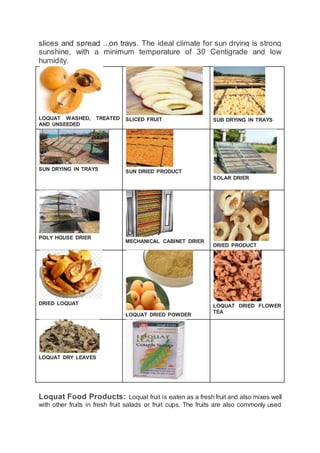
Removalof seed and Peel:
The peel is edible and should stay intact with fruit. It is peeled to
preserve in the form of various products. One of the easiest ways to
remove the skin is by blanching, or, boiling in water for only a few
minutes. To peel the the fresh fruit cut the loquat in half, and twist the
two sides apart to split. Pull out the shoot.. Peel off the skin
before removing the seeds and the remove seed.
TAKE KNIFE AND SPOON CUT AND TWIST SPLIT WITH KNIFE
REMOVE THE SHOOT PEEL OFF THE SKIN AND
REMOVE SEED
REMOVE THE SEED
TAKE JUST BOILING WATER
IN BUCKET FOR
BLANCHING. ADD A SPOON
LEMON JUICE
IMMERSE FRUT IN HOT
WATER FOR 3 -5 MINUTES
FOR BLANCHING. Skin gets
softened
PEELED LOQUAT
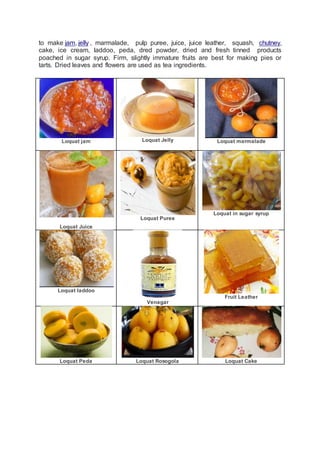
Drying Loquat Slices:
Loquat slices can be dehydrated / dried using Hot Air Mechanical Drier
or Flat Plate Solar Drier or Open Sun Drying methods. Wash the fruits
thoroughly in clean water and finally with preservative solution of Sodium
Benzoate. The fruit slices after removing seeds are dried. The solar
drying preserved maximum (52 %) antioxidants . For open sun drying -
make drying tray with a plastic screen stretched tightly on a frame.
Harvest the fruit just before it becomes over-ripe. Wash, pit , make thin
slices and spread ...on trays. The ideal climate for sun drying is strong
sunshine, with a minimum temperature of 30 Centigrade and low
humidity.
LOQUAT WASHED, TREATED
AND UNSEEDED
SLICED FRUIT SUB DRYING IN TRAYS
SUN DRYING IN TRAYS SUN DRIED PRODUCT
SOLAR DRIER
POLY HOUSE DRIER
MECHANICAL CABINET DRIER
DRIED PRODUCT
DRIED LOQUAT
LOQUAT DRIED POWDER
LOQUAT DRIED FLOWER
TEA
LOQUAT DRY LEAVES
Loquat Food Products: Loquat fruit is eaten as a fresh fruit and also mixes well
with other fruits in fresh fruit salads or fruit cups. The fruits are also commonly used
to make jam, jelly , marmalade, pulp puree, juice, juice leather, squash, chutney,
cake, ice cream, laddoo, peda, dred powder, dried and fresh tinned products
poached in sugar syrup. Firm, slightly immature fruits are best for making pies or
tarts. Dried leaves and flowers are used as tea ingredients.
Loquat jam Loquat Jelly Loquat marmalade
Loquat Juice
Loquat Puree
Loquat in sugar syrup
Loquat laddoo
Venagar
Fruit Leather
Loquat Peda Loquat Rosogola Loquat Cake
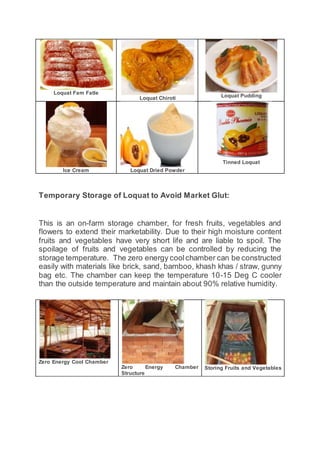
Loquat Fam Fatle
Loquat Chiroti Loquat Pudding
Ice Cream Loquat Dried Powder
Tinned Loquat
Temporary Storage of Loquat to Avoid Market Glut:
This is an on-farm storage chamber, for fresh fruits, vegetables and
flowers to extend their marketability. Due to their high moisture content
fruits and vegetables have very short life and are liable to spoil. The
spoilage of fruits and vegetables can be controlled by reducing the
storage temperature. The zero energy coolchamber can be constructed
easily with materials like brick, sand, bamboo, khash khas / straw, gunny
bag etc. The chamber can keep the temperature 10-15 Deg C cooler
than the outside temperature and maintain about 90% relative humidity.
Zero Energy Cool Chamber
Zero Energy Chamber
Structure
Storing Fruits and Vegetables
Availability of Loquat in India
Loquats are high in natural pectin, so they are easy to preserve.
Storage:
Zero Energy Chambers
Juice, jam, marmalade, jelly
,chutney, cake, cake
Pham phatale, fruit leather
Loquat Recipe Ideas and Uses:
--Make a preserve and use to top pancakes, cakes, ice cream and
pastries. Because loquats have such a mild flavor, consider
supplementing them with additional spices, such as cinnamon, clove or
cardamom. Also, though loquats have some pectin, add more to
improve the preserveтАЩs consistency.
--Use in ice cream, but use supplementary spices to enhance loquatтАЩs
subdued flavor. Though loquats go well with warm spices, they can also
pair with bright, cool flavors like mint and lemon.
--Like apricots and peach, cut, peeled loquats make a beautiful addition
to tarts.
--Swirl into creamy batters for breads, yoghurts or cheesecakes: the fruit
pairs beautifully with cheese and cheese-like flavors.
--Add loquats as a rambutan or lychee substitute in any Chinese cooking
dish.
--Make loquat syrup by stewing the peeled, seeded fruit puree in sugar
and water, reducing the concoction into a syrupy broth. Add vanilla and
a pinch of salt.
--Bake loquats with nuts, sugar, garlic and onions, and serve atop rice
and grain dishes such as tagine, biryani, and couscous. Baking does
not require peeling the fruit.
--Poach the fruit with sugar and a cinnamon stick
--Add loquat to salsa recipes
--Make loquat soda by first peeling loquats and deseeding them. Use a
juicer to extract the pulp and juice, and then boil with sugar. Strain the
concoction through cheesecloth, and refrigerate. Add carbonated water
and ice. Note: if desiring a more tart, tangy flavor, leave the skins on
some of the fruits.
Postharvest Atmosphere Management
fresh fruit quality could be maintained for up to 30 days at 1 - 5┬░C, 15
days at 10┬░C and 10 days at 20┬░C. Relative humidity should remain
between 90 and 95%. If they are put in contact with ethylene, it will
cause the acceleration of green colour loss, although the taste of the
fruit will not improve.
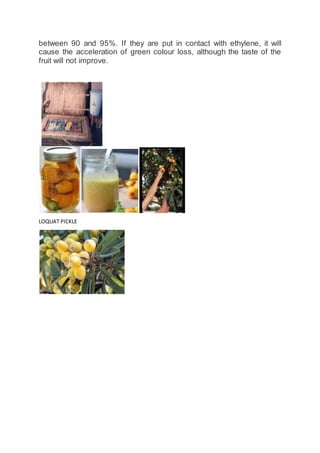
LOQUAT PICKLE

Loquat processing

  • 1.
    LOQUAT (Eriobotrya japonicaтАУ Lindl) PROCESSING AND VALUE ADDITION Dr jai Singh (ARS) M. Tech. Ph. D Former Director ICAR тАУ CIPHET Mob: 8958463808 E-Mail: jsingh.sre@gmail.com INTRODUCTION Loquat (Eriobotrya japonica тАУ Lindl - Family тАУ Rosaceae) is a large evergreen shrub or small tree, with a rounded crown, short trunk and woolly new twigs. The loquat fruit is delicious, juicy, sweet, and bursting with juice and flavor. The flavor is a pleasant blend of apricot, plum and cherry with floral overtones, and is quite sweet when ripe. The tree can grow to 5тАУ10 metres tall, but is often smaller, about 3тАУ4 metres. Loquat start bearing fruits from 3rd year of plantation and gives maximum yield at 15 years age. Fruits take 2 тАУ 3 months to mature after set. It grows up to 1525 m in elevation all over India (Uttar Pradesh, Delhi, Punjab, Himachal Pradesh, Assam, Maharashtra, and a few of the hill stations in the south). In North India loquat fruit ripens during end March to May. Loquat fruits, grow in clusters, are oval, rounded or pear-shaped. yellow or orange . Each fruit contains three to five large brown seeds. It contains 60 to 70 percent pulp depending upon the cultivar and 15-20 percent seed. The pulp is composed of 88% water, 0.6% proteins, 9.6% carbohydrates, 0.5% minerals, 1.0% fibre and 55% lU vitamin A. Waste loquat kernels can be used to produce valuable industrial compounds providing cheap substrates to industrial fermentation Loquat Health Benefits : Beneficial in Cancer Therapies due to its cytokine. Excellent Vitamin A . Controls heart hate & blood pressure. Reduces blood cholesterol level. Good source of essential minerals. Fights memory impairment, neurological & oxidative stress. Anti-Inflammatory & analgesic properties. Mild sedative quality: Loquat fruit moistens lungs, reduces
  • 2.
    coughing, quenches thirstand eases stomach problems such as nausea. Planting Loquat : It can be planted in February-March and August- September. The planting distance varies from 6 meters to 7 meters or 196 to 256 plants per hectare. Pits of 1m x 1m x 1m (length x width x depth) are prepared one month prior to plantation. White ant treatment is given but no compost or fertilizer is applied to the soil when planting loquat trees. Loquat seed Loquat seed Seed Bed make 20mm deep hole and put seed Germinate seed Scratch the seed coat with knife Plant scratched seed in seed bed Loquat plant afeter a month Loquat plant in plastic bag Loquat plant
  • 3.
    Loquat flower budsLoquat reee flowering Fruit buds Fruit laden tree Loquat fruit cluster Fruit Maturity, Harvesting and Grading: Fully matured and well coloured fruits with TSS above 9% should be harvested. All the fruits in a cluster almost ripen uniformly. While harvesting a small portion of the shoot should also be harvested with a sharp secateurs / improved tools. Separate the clusters as A and B grade. HAND HARVESTING HARVESTING WITH sharp secateurs. ICAR тАУ CIPHET FRUIT CLIPPER
  • 4.
    ICAR тАУ CIPHETFRUIT CARRIER FROM TREE TO GROUND LOQUAT TO BE HARVESTED WITH SHOOT Harvesting tool Expanding slot grader Icar тАУ ciphet portable fruit grader Close up of grading unit Packaging: Fruit should be harvested at eating ripe stage before becoming fully ripe. The loquat is a very delicate fruit that requires careful handling to avoid damages. The graded fruits are properly packed in boxes. The boxes may be wooden or card board. Well sized un-bruised fruits are packed in A grade and small sized good fruits in B grade. Rest of the fruits may be graded according to sizes and packed separately. Provide proper cushion at the bottom of box and at different layers. Individual fruit Wooden boxes Card board box Removalof seed and Peel: The peel is edible and should stay intact with fruit. It is peeled to preserve in the form of various products. One of the easiest ways to
  • 5.
    remove the skinis by blanching, or, boiling in water for only a few minutes. To peel the the fresh fruit cut the loquat in half, and twist the two sides apart to split. Pull out the shoot.. Peel off the skin before removing the seeds and the remove seed. TAKE KNIFE AND SPOON CUT AND TWIST SPLIT WITH KNIFE REMOVE THE SHOOT PEEL OFF THE SKIN AND REMOVE SEED REMOVE THE SEED TAKE JUST BOILING WATER IN BUCKET FOR BLANCHING. ADD A SPOON LEMON JUICE IMMERSE FRUT IN HOT WATER FOR 3 -5 MINUTES FOR BLANCHING. Skin gets softened PEELED LOQUAT Drying Loquat Slices: Loquat slices can be dehydrated / dried using Hot Air Mechanical Drier or Flat Plate Solar Drier or Open Sun Drying methods. Wash the fruits thoroughly in clean water and finally with preservative solution of Sodium Benzoate. The fruit slices after removing seeds are dried. The solar drying preserved maximum (52 %) antioxidants . For open sun drying - make drying tray with a plastic screen stretched tightly on a frame. Harvest the fruit just before it becomes over-ripe. Wash, pit , make thin
  • 6.
    slices and spread...on trays. The ideal climate for sun drying is strong sunshine, with a minimum temperature of 30 Centigrade and low humidity. LOQUAT WASHED, TREATED AND UNSEEDED SLICED FRUIT SUB DRYING IN TRAYS SUN DRYING IN TRAYS SUN DRIED PRODUCT SOLAR DRIER POLY HOUSE DRIER MECHANICAL CABINET DRIER DRIED PRODUCT DRIED LOQUAT LOQUAT DRIED POWDER LOQUAT DRIED FLOWER TEA LOQUAT DRY LEAVES Loquat Food Products: Loquat fruit is eaten as a fresh fruit and also mixes well with other fruits in fresh fruit salads or fruit cups. The fruits are also commonly used
  • 7.
    to make jam,jelly , marmalade, pulp puree, juice, juice leather, squash, chutney, cake, ice cream, laddoo, peda, dred powder, dried and fresh tinned products poached in sugar syrup. Firm, slightly immature fruits are best for making pies or tarts. Dried leaves and flowers are used as tea ingredients. Loquat jam Loquat Jelly Loquat marmalade Loquat Juice Loquat Puree Loquat in sugar syrup Loquat laddoo Venagar Fruit Leather Loquat Peda Loquat Rosogola Loquat Cake
  • 8.
    Loquat Fam Fatle LoquatChiroti Loquat Pudding Ice Cream Loquat Dried Powder Tinned Loquat Temporary Storage of Loquat to Avoid Market Glut: This is an on-farm storage chamber, for fresh fruits, vegetables and flowers to extend their marketability. Due to their high moisture content fruits and vegetables have very short life and are liable to spoil. The spoilage of fruits and vegetables can be controlled by reducing the storage temperature. The zero energy coolchamber can be constructed easily with materials like brick, sand, bamboo, khash khas / straw, gunny bag etc. The chamber can keep the temperature 10-15 Deg C cooler than the outside temperature and maintain about 90% relative humidity. Zero Energy Cool Chamber Zero Energy Chamber Structure Storing Fruits and Vegetables
  • 9.
    Availability of Loquatin India Loquats are high in natural pectin, so they are easy to preserve. Storage: Zero Energy Chambers Juice, jam, marmalade, jelly ,chutney, cake, cake
  • 10.
    Pham phatale, fruitleather Loquat Recipe Ideas and Uses: --Make a preserve and use to top pancakes, cakes, ice cream and pastries. Because loquats have such a mild flavor, consider supplementing them with additional spices, such as cinnamon, clove or cardamom. Also, though loquats have some pectin, add more to improve the preserveтАЩs consistency. --Use in ice cream, but use supplementary spices to enhance loquatтАЩs subdued flavor. Though loquats go well with warm spices, they can also pair with bright, cool flavors like mint and lemon. --Like apricots and peach, cut, peeled loquats make a beautiful addition to tarts. --Swirl into creamy batters for breads, yoghurts or cheesecakes: the fruit pairs beautifully with cheese and cheese-like flavors. --Add loquats as a rambutan or lychee substitute in any Chinese cooking dish. --Make loquat syrup by stewing the peeled, seeded fruit puree in sugar and water, reducing the concoction into a syrupy broth. Add vanilla and a pinch of salt. --Bake loquats with nuts, sugar, garlic and onions, and serve atop rice and grain dishes such as tagine, biryani, and couscous. Baking does not require peeling the fruit. --Poach the fruit with sugar and a cinnamon stick --Add loquat to salsa recipes --Make loquat soda by first peeling loquats and deseeding them. Use a juicer to extract the pulp and juice, and then boil with sugar. Strain the concoction through cheesecloth, and refrigerate. Add carbonated water and ice. Note: if desiring a more tart, tangy flavor, leave the skins on some of the fruits. Postharvest Atmosphere Management fresh fruit quality could be maintained for up to 30 days at 1 - 5┬░C, 15 days at 10┬░C and 10 days at 20┬░C. Relative humidity should remain
  • 11.
    between 90 and95%. If they are put in contact with ethylene, it will cause the acceleration of green colour loss, although the taste of the fruit will not improve. LOQUAT PICKLE