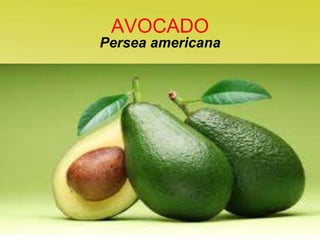
AVOCADO
Persea americana
Introduction
• Family - Lauraceous
• Species - Persea americana
• Avocado is a perennial plant
• It is a hardy plant.
• Avocado is medium to large ever green plant
• Known as a 'poor man’s butter’ to the King of Fruits
• Most varieties of avocado are oval or round shaped
with thick, rough green skin.
• The avocado is native to Mexico and Central
America
• Avocado or alligator pear also refers to
the fruit, botanically a large berry that contains a
single seed.
Major Growing Areas
• Kandy
• Matale
• Nuwara Eliya
• Badulla
• Kegalle
Soil Condition
• Need well-aerated and loose soil
• Limestone, sandy loam and decomposed
granite are the main soil types
• Avocado trees tolerate both acidic and
alkaline soils
• pH range should be 6- 6.5
• Compacted soils will affect root spread
• Refers slightly dry condition
Climatic Condition
• Grown only in subtropical or tropical climates
• Temperatures need 26-30 0C
• Minimum survival temperature is about - 4 °C
• Hot, dry conditions could result in low yields
because of fruit and flower drop
• A high humidity is desirable, because it
decreases stress conditions
• Rainfall exceeding 1 000 mm is desirable
Morphology
• Trees to 30m tall
• Leaves
– Narrowly to broadly elliptic
– Leaf blades 10-30cm long
– 3-19cm width
• Flowers
– 3-6mm long
– Yellowish green color
– Determinate and indeterminate type
• Root system
– Shallow root system
• Fruit
– pear-shaped,
– often more or less necked
– oval or nearly round
– yellow-green, deep-green or very dark-green,
reddish-purple, or so dark a purple as to appear
almost black, and is sometimes speckled with tiny
yellow dots,
– lossy or leathery skin
Varieties
• Pollock
• Purple varieties
• Fuerte
• Booth - 7
• Simmonds
• Tower 11
Pollock Simmods
Purple variety
Fuerte
GROWTH STAGES
Bud Development
Flowering
• Avocado flowers carry both male and female
reproductive organs
• Each flower opens twice over a two-day
period
• The first day as a female and the second day
as a male.
• Air temperature regulates the opening and
closing of flowers
Three requirements for a
successful fruit set
1. An overlapping of the flowering stages
2. Significant insect activity, including bees
3. Temperature is somewhat low
PRODUCTION OF PLANTING
MATERIAL
• Nursery management
– Poly bag nurseries are prominent
– Need proper drainage
– Seed should be treated with hot water for 30 min
– Apply fungicides and gypsum
Propagation
• Sexual
• Asexual or vegetative
Vegetative propagation
• Grafting is prominent
• Stem or branch may not be thicker than 2 cm
diameter
• Remove the top and bottom part of the
branch
• Two types of rootstock can be used
– the cultivar and the seedling rootstock
• cultivar rootstock is produced by vegetative
methods, Seedling rootstocks grow from seed
Crop Establishment
• Site selection
– Surface and subsoil drainage must be
excellent.
– Sloping ground with a porous top soil
structure may be unsuitable
• Land preparation
– Dig holes large enough to take the
root system comfortably
– Do not place fertilizers in the planting
hole
– Half fill the hole with soil and Fill the
hole with water
• Planting
– Planting space varies among varieties
– common planting space was about 20’x 15’ with
145 trees per acre
Management practices
• Mulching
– This should be loose, 10 to 15cm deep
– Oats, sorghum, mixtures of these with a legume
– Mulch provides organic matter, a valuable source
of tree nutrients and food for beneficial soil
microorganisms
• Tree training and pruning
– Little pruning is required
– regulate tree canopy size
– tree removal
• When yield decline immediately follows the removal of
productive trees
• Selective limb removal
– Limbs that are low, overlapping or growing up the
centre of the tree
– exposed limbs with white plastic paint
• Stag horning
– pruning a tree above the graft
• Fertilizing
– small amounts of fertilizers
– applicable on sandy soils
– Every 8 weeks apply a nitrogenous fertilizer
– Organic fertilizers are ideal, applied on top of the
mulch layer.
– Use 10 liters of matured poultry manure per tree
– From the third year apply an NPK mixture
• Irrigation
– 1800 mm per year rainfall
– Avocados are very sensitive to moisture stress,
especially during
• flowering
• fruit set
• fruit development
– Irrigation systems should be designed depends on
• number of trees per hectare
• soil texture and depth
• weather conditions
• trees’ growth cycle
– In orchard's basically drip irrigation techniques
– Required ammount 3 to 5ML per hectare
– Water stress can cause symptoms including;
• fruit drop
• ring-necking
• skin cracking
• salt burn
• In young trees, vegetative growth is reduced
Pest and Disease Management
• Common pests
– avocado leaf roller
– Avocado thrips
– Persea mites
Thrips attack
Persea mites
Pests
• Avocado thrips - Scirtothrips perseae
– Symptoms
• leathery patches and spread across fruit
• adult insect is orange-yellow in color with distinct
brown bands
– Management
• organic mulch about 6 inches
• if insecticides are to be applied
• Diseases
– Anthracnose
– Scab
– Stem-end rot
– Phytophthora root rot
– Black streak
– Bacterial soft rot
– Sun blotch
– leaf spot
Anthracnose
Scab
Diseases
• Scab - Sphaceloma perseae
– Symptoms
• Oval or irregular brown or purple spots on fruit with rough
texture
– Management
• Plant tolerant varieties; spray with copper containing
fungicides
Harvesting
• Handle fruit carefully during harvesting
• Fruit should be cut off
• Healthy fruit should be carried in canvas
picking bags
• Harvested fruit should be removed as soon as
possible
• place it in cold storage
Uses of Avocado
• Health benefits
– lower cholesterol levels
– seeds, leaves, and bark are used for dysentery
and diarrhea.
– promote hair growth
– relieve toothache.
– Use for skin care
• Use as food item
• Beverages
Value added products
Research Ideas
• Investigate the relationship between fresh avocado
consumption and risk factors for cardiovascular disease
emerging research suggests that fresh avocados may play a
positive role in many emerging areas including skin, eye, joint
and cellular health.
References
• http://www.fao.org
• http://ucanr.edu/sites/Farm_Management/fil
es/156255.pdf
• https://www.plantvillage.com/en/topics/avoc
ado/infos/diseases_and_pests_description_us
es_propagation
Thank you

Avacado

  • 1.
  • 2.
    Introduction • Family -Lauraceous • Species - Persea americana • Avocado is a perennial plant • It is a hardy plant.
  • 3.
    • Avocado ismedium to large ever green plant • Known as a 'poor man’s butter’ to the King of Fruits • Most varieties of avocado are oval or round shaped with thick, rough green skin. • The avocado is native to Mexico and Central America • Avocado or alligator pear also refers to the fruit, botanically a large berry that contains a single seed.
  • 4.
    Major Growing Areas •Kandy • Matale • Nuwara Eliya • Badulla • Kegalle
  • 5.
    Soil Condition • Needwell-aerated and loose soil • Limestone, sandy loam and decomposed granite are the main soil types • Avocado trees tolerate both acidic and alkaline soils • pH range should be 6- 6.5 • Compacted soils will affect root spread • Refers slightly dry condition
  • 6.
    Climatic Condition • Grownonly in subtropical or tropical climates • Temperatures need 26-30 0C • Minimum survival temperature is about - 4 °C • Hot, dry conditions could result in low yields because of fruit and flower drop • A high humidity is desirable, because it decreases stress conditions • Rainfall exceeding 1 000 mm is desirable
  • 7.
    Morphology • Trees to30m tall • Leaves – Narrowly to broadly elliptic – Leaf blades 10-30cm long – 3-19cm width • Flowers – 3-6mm long – Yellowish green color – Determinate and indeterminate type
  • 10.
    • Root system –Shallow root system • Fruit – pear-shaped, – often more or less necked – oval or nearly round – yellow-green, deep-green or very dark-green, reddish-purple, or so dark a purple as to appear almost black, and is sometimes speckled with tiny yellow dots, – lossy or leathery skin
  • 12.
    Varieties • Pollock • Purplevarieties • Fuerte • Booth - 7 • Simmonds • Tower 11
  • 13.
  • 14.
  • 15.
  • 16.
  • 17.
    Flowering • Avocado flowerscarry both male and female reproductive organs • Each flower opens twice over a two-day period • The first day as a female and the second day as a male. • Air temperature regulates the opening and closing of flowers
  • 18.
    Three requirements fora successful fruit set 1. An overlapping of the flowering stages 2. Significant insect activity, including bees 3. Temperature is somewhat low
  • 19.
    PRODUCTION OF PLANTING MATERIAL •Nursery management – Poly bag nurseries are prominent – Need proper drainage – Seed should be treated with hot water for 30 min – Apply fungicides and gypsum
  • 20.
  • 21.
    Vegetative propagation • Graftingis prominent • Stem or branch may not be thicker than 2 cm diameter • Remove the top and bottom part of the branch • Two types of rootstock can be used – the cultivar and the seedling rootstock • cultivar rootstock is produced by vegetative methods, Seedling rootstocks grow from seed
  • 24.
    Crop Establishment • Siteselection – Surface and subsoil drainage must be excellent. – Sloping ground with a porous top soil structure may be unsuitable
  • 25.
    • Land preparation –Dig holes large enough to take the root system comfortably – Do not place fertilizers in the planting hole – Half fill the hole with soil and Fill the hole with water
  • 26.
    • Planting – Plantingspace varies among varieties – common planting space was about 20’x 15’ with 145 trees per acre
  • 27.
    Management practices • Mulching –This should be loose, 10 to 15cm deep – Oats, sorghum, mixtures of these with a legume – Mulch provides organic matter, a valuable source of tree nutrients and food for beneficial soil microorganisms
  • 29.
    • Tree trainingand pruning – Little pruning is required – regulate tree canopy size – tree removal • When yield decline immediately follows the removal of productive trees
  • 30.
    • Selective limbremoval – Limbs that are low, overlapping or growing up the centre of the tree – exposed limbs with white plastic paint • Stag horning – pruning a tree above the graft
  • 31.
    • Fertilizing – smallamounts of fertilizers – applicable on sandy soils – Every 8 weeks apply a nitrogenous fertilizer – Organic fertilizers are ideal, applied on top of the mulch layer. – Use 10 liters of matured poultry manure per tree – From the third year apply an NPK mixture
  • 32.
    • Irrigation – 1800mm per year rainfall – Avocados are very sensitive to moisture stress, especially during • flowering • fruit set • fruit development – Irrigation systems should be designed depends on • number of trees per hectare • soil texture and depth • weather conditions • trees’ growth cycle
  • 33.
    – In orchard'sbasically drip irrigation techniques – Required ammount 3 to 5ML per hectare – Water stress can cause symptoms including; • fruit drop • ring-necking • skin cracking • salt burn • In young trees, vegetative growth is reduced
  • 34.
    Pest and DiseaseManagement • Common pests – avocado leaf roller – Avocado thrips – Persea mites
  • 35.
  • 36.
    Pests • Avocado thrips- Scirtothrips perseae – Symptoms • leathery patches and spread across fruit • adult insect is orange-yellow in color with distinct brown bands – Management • organic mulch about 6 inches • if insecticides are to be applied
  • 38.
    • Diseases – Anthracnose –Scab – Stem-end rot – Phytophthora root rot – Black streak – Bacterial soft rot – Sun blotch – leaf spot
  • 39.
  • 40.
    Diseases • Scab -Sphaceloma perseae – Symptoms • Oval or irregular brown or purple spots on fruit with rough texture – Management • Plant tolerant varieties; spray with copper containing fungicides
  • 41.
    Harvesting • Handle fruitcarefully during harvesting • Fruit should be cut off • Healthy fruit should be carried in canvas picking bags • Harvested fruit should be removed as soon as possible • place it in cold storage
  • 45.
    Uses of Avocado •Health benefits – lower cholesterol levels – seeds, leaves, and bark are used for dysentery and diarrhea. – promote hair growth – relieve toothache. – Use for skin care • Use as food item • Beverages
  • 47.
  • 49.
    Research Ideas • Investigatethe relationship between fresh avocado consumption and risk factors for cardiovascular disease emerging research suggests that fresh avocados may play a positive role in many emerging areas including skin, eye, joint and cellular health.
  • 50.
    References • http://www.fao.org • http://ucanr.edu/sites/Farm_Management/fil es/156255.pdf •https://www.plantvillage.com/en/topics/avoc ado/infos/diseases_and_pests_description_us es_propagation
  • 51.