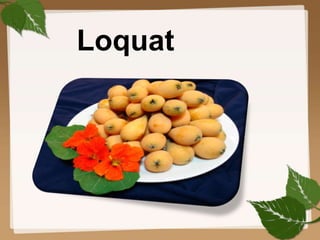
Loquat
1
Botany
Common name:
Japanese medlar, Japanese plum,
Chinese plum.
Bot. Name:
Eriobotrya japonica
Family:
Rosaceae
Subfamily:
Pomoideae
Genus :
Eriobotrya
Also resembles to genus Mespilus, so fruit is called medlar.
2
Origin and distribution
• Loquat is among the first fruits cultivated in Asia.
• Native to central eastern China
• For centuries only Chinese royalty was allowed to eat.
• The fruit was introduced from China to Japan 700 AD.
• The west learned of it from the botanist Kaempfer in
1690.
• It was planted in the National Gardens, Paris, in 1784.
• Plants were taken from Canton, China, to the Royal
Botanical Gardens at Kew, England, in 1787.
3
Origin and distribution
• Sometimes called pipa (Chinese), and biwa
(Japanese).
• Commercially grown in Australia , South
Africa, USA, Japan, China, India.. )
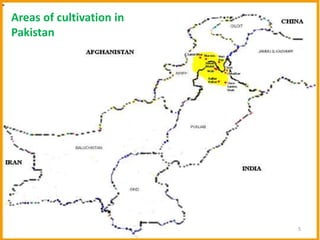
• As minor fruit crop In Pakistan.
• Lahore, Gujranwala, Jehlum, Rawalpindi, Kalar
Kahar, Hazara, Mardan,, Choa Saiden Shah,
Chhattar, Tret, Hasan Abdal, Wah, Hari Pur, Mardan
and Takht Bhai.
• Available when other fruits are not abundantly
present in makets.
4
Areas of cultivation in
Pakistan
5
Plant Description
Tree:
Moderate size tree, 20 to 30 ft height, rounded crown,
short trunk, and woolly new twigs.
Foliage:
• Leaves evergreen, whorled at the branch tips, elliptical-
lanceolate, 12.5-30 cm long and 7.5-10 cm wide
• Upper surface dark-green & glossy, whitish-or rusty-
hairy beneath
• Thick, stiff, with conspicuous parallel, oblique veins,
each terminating at the margin in a short, prickly point.
6
Plant Description
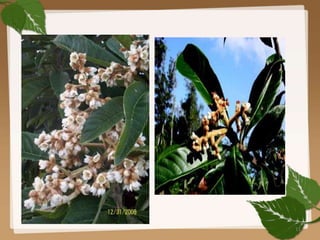
Flower:
Sweetly fragrant , borne in rusty-hairy, terminal panicles of
30 to 100 blooms, are white, 5-petalled
Fruit:
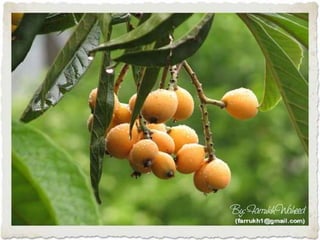
• Pome , clusters of 4 to 30, oval, rounded or pear-shaped,
2.5-5 cm long.
• Smooth, yellow to orange, sometimes red-blushed skin.
• White, yellow or orange, succulent pulp, sweet to sub-acid
or acid flavor.
• Avg. fruit weight is 6.5 g.
• 1 to 10 seeds, usually 3 to 5, dark-brown or light-brown,
angular -ellipsoid, about 1.5 cm long and 8 mm thick.
7
Soil and climate
• Prefers upper elevations 1000 - 5000 ft.
• At lower elevations as an ornamental.
• Mild sub-tropical climate with 75-100 cm rainfall
(ideal).
• Also adapted to Mediterranean climate.
• Deep, well drained, fertile light loamy soil, with a
slightly acidic PH balance.
• Excessive lime, hard pan, gravel in sub soil is not
good.
8
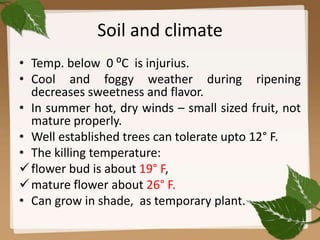
Soil and climate
• Temp. below 0 ⁰C is injurius.
• Cool and foggy weather during ripening
decreases sweetness and flavor.
• In summer hot, dry winds – small sized fruit, not
mature properly.
• Well established trees can tolerate upto 12° F.
• The killing temperature:
flower bud is about 19° F,
mature flower about 26° F.
• Can grow in shade, as temporary plant.
9
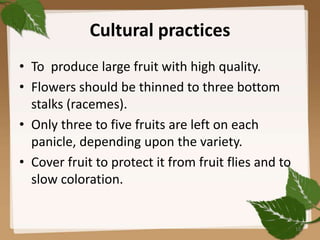
Cultural practices
• To produce large fruit with high quality.
• Flowers should be thinned to three bottom
stalks (racemes).
• Only three to five fruits are left on each
panicle, depending upon the variety.
• Cover fruit to protect it from fruit flies and to
slow coloration.
10
11
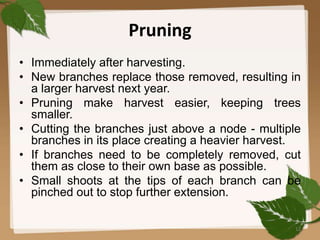
Pruning
• Immediately after harvesting.
• New branches replace those removed, resulting in
a larger harvest next year.
• Pruning make harvest easier, keeping trees
smaller.
• Cutting the branches just above a node - multiple
branches in its place creating a heavier harvest.
• If branches need to be completely removed, cut
them as close to their own base as possible.
• Small shoots at the tips of each branch can be
pinched out to stop further extension.
12
Fertilizer requirement
• Nitrogen based fertilizer three times a year,
producing better fruit and more foliage.
• Chicken manure is an excellent organic source
of nitrogen.
• 60 kg mixture of well rotten cow dung or FYM,
bonemeal and woodash in the ratio of
100:5:10 in Oct, with irrigation.
• Young trees should be applied half of the said
quantity, acc. To age of tree.
13
Irrigation
• Although loquats is drought tolerant ,
irrrigation help them to grow faster and
produce more fruit of a higher quality.
• Deep watering in warmer months (10-15 days
interval) is needed as well as during cooler
months (every month) if rain is lacking, or
according to weather conditions.
14
Propagation
i. By seeds
ii. By air layering
iii. By inarching (grafting)
iv. Shield budding
15
Propagation by seeds
• Seeds are only good for ornamental value, fruits
bearing is insignificant.
• Planted directly into soft potting soil. Delay
makes the germination of seeds poor.
• Once planted, watered from above daily to
ensure that the soil is kept constantly moist.
• Soon enough your seeds will sprout and slowly
begin growing.
• The seedlings can be re-potted or planted into
the ground once they have reached a height of
around 15cm tall.
16
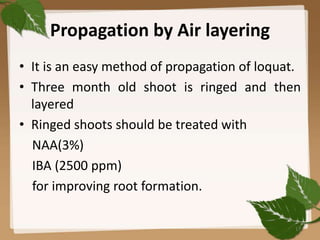
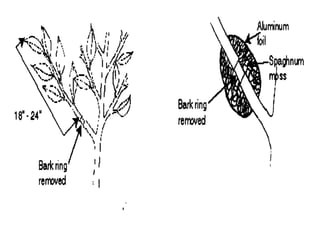
Propagation by Air layering
• It is an easy method of propagation of loquat.
• Three month old shoot is ringed and then
layered
• Ringed shoots should be treated with
NAA(3%)
IBA (2500 ppm)
for improving root formation.
17
18
Inarching
• Simplest method of grafting.
• Scion, from three months old branches.
• Accomplished before new growth starts in the
spring ( Jan-Feb ).
• Seedlings of commercial varieties are used as
root-stock.
• Varieties to use are Advance, Champagne, Oliver,
Pineapple and Thales.
• Root-stocks such as apple, pear and cydonia have
also been used.
19
Shield budding
• Common method of veg. propagation
• Buds from well matured wood of the previous
season growth.
• Performed in Jan-Feb give encouraging
success (before new growth starts in the
spring).
20
Flowering
• Flowers at terminal end on new years shoots
• Flowering starts in July-Aug, continues upto Jan-
Feb in the form of panicles.
• Panicle is conical or cylindrical in shape.
• Avg. 150-200 flowers / panicle.
Three flushes in loquat:
1) Flowers produced in first flush mostly shed.
2) Major crop, mostly from second flush.
3) Usually crop from third flowering is poor.
21
Fruit development
• Thickening of the toral rim just above the carpel.
• Rapid cell division & enlargement more or less uniformly.
• The sepals grow & cover the distal portions of carpel.
• Sepals base thickens and persists as a permanent structure;
petals, stamens and carpel dry up.
• Hood enclosing distal portion of the carpels are exposed to
see.
• The edible part is wholy toral in nature.
• loquat have SSC >12%, moderate TA (0.3 to 0.6%)
• In mature fruits, the toral cells are large, thin walled
and juicy
22
Fruit thinning
• Flower buds produced at terminal end of
current season growth and fruit bearing takes
place in clusters.
• To thin out few fruits for better development
of each fruit is impractical.
• When overcrowding, clip out the ends of
bunches.
• Fruits thinned when less than 12cm in
diameter.
23
24
Harvesting and yield
• Harvest when fruit matures and turns golden pale or
orange color.
• Loquats harvested in the fully ripe stage have the optimum
quality.
• Harvested at the eating-ripe stage before becoming fully
ripe.
• Usually, fruits in a cluster mature uniformly, so whole
cluster may be cut, If not, then ripened fruits are harvested
by clipping.
• Fruit bearing starts from 4th year of planting
• Yield increases with age of trees. Max at 15 years.
• Avg. yield 25-30 kg /tree
25
Storage
• Commercial storage: 0-5 °C with > 90% RH.
• Can be kept in good condition for 3 to 4 weeks at
0 °C and 2 weeks at 10 °C .
• In order to maintain quality and storage-life,
loquat should be pre-cooled to < 5 °C within 20 h
of harvest.
• A refrigerated shelf at 5 to 12 °C is good.
• Use of polyethylene bags retards weight loss and
minimizes decreases in organic acids
26
Physiological Disorders:
• Fruit are easily bruised and scratched
• Damaged areas usually turn brown or black
• Careful handling and packaging during and
after harvest are important.
• Also, internal browning and brown surface
spotting occur during long-term or high CO2
storage.
27
Pests and Diseases
Fruit fly ( Daucus dorsalis )
• Loquats is affected by fruit fly becoming a host to
the pests during April-May,
Symptoms
• Tiny holes in fruit, insect lay eggs under fruit skin
• Small maggots throughout the flesh.
• Control
• Affected fruits should be destroyed
• Spray 0.2% sevin , 15 days before harvesting
• Use of poison baits may also be effective
28
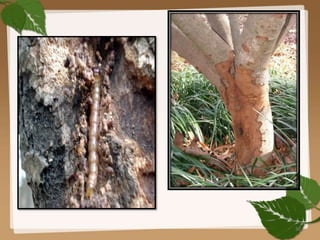
Bark eating caterpillars
• Severe attack is noticed during Oct-Nov
• Insect attacks under the soil in roots
Control:
• By cleaning the holes with a spoke
• Inserting soaked cotton in 0.4 % solution of
Nuvacron and then
• Plastering the holes with mud
29
30
Colar rot
• This disease is caused by the fungus Diplodia
natelensis
• Fungus attack the bark of the colar region which
turns brown, then cracks or sometime peels off
• The whole tree may be killed
Control
• By scrapping the infected portion, and painting
with solution having Phytolan 225 g, lime 112 g in
2.25 litres of water.
31
Other Pests
• The tree is also susceptible to nematodes.
• Pest Management Program recommendations
is highly advisable.
• Good sanitation should be practiced.
• Green scale (Coccus viridis) can also affect the
plants.
• Loquat can be affected by fire blight (Erwinia
amylovora), and damaged wood should be
removed and disposed off.
32
Varieties
• There are over 900 loquat cultivars in many
growing areas around the world.

• In Hawai‘i, common varieties are ‘Tanaka’,
‘Gold’, Nugget’, ‘Mammoth’, ‘Advance’, and
‘Wolf’.
• Varieties introduced in the 1990s from Japan
include ‘Obusa’, ‘Fusahikari’, and ‘Mizuho’.
• These trees can be top-worked and grafted
with newer varieties.
33
Varieties
• Depending upon the time of fruit maturity:
a) Early Season variety:
golden yellow, pale yellow, large round
b) Mid season variety:
fire ball, safeda, mammoth
c) Late season variety:
California advance, tanaka.
A seedless variety, ‘Kibou’, was developed in 2003
in Chiba, Japan, but it has not yet been released
to growers.
34
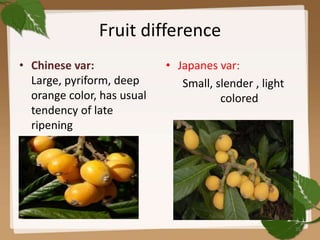
Fruit difference
• Chinese var:
Large, pyriform, deep
orange color, has usual
tendency of late
ripening
• Japanes var:
Small, slender , light
colored
35
Health & Nutritional Benefits of Loquat
• Source of Vitamin A, visual and dental health of an individual.
• Extract from leaves is an important ingredient for lung ailments,
used by Chinese since ancient times.
• Maintaining optimum health, as they are low in saturated fat and
cholesterol.
• Loquats are rich in fiber, suitable for those who wish to lose
weight.
• The loquat leaf is said to alleviate coughing and nausea. It even
dissolves phlegm and is an expectorant.
• Loquat paste helps in soothing the digestive and respiratory
systems of a person.
• Loquat contains mallic acid, tartaric acid, citric acid, vitamins A, B
and C, and B17.
• Vitamin B17 is known as amygdaline, laetrile or the anti-cancer
vitamin, as it helps prevent cancer.
36
Nutritional value per 100 g of edible portion
• Moisture ........................................... 87 g
• Calories ............................................ 47–168
• Protein .............................................. 00.43–1.4 g
• Fat .................................................... 00.64–0.7 g
• Carbohydrates ................................. 11–43.3 g
• Fiber ................................................. 00.83–1.7g
• Ash ................................................... 00.48 g
• Calcium ............................................ 09–70 mg
• Iron ................................................... 0.14–1.4 mg
• Phosphorus ...................................... 11–126 mg
• Potassium ........................................ 185–1216 mg
• Vitamin A .......................................... 1122–2340 I.U.
• Ascorbic acid .................................... 00–3 mg
• Ranges vary greatly due to degree of ripeness of fruits tested.
37

Loquat in Pakistan

  • 1.
  • 2.
    Botany Common name: Japanese medlar,Japanese plum, Chinese plum. Bot. Name: Eriobotrya japonica Family: Rosaceae Subfamily: Pomoideae Genus : Eriobotrya Also resembles to genus Mespilus, so fruit is called medlar. 2
  • 3.
    Origin and distribution •Loquat is among the first fruits cultivated in Asia. • Native to central eastern China • For centuries only Chinese royalty was allowed to eat. • The fruit was introduced from China to Japan 700 AD. • The west learned of it from the botanist Kaempfer in 1690. • It was planted in the National Gardens, Paris, in 1784. • Plants were taken from Canton, China, to the Royal Botanical Gardens at Kew, England, in 1787. 3
  • 4.
    Origin and distribution •Sometimes called pipa (Chinese), and biwa (Japanese). • Commercially grown in Australia , South Africa, USA, Japan, China, India.. ) • As minor fruit crop In Pakistan. • Lahore, Gujranwala, Jehlum, Rawalpindi, Kalar Kahar, Hazara, Mardan,, Choa Saiden Shah, Chhattar, Tret, Hasan Abdal, Wah, Hari Pur, Mardan and Takht Bhai. • Available when other fruits are not abundantly present in makets. 4
  • 5.
    Areas of cultivationin Pakistan 5
  • 6.
    Plant Description Tree: Moderate sizetree, 20 to 30 ft height, rounded crown, short trunk, and woolly new twigs. Foliage: • Leaves evergreen, whorled at the branch tips, elliptical- lanceolate, 12.5-30 cm long and 7.5-10 cm wide • Upper surface dark-green & glossy, whitish-or rusty- hairy beneath • Thick, stiff, with conspicuous parallel, oblique veins, each terminating at the margin in a short, prickly point. 6
  • 7.
    Plant Description Flower: Sweetly fragrant, borne in rusty-hairy, terminal panicles of 30 to 100 blooms, are white, 5-petalled Fruit: • Pome , clusters of 4 to 30, oval, rounded or pear-shaped, 2.5-5 cm long. • Smooth, yellow to orange, sometimes red-blushed skin. • White, yellow or orange, succulent pulp, sweet to sub-acid or acid flavor. • Avg. fruit weight is 6.5 g. • 1 to 10 seeds, usually 3 to 5, dark-brown or light-brown, angular -ellipsoid, about 1.5 cm long and 8 mm thick. 7
  • 8.
    Soil and climate •Prefers upper elevations 1000 - 5000 ft. • At lower elevations as an ornamental. • Mild sub-tropical climate with 75-100 cm rainfall (ideal). • Also adapted to Mediterranean climate. • Deep, well drained, fertile light loamy soil, with a slightly acidic PH balance. • Excessive lime, hard pan, gravel in sub soil is not good. 8
  • 9.
    Soil and climate •Temp. below 0 ⁰C is injurius. • Cool and foggy weather during ripening decreases sweetness and flavor. • In summer hot, dry winds – small sized fruit, not mature properly. • Well established trees can tolerate upto 12° F. • The killing temperature: flower bud is about 19° F, mature flower about 26° F. • Can grow in shade, as temporary plant. 9
  • 10.
    Cultural practices • Toproduce large fruit with high quality. • Flowers should be thinned to three bottom stalks (racemes). • Only three to five fruits are left on each panicle, depending upon the variety. • Cover fruit to protect it from fruit flies and to slow coloration. 10
  • 11.
  • 12.
    Pruning • Immediately afterharvesting. • New branches replace those removed, resulting in a larger harvest next year. • Pruning make harvest easier, keeping trees smaller. • Cutting the branches just above a node - multiple branches in its place creating a heavier harvest. • If branches need to be completely removed, cut them as close to their own base as possible. • Small shoots at the tips of each branch can be pinched out to stop further extension. 12
  • 13.
    Fertilizer requirement • Nitrogenbased fertilizer three times a year, producing better fruit and more foliage. • Chicken manure is an excellent organic source of nitrogen. • 60 kg mixture of well rotten cow dung or FYM, bonemeal and woodash in the ratio of 100:5:10 in Oct, with irrigation. • Young trees should be applied half of the said quantity, acc. To age of tree. 13
  • 14.
    Irrigation • Although loquatsis drought tolerant , irrrigation help them to grow faster and produce more fruit of a higher quality. • Deep watering in warmer months (10-15 days interval) is needed as well as during cooler months (every month) if rain is lacking, or according to weather conditions. 14
  • 15.
    Propagation i. By seeds ii.By air layering iii. By inarching (grafting) iv. Shield budding 15
  • 16.
    Propagation by seeds •Seeds are only good for ornamental value, fruits bearing is insignificant. • Planted directly into soft potting soil. Delay makes the germination of seeds poor. • Once planted, watered from above daily to ensure that the soil is kept constantly moist. • Soon enough your seeds will sprout and slowly begin growing. • The seedlings can be re-potted or planted into the ground once they have reached a height of around 15cm tall. 16
  • 17.
    Propagation by Airlayering • It is an easy method of propagation of loquat. • Three month old shoot is ringed and then layered • Ringed shoots should be treated with NAA(3%) IBA (2500 ppm) for improving root formation. 17
  • 18.
  • 19.
    Inarching • Simplest methodof grafting. • Scion, from three months old branches. • Accomplished before new growth starts in the spring ( Jan-Feb ). • Seedlings of commercial varieties are used as root-stock. • Varieties to use are Advance, Champagne, Oliver, Pineapple and Thales. • Root-stocks such as apple, pear and cydonia have also been used. 19
  • 20.
    Shield budding • Commonmethod of veg. propagation • Buds from well matured wood of the previous season growth. • Performed in Jan-Feb give encouraging success (before new growth starts in the spring). 20
  • 21.
    Flowering • Flowers atterminal end on new years shoots • Flowering starts in July-Aug, continues upto Jan- Feb in the form of panicles. • Panicle is conical or cylindrical in shape. • Avg. 150-200 flowers / panicle. Three flushes in loquat: 1) Flowers produced in first flush mostly shed. 2) Major crop, mostly from second flush. 3) Usually crop from third flowering is poor. 21
  • 22.
    Fruit development • Thickeningof the toral rim just above the carpel. • Rapid cell division & enlargement more or less uniformly. • The sepals grow & cover the distal portions of carpel. • Sepals base thickens and persists as a permanent structure; petals, stamens and carpel dry up. • Hood enclosing distal portion of the carpels are exposed to see. • The edible part is wholy toral in nature. • loquat have SSC >12%, moderate TA (0.3 to 0.6%) • In mature fruits, the toral cells are large, thin walled and juicy 22
  • 23.
    Fruit thinning • Flowerbuds produced at terminal end of current season growth and fruit bearing takes place in clusters. • To thin out few fruits for better development of each fruit is impractical. • When overcrowding, clip out the ends of bunches. • Fruits thinned when less than 12cm in diameter. 23
  • 24.
  • 25.
    Harvesting and yield •Harvest when fruit matures and turns golden pale or orange color. • Loquats harvested in the fully ripe stage have the optimum quality. • Harvested at the eating-ripe stage before becoming fully ripe. • Usually, fruits in a cluster mature uniformly, so whole cluster may be cut, If not, then ripened fruits are harvested by clipping. • Fruit bearing starts from 4th year of planting • Yield increases with age of trees. Max at 15 years. • Avg. yield 25-30 kg /tree 25
  • 26.
    Storage • Commercial storage:0-5 °C with > 90% RH. • Can be kept in good condition for 3 to 4 weeks at 0 °C and 2 weeks at 10 °C . • In order to maintain quality and storage-life, loquat should be pre-cooled to < 5 °C within 20 h of harvest. • A refrigerated shelf at 5 to 12 °C is good. • Use of polyethylene bags retards weight loss and minimizes decreases in organic acids 26
  • 27.
    Physiological Disorders: • Fruitare easily bruised and scratched • Damaged areas usually turn brown or black • Careful handling and packaging during and after harvest are important. • Also, internal browning and brown surface spotting occur during long-term or high CO2 storage. 27
  • 28.
    Pests and Diseases Fruitfly ( Daucus dorsalis ) • Loquats is affected by fruit fly becoming a host to the pests during April-May, Symptoms • Tiny holes in fruit, insect lay eggs under fruit skin • Small maggots throughout the flesh. • Control • Affected fruits should be destroyed • Spray 0.2% sevin , 15 days before harvesting • Use of poison baits may also be effective 28
  • 29.
    Bark eating caterpillars •Severe attack is noticed during Oct-Nov • Insect attacks under the soil in roots Control: • By cleaning the holes with a spoke • Inserting soaked cotton in 0.4 % solution of Nuvacron and then • Plastering the holes with mud 29
  • 30.
  • 31.
    Colar rot • Thisdisease is caused by the fungus Diplodia natelensis • Fungus attack the bark of the colar region which turns brown, then cracks or sometime peels off • The whole tree may be killed Control • By scrapping the infected portion, and painting with solution having Phytolan 225 g, lime 112 g in 2.25 litres of water. 31
  • 32.
    Other Pests • Thetree is also susceptible to nematodes. • Pest Management Program recommendations is highly advisable. • Good sanitation should be practiced. • Green scale (Coccus viridis) can also affect the plants. • Loquat can be affected by fire blight (Erwinia amylovora), and damaged wood should be removed and disposed off. 32
  • 33.
    Varieties • There areover 900 loquat cultivars in many growing areas around the world. • In Hawai‘i, common varieties are ‘Tanaka’, ‘Gold’, Nugget’, ‘Mammoth’, ‘Advance’, and ‘Wolf’. • Varieties introduced in the 1990s from Japan include ‘Obusa’, ‘Fusahikari’, and ‘Mizuho’. • These trees can be top-worked and grafted with newer varieties. 33
  • 34.
    Varieties • Depending uponthe time of fruit maturity: a) Early Season variety: golden yellow, pale yellow, large round b) Mid season variety: fire ball, safeda, mammoth c) Late season variety: California advance, tanaka. A seedless variety, ‘Kibou’, was developed in 2003 in Chiba, Japan, but it has not yet been released to growers. 34
  • 35.
    Fruit difference • Chinesevar: Large, pyriform, deep orange color, has usual tendency of late ripening • Japanes var: Small, slender , light colored 35
  • 36.
    Health & NutritionalBenefits of Loquat • Source of Vitamin A, visual and dental health of an individual. • Extract from leaves is an important ingredient for lung ailments, used by Chinese since ancient times. • Maintaining optimum health, as they are low in saturated fat and cholesterol. • Loquats are rich in fiber, suitable for those who wish to lose weight. • The loquat leaf is said to alleviate coughing and nausea. It even dissolves phlegm and is an expectorant. • Loquat paste helps in soothing the digestive and respiratory systems of a person. • Loquat contains mallic acid, tartaric acid, citric acid, vitamins A, B and C, and B17. • Vitamin B17 is known as amygdaline, laetrile or the anti-cancer vitamin, as it helps prevent cancer. 36
  • 37.
    Nutritional value per100 g of edible portion • Moisture ........................................... 87 g • Calories ............................................ 47–168 • Protein .............................................. 00.43–1.4 g • Fat .................................................... 00.64–0.7 g • Carbohydrates ................................. 11–43.3 g • Fiber ................................................. 00.83–1.7g • Ash ................................................... 00.48 g • Calcium ............................................ 09–70 mg • Iron ................................................... 0.14–1.4 mg • Phosphorus ...................................... 11–126 mg • Potassium ........................................ 185–1216 mg • Vitamin A .......................................... 1122–2340 I.U. • Ascorbic acid .................................... 00–3 mg • Ranges vary greatly due to degree of ripeness of fruits tested. 37