COMPETITIVE ADVANTAGES AND KEY
STRATEGY IN SUPPLY CHAIN
Advance Diploma In Logistics & Supply Chain (ADLSC)
-By Keshar Khadka
Course Objective
After Reading this course, you should be able
 To define supply chain management Process
 To know competitive advantages that supply chain management offer.
 To explain key strategies to achieve company competitive advantages
 To be familiar with DHL Competitive advantages offer
1- Introduction To Supply Chain Management
Why do we need Supply chain management??
Process Improvement
 Higher level of integration and collaboration
 Reduction of cost 10% in logistics and supply chain cost
 Improves margins by 20%
 Improved relationship management among the Supplychian partners
7/14/20173
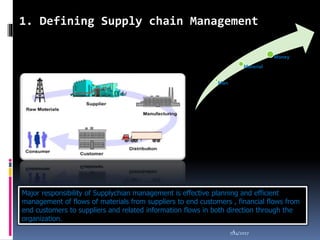
Man
Material
Money
7/14/20174
Major responsibility of Supplychian management is effective planning and efficient
management of flows of materials from suppliers to end customers , financial flows from
end customers to suppliers and related information flows in both direction through the
organization.
1. Defining Supply chain Management
1. Introduction To Supply Chain Management
7/14/20175
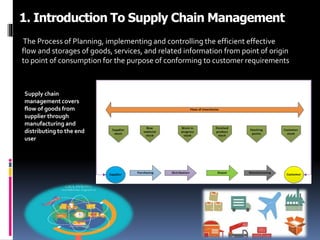
Supply chain
management covers
flow of goods from
supplier through
manufacturing and
distributing to the end
user
The Process of Planning, implementing and controlling the efficient effective
flow and storages of goods, services, and related information from point of origin
to point of consumption for the purpose of conforming to customer requirements
1. Introduction To Supply Chain Management
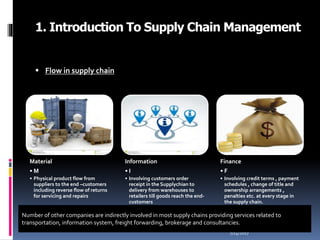
Material
• M
• Physical product flow from
suppliers to the end –customers
including reverse flow of returns
for servicing and repairs
Information
• I
• Involving customers order
receipt in the Supplychian to
delivery from warehouses to
retailers till goods reach the end-
customers
Finance
• F
• Involving credit terms , payment
schedules , change of title and
ownership arrangements ,
penalties etc. at every stage in
the supply chain.
7/14/20176
Number of other companies are indirectly involved in most supply chains providing services related to
transportation, information system, freight forwarding, brokerage and consultancies.
 Flow in supply chain
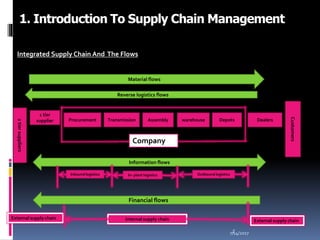
1 tier
supplier Procurement Transmission Assembly warehouse Depots Dealers
2tiersuppliers
Customers
Material flows
Reverse logistics flows
Financial flows
Inbound logistics
1. Introduction To Supply Chain Management
Integrated Supply Chain And The Flows
7/14/20177
In- plant logistics Outbound logistics
External supply chain Internal supply chain External supply chain
Information flows
Company
2. Defining The Competitive Advantages
 In general business terms , the Competitive
advantage means superior performance relative to
other competitors in the same industry or superior
performance relative to the industry average.
 In supply chain view , The Competitive advantages
of a company can be defined as the products and
services that are offered by company are best value
with superior performance against of its competitor
within similar business industry in order to satisfy
the needs of its customers.
 The competitive advantages offer can be achieved
from the various area of supply chain management
including sourcing & procurement of materials
,manufacturing, transportation of material to and
from company ,distribution and sales after service.
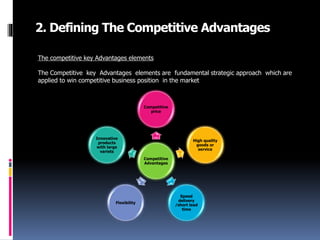
Competitive
Advantages
Competitive
price
High quality
goods or
service
Speed
delivery
/short lead
time
Flexibility
Innovative
products
with large
variets
2. Defining The Competitive Advantages
The competitive key Advantages elements
The Competitive key Advantages elements are fundamental strategic approach which are
applied to win competitive business position in the market
2. Defining The Competitive Advantages
 Competitive Price : Price is the key elements that influence the customer buying
behaviour and low price leads more demands of goods or service that finally
gain the competitive advantages for both company as well customer.
 Superior Quality : Best quality values with finest attributes offer in to product or
service allow more customer to buy goods or service. Due to more globalization
and free trade, business firms are more in competitive terms to offer superior
quality to its target customer.
2. Defining The Competitive Advantages
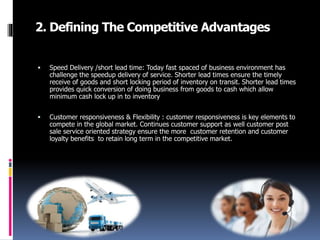
 Speed Delivery /short lead time: Today fast spaced of business environment has
challenge the speedup delivery of service. Shorter lead times ensure the timely
receive of goods and short locking period of inventory on transit. Shorter lead times
provides quick conversion of doing business from goods to cash which allow
minimum cash lock up in to inventory
 Customer responsiveness & Flexibility : customer responsiveness is key elements to
compete in the global market. Continues customer support as well customer post
sale service oriented strategy ensure the more customer retention and customer
loyalty benefits to retain long term in the competitive market.
2. Defining The Competitive Advantages
 Innovative products & service : Product innovation is the development of new
products, making changes in the current product design or using new techniques
and means in the current production methods, which meets or exceed customer
demand within competitive business environment . in other words, it focuses on
existing markets for existing products, differentiating through features and functions
that current offers do not have added service.
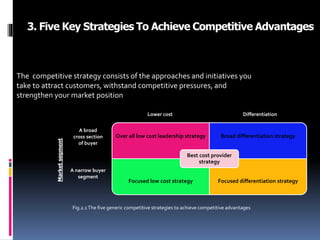
3. Five Key Strategies To Achieve Competitive Advantages
Over all low cost leadership strategy Broad differentiation strategy
Focused low cost strategy Focused differentiation strategy
Best cost provider
strategy
Marketsegment
Lower cost Differentiation
A narrow buyer
segment
A broad
cross section
of buyer
Fig.2.1The five generic competitive strategies to achieve competitive advantages
The competitive strategy consists of the approaches and initiatives you
take to attract customers, withstand competitive pressures, and
strengthen your market position
3. Five Key Strategies To Achieve Competitive Advantages
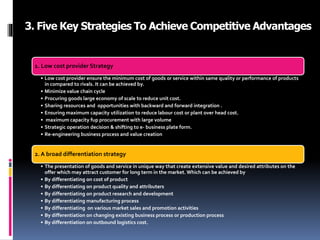
1. Low cost provider Strategy
• Low cost provider ensure the minimum cost of goods or service within same quality or performance of products
in compared to rivals. It can be achieved by.
• Minimize value chain cycle
• Procuring goods large economy of scale to reduce unit cost.
• Sharing resources and opportunities with backward and forward integration .
• Ensuring maximum capacity utilization to reduce labour cost or plant over head cost.
• maximum capacity fup procurement with large volume
• Strategic operation decision & shifting to e- business plate form.
• Re-engineering business process and value creation
2. A broad differentiation strategy
• The presentation of goods and service in unique way that create extensive value and desired attributes on the
offer which may attract customer for long term in the market. Which can be achieved by
• By differentiating on cost of product
• By differentiating on product quality and attributers
• By differentiating on product research and development
• By differentiating manufacturing process
• By differentiating on various market sales and promotion activities
• By differentiation on changing existing business process or production process
• By differentiation on outbound logistics cost.
3. Five Key Strategies To Achieve Competitive Advantages
3. Best cost provider strategy
• best cost provider strategy: giving customers more value for the money by emphasizing both low
cost and upscale difference, the goal being to keep costs and prices lower than those of other
providers of comparable quality and features (a couple of examples are the Honda andToyota car
)companies with customer satisfaction ratings that rival those of much more expensive cars)
4.Focused strategies based on low cost
• A focused, or market-niche, strategy based on lower cost: concentrating on a narrow buyer
segment and outcompeting rivals on the basis of lower cost (The Gap is a good example). It is based
either on low cost or differentiation strategy or both.
5.Focused strategy based on differentiation
• A focused, or market-niche, strategy based on differentiation: offering niche members a
product or service customized to their tastes and requirements [examples are Rolls-Royce (sells
limited number of high-end, custom-built cars) and men’s big and tall shops (sell mainstream styles
to a limited market with specific requirements)].
In summary ,
Firms create and sustain competitive advantage because of the capacity to continuously improve,
innovate, and upgrade their competitive advantages over time. Upgrading is the process of
shifting advantages throughout the value chain to more sophisticated types, and employing
higher levels of skill and technology. Successful firms are those that improve and innovate in ways
that are valued not only at home but elsewhere. Competitive success is enhanced by moving early
in each product or process generation, provided that the movement is along a path that reflects
evolving technology and buyer need, and that early movers subsequently upgrade their positions
rather than rest upon them. In this view, firms have considerable discretion in relaxing external
and internal constraints.
 Four broad attributes of the proximate environment of a firm have the greatest influence on its
ability to innovate and upgrade.These attributes shape the information firms have available to
perceive opportunities, the pool of inputs, skills and knowledge they can draw upon, the goals that
condition investment, and the pressures on the firm to act.The environment is important in
providing the initial insight that underpins competitive advantage, the inputs needed to act on it,
and to accumulate knowledge and skills over time, and the forces needed to keep progressing.
 Sustainable competitive advantage allows for the maintenance and improvement
of your company’s competitive position in the market. It is an advantage that
enables your business to survive against its competition over a long period of time.
The advantage comes from your company’s unique skills and resources working
together to implement strategies that competitors cannot implement as effectively.
 Keep in mind that most advantages can be duplicated within a period of time.
Approximately 70 percent of all new products can be duplicated within one year and
60 to 90 percent of process improvements eventually spreads to your competitors.
Competitive advantage is a dynamic process that demands constant attention. It is
NOT a once and done flavour of the month!
4. DHL- A case Study
DHL COMPETITIVE ADVANTAGE
 When you use DHL Same Day, you’re taking advantage of a truly competitive edge. Our
dedicated “Special Services” team within DHL manages more than half a million high-
profile SameDay shipments annually, proactively monitoring each one from origin to
destination. Operating 24 hours a day, 7 days a week, 365 days a year, we’re always there
for you.
 A unique, proprietary routing system
 The DHL SameDay proprietary, multi-modal system gives us the unique ability to find not
just a fast route for your shipment, butTHE fastest route. Once we obtain your destination
information, our Customer Service Representatives know within seconds the most
advantageous route to use. It might be by air, by land or a combination of both, but only the
DHL SameDay system identifies the optimal path for your shipment.
4. DHL- COMPETITIVE ADVANTAGE
Best-in-class technology
 Every shipment and warehouse need is supported by customized software, built
specifically for DHL SameDay.
Our technology services and functions include, but are not limited to:
 Automated Dispatch System (ADS) for automated updates and Proof-of-Delivery
 Performance-based “best-flight-out” selection and optimized routing
 Self-help web portal
 Quarterly Business Reporting (QBR) tool
 Best-in-class phone system with call balance routing, secure monitoring and call
identifier features to speed order flow
 Auto advisements via e-mail, fax or SMS messaging
 Direct airline links
 Driver scanning and paging tools
 EDI alternatives
Strategic decision in supply chain

Strategic decision in supply chain

  • 1.
    COMPETITIVE ADVANTAGES ANDKEY STRATEGY IN SUPPLY CHAIN Advance Diploma In Logistics & Supply Chain (ADLSC) -By Keshar Khadka
  • 2.
    Course Objective After Readingthis course, you should be able  To define supply chain management Process  To know competitive advantages that supply chain management offer.  To explain key strategies to achieve company competitive advantages  To be familiar with DHL Competitive advantages offer
  • 3.
    1- Introduction ToSupply Chain Management Why do we need Supply chain management?? Process Improvement  Higher level of integration and collaboration  Reduction of cost 10% in logistics and supply chain cost  Improves margins by 20%  Improved relationship management among the Supplychian partners 7/14/20173
  • 4.
    Man Material Money 7/14/20174 Major responsibility ofSupplychian management is effective planning and efficient management of flows of materials from suppliers to end customers , financial flows from end customers to suppliers and related information flows in both direction through the organization. 1. Defining Supply chain Management
  • 5.
    1. Introduction ToSupply Chain Management 7/14/20175 Supply chain management covers flow of goods from supplier through manufacturing and distributing to the end user The Process of Planning, implementing and controlling the efficient effective flow and storages of goods, services, and related information from point of origin to point of consumption for the purpose of conforming to customer requirements
  • 6.
    1. Introduction ToSupply Chain Management Material • M • Physical product flow from suppliers to the end –customers including reverse flow of returns for servicing and repairs Information • I • Involving customers order receipt in the Supplychian to delivery from warehouses to retailers till goods reach the end- customers Finance • F • Involving credit terms , payment schedules , change of title and ownership arrangements , penalties etc. at every stage in the supply chain. 7/14/20176 Number of other companies are indirectly involved in most supply chains providing services related to transportation, information system, freight forwarding, brokerage and consultancies.  Flow in supply chain
  • 7.
    1 tier supplier ProcurementTransmission Assembly warehouse Depots Dealers 2tiersuppliers Customers Material flows Reverse logistics flows Financial flows Inbound logistics 1. Introduction To Supply Chain Management Integrated Supply Chain And The Flows 7/14/20177 In- plant logistics Outbound logistics External supply chain Internal supply chain External supply chain Information flows Company
  • 8.
    2. Defining TheCompetitive Advantages  In general business terms , the Competitive advantage means superior performance relative to other competitors in the same industry or superior performance relative to the industry average.  In supply chain view , The Competitive advantages of a company can be defined as the products and services that are offered by company are best value with superior performance against of its competitor within similar business industry in order to satisfy the needs of its customers.  The competitive advantages offer can be achieved from the various area of supply chain management including sourcing & procurement of materials ,manufacturing, transportation of material to and from company ,distribution and sales after service.
  • 9.
    Competitive Advantages Competitive price High quality goods or service Speed delivery /shortlead time Flexibility Innovative products with large variets 2. Defining The Competitive Advantages The competitive key Advantages elements The Competitive key Advantages elements are fundamental strategic approach which are applied to win competitive business position in the market
  • 10.
    2. Defining TheCompetitive Advantages  Competitive Price : Price is the key elements that influence the customer buying behaviour and low price leads more demands of goods or service that finally gain the competitive advantages for both company as well customer.  Superior Quality : Best quality values with finest attributes offer in to product or service allow more customer to buy goods or service. Due to more globalization and free trade, business firms are more in competitive terms to offer superior quality to its target customer.
  • 11.
    2. Defining TheCompetitive Advantages  Speed Delivery /short lead time: Today fast spaced of business environment has challenge the speedup delivery of service. Shorter lead times ensure the timely receive of goods and short locking period of inventory on transit. Shorter lead times provides quick conversion of doing business from goods to cash which allow minimum cash lock up in to inventory  Customer responsiveness & Flexibility : customer responsiveness is key elements to compete in the global market. Continues customer support as well customer post sale service oriented strategy ensure the more customer retention and customer loyalty benefits to retain long term in the competitive market.
  • 12.
    2. Defining TheCompetitive Advantages  Innovative products & service : Product innovation is the development of new products, making changes in the current product design or using new techniques and means in the current production methods, which meets or exceed customer demand within competitive business environment . in other words, it focuses on existing markets for existing products, differentiating through features and functions that current offers do not have added service.
  • 13.
    3. Five KeyStrategies To Achieve Competitive Advantages Over all low cost leadership strategy Broad differentiation strategy Focused low cost strategy Focused differentiation strategy Best cost provider strategy Marketsegment Lower cost Differentiation A narrow buyer segment A broad cross section of buyer Fig.2.1The five generic competitive strategies to achieve competitive advantages The competitive strategy consists of the approaches and initiatives you take to attract customers, withstand competitive pressures, and strengthen your market position
  • 14.
    3. Five KeyStrategies To Achieve Competitive Advantages 1. Low cost provider Strategy • Low cost provider ensure the minimum cost of goods or service within same quality or performance of products in compared to rivals. It can be achieved by. • Minimize value chain cycle • Procuring goods large economy of scale to reduce unit cost. • Sharing resources and opportunities with backward and forward integration . • Ensuring maximum capacity utilization to reduce labour cost or plant over head cost. • maximum capacity fup procurement with large volume • Strategic operation decision & shifting to e- business plate form. • Re-engineering business process and value creation 2. A broad differentiation strategy • The presentation of goods and service in unique way that create extensive value and desired attributes on the offer which may attract customer for long term in the market. Which can be achieved by • By differentiating on cost of product • By differentiating on product quality and attributers • By differentiating on product research and development • By differentiating manufacturing process • By differentiating on various market sales and promotion activities • By differentiation on changing existing business process or production process • By differentiation on outbound logistics cost.
  • 15.
    3. Five KeyStrategies To Achieve Competitive Advantages 3. Best cost provider strategy • best cost provider strategy: giving customers more value for the money by emphasizing both low cost and upscale difference, the goal being to keep costs and prices lower than those of other providers of comparable quality and features (a couple of examples are the Honda andToyota car )companies with customer satisfaction ratings that rival those of much more expensive cars) 4.Focused strategies based on low cost • A focused, or market-niche, strategy based on lower cost: concentrating on a narrow buyer segment and outcompeting rivals on the basis of lower cost (The Gap is a good example). It is based either on low cost or differentiation strategy or both. 5.Focused strategy based on differentiation • A focused, or market-niche, strategy based on differentiation: offering niche members a product or service customized to their tastes and requirements [examples are Rolls-Royce (sells limited number of high-end, custom-built cars) and men’s big and tall shops (sell mainstream styles to a limited market with specific requirements)].
  • 16.
    In summary , Firmscreate and sustain competitive advantage because of the capacity to continuously improve, innovate, and upgrade their competitive advantages over time. Upgrading is the process of shifting advantages throughout the value chain to more sophisticated types, and employing higher levels of skill and technology. Successful firms are those that improve and innovate in ways that are valued not only at home but elsewhere. Competitive success is enhanced by moving early in each product or process generation, provided that the movement is along a path that reflects evolving technology and buyer need, and that early movers subsequently upgrade their positions rather than rest upon them. In this view, firms have considerable discretion in relaxing external and internal constraints.  Four broad attributes of the proximate environment of a firm have the greatest influence on its ability to innovate and upgrade.These attributes shape the information firms have available to perceive opportunities, the pool of inputs, skills and knowledge they can draw upon, the goals that condition investment, and the pressures on the firm to act.The environment is important in providing the initial insight that underpins competitive advantage, the inputs needed to act on it, and to accumulate knowledge and skills over time, and the forces needed to keep progressing.
  • 17.
     Sustainable competitiveadvantage allows for the maintenance and improvement of your company’s competitive position in the market. It is an advantage that enables your business to survive against its competition over a long period of time. The advantage comes from your company’s unique skills and resources working together to implement strategies that competitors cannot implement as effectively.  Keep in mind that most advantages can be duplicated within a period of time. Approximately 70 percent of all new products can be duplicated within one year and 60 to 90 percent of process improvements eventually spreads to your competitors. Competitive advantage is a dynamic process that demands constant attention. It is NOT a once and done flavour of the month!
  • 18.
    4. DHL- Acase Study DHL COMPETITIVE ADVANTAGE  When you use DHL Same Day, you’re taking advantage of a truly competitive edge. Our dedicated “Special Services” team within DHL manages more than half a million high- profile SameDay shipments annually, proactively monitoring each one from origin to destination. Operating 24 hours a day, 7 days a week, 365 days a year, we’re always there for you.  A unique, proprietary routing system  The DHL SameDay proprietary, multi-modal system gives us the unique ability to find not just a fast route for your shipment, butTHE fastest route. Once we obtain your destination information, our Customer Service Representatives know within seconds the most advantageous route to use. It might be by air, by land or a combination of both, but only the DHL SameDay system identifies the optimal path for your shipment.
  • 19.
    4. DHL- COMPETITIVEADVANTAGE Best-in-class technology  Every shipment and warehouse need is supported by customized software, built specifically for DHL SameDay. Our technology services and functions include, but are not limited to:  Automated Dispatch System (ADS) for automated updates and Proof-of-Delivery  Performance-based “best-flight-out” selection and optimized routing  Self-help web portal  Quarterly Business Reporting (QBR) tool  Best-in-class phone system with call balance routing, secure monitoring and call identifier features to speed order flow  Auto advisements via e-mail, fax or SMS messaging  Direct airline links  Driver scanning and paging tools  EDI alternatives