Chapter 13:
Supply Chain Performance
Measurement
Learning Objectives - After reading this
chapter, you should be able to do the following:
 Understand the scope and importance of
performance measurement.
 Explain the characteristics of good
performance measures.
 Discuss cost and service performance
measurement and quantification.
 Understand transaction and revenue
measurement and quantification.
Learning Objectives
 Explain supply chain channel measurement.
 Discuss overall supply chain metrics.
Logistics Profile: Micros
and More…A Final Sequel
 “If you can’t measure it, you can’t manage it.”;
Micros and More was uncertain if their recent
gains were appropriate.
 Micros and More was unsure about ‘where
they are’ and ‘where they have been’; this
makes it difficult to evaluate performance.
 Developing a set of performance metrics will
help Micros and More chart a course for the
future and evaluate their performance along
the way.
Supply Chain Performance
Measurement: Introduction
 The Micros and More logistics profile
points out a very important issue for all
organizations: Each needs performance
measurements or metrics.
 Achieving efficiency and effectiveness
objectives requires a set of standards to
compare to actual performance.
 These standards are called metrics.
Dimensions of
Performance Metrics
 Establishing appropriate metrics is a complex
problem.
 Measuring inappropriate performance can
lead to a company chasing the wrong goal.
 Metrics drive behavior --- what you
measure is what you get.
 Logistics cost metrics should focus on the
total supply chain, not on just one link.
Figure 13-1
Raising the Performance Bar
Overview of Performance
Measurement1
 Figure 13-2 contains a list of performance
measures captured on a regular basis within
companies.
 Knowing what metrics to use is a very
important issue.
 Figure 13-3 provides some insight into the
characteristics of good performance
measures.
Figure 13-2 Measures Captured on a Regular
Basis Within the Company
Figure 13-3 Characteristics of
Good Measures
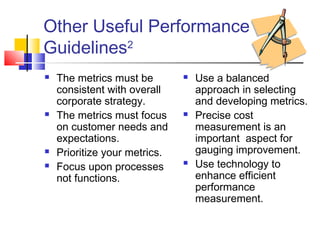
Other Useful Performance
Guidelines2
 The metrics must be
consistent with overall
corporate strategy.
 The metrics must focus
on customer needs and
expectations.
 Prioritize your metrics.
 Focus upon processes
not functions.
 Use a balanced
approach in selecting
and developing metrics.
 Precise cost
measurement is an
important aspect for
gauging improvement.
 Use technology to
enhance efficient
performance
measurement.
On the Line:
Measuring Performance
 The current economic slowdown has sent
many companies looking for ways to cut
costs and improve productivity without
increasing resources.
 By establishing performance metrics
throughout the supply chain, companies are
more likely to reach overall corporate goals.
 Systems such as KPIs, SCOR, and e-
SCOR are being used to develop these
metrics.
Evolution of
Metrics Utilization
 Most organizations go through several
phases in the development of meaningful
metrics:
 Stage 1 – awareness of the importance of
using the appropriate metric
 Stage 2 – developing the actual metric
 Stage 3 – performance improvement
 Stage 4 – integration internally and across
the supply chain
Performance
Categories
 There are a number of approaches that can
be used to classify performance metrics.
 The next two slides illustrate performance
metrics:
 Figure 13-4 identifies four principle process
measure categories.
 Figure 13-5 shows various customer
service metrics and how important they are
to customers.
Figure 13-4
Process Measure Categories
Figure 13-5 Do Customers Use These
Measures to Evaluate Your Performance?
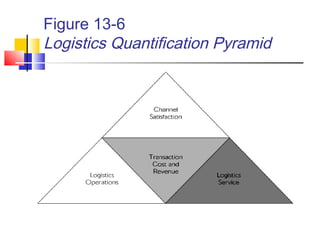
Figure 13-6
Logistics Quantification Pyramid
Another Approach to
Metric Classification
 The next four slides demonstrate other approaches to
metric classification:
 Figures 13-7 and 13-8 illustrate for ABC Power
Tools, cost and management of inventory metrics.
 Figure 13-9 shows basic logistics service outputs
or service performance for metrics development.
 Figure 13-10 shows the results of a 1999 survey of
the percentage of companies that measure
performance of each of the five service outputs as
well as the percentage that measures value.
Figure 13-7
Distribution Inventory Costs
Figure 13-8
Distribution Inventory Management
Figure 13-9 Logistics Outputs
That Influence Customer Service
Figure 13-10
Service Measurement
Supply Chain
Metrics
 Supply chain metrics are very different from
traditional logistics metrics in that they
measure inter-company performance rather
than just internal performance.
 These measures of performance must be
common across the firms in the supply chain
to be meaningful.
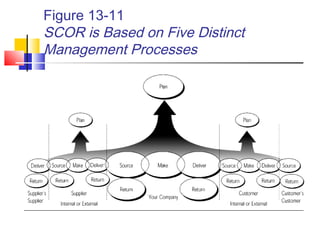
The Supply Chain Operations
Reference (SCOR) Model
 This model was attempts to integrate well known concepts
of process reengineering, benchmarking, and process
measurement into a cross functional relationship by:
 Capturing the “as is” state of a process and derive the
“to be” future state (reengineering);
 Quantify the operational performance of similar
companies and establish “best of class” performance
(benchmarking); and,
 Characterize and describe the management processes
that will result in “best in class” performance (best
practice analysis).
Figure 13-11
SCOR is Based on Five Distinct
Management Processes
Chapter 13:
Summary and Review Questions
Students should review their knowledge of the chapter
by checking out the Summary and Study Questions for
Chapter 13.
End of Chapter 13 Slides
Supply Chain Performance
Measurement

SUPPLY CHAIN PERFORMANCE MEASUREMENT

  • 1.
    Chapter 13: Supply ChainPerformance Measurement
  • 2.
    Learning Objectives -After reading this chapter, you should be able to do the following:  Understand the scope and importance of performance measurement.  Explain the characteristics of good performance measures.  Discuss cost and service performance measurement and quantification.  Understand transaction and revenue measurement and quantification.
  • 3.
    Learning Objectives  Explainsupply chain channel measurement.  Discuss overall supply chain metrics.
  • 4.
    Logistics Profile: Micros andMore…A Final Sequel  “If you can’t measure it, you can’t manage it.”; Micros and More was uncertain if their recent gains were appropriate.  Micros and More was unsure about ‘where they are’ and ‘where they have been’; this makes it difficult to evaluate performance.  Developing a set of performance metrics will help Micros and More chart a course for the future and evaluate their performance along the way.
  • 5.
    Supply Chain Performance Measurement:Introduction  The Micros and More logistics profile points out a very important issue for all organizations: Each needs performance measurements or metrics.  Achieving efficiency and effectiveness objectives requires a set of standards to compare to actual performance.  These standards are called metrics.
  • 6.
    Dimensions of Performance Metrics Establishing appropriate metrics is a complex problem.  Measuring inappropriate performance can lead to a company chasing the wrong goal.  Metrics drive behavior --- what you measure is what you get.  Logistics cost metrics should focus on the total supply chain, not on just one link.
  • 7.
    Figure 13-1 Raising thePerformance Bar
  • 8.
    Overview of Performance Measurement1 Figure 13-2 contains a list of performance measures captured on a regular basis within companies.  Knowing what metrics to use is a very important issue.  Figure 13-3 provides some insight into the characteristics of good performance measures.
  • 9.
    Figure 13-2 MeasuresCaptured on a Regular Basis Within the Company
  • 10.
  • 11.
    Other Useful Performance Guidelines2 The metrics must be consistent with overall corporate strategy.  The metrics must focus on customer needs and expectations.  Prioritize your metrics.  Focus upon processes not functions.  Use a balanced approach in selecting and developing metrics.  Precise cost measurement is an important aspect for gauging improvement.  Use technology to enhance efficient performance measurement.
  • 12.
    On the Line: MeasuringPerformance  The current economic slowdown has sent many companies looking for ways to cut costs and improve productivity without increasing resources.  By establishing performance metrics throughout the supply chain, companies are more likely to reach overall corporate goals.  Systems such as KPIs, SCOR, and e- SCOR are being used to develop these metrics.
  • 13.
    Evolution of Metrics Utilization Most organizations go through several phases in the development of meaningful metrics:  Stage 1 – awareness of the importance of using the appropriate metric  Stage 2 – developing the actual metric  Stage 3 – performance improvement  Stage 4 – integration internally and across the supply chain
  • 14.
    Performance Categories  There area number of approaches that can be used to classify performance metrics.  The next two slides illustrate performance metrics:  Figure 13-4 identifies four principle process measure categories.  Figure 13-5 shows various customer service metrics and how important they are to customers.
  • 15.
  • 16.
    Figure 13-5 DoCustomers Use These Measures to Evaluate Your Performance?
  • 17.
  • 18.
    Another Approach to MetricClassification  The next four slides demonstrate other approaches to metric classification:  Figures 13-7 and 13-8 illustrate for ABC Power Tools, cost and management of inventory metrics.  Figure 13-9 shows basic logistics service outputs or service performance for metrics development.  Figure 13-10 shows the results of a 1999 survey of the percentage of companies that measure performance of each of the five service outputs as well as the percentage that measures value.
  • 19.
  • 20.
  • 21.
    Figure 13-9 LogisticsOutputs That Influence Customer Service
  • 22.
  • 23.
    Supply Chain Metrics  Supplychain metrics are very different from traditional logistics metrics in that they measure inter-company performance rather than just internal performance.  These measures of performance must be common across the firms in the supply chain to be meaningful.
  • 24.
    The Supply ChainOperations Reference (SCOR) Model  This model was attempts to integrate well known concepts of process reengineering, benchmarking, and process measurement into a cross functional relationship by:  Capturing the “as is” state of a process and derive the “to be” future state (reengineering);  Quantify the operational performance of similar companies and establish “best of class” performance (benchmarking); and,  Characterize and describe the management processes that will result in “best in class” performance (best practice analysis).
  • 25.
    Figure 13-11 SCOR isBased on Five Distinct Management Processes
  • 26.
    Chapter 13: Summary andReview Questions Students should review their knowledge of the chapter by checking out the Summary and Study Questions for Chapter 13.
  • 27.
    End of Chapter13 Slides Supply Chain Performance Measurement