Parts
2-5
Basic Components,
Structure and Logic of
Argumentation
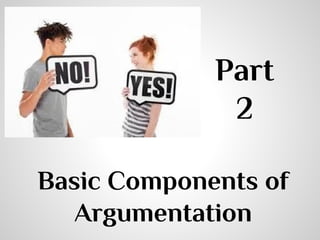
Part
2
Basic Components of
Argumentation
“Master the machinery of [logic], and you have a mental
occupation always at hand… that will be of real use to
you in any subject you take up. It will give you clearness
of thought – the ability to see your way through a puzzle
– the habit of arranging your ideas in an orderly and getat-able form – and, more valuable than all, the power to
detect fallacies, and to tear to pieces the flimsy illogical
arguments, which you will so continually encounter in
books, in newspapers, in speeches, and even in sermons,
and which so easily delude those who have never taken
the trouble to master this fascinating Art. Try it. That is
all I ask of you!”
-Lewis Carroll
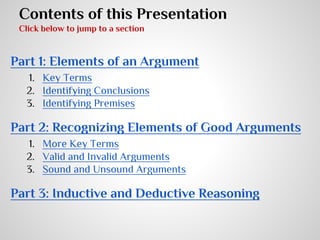
Contents of this Presentation
Click below to jump to a section

Part 1: Elements of an Argument
1. Key Terms
2. Identifying Conclusions
3. Identifying Premises

Part 2: Recognizing Elements of Good Arguments
1. More Key Terms
2. Valid and Invalid Arguments
3. Sound and Unsound Arguments

Part 3: Inductive and Deductive Reasoning
Part 1:
Elements of an Argument
1. Argumentation Key Terms
2. Identifying Conclusions
3. Identifying Premises
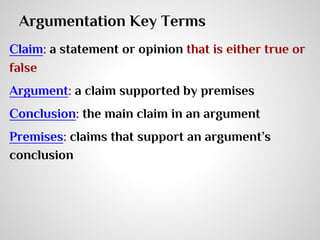
Argumentation Key Terms
Claim: a statement or opinion that is either true or
false
Argument: a claim supported by premises
Conclusion: the main claim in an argument
Premises: claims that support an argument’s
conclusion
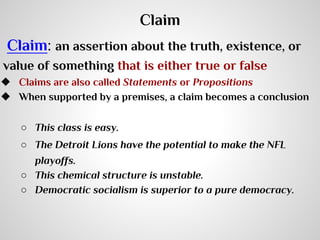
Claim
Claim: an assertion about the truth, existence, or
value of something that is either true or false
❖ Claims are also called Statements or Propositions
❖ When supported by a premises, a claim becomes a conclusion
○ This class is easy.
○ The Detroit Lions have the potential to make the NFL
playoffs.
○ This chemical structure is unstable.
○ Democratic socialism is superior to a pure democracy.
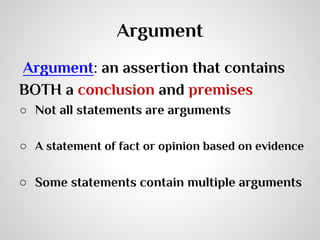
Argument
Argument: an assertion that contains
BOTH a conclusion and premises
○ Not all statements are arguments
○ A statement of fact or opinion based on evidence

○ Some statements contain multiple arguments
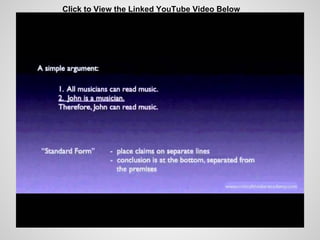
Click to View the Linked YouTube Video Below
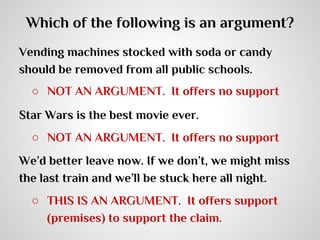
Which of the following is an argument?
Vending machines stocked with soda or candy
should be removed from all public schools.
○ NOT AN ARGUMENT. It offers no support
Star Wars is the best movie ever.
○ NOT AN ARGUMENT. It offers no support
We’d better leave now. If we don’t, we might miss
the last train and we’ll be stuck here all night.
○ THIS IS AN ARGUMENT. It offers support
(premises) to support the claim.
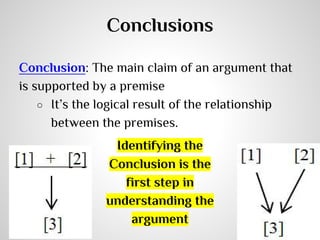
Conclusions
Conclusion: The main claim of an argument that
is supported by a premise
○ It’s the logical result of the relationship
between the premises.
Identifying the
Conclusion is the
first step in
understanding the
argument
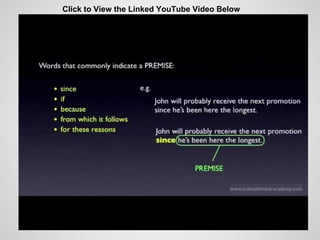
Click to View the Linked YouTube Video Below
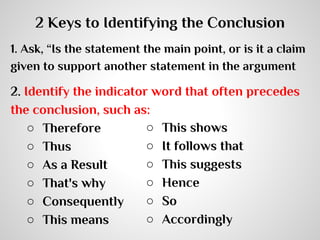
2 Keys to Identifying the Conclusion
1. Ask, “Is the statement the main point, or is it a claim
given to support another statement in the argument

2. Identify the indicator word that often precedes
the conclusion, such as:
○ This shows
○ Therefore
○ It follows that
○ Thus
○ This suggests
○ As a Result
○ Hence
○ That's why
○ So
○ Consequently
○ Accordingly
○ This means
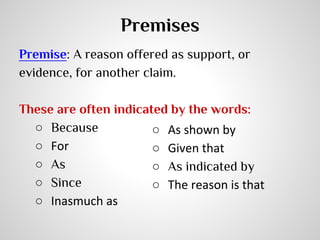
Premises
Premise: A reason offered as support, or
evidence, for another claim.
These are often indicated by the words:
○ Because
○ As shown by
○ For
○ Given that
○ As
○ As indicated by
○ Since
○ The reason is that
○ Inasmuch as
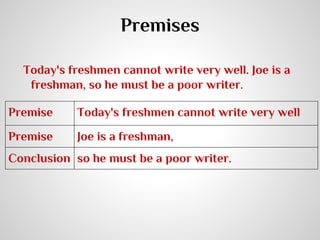
Premises
Today's freshmen cannot write very well. Joe is a
freshman, so he must be a poor writer.
Premise

Today's freshmen cannot write very well

Premise

Joe is a freshman,

Conclusion so he must be a poor writer.
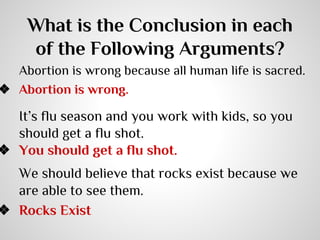
What is the Conclusion in each
of the Following Arguments?

Abortion is wrong because all human life is sacred.
❖ Abortion is wrong.

It’s flu season and you work with kids, so you
should get a flu shot.
❖ You should get a flu shot.

We should believe that rocks exist because we
are able to see them.
❖ Rocks Exist
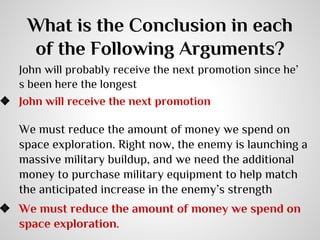
What is the Conclusion in each
of the Following Arguments?

John will probably receive the next promotion since he’
s been here the longest
❖ John will receive the next promotion

We must reduce the amount of money we spend on
space exploration. Right now, the enemy is launching a
massive military buildup, and we need the additional
money to purchase military equipment to help match
the anticipated increase in the enemy’s strength

❖ We must reduce the amount of money we spend on
space exploration.
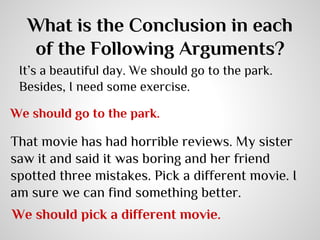
What is the Conclusion in each
of the Following Arguments?
It’s a beautiful day. We should go to the park.
Besides, I need some exercise.
We should go to the park.

That movie has had horrible reviews. My sister
saw it and said it was boring and her friend
spotted three mistakes. Pick a different movie. I
am sure we can find something better.
We should pick a different movie.
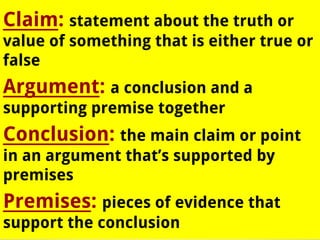
Claim: statement about the truth or
value of something that is either true or
false

Argument: a conclusion and a
supporting premise together

Conclusion: the main claim or point
in an argument that’s supported by
premises

Premises: pieces of evidence that
support the conclusion
CLICK HERE
for Practice Identifying the
Premises and Conclusions of
Arguments
Part 3:
Standard Argument Form

Identify the Premises and Conclusion
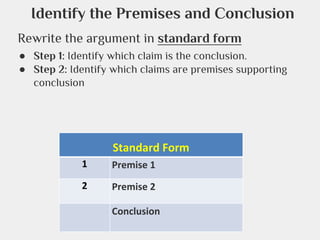
Rewrite the argument in standard form
● Step 1: Identify which claim is the conclusion.
● Step 2: Identify which claims are premises supporting
conclusion

Standard Form
1

Premise 1

2

Premise 2
Conclusion
Identify the Premises and Conclusion
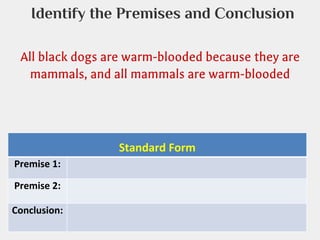
All black dogs are warm-blooded because they are
mammals, and all mammals are warm-blooded

Standard Form
Premise 1:
Premise 2:
Conclusion:
Identify the Premises and Conclusion
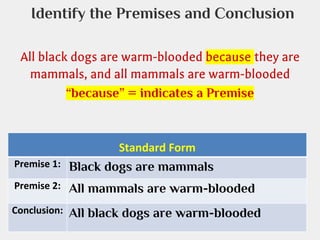
All black dogs are warm-blooded because they are
mammals, and all mammals are warm-blooded
“because” = indicates a Premise

Standard Form
Premise 1:

Black dogs are mammals

Premise 2:

All mammals are warm-blooded

Conclusion:

All black dogs are warm-blooded
Identify the Premises and Conclusion
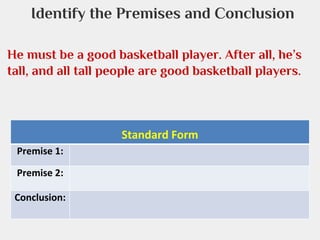
He must be a good basketball player. After all, he’s
tall, and all tall people are good basketball players.

Standard Form
Premise 1:
Premise 2:
Conclusion:
Identify the Premises and Conclusion
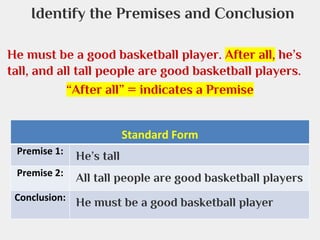
He must be a good basketball player. After all, he’s
tall, and all tall people are good basketball players.
“After all” = indicates a Premise
Standard Form
Premise 1:

He’s tall

Premise 2:

All tall people are good basketball players

Conclusion:

He must be a good basketball player
Identify the Premises and Conclusion
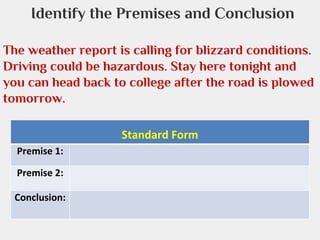
The weather report is calling for blizzard conditions.
Driving could be hazardous. Stay here tonight and
you can head back to college after the road is plowed
tomorrow.
Standard Form
Premise 1:
Premise 2:
Conclusion:
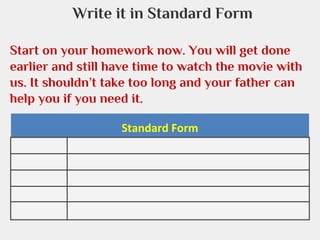
Write it in Standard Form
Start on your homework now. You will get done
earlier and still have time to watch the movie with
us. It shouldn’t take too long and your father can
help you if you need it.
Standard Form
Identify the Premises and Conclusion
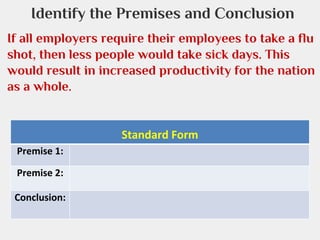
If all employers require their employees to take a flu
shot, then less people would take sick days. This
would result in increased productivity for the nation
as a whole.

Standard Form
Premise 1:
Premise 2:
Conclusion:
Identify the Premises and Conclusion
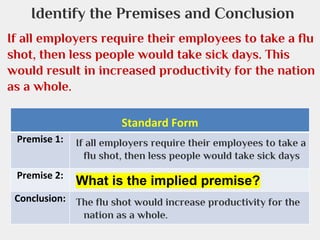
If all employers require their employees to take a flu
shot, then less people would take sick days. This
would result in increased productivity for the nation
as a whole.
Standard Form
Premise 1:

If all employers require their employees to take a
flu shot, then less people would take sick days

Premise 2:

What is the implied premise?

Conclusion: The flu shot would increase productivity for the
nation as a whole.
Identify the Premises and Conclusion
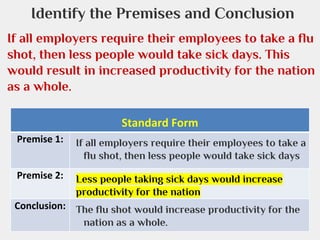
If all employers require their employees to take a flu
shot, then less people would take sick days. This
would result in increased productivity for the nation
as a whole.
Standard Form
Premise 1:

If all employers require their employees to take a
flu shot, then less people would take sick days

Premise 2:

Less people taking sick days would increase
productivity for the nation

Conclusion: The flu shot would increase productivity for the
nation as a whole.
Identify the Premises and Conclusion
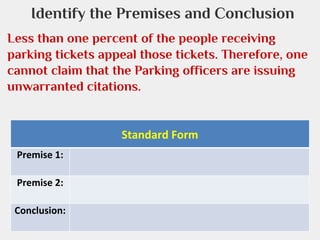
Less than one percent of the people receiving
parking tickets appeal those tickets. Therefore, one
cannot claim that the Parking officers are issuing
unwarranted citations.

Standard Form
Premise 1:
Premise 2:
Conclusion:
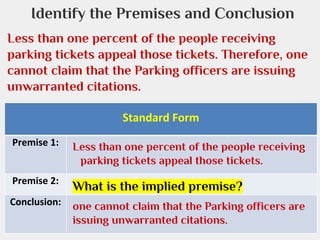
Identify the Premises and Conclusion
Less than one percent of the people receiving
parking tickets appeal those tickets. Therefore, one
cannot claim that the Parking officers are issuing
unwarranted citations.
Standard Form
Premise 1:

Less than one percent of the people receiving
parking tickets appeal those tickets.

Premise 2:

What is the implied premise?

Conclusion:

one cannot claim that the Parking officers are
issuing unwarranted citations.
Identify the Premises and Conclusion
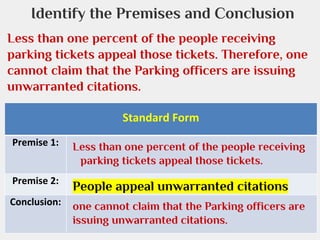
Less than one percent of the people receiving
parking tickets appeal those tickets. Therefore, one
cannot claim that the Parking officers are issuing
unwarranted citations.
Standard Form
Premise 1:

Less than one percent of the people receiving
parking tickets appeal those tickets.

Premise 2:

People appeal unwarranted citations

Conclusion:

one cannot claim that the Parking officers are
issuing unwarranted citations.
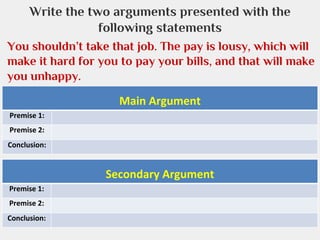
Write the two arguments presented with the
following statements
You shouldn’t take that job. The pay is lousy, which will
make it hard for you to pay your bills, and that will make
you unhappy.
Main Argument
Premise 1:
Premise 2:
Conclusion:

Secondary Argument
Premise 1:
Premise 2:
Conclusion:
Write the two arguments presented with the
following statements
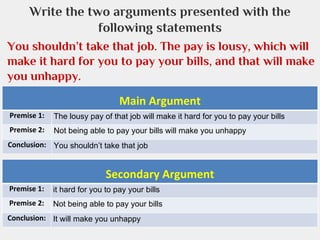
You shouldn’t take that job. The pay is lousy, which will
make it hard for you to pay your bills, and that will make
you unhappy.
Main Argument
Premise 1:

The lousy pay of that job will make it hard for you to pay your bills

Premise 2:

Not being able to pay your bills will make you unhappy

Conclusion: You shouldn’t take that job

Secondary Argument
Premise 1:

it hard for you to pay your bills

Premise 2:

Not being able to pay your bills

Conclusion: It will make you unhappy
Identify the Premises and Conclusion
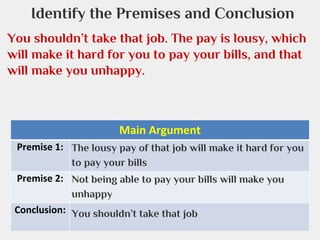
You shouldn’t take that job. The pay is lousy, which
will make it hard for you to pay your bills, and that
will make you unhappy.

Main Argument
Premise 1: The lousy pay of that job will make it hard for you
to pay your bills
Premise 2: Not being able to pay your bills will make you
unhappy
Conclusion: You shouldn’t take that job
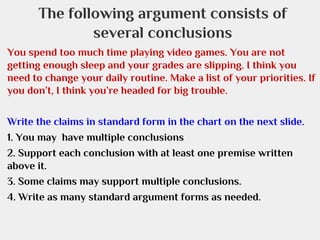
The following argument consists of
several conclusions
You spend too much time playing video games. You are not
getting enough sleep and your grades are slipping. I think you
need to change your daily routine. Make a list of your priorities. If
you don’t, I think you’re headed for big trouble.
Write the claims in standard form in the chart on the next slide.
1. You may have multiple conclusions
2. Support each conclusion with at least one premise written
above it.
3. Some claims may support multiple conclusions.
4. Write as many standard argument forms as needed.
You spend too much time playing video games. You are not
getting enough sleep and your grades are slipping. I think you
need to change your daily routine. Make a list of your priorities. If
you don’t, I think you’re headed for big trouble.
Part 4

Recognizing Good Arguments
1. More Argumentation Key Terms
2. Valid and Invalid Arguments
3. Sound and Unsound Arguments
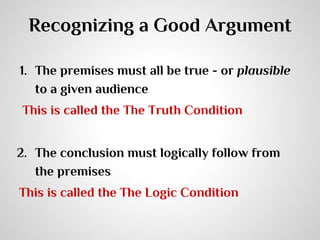
Recognizing a Good Argument
1. The premises must all be true - or plausible
to a given audience
This is called the The Truth Condition
2. The conclusion must logically follow from
the premises
This is called the The Logic Condition
Click to View the Linked YouTube Video Below
Argumentation Key Terms
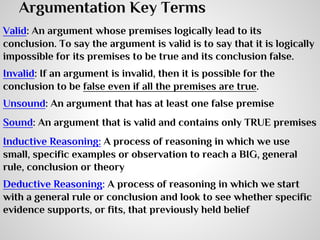
Valid: An argument whose premises logically lead to its
conclusion. To say the argument is valid is to say that it is logically
impossible for its premises to be true and its conclusion false.
Invalid: If an argument is invalid, then it is possible for the
conclusion to be false even if all the premises are true.
Unsound: An argument that has at least one false premise
Sound: An argument that is valid and contains only TRUE premises
Inductive Reasoning: A process of reasoning in which we use
small, specific examples or observation to reach a BIG, general
rule, conclusion or theory
Deductive Reasoning: A process of reasoning in which we start
with a general rule or conclusion and look to see whether specific
evidence supports, or fits, that previously held belief
Valid Argument
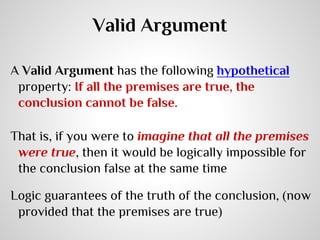
A Valid Argument has the following hypothetical
property: If all the premises are true, the
conclusion cannot be false.
That is, if you were to imagine that all the premises
were true, then it would be logically impossible for
the conclusion false at the same time
Logic guarantees of the truth of the conclusion, (now
provided that the premises are true)
Valid Argument
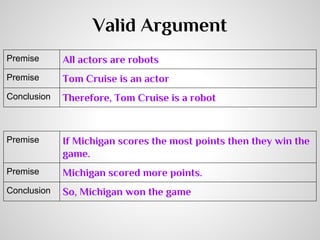
Premise

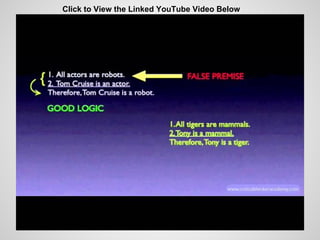
All actors are robots

Premise

Tom Cruise is an actor

Conclusion

Therefore, Tom Cruise is a robot

Premise

If Michigan scores the most points then they win the
game.

Premise

Michigan scored more points.
Conclusion

So, Michigan won the game
Valid Argument
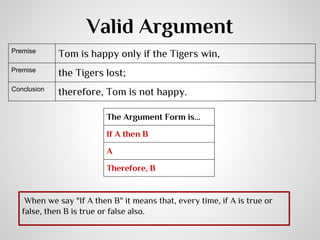
Premise

Tom is happy only if the Tigers win,

Premise

the Tigers lost;

Conclusion

therefore, Tom is not happy.
The Argument Form is...
If A then B
A
Therefore, B

When we say "If A then B" it means that, every time, if A is true or
false, then B is true or false also.
Click to View the Linked YouTube Video Below
Valid Argument Forms
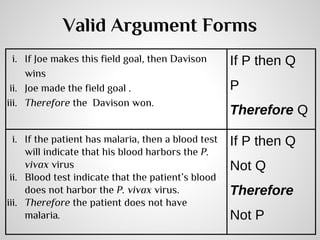
i. If Joe makes this field goal, then Davison
wins
ii. Joe made the field goal .
iii. Therefore the Davison won.

If P then Q

i. If the patient has malaria, then a blood test
will indicate that his blood harbors the P.
vivax virus
ii. Blood test indicate that the patient’s blood
does not harbor the P. vivax virus.
iii. Therefore the patient does not have
malaria.

If P then Q

P
Therefore Q

Not Q
Therefore
Not P
Valid Argument Forms
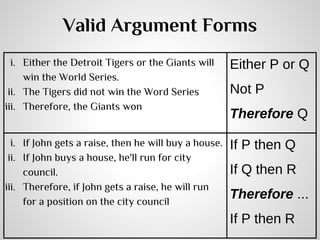
i. Either the Detroit Tigers or the Giants will
win the World Series.
ii. The Tigers did not win the Word Series
iii. Therefore, the Giants won

Either P or Q

i. If John gets a raise, then he will buy a house.
ii. If John buys a house, he'll run for city
council.
iii. Therefore, if John gets a raise, he will run
for a position on the city council

If P then Q

Not P
Therefore Q

If Q then R
Therefore ...
If P then R
Valid Arguments
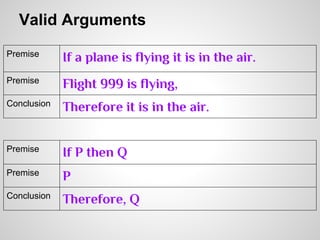
Premise

If a plane is flying it is in the air.

Premise

Flight 999 is flying,

Conclusion

Therefore it is in the air.

Premise

If P then Q

Premise

P

Conclusion

Therefore, Q
Valid Arguments
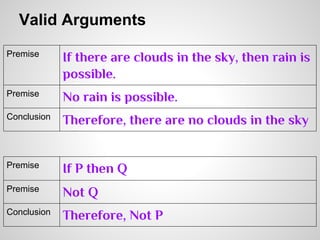
Premise

If there are clouds in the sky, then rain is
possible.

Premise

No rain is possible.

Conclusion

Therefore, there are no clouds in the sky

Premise

If P then Q

Premise

Not Q

Conclusion

Therefore, Not P
Valid Arguments
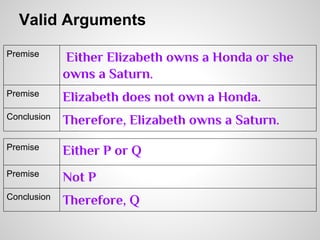
Premise

Either Elizabeth owns a Honda or she
owns a Saturn.

Premise

Elizabeth does not own a Honda.

Conclusion

Therefore, Elizabeth owns a Saturn.

Premise

Either P or Q

Premise

Not P

Conclusion

Therefore, Q
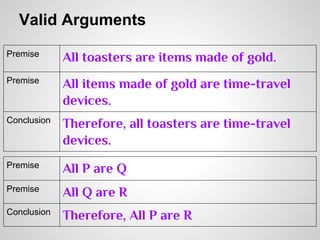
Valid Arguments
Premise

All toasters are items made of gold.

Premise

All items made of gold are time-travel
devices.

Conclusion

Therefore, all toasters are time-travel
devices.

Premise

All P are Q

Premise

All Q are R

Conclusion

Therefore, All P are R
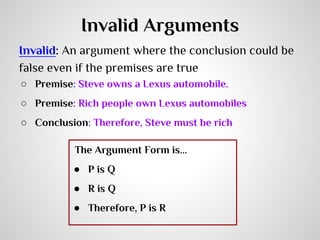
Invalid Arguments
Invalid: An argument where the conclusion could be
false even if the premises are true
○ Premise: Steve owns a Lexus automobile.
○ Premise: Rich people own Lexus automobiles
○ Conclusion: Therefore, Steve must be rich
The Argument Form is...
● P is Q
● R is Q
● Therefore, P is R
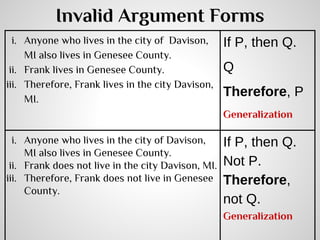
Invalid Argument Forms
i. Anyone who lives in the city of Davison,
MI also lives in Genesee County.
ii. Frank lives in Genesee County.
iii. Therefore, Frank lives in the city Davison,
MI.

If P, then Q.
Q
Therefore, P
Generalization

i. Anyone who lives in the city of Davison,
MI also lives in Genesee County.
ii. Frank does not live in the city Davison, MI.
iii. Therefore, Frank does not live in Genesee
County.

If P, then Q.
Not P.
Therefore,
not Q.
Generalization
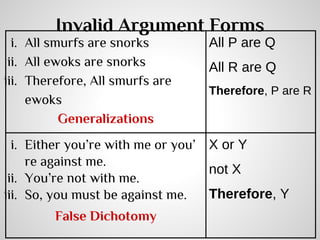
Invalid Argument Forms

i. All smurfs are snorks
ii. All ewoks are snorks
iii. Therefore, All smurfs are
ewoks
Generalizations

All P are Q
All R are Q
Therefore, P are R

i. Either you’re with me or you’ X or Y
re against me.
not X
ii. You’re not with me.
Therefore, Y
iii. So, you must be against me.
False Dichotomy
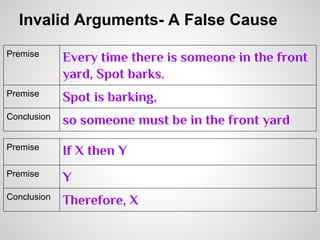
Invalid Arguments- A False Cause
Premise

Every time there is someone in the front
yard, Spot barks.

Premise

Spot is barking,

Conclusion

so someone must be in the front yard

Premise

If X then Y

Premise

Y

Conclusion

Therefore, X
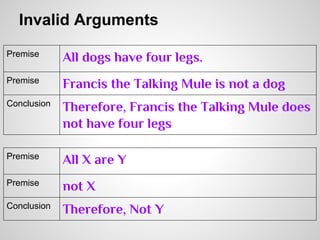
Invalid Arguments
Premise

All dogs have four legs.

Premise

Francis the Talking Mule is not a dog

Conclusion

Therefore, Francis the Talking Mule does
not have four legs

Premise

All X are Y

Premise

not X

Conclusion

Therefore, Not Y
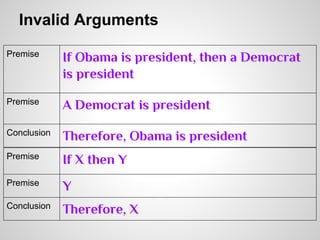
Invalid Arguments
Premise

If Obama is president, then a Democrat
is president

Premise

A Democrat is president

Conclusion

Therefore, Obama is president

Premise

If X then Y

Premise

Y

Conclusion

Therefore, X
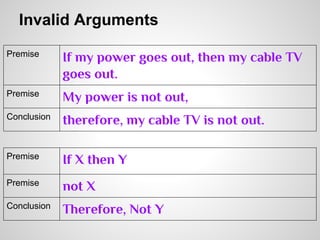
Invalid Arguments
Premise

If my power goes out, then my cable TV
goes out.

Premise

My power is not out,

Conclusion

therefore, my cable TV is not out.

Premise

If X then Y

Premise

not X

Conclusion

Therefore, Not Y
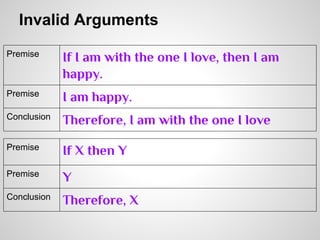
Invalid Arguments
Premise

If I am with the one I love, then I am
happy.

Premise

I am happy.

Conclusion

Therefore, I am with the one I love

Premise

If X then Y

Premise

Y

Conclusion

Therefore, X
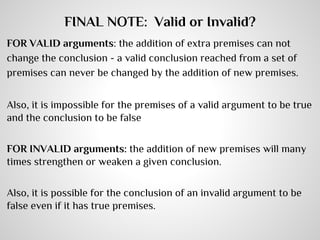
FINAL NOTE: Valid or Invalid?
FOR VALID arguments: the addition of extra premises can not
change the conclusion - a valid conclusion reached from a set of
premises can never be changed by the addition of new premises.
Also, it is impossible for the premises of a valid argument to be true
and the conclusion to be false
FOR INVALID arguments: the addition of new premises will many
times strengthen or weaken a given conclusion.
Also, it is possible for the conclusion of an invalid argument to be
false even if it has true premises.
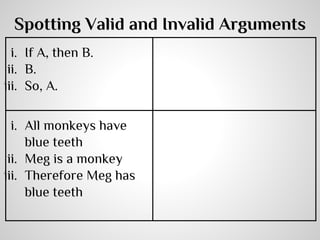
Spotting Valid and Invalid Arguments
i. If A, then B.
ii. B.
iii. So, A.
i. All monkeys have
blue teeth
ii. Meg is a monkey
iii. Therefore Meg has
blue teeth
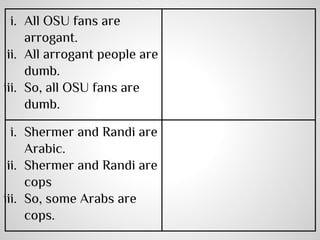
i. All OSU fans are
arrogant.
ii. All arrogant people are
dumb.
iii. So, all OSU fans are
dumb.
i. Shermer and Randi are
Arabic.
ii. Shermer and Randi are
cops
iii. So, some Arabs are
cops.
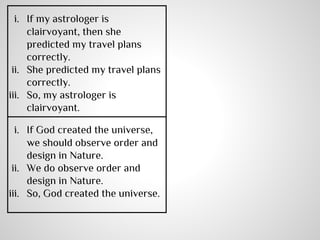
i. If my astrologer is
clairvoyant, then she
predicted my travel plans
correctly.
ii. She predicted my travel plans
correctly.
iii. So, my astrologer is
clairvoyant.
i. If God created the universe,
we should observe order and
design in Nature.
ii. We do observe order and
design in Nature.
iii. So, God created the universe.
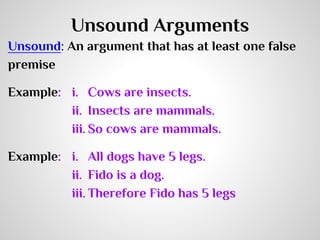
Unsound Arguments
Unsound: An argument that has at least one false
premise
Example: i. Cows are insects.
ii. Insects are mammals.
iii. So cows are mammals.
Example: i. All dogs have 5 legs.
ii. Fido is a dog.
iii. Therefore Fido has 5 legs
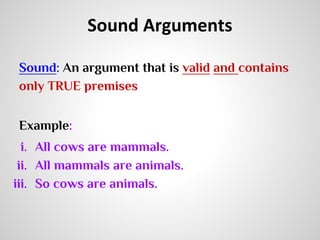
Sound Arguments
Sound: An argument that is valid and contains
only TRUE premises
Example:
i. All cows are mammals.
ii. All mammals are animals.
iii. So cows are animals.
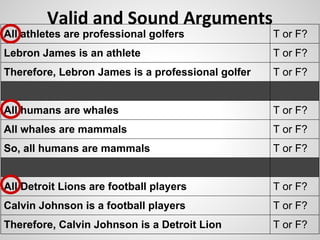
Valid and Sound Arguments
All athletes are professional golfers

T or F?

Lebron James is an athlete

T or F?

Therefore, Lebron James is a professional golfer

T or F?

All humans are whales

T or F?

All whales are mammals

T or F?

So, all humans are mammals

T or F?

All Detroit Lions are football players

T or F?

Calvin Johnson is a football players

T or F?

Therefore, Calvin Johnson is a Detroit Lion

T or F?
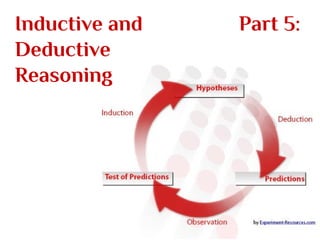
Inductive and
Deductive
Reasoning

Part 5:
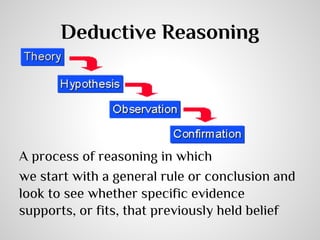
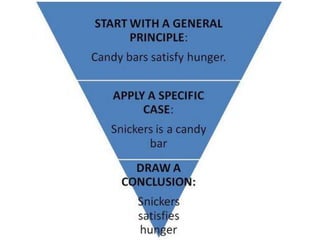
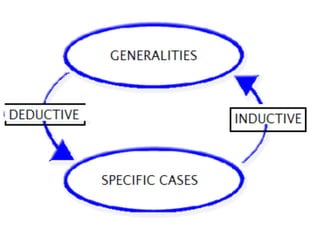
Deductive Reasoning

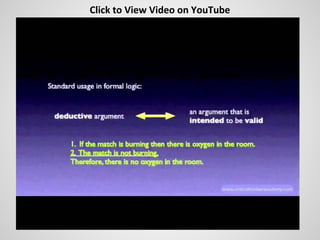
A process of reasoning in which
we start with a general rule or conclusion and
look to see whether specific evidence
supports, or fits, that previously held belief
Deductive Reasoning
1. What is the conclusion?
2. What evidence supports it?
3. Is that evidence logical?
If you can answer yes to question 3, then the
conclusion should be logical and the
argument valid and sound.
Many deductive arguments are valid
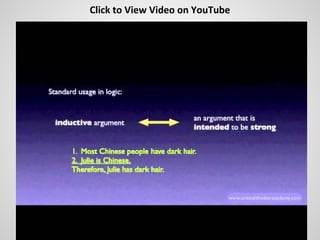
Click to View Video on YouTube
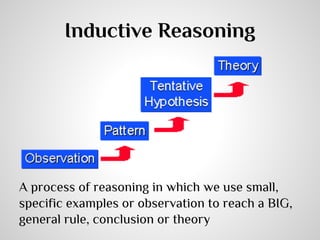
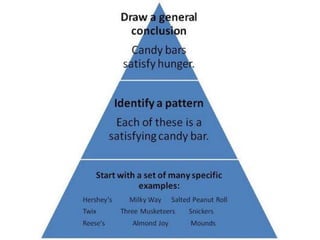
Inductive Reasoning

A process of reasoning in which we use small,
specific examples or observation to reach a BIG,
general rule, conclusion or theory
Inductive Reasoning
When detectives arrive at the scene of a crime, the
first thing they do is look for clues that can help them
piece together what happened.
1. What have you observed? What evidence is
available?
2. What can you conclude from that evidence?
3. Is that conclusion logical?
Many Inductive arguments are strong but invalid
Click to View Video on YouTube
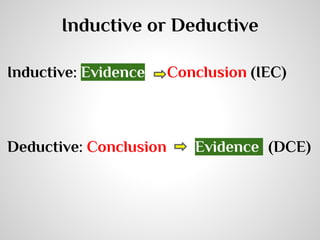
Inductive or Deductive
Inductive: Evidence

Deductive: Conclusion

Conclusion (IEC)

Evidence (DCE)
Inductive or Deductive
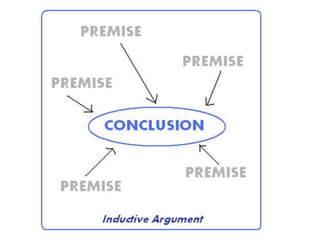
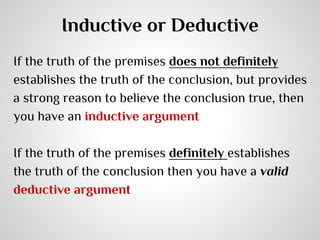
If the truth of the premises does not definitely
establishes the truth of the conclusion, but provides
a strong reason to believe the conclusion true, then
you have an inductive argument
If the truth of the premises definitely establishes
the truth of the conclusion then you have a valid
deductive argument
Inductive or Deductive
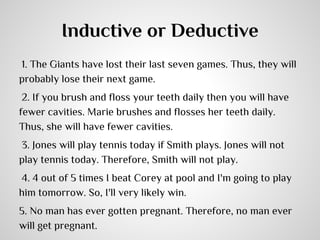
1. The Giants have lost their last seven games. Thus, they will
probably lose their next game.
 2. If you brush and floss your teeth daily then you will have
fewer cavities. Marie brushes and flosses her teeth daily.
Thus, she will have fewer cavities.
 3. Jones will play tennis today if Smith plays. Jones will not
play tennis today. Therefore, Smith will not play.
 4. 4 out of 5 times I beat Corey at pool and I'm going to play
him tomorrow. So, I'll very likely win.
5. No man has ever gotten pregnant. Therefore, no man ever
will get pregnant.
Inductive or Deductive
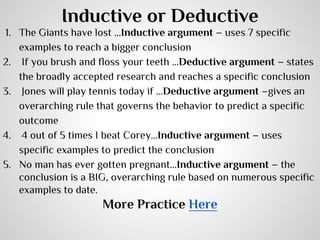
1. The Giants have lost …Inductive argument – uses 7 specific
examples to reach a bigger conclusion
2.  If you brush and floss your teeth …Deductive argument – states
the broadly accepted research and reaches a specific conclusion
3.  Jones will play tennis today if …Deductive argument –gives an
overarching rule that governs the behavior to predict a specific
outcome
4.  4 out of 5 times I beat Corey…Inductive argument – uses
specific examples to predict the conclusion
5. No man has ever gotten pregnant…Inductive argument – the
conclusion is a BIG, overarching rule based on numerous specific
examples to date.

More Practice Here